SUBSCRIBE TO OUR FREE NEWSLETTER
Daily news & progressive opinion—funded by the people, not the corporations—delivered straight to your inbox.
5
#000000
#FFFFFF
To donate by check, phone, or other method, see our More Ways to Give page.


Daily news & progressive opinion—funded by the people, not the corporations—delivered straight to your inbox.

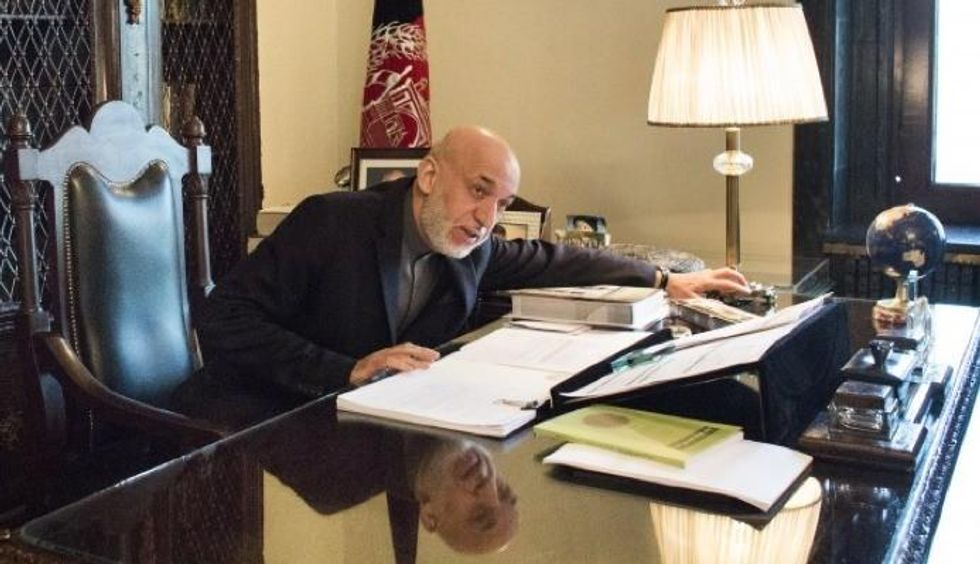
That's what outgoing Afghan President Hamid Karzai told the Washington Post in an interview that took place this weekend in Kabul and was published on Monday.
Karzai says his intrasigence over a bilateral security agreement with the U.S. is fueled by his anger at the Obama administration and the sadness he feels after witnessing so much pain and suffering inflicted upon his people by a war that has dragged on for more than twelve years.
The war, he says, was fought for "for the U.S. security and for the Western interest" but it was ordinary Afghans, including a four-year-old girl he recently visited in the hospital who had half her face blown off during a U.S. bombing.
"That day, I wished she were dead, so she could be buried with her parents and brothers and sisters" -- 14 of whom had been killed in the same attack -- he told the Post.
Was the war worth it? he was asked.
Karzai responded: "I am of two hearts here. When I see good, I am in approval. When I see the losses of Afghan people, our children, maimed and killed, I'm in disapproval," he said, speaking in English. "Maybe I can give you an answer of yes or no two, three or five years from now, when my emotions have subsided. Right now, I'm full of emotions.''
He says he will likely not sign the BSA that Obama and the Pentagon insist is imperative if the U.S. is to keep soldiers on the ground beyond the end of the year. He does think, however, that his successor should and will sign such an agreement.
The reason he has held out, he explains, is because it has become his only source of leverage with the Obama administration. If he signs it, then he will have no way to issue the demands he still has: namely that the U.S. step up its efforts to make peace talks with the Taliban, a moratorium on night raids by U.S. troops that have terrorized Afghan families, and an end to airstrikes that have killed hundreds of innocent civilians.
Karzai offered this parting message to the reporters as they left: "To the American people, give them my best wishes and my gratitude. To the U.S. government, give them my anger, my extreme anger.''
______________________________

Dear Common Dreams reader, The U.S. is on a fast track to authoritarianism like nothing I've ever seen. Meanwhile, corporate news outlets are utterly capitulating to Trump, twisting their coverage to avoid drawing his ire while lining up to stuff cash in his pockets. That's why I believe that Common Dreams is doing the best and most consequential reporting that we've ever done. Our small but mighty team is a progressive reporting powerhouse, covering the news every day that the corporate media never will. Our mission has always been simple: To inform. To inspire. And to ignite change for the common good. Now here's the key piece that I want all our readers to understand: None of this would be possible without your financial support. That's not just some fundraising cliche. It's the absolute and literal truth. We don't accept corporate advertising and never will. We don't have a paywall because we don't think people should be blocked from critical news based on their ability to pay. Everything we do is funded by the donations of readers like you. Will you donate now to help power the nonprofit, independent reporting of Common Dreams? Thank you for being a vital member of our community. Together, we can keep independent journalism alive when it’s needed most. - Craig Brown, Co-founder |

That's what outgoing Afghan President Hamid Karzai told the Washington Post in an interview that took place this weekend in Kabul and was published on Monday.
Karzai says his intrasigence over a bilateral security agreement with the U.S. is fueled by his anger at the Obama administration and the sadness he feels after witnessing so much pain and suffering inflicted upon his people by a war that has dragged on for more than twelve years.
The war, he says, was fought for "for the U.S. security and for the Western interest" but it was ordinary Afghans, including a four-year-old girl he recently visited in the hospital who had half her face blown off during a U.S. bombing.
"That day, I wished she were dead, so she could be buried with her parents and brothers and sisters" -- 14 of whom had been killed in the same attack -- he told the Post.
Was the war worth it? he was asked.
Karzai responded: "I am of two hearts here. When I see good, I am in approval. When I see the losses of Afghan people, our children, maimed and killed, I'm in disapproval," he said, speaking in English. "Maybe I can give you an answer of yes or no two, three or five years from now, when my emotions have subsided. Right now, I'm full of emotions.''
He says he will likely not sign the BSA that Obama and the Pentagon insist is imperative if the U.S. is to keep soldiers on the ground beyond the end of the year. He does think, however, that his successor should and will sign such an agreement.
The reason he has held out, he explains, is because it has become his only source of leverage with the Obama administration. If he signs it, then he will have no way to issue the demands he still has: namely that the U.S. step up its efforts to make peace talks with the Taliban, a moratorium on night raids by U.S. troops that have terrorized Afghan families, and an end to airstrikes that have killed hundreds of innocent civilians.
Karzai offered this parting message to the reporters as they left: "To the American people, give them my best wishes and my gratitude. To the U.S. government, give them my anger, my extreme anger.''
______________________________

That's what outgoing Afghan President Hamid Karzai told the Washington Post in an interview that took place this weekend in Kabul and was published on Monday.
Karzai says his intrasigence over a bilateral security agreement with the U.S. is fueled by his anger at the Obama administration and the sadness he feels after witnessing so much pain and suffering inflicted upon his people by a war that has dragged on for more than twelve years.
The war, he says, was fought for "for the U.S. security and for the Western interest" but it was ordinary Afghans, including a four-year-old girl he recently visited in the hospital who had half her face blown off during a U.S. bombing.
"That day, I wished she were dead, so she could be buried with her parents and brothers and sisters" -- 14 of whom had been killed in the same attack -- he told the Post.
Was the war worth it? he was asked.
Karzai responded: "I am of two hearts here. When I see good, I am in approval. When I see the losses of Afghan people, our children, maimed and killed, I'm in disapproval," he said, speaking in English. "Maybe I can give you an answer of yes or no two, three or five years from now, when my emotions have subsided. Right now, I'm full of emotions.''
He says he will likely not sign the BSA that Obama and the Pentagon insist is imperative if the U.S. is to keep soldiers on the ground beyond the end of the year. He does think, however, that his successor should and will sign such an agreement.
The reason he has held out, he explains, is because it has become his only source of leverage with the Obama administration. If he signs it, then he will have no way to issue the demands he still has: namely that the U.S. step up its efforts to make peace talks with the Taliban, a moratorium on night raids by U.S. troops that have terrorized Afghan families, and an end to airstrikes that have killed hundreds of innocent civilians.
Karzai offered this parting message to the reporters as they left: "To the American people, give them my best wishes and my gratitude. To the U.S. government, give them my anger, my extreme anger.''
______________________________