SUBSCRIBE TO OUR FREE NEWSLETTER
Daily news & progressive opinion—funded by the people, not the corporations—delivered straight to your inbox.
5
#000000
#FFFFFF
To donate by check, phone, or other method, see our More Ways to Give page.
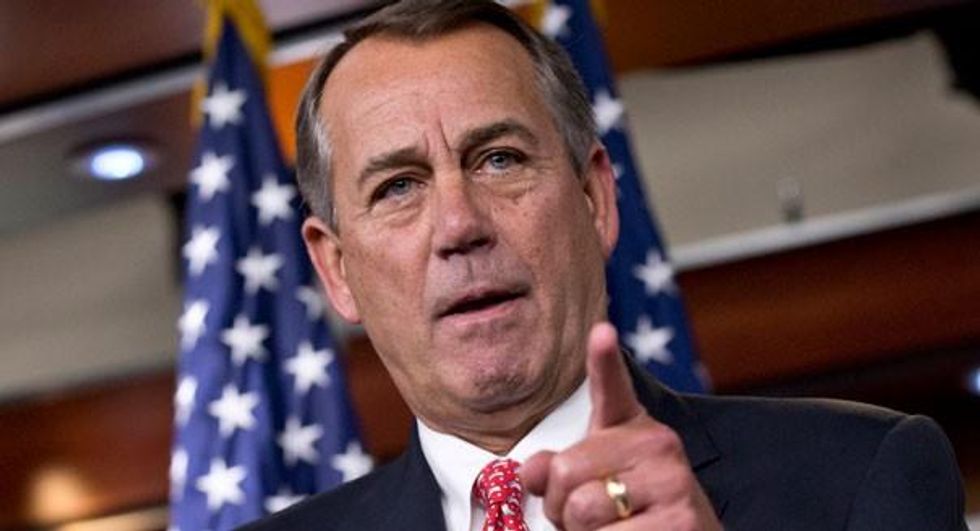
And speaking of 'dead'--and according to The Hill on Friday--that's exactly what Speaker of the House John Boehner (R-OH) would prefer to be, if forced to choose between ending his life and giving low-wage workers even in the most minimum of wage hikes.
With the headline, 'Boehner: I'd rather kill myself than raise the minimum wage,' the newspaper reports that the GOP leader's opposition to the measure is so strong historically that he once told The Weekly Standard he would "commit suicide" before voting 'Yes' on a clean minimum wage increase for workers.
The story serves as a reminder of a typical--yet not to be forgotten--scenario in Washington. In this case, a minimum wage increase that would still leave workers barely scraping by is put forth by Democrats in order to give them electoral leverage going into the mid-terms, but even that half-measure is categorized as leftist, anti-business fanaticism by their Republican counterparts (also scoring points with their base). Likely to pass the Democrat-controlled Senate--where it heads to floor as early as next week--but not even receive a vote in GOP-controlled House, currently led by Boehner, the increase remains stranded and workers continue to suffer under wages that haven't budged in nearly forty years.
That's Washington.
As The Stranger, a local newspaper, reported: "These numbers may be off the charts, but they're rock solid."
"We were certainly surprised," admitted Andrew Thibault, whose company conducted the survey, about the unexpectedly positive results, "but it seems that there is a tipping point."
What's additionally striking is that the poll found support for a straight up increase to $15 with people saying that workers shouldn't wait for the wage to be "phased-in" and that exemptions should not be made. Proving that bold is better, it seemed to analysts that one of main driving forces behind the support for a more aggressive increase in the city was the corresponding fact that people in Seattle are riding a wave of political optimism in which they think the city's moving in the right direction. As The Stranger exlpains:
Thibault suspects another factor may have come into play, one beyond the control of either side of the debate: Seattle's surging sense of self-confidence. According to the survey, 63 percent of Seattle voters believe the city is "going in the right direction," up from 53 percent in September and 43 percent in 2011. "That's a crazy number," says Thibault.
But perhaps more impressive is the "wrong track" number, which has plummeted to just 19 percent. "There's a tremendous amount of optimism in the city," says Thibault.
And that optimism may help explain why even when a narrow majority agree with one of the leading talking points against raising the minimum wage, it doesn't move the dial very far. For example, 51 percent of voters actually agree that "increasing the minimum wage will hurt local small, minority owned, and family owned businesses." But at the same time, 71 percent of voters also agree that a higher minimum wage would "help" local businesses "because more workers making more money means they will have money to spend at local businesses."
Seattle voters aren't ignoring the concerns of small businesses; they have simply determined that the benefits of a higher minimum wage outweigh the costs: 82 percent agree that raising the minimum wage "ensures more families can make ends meet and get ahead," while only 40 percent call it a "job killer." Seattle voters simply aren't moved by the classic argument that a higher minimum wage would shutter businesses and destroy jobs. "People right now aren't buying it," says Thibault.
______________________________________
And speaking of 'dead'--and according to The Hill on Friday--that's exactly what Speaker of the House John Boehner (R-OH) would prefer to be, if forced to choose between ending his life and giving low-wage workers even in the most minimum of wage hikes.
With the headline, 'Boehner: I'd rather kill myself than raise the minimum wage,' the newspaper reports that the GOP leader's opposition to the measure is so strong historically that he once told The Weekly Standard he would "commit suicide" before voting 'Yes' on a clean minimum wage increase for workers.
The story serves as a reminder of a typical--yet not to be forgotten--scenario in Washington. In this case, a minimum wage increase that would still leave workers barely scraping by is put forth by Democrats in order to give them electoral leverage going into the mid-terms, but even that half-measure is categorized as leftist, anti-business fanaticism by their Republican counterparts (also scoring points with their base). Likely to pass the Democrat-controlled Senate--where it heads to floor as early as next week--but not even receive a vote in GOP-controlled House, currently led by Boehner, the increase remains stranded and workers continue to suffer under wages that haven't budged in nearly forty years.
That's Washington.
As The Stranger, a local newspaper, reported: "These numbers may be off the charts, but they're rock solid."
"We were certainly surprised," admitted Andrew Thibault, whose company conducted the survey, about the unexpectedly positive results, "but it seems that there is a tipping point."
What's additionally striking is that the poll found support for a straight up increase to $15 with people saying that workers shouldn't wait for the wage to be "phased-in" and that exemptions should not be made. Proving that bold is better, it seemed to analysts that one of main driving forces behind the support for a more aggressive increase in the city was the corresponding fact that people in Seattle are riding a wave of political optimism in which they think the city's moving in the right direction. As The Stranger exlpains:
Thibault suspects another factor may have come into play, one beyond the control of either side of the debate: Seattle's surging sense of self-confidence. According to the survey, 63 percent of Seattle voters believe the city is "going in the right direction," up from 53 percent in September and 43 percent in 2011. "That's a crazy number," says Thibault.
But perhaps more impressive is the "wrong track" number, which has plummeted to just 19 percent. "There's a tremendous amount of optimism in the city," says Thibault.
And that optimism may help explain why even when a narrow majority agree with one of the leading talking points against raising the minimum wage, it doesn't move the dial very far. For example, 51 percent of voters actually agree that "increasing the minimum wage will hurt local small, minority owned, and family owned businesses." But at the same time, 71 percent of voters also agree that a higher minimum wage would "help" local businesses "because more workers making more money means they will have money to spend at local businesses."
Seattle voters aren't ignoring the concerns of small businesses; they have simply determined that the benefits of a higher minimum wage outweigh the costs: 82 percent agree that raising the minimum wage "ensures more families can make ends meet and get ahead," while only 40 percent call it a "job killer." Seattle voters simply aren't moved by the classic argument that a higher minimum wage would shutter businesses and destroy jobs. "People right now aren't buying it," says Thibault.
______________________________________
And speaking of 'dead'--and according to The Hill on Friday--that's exactly what Speaker of the House John Boehner (R-OH) would prefer to be, if forced to choose between ending his life and giving low-wage workers even in the most minimum of wage hikes.
With the headline, 'Boehner: I'd rather kill myself than raise the minimum wage,' the newspaper reports that the GOP leader's opposition to the measure is so strong historically that he once told The Weekly Standard he would "commit suicide" before voting 'Yes' on a clean minimum wage increase for workers.
The story serves as a reminder of a typical--yet not to be forgotten--scenario in Washington. In this case, a minimum wage increase that would still leave workers barely scraping by is put forth by Democrats in order to give them electoral leverage going into the mid-terms, but even that half-measure is categorized as leftist, anti-business fanaticism by their Republican counterparts (also scoring points with their base). Likely to pass the Democrat-controlled Senate--where it heads to floor as early as next week--but not even receive a vote in GOP-controlled House, currently led by Boehner, the increase remains stranded and workers continue to suffer under wages that haven't budged in nearly forty years.
That's Washington.
As The Stranger, a local newspaper, reported: "These numbers may be off the charts, but they're rock solid."
"We were certainly surprised," admitted Andrew Thibault, whose company conducted the survey, about the unexpectedly positive results, "but it seems that there is a tipping point."
What's additionally striking is that the poll found support for a straight up increase to $15 with people saying that workers shouldn't wait for the wage to be "phased-in" and that exemptions should not be made. Proving that bold is better, it seemed to analysts that one of main driving forces behind the support for a more aggressive increase in the city was the corresponding fact that people in Seattle are riding a wave of political optimism in which they think the city's moving in the right direction. As The Stranger exlpains:
Thibault suspects another factor may have come into play, one beyond the control of either side of the debate: Seattle's surging sense of self-confidence. According to the survey, 63 percent of Seattle voters believe the city is "going in the right direction," up from 53 percent in September and 43 percent in 2011. "That's a crazy number," says Thibault.
But perhaps more impressive is the "wrong track" number, which has plummeted to just 19 percent. "There's a tremendous amount of optimism in the city," says Thibault.
And that optimism may help explain why even when a narrow majority agree with one of the leading talking points against raising the minimum wage, it doesn't move the dial very far. For example, 51 percent of voters actually agree that "increasing the minimum wage will hurt local small, minority owned, and family owned businesses." But at the same time, 71 percent of voters also agree that a higher minimum wage would "help" local businesses "because more workers making more money means they will have money to spend at local businesses."
Seattle voters aren't ignoring the concerns of small businesses; they have simply determined that the benefits of a higher minimum wage outweigh the costs: 82 percent agree that raising the minimum wage "ensures more families can make ends meet and get ahead," while only 40 percent call it a "job killer." Seattle voters simply aren't moved by the classic argument that a higher minimum wage would shutter businesses and destroy jobs. "People right now aren't buying it," says Thibault.
______________________________________