SUBSCRIBE TO OUR FREE NEWSLETTER
Daily news & progressive opinion—funded by the people, not the corporations—delivered straight to your inbox.
5
#000000
#FFFFFF
To donate by check, phone, or other method, see our More Ways to Give page.
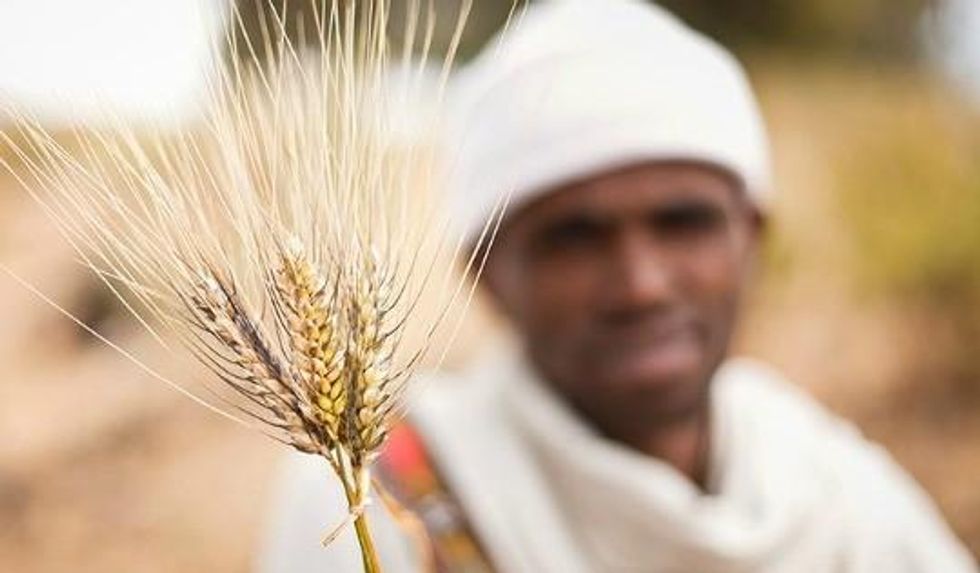
According to a Guardian report published Tuesday, the G8's New Alliance for Food Security and Nutrition initiative, supported by the Obama administration, has connected African leaders with major agribusiness corporations in an effort to map out a plan for agricultural development on the African continent in the coming years, which will loosen export and tax laws, award "huge chunks of land" for private investment and change seed laws to benefit international corporations and their GMO products.
In the "New Alliance" talks, agricultural giants such as Syngenta and Cargill have been granted "unprecedented access to decision-makers over the past two years," the Guardian reports, while small scale farmers are increasingly shut out of the process.
In a press release late last year, the Alliance for Food Sovereignty in Africa (AFSA), a Pan-African platform of networks and farmer organizations, warned against such policies, which are becoming increasingly common on the continent:
Africa's diversity and knowledge systems are being threatened by corporate and genetically modified (GM) seeds, agro-chemicals, resource grabs and laws that prevent farmers from freely using, sharing or selling their seed.
These threats come from amongst others, the Alliance for a Green Revolution in Africa (AGRA) and the G8 "New Alliance for Food Security and Nutrition" that strongly promote the interests of multinational seed, fertilizer and agro-chemical companies at the expense of the rights and interests of smallholder farmers.
"It will be like colonialism," Zitto Kabwe, the chairman of the Tanzanian parliament's public accounts committee told the Guardian. "Farmers will not be able to farm until they import, linking farmers to [the] vulnerability of international prices. Big companies will benefit. We should not allow that."
The initiative will change seed, land and tax laws in at least 10 different African countries with over 200 policy commitments coming from African leaders.
Governments are committing to investors "completely behind the screen" with "no long-term view about the future of smallholder farmers," Olivier de Schutter, the UN special rapporteur on the right to food, told the Guardian. "There's a struggle for land, for investment, for seed systems, and first and foremost there's a struggle for political influence."
"It will be like colonialism. Farmers will not be able to farm until they import, linking farmers to [the] vulnerability of international prices. Big companies will benefit. We should not allow that." - Zitto Kabwe, chairman of the Tanzanian parliament's public accounts committee
As AFSA and other critics have warned, development policies based on multinational agricultural industry forces small scale farmers to depend on imported and genetically modified seeds.
"It clearly puts seed production and distribution in the hands of companies," said Million Belay, the head (AFSA). "The trend is for companies to say they cannot invest in Africa without new laws ... Yes, agriculture needs investment, but that shouldn't be used as an excuse to bring greater control over farmers' lives."
"More than any other time in history, the African food production system is being challenged. More than any other time in history outside forces are deciding the future of our farming systems," said Belay.
Speaking to a group from the AFSA in August in Addis Ababa, Ethiopia (one of the countries targeted in the "New Alliance" plan), food sovereignty and seed activist Vandana Shiva warned against the initiative, pulling from lessons--learned the hard way--in India.
Shiva stated:
The G8 issue--the New Alliance for Food Security and Nutrition--it's not just the biggest corporations, in every sector, targeting food as the biggest opportunity but every government of the world. If you want to look at where the G8 will go, it's exactly where India went in 2005--where all the companies from seed to trade joined up to get the U.S. government to write an agreement with the government of India and they came in an integrated chain.
I've seen that they've created a whole alliance of the corporations for spreading misinformation. What they are bringing to you in terms of the Green Revolution, we've got all the outcome. So don't let them sell it to you as they sold it to India because we have the lessons.
Bhopal: 30,000 dead; Endosulfan: 1,000 dead; cancer train leaving the Green Revolution area of Punjab--a whole train daily full of cancer patients. And this is going to be worse here, because they introduced the Green Revolution in India in the Punjab, the land of five rivers, but they will introduce it here everywhere - including dry lands. And it's going to be a disaster like you can't imagine.
Watch video of Shiva's talk below:
______________________
According to a Guardian report published Tuesday, the G8's New Alliance for Food Security and Nutrition initiative, supported by the Obama administration, has connected African leaders with major agribusiness corporations in an effort to map out a plan for agricultural development on the African continent in the coming years, which will loosen export and tax laws, award "huge chunks of land" for private investment and change seed laws to benefit international corporations and their GMO products.
In the "New Alliance" talks, agricultural giants such as Syngenta and Cargill have been granted "unprecedented access to decision-makers over the past two years," the Guardian reports, while small scale farmers are increasingly shut out of the process.
In a press release late last year, the Alliance for Food Sovereignty in Africa (AFSA), a Pan-African platform of networks and farmer organizations, warned against such policies, which are becoming increasingly common on the continent:
Africa's diversity and knowledge systems are being threatened by corporate and genetically modified (GM) seeds, agro-chemicals, resource grabs and laws that prevent farmers from freely using, sharing or selling their seed.
These threats come from amongst others, the Alliance for a Green Revolution in Africa (AGRA) and the G8 "New Alliance for Food Security and Nutrition" that strongly promote the interests of multinational seed, fertilizer and agro-chemical companies at the expense of the rights and interests of smallholder farmers.
"It will be like colonialism," Zitto Kabwe, the chairman of the Tanzanian parliament's public accounts committee told the Guardian. "Farmers will not be able to farm until they import, linking farmers to [the] vulnerability of international prices. Big companies will benefit. We should not allow that."
The initiative will change seed, land and tax laws in at least 10 different African countries with over 200 policy commitments coming from African leaders.
Governments are committing to investors "completely behind the screen" with "no long-term view about the future of smallholder farmers," Olivier de Schutter, the UN special rapporteur on the right to food, told the Guardian. "There's a struggle for land, for investment, for seed systems, and first and foremost there's a struggle for political influence."
"It will be like colonialism. Farmers will not be able to farm until they import, linking farmers to [the] vulnerability of international prices. Big companies will benefit. We should not allow that." - Zitto Kabwe, chairman of the Tanzanian parliament's public accounts committee
As AFSA and other critics have warned, development policies based on multinational agricultural industry forces small scale farmers to depend on imported and genetically modified seeds.
"It clearly puts seed production and distribution in the hands of companies," said Million Belay, the head (AFSA). "The trend is for companies to say they cannot invest in Africa without new laws ... Yes, agriculture needs investment, but that shouldn't be used as an excuse to bring greater control over farmers' lives."
"More than any other time in history, the African food production system is being challenged. More than any other time in history outside forces are deciding the future of our farming systems," said Belay.
Speaking to a group from the AFSA in August in Addis Ababa, Ethiopia (one of the countries targeted in the "New Alliance" plan), food sovereignty and seed activist Vandana Shiva warned against the initiative, pulling from lessons--learned the hard way--in India.
Shiva stated:
The G8 issue--the New Alliance for Food Security and Nutrition--it's not just the biggest corporations, in every sector, targeting food as the biggest opportunity but every government of the world. If you want to look at where the G8 will go, it's exactly where India went in 2005--where all the companies from seed to trade joined up to get the U.S. government to write an agreement with the government of India and they came in an integrated chain.
I've seen that they've created a whole alliance of the corporations for spreading misinformation. What they are bringing to you in terms of the Green Revolution, we've got all the outcome. So don't let them sell it to you as they sold it to India because we have the lessons.
Bhopal: 30,000 dead; Endosulfan: 1,000 dead; cancer train leaving the Green Revolution area of Punjab--a whole train daily full of cancer patients. And this is going to be worse here, because they introduced the Green Revolution in India in the Punjab, the land of five rivers, but they will introduce it here everywhere - including dry lands. And it's going to be a disaster like you can't imagine.
Watch video of Shiva's talk below:
______________________
According to a Guardian report published Tuesday, the G8's New Alliance for Food Security and Nutrition initiative, supported by the Obama administration, has connected African leaders with major agribusiness corporations in an effort to map out a plan for agricultural development on the African continent in the coming years, which will loosen export and tax laws, award "huge chunks of land" for private investment and change seed laws to benefit international corporations and their GMO products.
In the "New Alliance" talks, agricultural giants such as Syngenta and Cargill have been granted "unprecedented access to decision-makers over the past two years," the Guardian reports, while small scale farmers are increasingly shut out of the process.
In a press release late last year, the Alliance for Food Sovereignty in Africa (AFSA), a Pan-African platform of networks and farmer organizations, warned against such policies, which are becoming increasingly common on the continent:
Africa's diversity and knowledge systems are being threatened by corporate and genetically modified (GM) seeds, agro-chemicals, resource grabs and laws that prevent farmers from freely using, sharing or selling their seed.
These threats come from amongst others, the Alliance for a Green Revolution in Africa (AGRA) and the G8 "New Alliance for Food Security and Nutrition" that strongly promote the interests of multinational seed, fertilizer and agro-chemical companies at the expense of the rights and interests of smallholder farmers.
"It will be like colonialism," Zitto Kabwe, the chairman of the Tanzanian parliament's public accounts committee told the Guardian. "Farmers will not be able to farm until they import, linking farmers to [the] vulnerability of international prices. Big companies will benefit. We should not allow that."
The initiative will change seed, land and tax laws in at least 10 different African countries with over 200 policy commitments coming from African leaders.
Governments are committing to investors "completely behind the screen" with "no long-term view about the future of smallholder farmers," Olivier de Schutter, the UN special rapporteur on the right to food, told the Guardian. "There's a struggle for land, for investment, for seed systems, and first and foremost there's a struggle for political influence."
"It will be like colonialism. Farmers will not be able to farm until they import, linking farmers to [the] vulnerability of international prices. Big companies will benefit. We should not allow that." - Zitto Kabwe, chairman of the Tanzanian parliament's public accounts committee
As AFSA and other critics have warned, development policies based on multinational agricultural industry forces small scale farmers to depend on imported and genetically modified seeds.
"It clearly puts seed production and distribution in the hands of companies," said Million Belay, the head (AFSA). "The trend is for companies to say they cannot invest in Africa without new laws ... Yes, agriculture needs investment, but that shouldn't be used as an excuse to bring greater control over farmers' lives."
"More than any other time in history, the African food production system is being challenged. More than any other time in history outside forces are deciding the future of our farming systems," said Belay.
Speaking to a group from the AFSA in August in Addis Ababa, Ethiopia (one of the countries targeted in the "New Alliance" plan), food sovereignty and seed activist Vandana Shiva warned against the initiative, pulling from lessons--learned the hard way--in India.
Shiva stated:
The G8 issue--the New Alliance for Food Security and Nutrition--it's not just the biggest corporations, in every sector, targeting food as the biggest opportunity but every government of the world. If you want to look at where the G8 will go, it's exactly where India went in 2005--where all the companies from seed to trade joined up to get the U.S. government to write an agreement with the government of India and they came in an integrated chain.
I've seen that they've created a whole alliance of the corporations for spreading misinformation. What they are bringing to you in terms of the Green Revolution, we've got all the outcome. So don't let them sell it to you as they sold it to India because we have the lessons.
Bhopal: 30,000 dead; Endosulfan: 1,000 dead; cancer train leaving the Green Revolution area of Punjab--a whole train daily full of cancer patients. And this is going to be worse here, because they introduced the Green Revolution in India in the Punjab, the land of five rivers, but they will introduce it here everywhere - including dry lands. And it's going to be a disaster like you can't imagine.
Watch video of Shiva's talk below:
______________________