SUBSCRIBE TO OUR FREE NEWSLETTER
Daily news & progressive opinion—funded by the people, not the corporations—delivered straight to your inbox.
5
#000000
#FFFFFF
To donate by check, phone, or other method, see our More Ways to Give page.
The push for a true living wage--not $8.25, not $9.50, not $10.10, but an hourly wage of $15--wants to go national.
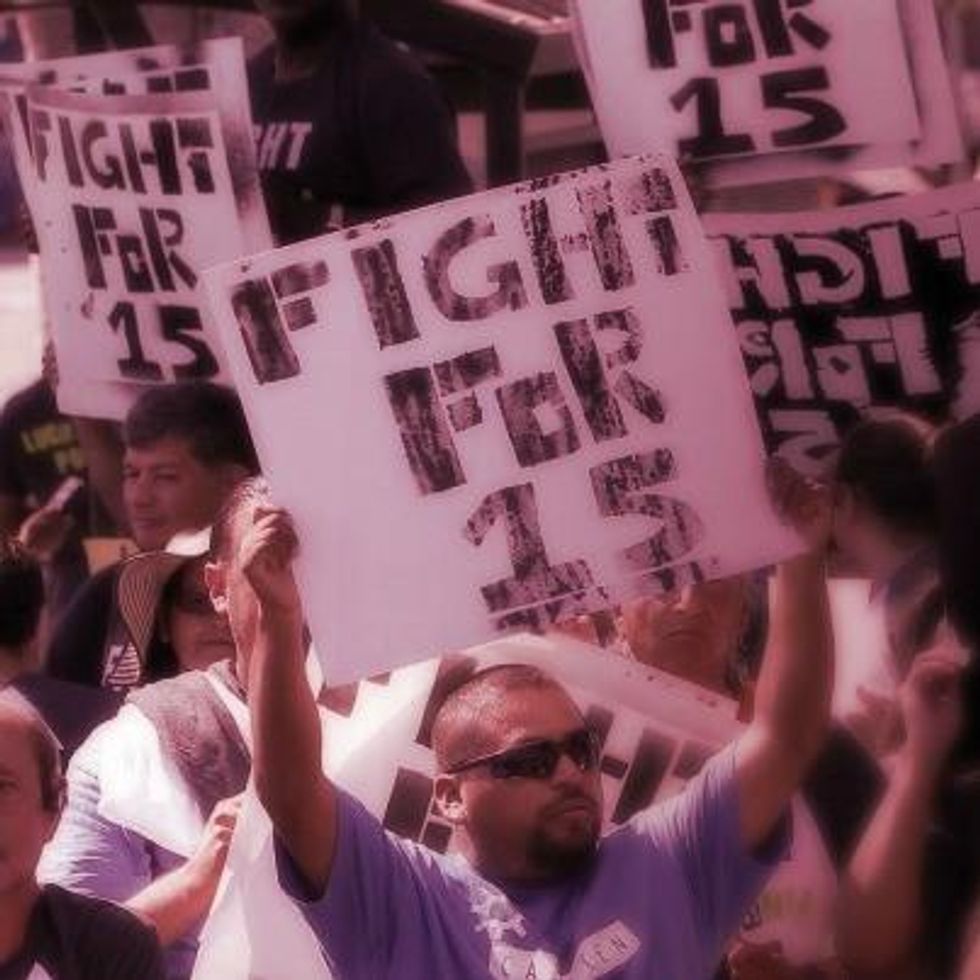
Following the victory of a $15 established hourly wage in the Washington state city of Seatac in November, coupled with the win of Kshama Sawant who ran for Seattle City Council as a Socialist Alternative candidate and a growing national movement led by low-wage retail and fast-food workers, organizers behind the '15Now Campaign' think the moment is now right to connect those across the country who are boldly calling for such an increase.
"Good jobs are disappearing while the wealthiest 1% are taking an unprecedented share of the national income," says Sawant who plans to fight for the $15 wage in Seattle where newly elected Mayor Ed Murray has also endorsed the idea.
"Nobody should have to struggle on poverty wages just to satisfy big corporations' endless thirst for profits," she continued. "Fast food and low wage workers are rising up demanding a $15/hour minimum wage. Let's unite in the Fight for $15 and win an historic victory for working people."
In statement announcing their new campaign, organizers said they will focus on Seattle as an immediate testing ground, but consider their push a national one.
"A $15 minimum wage in Seattle will set an example that working people and unions across the country would likely be inspired to follow," the campaign said in their official announcement. "In order to counter the resistance from corporate America, 15now.org appeals to people to get involved and join the fight. At 15now.org, people can donate $15/month, add your name to a list of endorsers, and sign up to volunteer."
The group plans to hold an initial rally in Seattle on Sunday, January 12th to publicly launch their campaign but acknowledges real progress will only come if they can help "build a massive grassroots campaign with local neighborhood and campus groups, town hall meetings, mass rallies, and strikes."
Though seen as politically unrealistic by many, organizers and propopents of a $15 wage say the economic data is clearly on their side. According to the group:
As consumer advocate and former presidential candidate Ralph Nader argued earlier this year, polling shows that the public widely approves of an increased federal wage and despite objections from the large corporate employers--whose executives have seen their salaries skyrocket over the decades--raising worker pay would both stimulate the overall economy and address the widespread inequities that continue to hinder shared productivity gains. As Nader wrote:
The first step in addressing the issue of income inequality in the United States is raising the federal minimum wage. President Obama recently called for raising the minimum wage to $9 an hour by 2015. (Candidate Obama in 2008 supported raising the minimum wage to $9.50 by 2011.) But $9 is far too little -- if adjusted for inflation based on the 1968 level, workers making the federal minimum wage would be making at least $10.50 an hour today. According to a recent Gallup poll, over 70 percent of the American public support raising the minimum wage. Many economists agree that it would stimulate the economy through larger sales volume, not harm it. Large companies such as Walmart and McDonald's (who employ over two-thirds of low wage workers) have profited off the backs of the working poor far too long.
And those at '15Now' say that as the wealthiest nation in world history, there is no doubt the U.S. as a whole has the resources to provide every worker a decent standard of living. "Every worker deserves a living wage - no one should have to live in poverty if they work a full-time job (or jobs)."
Find the '@FifteenNow' campaign and follow their work on Twitter.
_____________________________________
The push for a true living wage--not $8.25, not $9.50, not $10.10, but an hourly wage of $15--wants to go national.
Following the victory of a $15 established hourly wage in the Washington state city of Seatac in November, coupled with the win of Kshama Sawant who ran for Seattle City Council as a Socialist Alternative candidate and a growing national movement led by low-wage retail and fast-food workers, organizers behind the '15Now Campaign' think the moment is now right to connect those across the country who are boldly calling for such an increase.
"Good jobs are disappearing while the wealthiest 1% are taking an unprecedented share of the national income," says Sawant who plans to fight for the $15 wage in Seattle where newly elected Mayor Ed Murray has also endorsed the idea.
"Nobody should have to struggle on poverty wages just to satisfy big corporations' endless thirst for profits," she continued. "Fast food and low wage workers are rising up demanding a $15/hour minimum wage. Let's unite in the Fight for $15 and win an historic victory for working people."
In statement announcing their new campaign, organizers said they will focus on Seattle as an immediate testing ground, but consider their push a national one.
"A $15 minimum wage in Seattle will set an example that working people and unions across the country would likely be inspired to follow," the campaign said in their official announcement. "In order to counter the resistance from corporate America, 15now.org appeals to people to get involved and join the fight. At 15now.org, people can donate $15/month, add your name to a list of endorsers, and sign up to volunteer."
The group plans to hold an initial rally in Seattle on Sunday, January 12th to publicly launch their campaign but acknowledges real progress will only come if they can help "build a massive grassroots campaign with local neighborhood and campus groups, town hall meetings, mass rallies, and strikes."
Though seen as politically unrealistic by many, organizers and propopents of a $15 wage say the economic data is clearly on their side. According to the group:
As consumer advocate and former presidential candidate Ralph Nader argued earlier this year, polling shows that the public widely approves of an increased federal wage and despite objections from the large corporate employers--whose executives have seen their salaries skyrocket over the decades--raising worker pay would both stimulate the overall economy and address the widespread inequities that continue to hinder shared productivity gains. As Nader wrote:
The first step in addressing the issue of income inequality in the United States is raising the federal minimum wage. President Obama recently called for raising the minimum wage to $9 an hour by 2015. (Candidate Obama in 2008 supported raising the minimum wage to $9.50 by 2011.) But $9 is far too little -- if adjusted for inflation based on the 1968 level, workers making the federal minimum wage would be making at least $10.50 an hour today. According to a recent Gallup poll, over 70 percent of the American public support raising the minimum wage. Many economists agree that it would stimulate the economy through larger sales volume, not harm it. Large companies such as Walmart and McDonald's (who employ over two-thirds of low wage workers) have profited off the backs of the working poor far too long.
And those at '15Now' say that as the wealthiest nation in world history, there is no doubt the U.S. as a whole has the resources to provide every worker a decent standard of living. "Every worker deserves a living wage - no one should have to live in poverty if they work a full-time job (or jobs)."
Find the '@FifteenNow' campaign and follow their work on Twitter.
_____________________________________
The push for a true living wage--not $8.25, not $9.50, not $10.10, but an hourly wage of $15--wants to go national.
Following the victory of a $15 established hourly wage in the Washington state city of Seatac in November, coupled with the win of Kshama Sawant who ran for Seattle City Council as a Socialist Alternative candidate and a growing national movement led by low-wage retail and fast-food workers, organizers behind the '15Now Campaign' think the moment is now right to connect those across the country who are boldly calling for such an increase.
"Good jobs are disappearing while the wealthiest 1% are taking an unprecedented share of the national income," says Sawant who plans to fight for the $15 wage in Seattle where newly elected Mayor Ed Murray has also endorsed the idea.
"Nobody should have to struggle on poverty wages just to satisfy big corporations' endless thirst for profits," she continued. "Fast food and low wage workers are rising up demanding a $15/hour minimum wage. Let's unite in the Fight for $15 and win an historic victory for working people."
In statement announcing their new campaign, organizers said they will focus on Seattle as an immediate testing ground, but consider their push a national one.
"A $15 minimum wage in Seattle will set an example that working people and unions across the country would likely be inspired to follow," the campaign said in their official announcement. "In order to counter the resistance from corporate America, 15now.org appeals to people to get involved and join the fight. At 15now.org, people can donate $15/month, add your name to a list of endorsers, and sign up to volunteer."
The group plans to hold an initial rally in Seattle on Sunday, January 12th to publicly launch their campaign but acknowledges real progress will only come if they can help "build a massive grassroots campaign with local neighborhood and campus groups, town hall meetings, mass rallies, and strikes."
Though seen as politically unrealistic by many, organizers and propopents of a $15 wage say the economic data is clearly on their side. According to the group:
As consumer advocate and former presidential candidate Ralph Nader argued earlier this year, polling shows that the public widely approves of an increased federal wage and despite objections from the large corporate employers--whose executives have seen their salaries skyrocket over the decades--raising worker pay would both stimulate the overall economy and address the widespread inequities that continue to hinder shared productivity gains. As Nader wrote:
The first step in addressing the issue of income inequality in the United States is raising the federal minimum wage. President Obama recently called for raising the minimum wage to $9 an hour by 2015. (Candidate Obama in 2008 supported raising the minimum wage to $9.50 by 2011.) But $9 is far too little -- if adjusted for inflation based on the 1968 level, workers making the federal minimum wage would be making at least $10.50 an hour today. According to a recent Gallup poll, over 70 percent of the American public support raising the minimum wage. Many economists agree that it would stimulate the economy through larger sales volume, not harm it. Large companies such as Walmart and McDonald's (who employ over two-thirds of low wage workers) have profited off the backs of the working poor far too long.
And those at '15Now' say that as the wealthiest nation in world history, there is no doubt the U.S. as a whole has the resources to provide every worker a decent standard of living. "Every worker deserves a living wage - no one should have to live in poverty if they work a full-time job (or jobs)."
Find the '@FifteenNow' campaign and follow their work on Twitter.
_____________________________________