SUBSCRIBE TO OUR FREE NEWSLETTER
Daily news & progressive opinion—funded by the people, not the corporations—delivered straight to your inbox.
5
#000000
#FFFFFF
To donate by check, phone, or other method, see our More Ways to Give page.
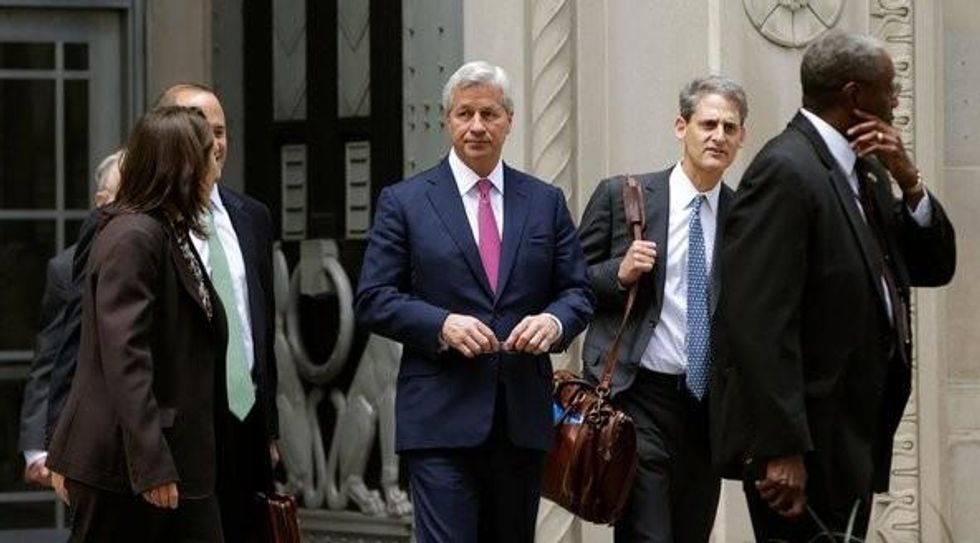
"The issue is that JPMorgan broke the law. They made criminal misrepresentations," said Dean Baker, co-director of the Center for Economic and Policy Research, in an interview with Common Dreams. "If there aren't criminal sanctions for individuals I don't see how you can change incentive. The penalty is no big deal."
Critics charged that even the $13 billion figure being championed by the Justice Department is not what it seems.
Four billion of this fine is the result of litigation between JPMorgan and the Federal Housing Finance Agency, settled independently from the Justice Department over a month ago. David Dayen writing for Salon argues that this sum was folded into the overall settlement because Attorney General Eric Holder wanted to "stand at a podium and give out a really big settlement number."
Yet, the $9 billion of fines that is left does not represent real dollars. As Dayen explains, "Nearly half of the [$9 billion dollar] figure comes in the form of 'mortgage relief,' which an independent monitor (and what's so independent about a monitor chosen by the bank?) has four years to distribute. Any time you extend the time horizon of a penalty, you're reducing its real value."
Furthermore, as JPMorgan's chief financial officer Marianne Lake said on a Tuesday investor call, a stunning $7 billion of the $9 billion fine is tax-deductible. Francisco Enriquez of U.S. PIRG told Common Dreams that the entire FHFA penalty is tax deductible. This means that a total $11 billion of the $13 billion overall fine will be tax-deductible, so U.S. taxpayers will shoulder a significant portion of the bill.
This is despite a petition organized by U.S. PIRG and Americans for Tax Fairness earlier this month, signed by over 160,000 people, demanding that the Justice Department block this tax deduction windfall. "I think taxpayers deserve to know if that happens and why they will be picking up the tab," said Lisa Gilbert of Public Citizen in an interview with Common Dreams.
Even if JPMorgan did pay the whole $13 billion fine, this would only represent half of its profits last year, a price that critics charge is nothing compared to the bank's windfall in profits from fraudulent mortgages.
"Many thousands of people have died from the social trauma inflicted by [JPMorgan chief executive] Jamie Dimon and his syndicate - and that's just in the United States," writes Glen Ford of Black Agenda Report. "Globally, millions have perished due to the actions for which the settlement is supposed to atone."
"Here's the question I ask," said Baker. "If I'm a banker, is knowing I could get caught for doing this worth my while to do it? My guess is anyone who looks at the money JPMorgan pocketed versus what they are paying now thinks the fine is worth it."
_____________________
"The issue is that JPMorgan broke the law. They made criminal misrepresentations," said Dean Baker, co-director of the Center for Economic and Policy Research, in an interview with Common Dreams. "If there aren't criminal sanctions for individuals I don't see how you can change incentive. The penalty is no big deal."
Critics charged that even the $13 billion figure being championed by the Justice Department is not what it seems.
Four billion of this fine is the result of litigation between JPMorgan and the Federal Housing Finance Agency, settled independently from the Justice Department over a month ago. David Dayen writing for Salon argues that this sum was folded into the overall settlement because Attorney General Eric Holder wanted to "stand at a podium and give out a really big settlement number."
Yet, the $9 billion of fines that is left does not represent real dollars. As Dayen explains, "Nearly half of the [$9 billion dollar] figure comes in the form of 'mortgage relief,' which an independent monitor (and what's so independent about a monitor chosen by the bank?) has four years to distribute. Any time you extend the time horizon of a penalty, you're reducing its real value."
Furthermore, as JPMorgan's chief financial officer Marianne Lake said on a Tuesday investor call, a stunning $7 billion of the $9 billion fine is tax-deductible. Francisco Enriquez of U.S. PIRG told Common Dreams that the entire FHFA penalty is tax deductible. This means that a total $11 billion of the $13 billion overall fine will be tax-deductible, so U.S. taxpayers will shoulder a significant portion of the bill.
This is despite a petition organized by U.S. PIRG and Americans for Tax Fairness earlier this month, signed by over 160,000 people, demanding that the Justice Department block this tax deduction windfall. "I think taxpayers deserve to know if that happens and why they will be picking up the tab," said Lisa Gilbert of Public Citizen in an interview with Common Dreams.
Even if JPMorgan did pay the whole $13 billion fine, this would only represent half of its profits last year, a price that critics charge is nothing compared to the bank's windfall in profits from fraudulent mortgages.
"Many thousands of people have died from the social trauma inflicted by [JPMorgan chief executive] Jamie Dimon and his syndicate - and that's just in the United States," writes Glen Ford of Black Agenda Report. "Globally, millions have perished due to the actions for which the settlement is supposed to atone."
"Here's the question I ask," said Baker. "If I'm a banker, is knowing I could get caught for doing this worth my while to do it? My guess is anyone who looks at the money JPMorgan pocketed versus what they are paying now thinks the fine is worth it."
_____________________
"The issue is that JPMorgan broke the law. They made criminal misrepresentations," said Dean Baker, co-director of the Center for Economic and Policy Research, in an interview with Common Dreams. "If there aren't criminal sanctions for individuals I don't see how you can change incentive. The penalty is no big deal."
Critics charged that even the $13 billion figure being championed by the Justice Department is not what it seems.
Four billion of this fine is the result of litigation between JPMorgan and the Federal Housing Finance Agency, settled independently from the Justice Department over a month ago. David Dayen writing for Salon argues that this sum was folded into the overall settlement because Attorney General Eric Holder wanted to "stand at a podium and give out a really big settlement number."
Yet, the $9 billion of fines that is left does not represent real dollars. As Dayen explains, "Nearly half of the [$9 billion dollar] figure comes in the form of 'mortgage relief,' which an independent monitor (and what's so independent about a monitor chosen by the bank?) has four years to distribute. Any time you extend the time horizon of a penalty, you're reducing its real value."
Furthermore, as JPMorgan's chief financial officer Marianne Lake said on a Tuesday investor call, a stunning $7 billion of the $9 billion fine is tax-deductible. Francisco Enriquez of U.S. PIRG told Common Dreams that the entire FHFA penalty is tax deductible. This means that a total $11 billion of the $13 billion overall fine will be tax-deductible, so U.S. taxpayers will shoulder a significant portion of the bill.
This is despite a petition organized by U.S. PIRG and Americans for Tax Fairness earlier this month, signed by over 160,000 people, demanding that the Justice Department block this tax deduction windfall. "I think taxpayers deserve to know if that happens and why they will be picking up the tab," said Lisa Gilbert of Public Citizen in an interview with Common Dreams.
Even if JPMorgan did pay the whole $13 billion fine, this would only represent half of its profits last year, a price that critics charge is nothing compared to the bank's windfall in profits from fraudulent mortgages.
"Many thousands of people have died from the social trauma inflicted by [JPMorgan chief executive] Jamie Dimon and his syndicate - and that's just in the United States," writes Glen Ford of Black Agenda Report. "Globally, millions have perished due to the actions for which the settlement is supposed to atone."
"Here's the question I ask," said Baker. "If I'm a banker, is knowing I could get caught for doing this worth my while to do it? My guess is anyone who looks at the money JPMorgan pocketed versus what they are paying now thinks the fine is worth it."
_____________________