
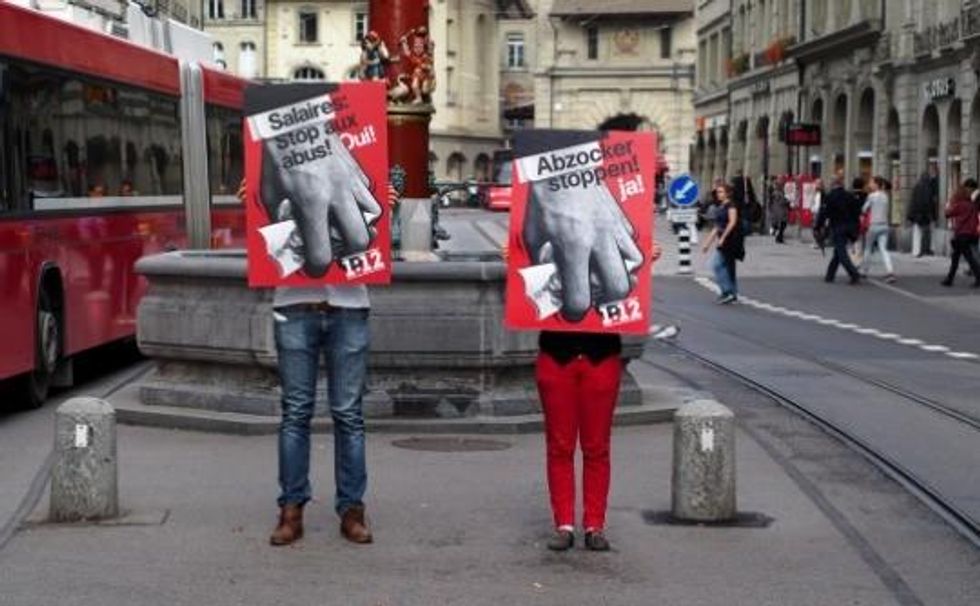
The "1:12" initiative in question would limit monthly executive pay to no more than what any company's lowest-paid staff earn in a year.
Although recent polls have shown voters are split on the initiative, recent campaigns in the country have proven very successful. A referendum, which bans so-called "golden handshake" deals and forces public companies to give shareholders a binding vote on compensation, passed with a landslide victory in March. And another referendum brought to parliament by petition earlier this month--calling for a guaranteed minimum income of $2,800 per month for every worker in the country--has received widespread popular support.
Nonetheless, organizers for the "1:12" initiative told Agence France-Presse that it is not the time to get comfortable, as the proposition faces fierce opposition from the wealthy elite and right-leaning voters.
"We're going to pull out all the stops," said David Roth, head of the youth wing of Switzerland's Socialist Party (JUSO), who have organized around the referendum.
Some of those stops include projecting images and campaign messages onto the buildings of major banking institutions and a "Fat Cat of the Week" campaign on the group's Facebook page--this week featuring UBS's investment banking division head Andrea Orcel.
Organizers underlined for AFP how "Orcel's salary is 194 times higher than that of the lowest-paid UBS employee." And the news reports that the "former Bank of America Merrill Lynch executive chairman, previously at Goldman Sachs, also received a 26-million Swiss franc ($29 million) golden handshake when he joined UBS in 2012."
Proponents of the "1:12" proposal will be holding a rally in Zurich on November 2nd, which organizers said is expected to draw a large crowd.
_______________________
The "1:12" initiative in question would limit monthly executive pay to no more than what any company's lowest-paid staff earn in a year.
Although recent polls have shown voters are split on the initiative, recent campaigns in the country have proven very successful. A referendum, which bans so-called "golden handshake" deals and forces public companies to give shareholders a binding vote on compensation, passed with a landslide victory in March. And another referendum brought to parliament by petition earlier this month--calling for a guaranteed minimum income of $2,800 per month for every worker in the country--has received widespread popular support.
Nonetheless, organizers for the "1:12" initiative told Agence France-Presse that it is not the time to get comfortable, as the proposition faces fierce opposition from the wealthy elite and right-leaning voters.
"We're going to pull out all the stops," said David Roth, head of the youth wing of Switzerland's Socialist Party (JUSO), who have organized around the referendum.
Some of those stops include projecting images and campaign messages onto the buildings of major banking institutions and a "Fat Cat of the Week" campaign on the group's Facebook page--this week featuring UBS's investment banking division head Andrea Orcel.
Organizers underlined for AFP how "Orcel's salary is 194 times higher than that of the lowest-paid UBS employee." And the news reports that the "former Bank of America Merrill Lynch executive chairman, previously at Goldman Sachs, also received a 26-million Swiss franc ($29 million) golden handshake when he joined UBS in 2012."
Proponents of the "1:12" proposal will be holding a rally in Zurich on November 2nd, which organizers said is expected to draw a large crowd.
_______________________
The "1:12" initiative in question would limit monthly executive pay to no more than what any company's lowest-paid staff earn in a year.
Although recent polls have shown voters are split on the initiative, recent campaigns in the country have proven very successful. A referendum, which bans so-called "golden handshake" deals and forces public companies to give shareholders a binding vote on compensation, passed with a landslide victory in March. And another referendum brought to parliament by petition earlier this month--calling for a guaranteed minimum income of $2,800 per month for every worker in the country--has received widespread popular support.
Nonetheless, organizers for the "1:12" initiative told Agence France-Presse that it is not the time to get comfortable, as the proposition faces fierce opposition from the wealthy elite and right-leaning voters.
"We're going to pull out all the stops," said David Roth, head of the youth wing of Switzerland's Socialist Party (JUSO), who have organized around the referendum.
Some of those stops include projecting images and campaign messages onto the buildings of major banking institutions and a "Fat Cat of the Week" campaign on the group's Facebook page--this week featuring UBS's investment banking division head Andrea Orcel.
Organizers underlined for AFP how "Orcel's salary is 194 times higher than that of the lowest-paid UBS employee." And the news reports that the "former Bank of America Merrill Lynch executive chairman, previously at Goldman Sachs, also received a 26-million Swiss franc ($29 million) golden handshake when he joined UBS in 2012."
Proponents of the "1:12" proposal will be holding a rally in Zurich on November 2nd, which organizers said is expected to draw a large crowd.
_______________________