SUBSCRIBE TO OUR FREE NEWSLETTER
Daily news & progressive opinion—funded by the people, not the corporations—delivered straight to your inbox.
5
#000000
#FFFFFF
To donate by check, phone, or other method, see our More Ways to Give page.


Daily news & progressive opinion—funded by the people, not the corporations—delivered straight to your inbox.

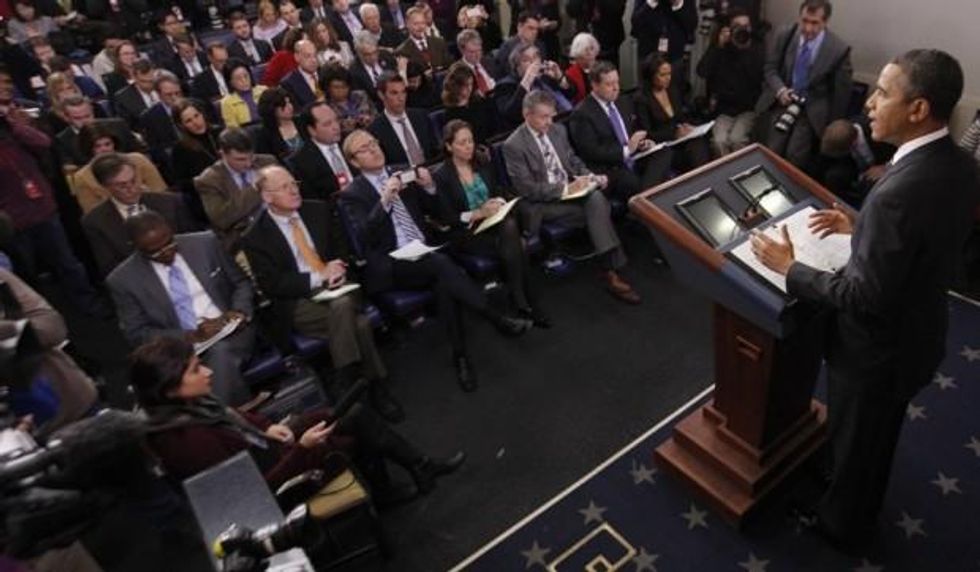
This is despite Obama's promises to create "unprecented" openness and transparency in government, the study finds.
The report, The Obama Administration and the Press: Leak investigations and surveillance in post-9/11 America, was penned by Leonard Downie Jr., former Washington Post executive editor and current Weil Family Professor of Journalism at Arizona State University's Walter Cronkite School of Journalism and Mass Communication. It is based on interviews with 30 experienced journalists who work in Washington, DC.
These testimonies collectively paint a picture of an administration that keeps a strangle-hold on access to information at all levels. "The administration's war on leaks and other efforts to control information are the most aggressive I've seen since the Nixon administration, when I was one of the editors involved in The Washington Post's investigation of Watergate," writes Downie. "The 30 experienced Washington journalists at a variety of news organizations whom I interviewed for this report could not remember any precedent."
Inheriting a secretive post-9/11 government, Obama pursued more closed policies, rebuffing his promises of transparency, the report states. Six government workers and two contractors have been prosecuted with felony charges under the Espionage since 2009 for allegedly leaking information to the media, with more prosecutions in the pipelines. There have only been three similar prosecutions in all prior administrations. "I think we have a real problem," said New York Times national security reporter Scott Shane in the report. "Most people are deterred by those leaks prosecutions. They're scared to death.
In at least two of these cases, journalists' communications were seized by the department of justice. Broader awareness of government surveillance, in part thanks to the revelations of NSA whistleblower Edward Snowden, has created a climate of fear for journalists. "I worry now about calling somebody because the contact can be found out through a check of phone records or e-mails," said veteran national security journalist R. Jeffrey Smith of the Center for Public Integrity.
Obama's 'Insider Threat' program, engineered to crack down on government leaks by encouraging employees to spy on each other, has created a "climate of fear" about openness within the government, the report charges. "I worry now about calling somebody because the contact can be found out through a check of phone records or e-mails," said veteran national security journalist R. Jeffrey Smith of the Center for Public Integrity, when interviewed for the report.
Journalists are shunted to media spokespeople only to be met with hostility and unresponsiveness when they request information, the report states. David E. Sanger, chief Washington correspondent of The New York Times, declared when interviewed for the report: "This is the most closed, control freak administration I've ever covered."
_____________________

Dear Common Dreams reader, The U.S. is on a fast track to authoritarianism like nothing I've ever seen. Meanwhile, corporate news outlets are utterly capitulating to Trump, twisting their coverage to avoid drawing his ire while lining up to stuff cash in his pockets. That's why I believe that Common Dreams is doing the best and most consequential reporting that we've ever done. Our small but mighty team is a progressive reporting powerhouse, covering the news every day that the corporate media never will. Our mission has always been simple: To inform. To inspire. And to ignite change for the common good. Now here's the key piece that I want all our readers to understand: None of this would be possible without your financial support. That's not just some fundraising cliche. It's the absolute and literal truth. We don't accept corporate advertising and never will. We don't have a paywall because we don't think people should be blocked from critical news based on their ability to pay. Everything we do is funded by the donations of readers like you. Will you donate now to help power the nonprofit, independent reporting of Common Dreams? Thank you for being a vital member of our community. Together, we can keep independent journalism alive when it’s needed most. - Craig Brown, Co-founder |

This is despite Obama's promises to create "unprecented" openness and transparency in government, the study finds.
The report, The Obama Administration and the Press: Leak investigations and surveillance in post-9/11 America, was penned by Leonard Downie Jr., former Washington Post executive editor and current Weil Family Professor of Journalism at Arizona State University's Walter Cronkite School of Journalism and Mass Communication. It is based on interviews with 30 experienced journalists who work in Washington, DC.
These testimonies collectively paint a picture of an administration that keeps a strangle-hold on access to information at all levels. "The administration's war on leaks and other efforts to control information are the most aggressive I've seen since the Nixon administration, when I was one of the editors involved in The Washington Post's investigation of Watergate," writes Downie. "The 30 experienced Washington journalists at a variety of news organizations whom I interviewed for this report could not remember any precedent."
Inheriting a secretive post-9/11 government, Obama pursued more closed policies, rebuffing his promises of transparency, the report states. Six government workers and two contractors have been prosecuted with felony charges under the Espionage since 2009 for allegedly leaking information to the media, with more prosecutions in the pipelines. There have only been three similar prosecutions in all prior administrations. "I think we have a real problem," said New York Times national security reporter Scott Shane in the report. "Most people are deterred by those leaks prosecutions. They're scared to death.
In at least two of these cases, journalists' communications were seized by the department of justice. Broader awareness of government surveillance, in part thanks to the revelations of NSA whistleblower Edward Snowden, has created a climate of fear for journalists. "I worry now about calling somebody because the contact can be found out through a check of phone records or e-mails," said veteran national security journalist R. Jeffrey Smith of the Center for Public Integrity.
Obama's 'Insider Threat' program, engineered to crack down on government leaks by encouraging employees to spy on each other, has created a "climate of fear" about openness within the government, the report charges. "I worry now about calling somebody because the contact can be found out through a check of phone records or e-mails," said veteran national security journalist R. Jeffrey Smith of the Center for Public Integrity, when interviewed for the report.
Journalists are shunted to media spokespeople only to be met with hostility and unresponsiveness when they request information, the report states. David E. Sanger, chief Washington correspondent of The New York Times, declared when interviewed for the report: "This is the most closed, control freak administration I've ever covered."
_____________________

This is despite Obama's promises to create "unprecented" openness and transparency in government, the study finds.
The report, The Obama Administration and the Press: Leak investigations and surveillance in post-9/11 America, was penned by Leonard Downie Jr., former Washington Post executive editor and current Weil Family Professor of Journalism at Arizona State University's Walter Cronkite School of Journalism and Mass Communication. It is based on interviews with 30 experienced journalists who work in Washington, DC.
These testimonies collectively paint a picture of an administration that keeps a strangle-hold on access to information at all levels. "The administration's war on leaks and other efforts to control information are the most aggressive I've seen since the Nixon administration, when I was one of the editors involved in The Washington Post's investigation of Watergate," writes Downie. "The 30 experienced Washington journalists at a variety of news organizations whom I interviewed for this report could not remember any precedent."
Inheriting a secretive post-9/11 government, Obama pursued more closed policies, rebuffing his promises of transparency, the report states. Six government workers and two contractors have been prosecuted with felony charges under the Espionage since 2009 for allegedly leaking information to the media, with more prosecutions in the pipelines. There have only been three similar prosecutions in all prior administrations. "I think we have a real problem," said New York Times national security reporter Scott Shane in the report. "Most people are deterred by those leaks prosecutions. They're scared to death.
In at least two of these cases, journalists' communications were seized by the department of justice. Broader awareness of government surveillance, in part thanks to the revelations of NSA whistleblower Edward Snowden, has created a climate of fear for journalists. "I worry now about calling somebody because the contact can be found out through a check of phone records or e-mails," said veteran national security journalist R. Jeffrey Smith of the Center for Public Integrity.
Obama's 'Insider Threat' program, engineered to crack down on government leaks by encouraging employees to spy on each other, has created a "climate of fear" about openness within the government, the report charges. "I worry now about calling somebody because the contact can be found out through a check of phone records or e-mails," said veteran national security journalist R. Jeffrey Smith of the Center for Public Integrity, when interviewed for the report.
Journalists are shunted to media spokespeople only to be met with hostility and unresponsiveness when they request information, the report states. David E. Sanger, chief Washington correspondent of The New York Times, declared when interviewed for the report: "This is the most closed, control freak administration I've ever covered."
_____________________