SUBSCRIBE TO OUR FREE NEWSLETTER
Daily news & progressive opinion—funded by the people, not the corporations—delivered straight to your inbox.
5
#000000
#FFFFFF
To donate by check, phone, or other method, see our More Ways to Give page.
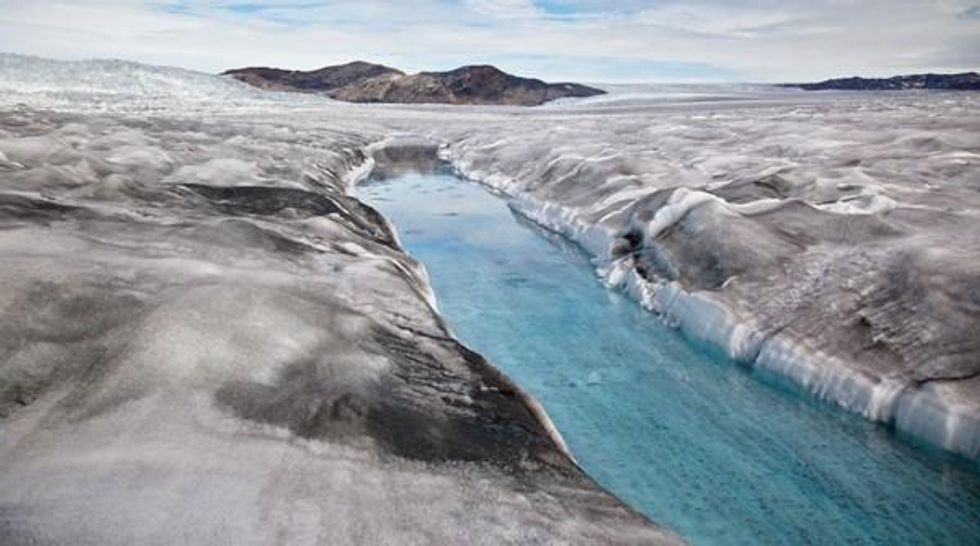
Based on leaked portions of draft version of the IPCC assessment, others have pointed out that one of its key messages is the report's finding that the world's scientific community is in more agreement than ever that global warming is not only an unprecedented planetary crisis, but that more than 95% of all scientists believe, beyond doubt, that it is being driven by human- and industrial-driven activities.
As Goodell--in a thorough new piece that reviews both the history of the IPCC's process and its possible future--writes:
The IPCC's Fifth Assessment Report offers slam-dunk evidence that burning fossil fuels is the cause of most of the temperature increases of recent decades, and warn that sea levels could rise by almost three feet by the end of the century if we don't change our ways. The report will underscore that the basic facts about climate change are more established than ever, and that the consequences of escalating carbon pollution are likely to mean that, as The New York Times recently argued, "babies being born now could live to see the early stages of a global calamity.
But the argument forged by Goodell is not that scientists now need to do a "better job" of explaining the alarming findings of their studies. Nor does he suggest they must become better at fighting off the attacks by the network of climate change deniers funded by the fossil fuel-funded industry and spread by libertarian conspiracy theorists. All that is well-traveled territory when it comes to climate science.
Instead, Goodell seems to find agreement with those who say the time for the drawn-out process of the IPCC review assessments may be coming to end.
Quoting David Keith, a Harvard professor who recently resigned as an author of the Fifth Assessment, Goodell says there is a group of scientists who feel as though the dire reality of the climate crisis demands more than a multi-year process that produces a document of many thousands of pages which few people will ever read.
"I think these reports have outgrown their usefulness," Keith said, adding that if the IPCC process was gone, "scientists might reorganize themselves in a more effective way."
The suggestion isn't that the work of the IPCC has not been vital. Indeed, there's little doubt that sciencific study has been the most vital tool for those raising the alarm bells and calling for a reduction of greenhouse gas emissions over the last several decades. However, as Goodell notes, "In the 25 years since the IPCC was formed, global carbon pollution is rising faster than ever."
It's not that the science isn't of inherent importance, but the fact that as the science has piled up--in study after study--the political will in Washington (or anywhere for that matter) has not risen to the challenge the science has presented.
As energy expert and Hampshire College professor Michael T. Klare has warned in a series of recent articles, the fossil fuel industry--despite what it knows about factually about the perilous results of its industrial processes--is working harder than ever to push extraction policies and keep the world mired in the carbon-based economy. And it's winning.
Though Klare recognizes that the growing climate justice movement--represented by groups like 350.org, Greenpeace and others--is doing courageous and quality organizing in order to break the industry's hold on power and push for a more sustainable energy future, he also says "the world's giant oil, gas, and coal corporations--are hardly going to acquiesce to this shift without a fight."
Whether or not environmental advocacy groups--which have waged their battle in front of the White House, in Congress, and in the streets--can ultimately break through on the political front remains to be seen, but to the extent that the scientific community has continually fueled the movement with sound arguments and a sense of urgency it's impossible to ignore the important nature of the relationship.
As Naomi Oreskes, a science historian at Harvard and co-author of the book Merchants of Doubt, explained to Goodell, "if there is one thing we have learned in recent years, it's that climate change is not just a scientific problem. It is also a political, social and cultural problem."
What remains is the question of whether or not the presentation of the first installment of the IPCC's Fifth Assessment Report at the end of September will generate enough new energy to significantly alter either the domestic or international debate on global warming and climate change.
And if it doesn't, Goodell won't be the only one wondering: What next?
____________________________________________________
Based on leaked portions of draft version of the IPCC assessment, others have pointed out that one of its key messages is the report's finding that the world's scientific community is in more agreement than ever that global warming is not only an unprecedented planetary crisis, but that more than 95% of all scientists believe, beyond doubt, that it is being driven by human- and industrial-driven activities.
As Goodell--in a thorough new piece that reviews both the history of the IPCC's process and its possible future--writes:
The IPCC's Fifth Assessment Report offers slam-dunk evidence that burning fossil fuels is the cause of most of the temperature increases of recent decades, and warn that sea levels could rise by almost three feet by the end of the century if we don't change our ways. The report will underscore that the basic facts about climate change are more established than ever, and that the consequences of escalating carbon pollution are likely to mean that, as The New York Times recently argued, "babies being born now could live to see the early stages of a global calamity.
But the argument forged by Goodell is not that scientists now need to do a "better job" of explaining the alarming findings of their studies. Nor does he suggest they must become better at fighting off the attacks by the network of climate change deniers funded by the fossil fuel-funded industry and spread by libertarian conspiracy theorists. All that is well-traveled territory when it comes to climate science.
Instead, Goodell seems to find agreement with those who say the time for the drawn-out process of the IPCC review assessments may be coming to end.
Quoting David Keith, a Harvard professor who recently resigned as an author of the Fifth Assessment, Goodell says there is a group of scientists who feel as though the dire reality of the climate crisis demands more than a multi-year process that produces a document of many thousands of pages which few people will ever read.
"I think these reports have outgrown their usefulness," Keith said, adding that if the IPCC process was gone, "scientists might reorganize themselves in a more effective way."
The suggestion isn't that the work of the IPCC has not been vital. Indeed, there's little doubt that sciencific study has been the most vital tool for those raising the alarm bells and calling for a reduction of greenhouse gas emissions over the last several decades. However, as Goodell notes, "In the 25 years since the IPCC was formed, global carbon pollution is rising faster than ever."
It's not that the science isn't of inherent importance, but the fact that as the science has piled up--in study after study--the political will in Washington (or anywhere for that matter) has not risen to the challenge the science has presented.
As energy expert and Hampshire College professor Michael T. Klare has warned in a series of recent articles, the fossil fuel industry--despite what it knows about factually about the perilous results of its industrial processes--is working harder than ever to push extraction policies and keep the world mired in the carbon-based economy. And it's winning.
Though Klare recognizes that the growing climate justice movement--represented by groups like 350.org, Greenpeace and others--is doing courageous and quality organizing in order to break the industry's hold on power and push for a more sustainable energy future, he also says "the world's giant oil, gas, and coal corporations--are hardly going to acquiesce to this shift without a fight."
Whether or not environmental advocacy groups--which have waged their battle in front of the White House, in Congress, and in the streets--can ultimately break through on the political front remains to be seen, but to the extent that the scientific community has continually fueled the movement with sound arguments and a sense of urgency it's impossible to ignore the important nature of the relationship.
As Naomi Oreskes, a science historian at Harvard and co-author of the book Merchants of Doubt, explained to Goodell, "if there is one thing we have learned in recent years, it's that climate change is not just a scientific problem. It is also a political, social and cultural problem."
What remains is the question of whether or not the presentation of the first installment of the IPCC's Fifth Assessment Report at the end of September will generate enough new energy to significantly alter either the domestic or international debate on global warming and climate change.
And if it doesn't, Goodell won't be the only one wondering: What next?
____________________________________________________
Based on leaked portions of draft version of the IPCC assessment, others have pointed out that one of its key messages is the report's finding that the world's scientific community is in more agreement than ever that global warming is not only an unprecedented planetary crisis, but that more than 95% of all scientists believe, beyond doubt, that it is being driven by human- and industrial-driven activities.
As Goodell--in a thorough new piece that reviews both the history of the IPCC's process and its possible future--writes:
The IPCC's Fifth Assessment Report offers slam-dunk evidence that burning fossil fuels is the cause of most of the temperature increases of recent decades, and warn that sea levels could rise by almost three feet by the end of the century if we don't change our ways. The report will underscore that the basic facts about climate change are more established than ever, and that the consequences of escalating carbon pollution are likely to mean that, as The New York Times recently argued, "babies being born now could live to see the early stages of a global calamity.
But the argument forged by Goodell is not that scientists now need to do a "better job" of explaining the alarming findings of their studies. Nor does he suggest they must become better at fighting off the attacks by the network of climate change deniers funded by the fossil fuel-funded industry and spread by libertarian conspiracy theorists. All that is well-traveled territory when it comes to climate science.
Instead, Goodell seems to find agreement with those who say the time for the drawn-out process of the IPCC review assessments may be coming to end.
Quoting David Keith, a Harvard professor who recently resigned as an author of the Fifth Assessment, Goodell says there is a group of scientists who feel as though the dire reality of the climate crisis demands more than a multi-year process that produces a document of many thousands of pages which few people will ever read.
"I think these reports have outgrown their usefulness," Keith said, adding that if the IPCC process was gone, "scientists might reorganize themselves in a more effective way."
The suggestion isn't that the work of the IPCC has not been vital. Indeed, there's little doubt that sciencific study has been the most vital tool for those raising the alarm bells and calling for a reduction of greenhouse gas emissions over the last several decades. However, as Goodell notes, "In the 25 years since the IPCC was formed, global carbon pollution is rising faster than ever."
It's not that the science isn't of inherent importance, but the fact that as the science has piled up--in study after study--the political will in Washington (or anywhere for that matter) has not risen to the challenge the science has presented.
As energy expert and Hampshire College professor Michael T. Klare has warned in a series of recent articles, the fossil fuel industry--despite what it knows about factually about the perilous results of its industrial processes--is working harder than ever to push extraction policies and keep the world mired in the carbon-based economy. And it's winning.
Though Klare recognizes that the growing climate justice movement--represented by groups like 350.org, Greenpeace and others--is doing courageous and quality organizing in order to break the industry's hold on power and push for a more sustainable energy future, he also says "the world's giant oil, gas, and coal corporations--are hardly going to acquiesce to this shift without a fight."
Whether or not environmental advocacy groups--which have waged their battle in front of the White House, in Congress, and in the streets--can ultimately break through on the political front remains to be seen, but to the extent that the scientific community has continually fueled the movement with sound arguments and a sense of urgency it's impossible to ignore the important nature of the relationship.
As Naomi Oreskes, a science historian at Harvard and co-author of the book Merchants of Doubt, explained to Goodell, "if there is one thing we have learned in recent years, it's that climate change is not just a scientific problem. It is also a political, social and cultural problem."
What remains is the question of whether or not the presentation of the first installment of the IPCC's Fifth Assessment Report at the end of September will generate enough new energy to significantly alter either the domestic or international debate on global warming and climate change.
And if it doesn't, Goodell won't be the only one wondering: What next?
____________________________________________________