

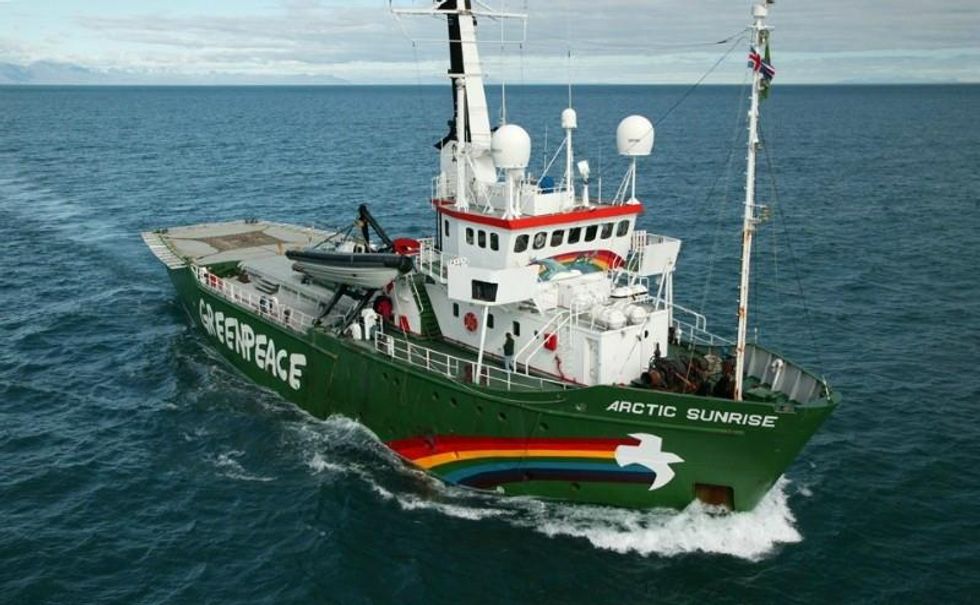
The entry is a bold challenge to Russia's collusion with the oil industry--also rampant in the U.S. and across the world--by banning environmental activists and monitors yet welcoming oil drilling exploration vessels with open arms.
"We refuse to let illegal attempts by the Russian government to stop us from exposing dangerous oil drilling in the Arctic," declared Christy Ferguson, Greenpeace Arctic Campaigner aboard the 'Arctic Sunrise' Greenpeace ship. "The Russian Arctic National Park is a special place full of rare and threatened Arctic wildlife, and faces an infinitely greater threat from reckless oil companies than a fully equipped Greenpeace icebreaker."
"If Rosneft and ExxonMobil bring in offshore drilling platforms they will risk catastrophic blowouts and spills that could devastate the region," she added.
Greenpeace announced Wednesday that the 'Arctic Sunrise' was banned from entering the waters after three applications for entry were rejected even though the ship had met all requirements, and despite Russian approval of over 400 oil exploration vessels this year. "This is a thinly veiled attempt to stifle peaceful protest and keep international attention away from Arctic oil exploration in Russia," declared Ferguson on Wednesday.
The Russian Arctic National Park--termed the 'Pearl of the Arctic'--is an important habitat for narwhals, polar bears, and whales. The Russian government has allowed Rosneft and ExxonMobil to conduct exploratory drilling on 450,000 hectares of park land, in direct contradiction of federal laws that protect the park.
Experts say that the sear route near the park, controlled by Russia, is expected to be a key path for export of oil and gas extracted from the arctic.
The Arctic Sunrise is on a month-long journey in the arctic to expose this and other violations of Russian environmental laws.
_____________________
The entry is a bold challenge to Russia's collusion with the oil industry--also rampant in the U.S. and across the world--by banning environmental activists and monitors yet welcoming oil drilling exploration vessels with open arms.
"We refuse to let illegal attempts by the Russian government to stop us from exposing dangerous oil drilling in the Arctic," declared Christy Ferguson, Greenpeace Arctic Campaigner aboard the 'Arctic Sunrise' Greenpeace ship. "The Russian Arctic National Park is a special place full of rare and threatened Arctic wildlife, and faces an infinitely greater threat from reckless oil companies than a fully equipped Greenpeace icebreaker."
"If Rosneft and ExxonMobil bring in offshore drilling platforms they will risk catastrophic blowouts and spills that could devastate the region," she added.
Greenpeace announced Wednesday that the 'Arctic Sunrise' was banned from entering the waters after three applications for entry were rejected even though the ship had met all requirements, and despite Russian approval of over 400 oil exploration vessels this year. "This is a thinly veiled attempt to stifle peaceful protest and keep international attention away from Arctic oil exploration in Russia," declared Ferguson on Wednesday.
The Russian Arctic National Park--termed the 'Pearl of the Arctic'--is an important habitat for narwhals, polar bears, and whales. The Russian government has allowed Rosneft and ExxonMobil to conduct exploratory drilling on 450,000 hectares of park land, in direct contradiction of federal laws that protect the park.
Experts say that the sear route near the park, controlled by Russia, is expected to be a key path for export of oil and gas extracted from the arctic.
The Arctic Sunrise is on a month-long journey in the arctic to expose this and other violations of Russian environmental laws.
_____________________
The entry is a bold challenge to Russia's collusion with the oil industry--also rampant in the U.S. and across the world--by banning environmental activists and monitors yet welcoming oil drilling exploration vessels with open arms.
"We refuse to let illegal attempts by the Russian government to stop us from exposing dangerous oil drilling in the Arctic," declared Christy Ferguson, Greenpeace Arctic Campaigner aboard the 'Arctic Sunrise' Greenpeace ship. "The Russian Arctic National Park is a special place full of rare and threatened Arctic wildlife, and faces an infinitely greater threat from reckless oil companies than a fully equipped Greenpeace icebreaker."
"If Rosneft and ExxonMobil bring in offshore drilling platforms they will risk catastrophic blowouts and spills that could devastate the region," she added.
Greenpeace announced Wednesday that the 'Arctic Sunrise' was banned from entering the waters after three applications for entry were rejected even though the ship had met all requirements, and despite Russian approval of over 400 oil exploration vessels this year. "This is a thinly veiled attempt to stifle peaceful protest and keep international attention away from Arctic oil exploration in Russia," declared Ferguson on Wednesday.
The Russian Arctic National Park--termed the 'Pearl of the Arctic'--is an important habitat for narwhals, polar bears, and whales. The Russian government has allowed Rosneft and ExxonMobil to conduct exploratory drilling on 450,000 hectares of park land, in direct contradiction of federal laws that protect the park.
Experts say that the sear route near the park, controlled by Russia, is expected to be a key path for export of oil and gas extracted from the arctic.
The Arctic Sunrise is on a month-long journey in the arctic to expose this and other violations of Russian environmental laws.
_____________________