SUBSCRIBE TO OUR FREE NEWSLETTER
Daily news & progressive opinion—funded by the people, not the corporations—delivered straight to your inbox.
5
#000000
#FFFFFF
To donate by check, phone, or other method, see our More Ways to Give page.
Daily news & progressive opinion—funded by the people, not the corporations—delivered straight to your inbox.
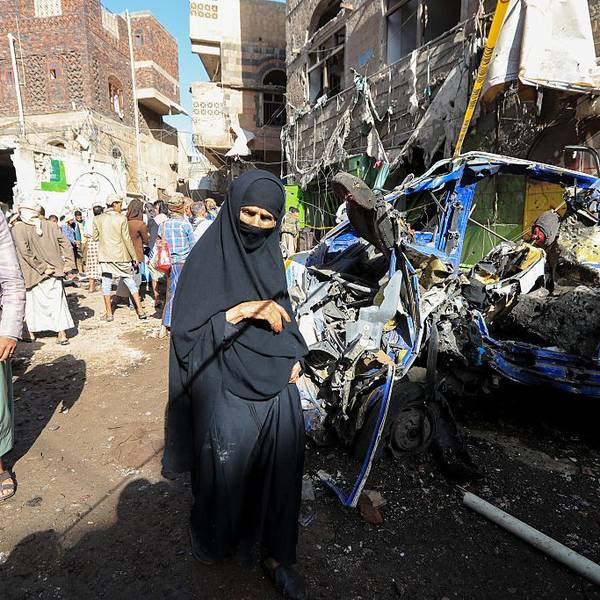
Protesters in Yemen expressed outrage Friday over a recent spike in US drone attacks which killed, according to witnesses, many civilian bystanders in addition to the likely targets.
Dozens of protesters in the southern town of Redaa staged a sit-in at a government administration building in reaction to at least five deadly attacks in the last ten days.
"If the authorities don't stop the American attacks then we will occupy the government institutions in the town," one protester told Reuters.
The southern region has become a continual and growing target for US drone missiles. Redaa, the site of the most recent strike, was also the scene of a drone strike in September that resulted in the death of at least 11 civilians, including three children.
On Thursday, a missile killed at least three people in Redaa. Local sources say the strike came from a US drone, though neither the Yemen or US government--per government policy--will confirm or deny such attacks.
An unnamed local Yemeni official told Reuters that those killed included a "senior al-Qaeda figure" and two "companions"; however, as the Washington Post recently reported, US drone strikes commonly take the lives of innocent civilians while US and Yemen officials--while offering no evidence--often claim the victims are militants.
The Bureau of Investigative Journalism reports that US drone strikes rose sharply in Yemen in 2012, saying a major covert US military offensive began there in March 2012.
"US or Yemeni officials often claim responsibility when senior militants are killed. In contrast there are rarely admissions of responsibility when civilians die in US airstrikes, as between 18 and 58 did in 2012. Only in December - three months after a dozen civilians died in Rada'a [sic] - did anonymous US officials admit that an American drone or plane had carried out an attack," TBIJ reports.
Additionally, as US and Yemen government officials seem to be working together in the attacks, other regional interests may also be at work in the skies over Yemen. According to the London Times, at least, Saudi Arabia may be providing fighter jets to assist the United States with its attacks in the region.
The Times reports, citing an anonymous US intelligence source, that "some of the so-called drone missions are actually Saudi Air Force missions".
Regardless of which government carried out any particular strike, the lives of innocent civilians are increasingly at risk due to covert foreign powers and their seemingly indiscriminate killings. US forces alone have killed up to 170 civilians since 2002, according to research by TBIJ.
Dear Common Dreams reader, It’s been nearly 30 years since I co-founded Common Dreams with my late wife, Lina Newhouser. We had the radical notion that journalism should serve the public good, not corporate profits. It was clear to us from the outset what it would take to build such a project. No paid advertisements. No corporate sponsors. No millionaire publisher telling us what to think or do. Many people said we wouldn't last a year, but we proved those doubters wrong. Together with a tremendous team of journalists and dedicated staff, we built an independent media outlet free from the constraints of profits and corporate control. Our mission has always been simple: To inform. To inspire. To ignite change for the common good. Building Common Dreams was not easy. Our survival was never guaranteed. When you take on the most powerful forces—Wall Street greed, fossil fuel industry destruction, Big Tech lobbyists, and uber-rich oligarchs who have spent billions upon billions rigging the economy and democracy in their favor—the only bulwark you have is supporters who believe in your work. But here’s the urgent message from me today. It's never been this bad out there. And it's never been this hard to keep us going. At the very moment Common Dreams is most needed, the threats we face are intensifying. We need your support now more than ever. We don't accept corporate advertising and never will. We don't have a paywall because we don't think people should be blocked from critical news based on their ability to pay. Everything we do is funded by the donations of readers like you. When everyone does the little they can afford, we are strong. But if that support retreats or dries up, so do we. Will you donate now to make sure Common Dreams not only survives but thrives? —Craig Brown, Co-founder |
Jacob Chamberlain is a former staff writer for Common Dreams. He is the author of Migrant Justice in the Age of Removal. His website is www.jacobpchamberlain.com.
Protesters in Yemen expressed outrage Friday over a recent spike in US drone attacks which killed, according to witnesses, many civilian bystanders in addition to the likely targets.
Dozens of protesters in the southern town of Redaa staged a sit-in at a government administration building in reaction to at least five deadly attacks in the last ten days.
"If the authorities don't stop the American attacks then we will occupy the government institutions in the town," one protester told Reuters.
The southern region has become a continual and growing target for US drone missiles. Redaa, the site of the most recent strike, was also the scene of a drone strike in September that resulted in the death of at least 11 civilians, including three children.
On Thursday, a missile killed at least three people in Redaa. Local sources say the strike came from a US drone, though neither the Yemen or US government--per government policy--will confirm or deny such attacks.
An unnamed local Yemeni official told Reuters that those killed included a "senior al-Qaeda figure" and two "companions"; however, as the Washington Post recently reported, US drone strikes commonly take the lives of innocent civilians while US and Yemen officials--while offering no evidence--often claim the victims are militants.
The Bureau of Investigative Journalism reports that US drone strikes rose sharply in Yemen in 2012, saying a major covert US military offensive began there in March 2012.
"US or Yemeni officials often claim responsibility when senior militants are killed. In contrast there are rarely admissions of responsibility when civilians die in US airstrikes, as between 18 and 58 did in 2012. Only in December - three months after a dozen civilians died in Rada'a [sic] - did anonymous US officials admit that an American drone or plane had carried out an attack," TBIJ reports.
Additionally, as US and Yemen government officials seem to be working together in the attacks, other regional interests may also be at work in the skies over Yemen. According to the London Times, at least, Saudi Arabia may be providing fighter jets to assist the United States with its attacks in the region.
The Times reports, citing an anonymous US intelligence source, that "some of the so-called drone missions are actually Saudi Air Force missions".
Regardless of which government carried out any particular strike, the lives of innocent civilians are increasingly at risk due to covert foreign powers and their seemingly indiscriminate killings. US forces alone have killed up to 170 civilians since 2002, according to research by TBIJ.
Jacob Chamberlain is a former staff writer for Common Dreams. He is the author of Migrant Justice in the Age of Removal. His website is www.jacobpchamberlain.com.
Protesters in Yemen expressed outrage Friday over a recent spike in US drone attacks which killed, according to witnesses, many civilian bystanders in addition to the likely targets.
Dozens of protesters in the southern town of Redaa staged a sit-in at a government administration building in reaction to at least five deadly attacks in the last ten days.
"If the authorities don't stop the American attacks then we will occupy the government institutions in the town," one protester told Reuters.
The southern region has become a continual and growing target for US drone missiles. Redaa, the site of the most recent strike, was also the scene of a drone strike in September that resulted in the death of at least 11 civilians, including three children.
On Thursday, a missile killed at least three people in Redaa. Local sources say the strike came from a US drone, though neither the Yemen or US government--per government policy--will confirm or deny such attacks.
An unnamed local Yemeni official told Reuters that those killed included a "senior al-Qaeda figure" and two "companions"; however, as the Washington Post recently reported, US drone strikes commonly take the lives of innocent civilians while US and Yemen officials--while offering no evidence--often claim the victims are militants.
The Bureau of Investigative Journalism reports that US drone strikes rose sharply in Yemen in 2012, saying a major covert US military offensive began there in March 2012.
"US or Yemeni officials often claim responsibility when senior militants are killed. In contrast there are rarely admissions of responsibility when civilians die in US airstrikes, as between 18 and 58 did in 2012. Only in December - three months after a dozen civilians died in Rada'a [sic] - did anonymous US officials admit that an American drone or plane had carried out an attack," TBIJ reports.
Additionally, as US and Yemen government officials seem to be working together in the attacks, other regional interests may also be at work in the skies over Yemen. According to the London Times, at least, Saudi Arabia may be providing fighter jets to assist the United States with its attacks in the region.
The Times reports, citing an anonymous US intelligence source, that "some of the so-called drone missions are actually Saudi Air Force missions".
Regardless of which government carried out any particular strike, the lives of innocent civilians are increasingly at risk due to covert foreign powers and their seemingly indiscriminate killings. US forces alone have killed up to 170 civilians since 2002, according to research by TBIJ.