SUBSCRIBE TO OUR FREE NEWSLETTER
Daily news & progressive opinion—funded by the people, not the corporations—delivered straight to your inbox.
5
#000000
#FFFFFF
To donate by check, phone, or other method, see our More Ways to Give page.
Six weeks before election day, advocates for groups most affected by new restrictive voting laws continue efforts to get out the vote, McClatchy reports Monday
Voter identification laws passed in the last year are being challenged in a number of states, however--most notably Florida, where Gov. Rick Scott has launched a second attempt at a purge of voting rolls.
Still, Republican efforts to suppress voter registration continue--and have been largely successful in a number of states.
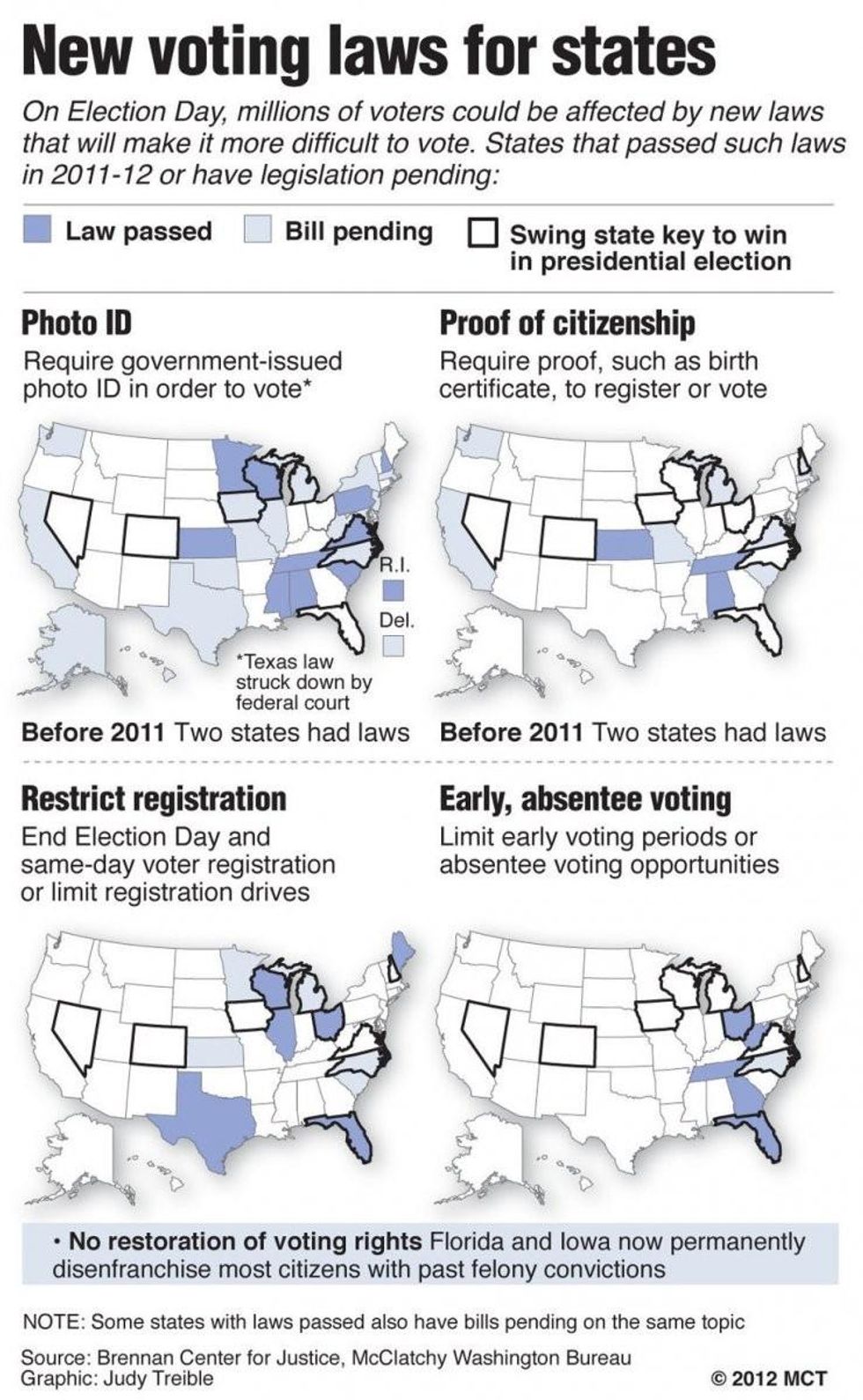
Since 2011, nine states have passed laws requiring voters to show government-issued photo ID at the polls, with five others now restricting early voting and three more requiring proof of citizenship such as a birth certificate.
Republicans claim the laws are necessary to prevent voter fraud, but Democrats counter that such incidents are "infinitesimal"--approximately 10 in every 146 million voters, according to the "Who Can Vote" study, a 2012 project of News21, a national investigative reporting project funded by the Carnegie Corporation of New York and the John S. and James L. Knight Foundation.
Democrats argue that Republicans actually seek to suppress voting by minorities and others who may be more likely to vote for Barack Obama.
The Brennan Center for Justice at New York University estimates that in 2008, 11 percent, or more than 21 million U.S. citizens, lacked state-issued photo identification, according to McClatchy, and as many as five million potential voters could be disenfranchised by the new laws.
While grassroots efforts by churches, the the NAACP and other organizations have sought to counter attempts to curtail voting rights, the GOP continues its efforts, despite allegations of fraud in Florida, a swing state in the 2008 election.
Florida law enforcement officials are investigating possible fraud related to the number of suspicious voter registration forms connected to a firm hired by the Republican party to sign up new voters had increased to 10, and more potential cases are being sought, The New York Times reported Saturday.
Strategic Allied Consulting was fired last week by the Republican National Committee and the Republican party. They had also been hired too conduct voter drives in Colorado, Nevada, North Carolina and Virginia.
The Florida Democratic Party asked the state to revoke the Republican Party's ability to register voters while the appeal continues, although GOP spokesman Brian Burgess told the Associated Press, "We are doing what we can to find out how broad the scope is."
Six weeks before election day, advocates for groups most affected by new restrictive voting laws continue efforts to get out the vote, McClatchy reports Monday
Voter identification laws passed in the last year are being challenged in a number of states, however--most notably Florida, where Gov. Rick Scott has launched a second attempt at a purge of voting rolls.
Still, Republican efforts to suppress voter registration continue--and have been largely successful in a number of states.
Since 2011, nine states have passed laws requiring voters to show government-issued photo ID at the polls, with five others now restricting early voting and three more requiring proof of citizenship such as a birth certificate.
Republicans claim the laws are necessary to prevent voter fraud, but Democrats counter that such incidents are "infinitesimal"--approximately 10 in every 146 million voters, according to the "Who Can Vote" study, a 2012 project of News21, a national investigative reporting project funded by the Carnegie Corporation of New York and the John S. and James L. Knight Foundation.
Democrats argue that Republicans actually seek to suppress voting by minorities and others who may be more likely to vote for Barack Obama.
The Brennan Center for Justice at New York University estimates that in 2008, 11 percent, or more than 21 million U.S. citizens, lacked state-issued photo identification, according to McClatchy, and as many as five million potential voters could be disenfranchised by the new laws.
While grassroots efforts by churches, the the NAACP and other organizations have sought to counter attempts to curtail voting rights, the GOP continues its efforts, despite allegations of fraud in Florida, a swing state in the 2008 election.
Florida law enforcement officials are investigating possible fraud related to the number of suspicious voter registration forms connected to a firm hired by the Republican party to sign up new voters had increased to 10, and more potential cases are being sought, The New York Times reported Saturday.
Strategic Allied Consulting was fired last week by the Republican National Committee and the Republican party. They had also been hired too conduct voter drives in Colorado, Nevada, North Carolina and Virginia.
The Florida Democratic Party asked the state to revoke the Republican Party's ability to register voters while the appeal continues, although GOP spokesman Brian Burgess told the Associated Press, "We are doing what we can to find out how broad the scope is."
Six weeks before election day, advocates for groups most affected by new restrictive voting laws continue efforts to get out the vote, McClatchy reports Monday
Voter identification laws passed in the last year are being challenged in a number of states, however--most notably Florida, where Gov. Rick Scott has launched a second attempt at a purge of voting rolls.
Still, Republican efforts to suppress voter registration continue--and have been largely successful in a number of states.
Since 2011, nine states have passed laws requiring voters to show government-issued photo ID at the polls, with five others now restricting early voting and three more requiring proof of citizenship such as a birth certificate.
Republicans claim the laws are necessary to prevent voter fraud, but Democrats counter that such incidents are "infinitesimal"--approximately 10 in every 146 million voters, according to the "Who Can Vote" study, a 2012 project of News21, a national investigative reporting project funded by the Carnegie Corporation of New York and the John S. and James L. Knight Foundation.
Democrats argue that Republicans actually seek to suppress voting by minorities and others who may be more likely to vote for Barack Obama.
The Brennan Center for Justice at New York University estimates that in 2008, 11 percent, or more than 21 million U.S. citizens, lacked state-issued photo identification, according to McClatchy, and as many as five million potential voters could be disenfranchised by the new laws.
While grassroots efforts by churches, the the NAACP and other organizations have sought to counter attempts to curtail voting rights, the GOP continues its efforts, despite allegations of fraud in Florida, a swing state in the 2008 election.
Florida law enforcement officials are investigating possible fraud related to the number of suspicious voter registration forms connected to a firm hired by the Republican party to sign up new voters had increased to 10, and more potential cases are being sought, The New York Times reported Saturday.
Strategic Allied Consulting was fired last week by the Republican National Committee and the Republican party. They had also been hired too conduct voter drives in Colorado, Nevada, North Carolina and Virginia.
The Florida Democratic Party asked the state to revoke the Republican Party's ability to register voters while the appeal continues, although GOP spokesman Brian Burgess told the Associated Press, "We are doing what we can to find out how broad the scope is."