SUBSCRIBE TO OUR FREE NEWSLETTER
Daily news & progressive opinion—funded by the people, not the corporations—delivered straight to your inbox.
5
#000000
#FFFFFF
To donate by check, phone, or other method, see our More Ways to Give page.
On Monday, as President Obama was answering questions during an interview conducted by several Americans through a Google+'s "hangout" group video chat feature, he acknowledged publicly the use of US drones and airstrikes inside Pakistan.
* * *
UPDATE: In response to Obama's acknowledgement of the drone program in Pakistan, Amnesty International today asked for his administration to clarify the legal basis for such a program. The statement, in part, read:
The US authorities must give a detailed explanation of how these strikes are lawful and what is being done to monitor civilian casualties and ensure proper accountability, said Sam Zarifi Amnesty International's Asia-Pacific director.
What are the rules of engagement? What proper legal justification exists for these attacks? While the President's confirmation of the use of drones in Pakistan is a welcome first step towards transparency, these and other questions need to be answered. [...]
Past justifications offered by US officials have invoked legal theories based on a "global war" between the USA and al-Qa'ida, a concept not recognized by international humanitarian or human rights law.
"The US administration must use the occasion of Attorney General Holder's speech to disclose the relevant legal and factual documentation necessary for a meaningful assessment of the lawfulness of the deliberate killings it is carrying out - simply trying to find another way to say 'trust us, it's legal' will not be good enough," said Sam Zarifi.
* * *
Obama's admission came in response to a question from a young man named, Evan, from Brooklyn, New York, who said: "Mr. President, since you took office you've ordered more drone attacks in your first year than your predecessor did in his entire term. These drone attacks cause a lot of civilian casualties. I'm curious to know how you feel they help the nation and whether you think they're worth it."
In answering, Obama first argued that "first of all, drones have not caused a great number of civilian casualties. For the most part they have been very precise, precision strikes against Al Qaeda and their affiliates. We have been very careful in how it's been applied." He goes on to say that the drone program is "kept on a very tight leash" and that it's not "just a bunch of folks in a room somewhere making decisions."
In a follow up question regarding the degree to which US drone incursions might be "perceived" as interference in other countries, Obama responded that even in "sovereign nations" its better to have pinpoint capabilities, suggesting airstrike accuracy lessens the infringement of sovereignty in those nations, and, in fact, are helpful to those countries because they could not otherwise apprehend (or annihilate) these targets.
Subsequently, Obama confirmed that "a lot of these strikes have been in the FATA [Pakistan's Federally Administered Tribal Areas]."
The session was broadcast live via YouTube. Here's the clip:
* * *
Pakistan Calls Drone Use, Missile Strikes 'Unlawful' and 'Counterproductive'
Al-Jazeera reports:
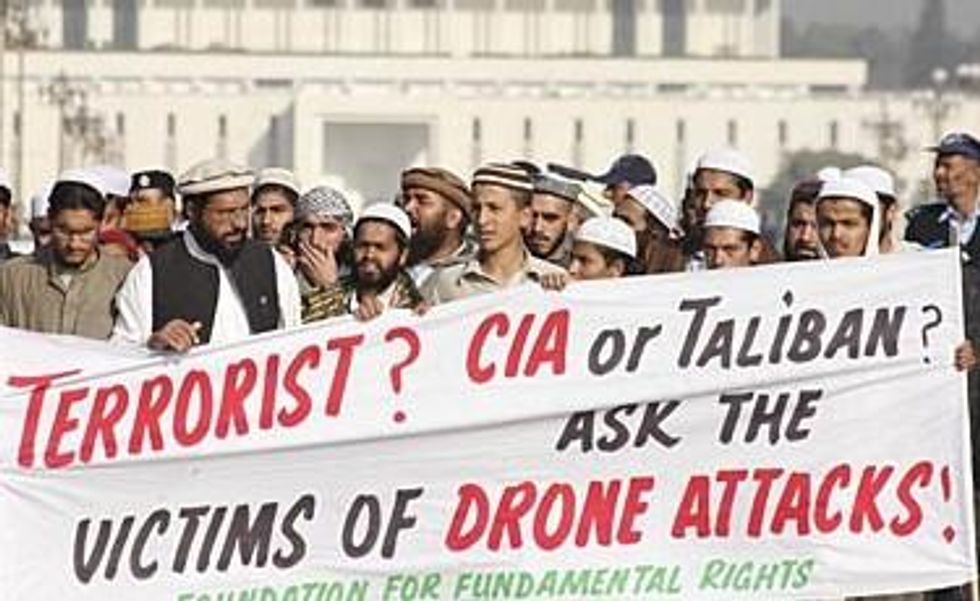
The controversial drone program run by the CIA has often been met with protests in Pakistan amid concerns of civilian casualties. The Pakistani government publicly protests the operations, but is believed to support them.
A spokesman for Pakistan's foreign ministry reiterated the government's public protest in response to Obama's comments.
"Notwithstanding tactical advantages of drone strikes, we are of the firm view that these are unlawful, counterproductive and hence unacceptable," Abdul Basit said.
The New America Foundation, a think tank in Washington, says drone strikes in Pakistan have killed between 1,715 and 2,680 people in the past eight years.
* * *
The New America Foundation report, Year of the Drone, which studied drone attacks and civilian casualties, strongly refutes Obama's claim that drones "have not caused a great number of civilian casualties." According to the report:
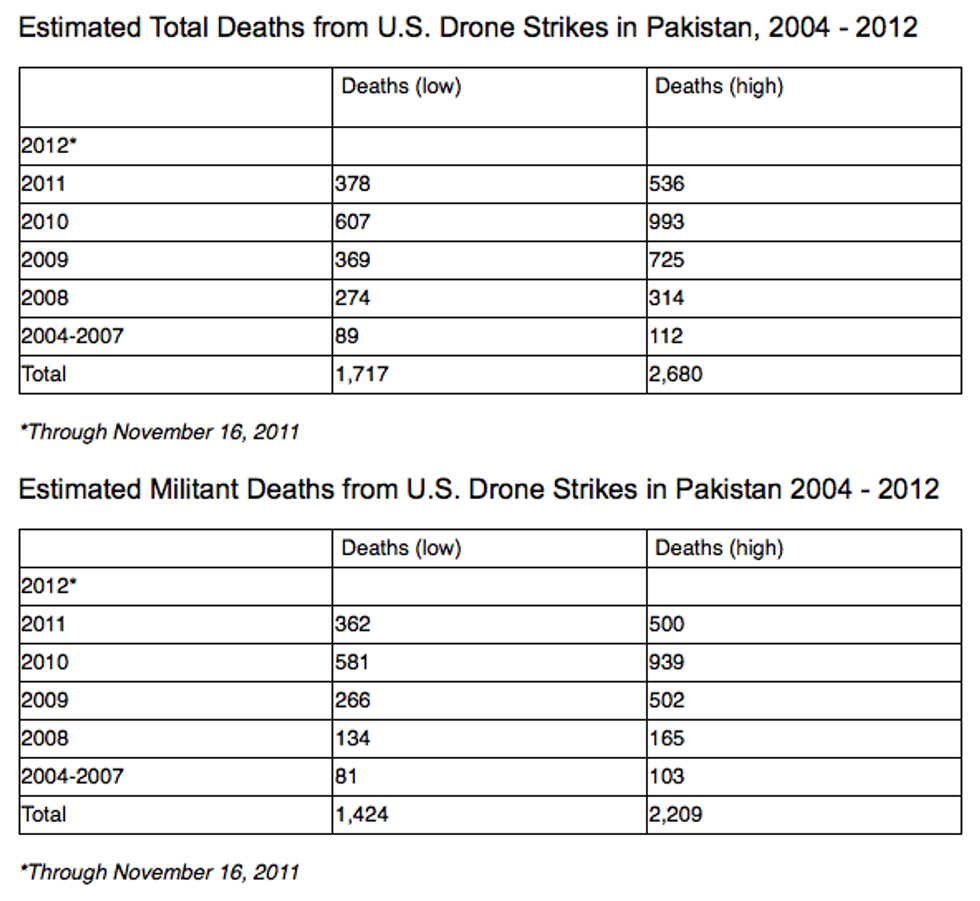
Our study shows that the 283 reported drone strikes in northwest Pakistan, including 70 in 2011, from 2004 to the present have killed approximately between 1,717 and 2,680 individuals, of whom around 1,424 to 2,209 were described as militants in reliable press accounts. Thus, the true non-militant fatality rate since 2004 according to our analysis is approximately 17 percent. In 2010, it was more like five percent.*
We have also constructed a map, based on the same reliable press accounts and publicly available maps, of the estimated location of each drone strike. Click each pin in the online version to see the details of a reported strike. And while we are not professional cartographers, and Google Maps is at times incomplete or imperfect, this map gives our best approximations of the locations and details of each reported drone strike since 2004.
Chart:
# # #
On Monday, as President Obama was answering questions during an interview conducted by several Americans through a Google+'s "hangout" group video chat feature, he acknowledged publicly the use of US drones and airstrikes inside Pakistan.
* * *
UPDATE: In response to Obama's acknowledgement of the drone program in Pakistan, Amnesty International today asked for his administration to clarify the legal basis for such a program. The statement, in part, read:
The US authorities must give a detailed explanation of how these strikes are lawful and what is being done to monitor civilian casualties and ensure proper accountability, said Sam Zarifi Amnesty International's Asia-Pacific director.
What are the rules of engagement? What proper legal justification exists for these attacks? While the President's confirmation of the use of drones in Pakistan is a welcome first step towards transparency, these and other questions need to be answered. [...]
Past justifications offered by US officials have invoked legal theories based on a "global war" between the USA and al-Qa'ida, a concept not recognized by international humanitarian or human rights law.
"The US administration must use the occasion of Attorney General Holder's speech to disclose the relevant legal and factual documentation necessary for a meaningful assessment of the lawfulness of the deliberate killings it is carrying out - simply trying to find another way to say 'trust us, it's legal' will not be good enough," said Sam Zarifi.
* * *
Obama's admission came in response to a question from a young man named, Evan, from Brooklyn, New York, who said: "Mr. President, since you took office you've ordered more drone attacks in your first year than your predecessor did in his entire term. These drone attacks cause a lot of civilian casualties. I'm curious to know how you feel they help the nation and whether you think they're worth it."
In answering, Obama first argued that "first of all, drones have not caused a great number of civilian casualties. For the most part they have been very precise, precision strikes against Al Qaeda and their affiliates. We have been very careful in how it's been applied." He goes on to say that the drone program is "kept on a very tight leash" and that it's not "just a bunch of folks in a room somewhere making decisions."
In a follow up question regarding the degree to which US drone incursions might be "perceived" as interference in other countries, Obama responded that even in "sovereign nations" its better to have pinpoint capabilities, suggesting airstrike accuracy lessens the infringement of sovereignty in those nations, and, in fact, are helpful to those countries because they could not otherwise apprehend (or annihilate) these targets.
Subsequently, Obama confirmed that "a lot of these strikes have been in the FATA [Pakistan's Federally Administered Tribal Areas]."
The session was broadcast live via YouTube. Here's the clip:
* * *
Pakistan Calls Drone Use, Missile Strikes 'Unlawful' and 'Counterproductive'
Al-Jazeera reports:
The controversial drone program run by the CIA has often been met with protests in Pakistan amid concerns of civilian casualties. The Pakistani government publicly protests the operations, but is believed to support them.
A spokesman for Pakistan's foreign ministry reiterated the government's public protest in response to Obama's comments.
"Notwithstanding tactical advantages of drone strikes, we are of the firm view that these are unlawful, counterproductive and hence unacceptable," Abdul Basit said.
The New America Foundation, a think tank in Washington, says drone strikes in Pakistan have killed between 1,715 and 2,680 people in the past eight years.
* * *
The New America Foundation report, Year of the Drone, which studied drone attacks and civilian casualties, strongly refutes Obama's claim that drones "have not caused a great number of civilian casualties." According to the report:
Our study shows that the 283 reported drone strikes in northwest Pakistan, including 70 in 2011, from 2004 to the present have killed approximately between 1,717 and 2,680 individuals, of whom around 1,424 to 2,209 were described as militants in reliable press accounts. Thus, the true non-militant fatality rate since 2004 according to our analysis is approximately 17 percent. In 2010, it was more like five percent.*
We have also constructed a map, based on the same reliable press accounts and publicly available maps, of the estimated location of each drone strike. Click each pin in the online version to see the details of a reported strike. And while we are not professional cartographers, and Google Maps is at times incomplete or imperfect, this map gives our best approximations of the locations and details of each reported drone strike since 2004.
Chart:
# # #
On Monday, as President Obama was answering questions during an interview conducted by several Americans through a Google+'s "hangout" group video chat feature, he acknowledged publicly the use of US drones and airstrikes inside Pakistan.
* * *
UPDATE: In response to Obama's acknowledgement of the drone program in Pakistan, Amnesty International today asked for his administration to clarify the legal basis for such a program. The statement, in part, read:
The US authorities must give a detailed explanation of how these strikes are lawful and what is being done to monitor civilian casualties and ensure proper accountability, said Sam Zarifi Amnesty International's Asia-Pacific director.
What are the rules of engagement? What proper legal justification exists for these attacks? While the President's confirmation of the use of drones in Pakistan is a welcome first step towards transparency, these and other questions need to be answered. [...]
Past justifications offered by US officials have invoked legal theories based on a "global war" between the USA and al-Qa'ida, a concept not recognized by international humanitarian or human rights law.
"The US administration must use the occasion of Attorney General Holder's speech to disclose the relevant legal and factual documentation necessary for a meaningful assessment of the lawfulness of the deliberate killings it is carrying out - simply trying to find another way to say 'trust us, it's legal' will not be good enough," said Sam Zarifi.
* * *
Obama's admission came in response to a question from a young man named, Evan, from Brooklyn, New York, who said: "Mr. President, since you took office you've ordered more drone attacks in your first year than your predecessor did in his entire term. These drone attacks cause a lot of civilian casualties. I'm curious to know how you feel they help the nation and whether you think they're worth it."
In answering, Obama first argued that "first of all, drones have not caused a great number of civilian casualties. For the most part they have been very precise, precision strikes against Al Qaeda and their affiliates. We have been very careful in how it's been applied." He goes on to say that the drone program is "kept on a very tight leash" and that it's not "just a bunch of folks in a room somewhere making decisions."
In a follow up question regarding the degree to which US drone incursions might be "perceived" as interference in other countries, Obama responded that even in "sovereign nations" its better to have pinpoint capabilities, suggesting airstrike accuracy lessens the infringement of sovereignty in those nations, and, in fact, are helpful to those countries because they could not otherwise apprehend (or annihilate) these targets.
Subsequently, Obama confirmed that "a lot of these strikes have been in the FATA [Pakistan's Federally Administered Tribal Areas]."
The session was broadcast live via YouTube. Here's the clip:
* * *
Pakistan Calls Drone Use, Missile Strikes 'Unlawful' and 'Counterproductive'
Al-Jazeera reports:
The controversial drone program run by the CIA has often been met with protests in Pakistan amid concerns of civilian casualties. The Pakistani government publicly protests the operations, but is believed to support them.
A spokesman for Pakistan's foreign ministry reiterated the government's public protest in response to Obama's comments.
"Notwithstanding tactical advantages of drone strikes, we are of the firm view that these are unlawful, counterproductive and hence unacceptable," Abdul Basit said.
The New America Foundation, a think tank in Washington, says drone strikes in Pakistan have killed between 1,715 and 2,680 people in the past eight years.
* * *
The New America Foundation report, Year of the Drone, which studied drone attacks and civilian casualties, strongly refutes Obama's claim that drones "have not caused a great number of civilian casualties." According to the report:
Our study shows that the 283 reported drone strikes in northwest Pakistan, including 70 in 2011, from 2004 to the present have killed approximately between 1,717 and 2,680 individuals, of whom around 1,424 to 2,209 were described as militants in reliable press accounts. Thus, the true non-militant fatality rate since 2004 according to our analysis is approximately 17 percent. In 2010, it was more like five percent.*
We have also constructed a map, based on the same reliable press accounts and publicly available maps, of the estimated location of each drone strike. Click each pin in the online version to see the details of a reported strike. And while we are not professional cartographers, and Google Maps is at times incomplete or imperfect, this map gives our best approximations of the locations and details of each reported drone strike since 2004.
Chart:
# # #