SUBSCRIBE TO OUR FREE NEWSLETTER
Daily news & progressive opinion—funded by the people, not the corporations—delivered straight to your inbox.
5
#000000
#FFFFFF
To donate by check, phone, or other method, see our More Ways to Give page.
Daily news & progressive opinion—funded by the people, not the corporations—delivered straight to your inbox.
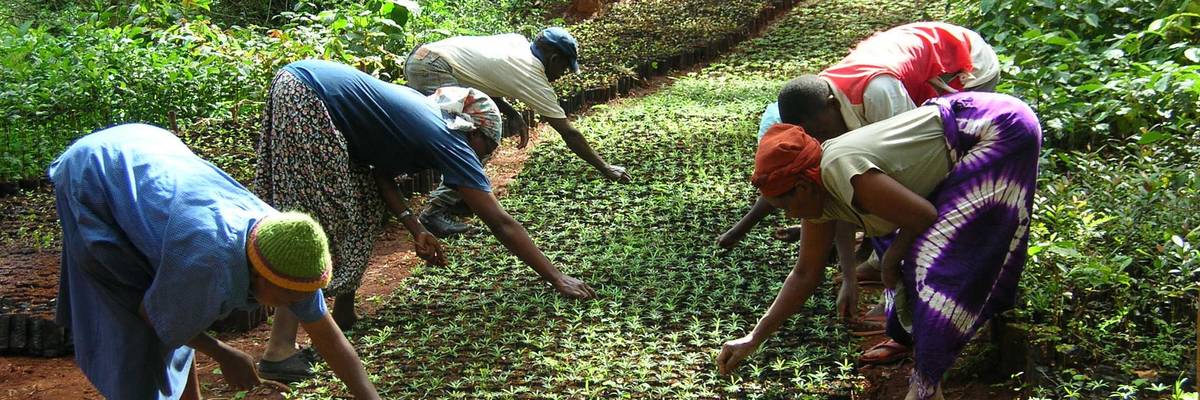
Fear can be a seedling for change. Green Belt Movement tree nursery in Tumutumu Hills, Kenya. (Photograph by Ariel Poster)
Tough, brave, fearless. Don't these words capture what courage means? Maybe not.
For me, courage is simply doing what I thought I could not do. It's acting for what I care about most, not because I'm fearless but despite my fear...fear that my action isn't enough, that I'll be alone, or that it's all futile, anyway, and my failure will be humiliating.
I used to think fear was a stop sign that read: "danger ahead." And to that danger I assumed Homo sapiens had evolved three useful, even life-saving responses. Freeze, fight, flee.
But humans, it turns out, are not trapped in pre-programmed responses. And that's the really good news. It's possible to rethink fear, to relearn its meaning. And, as the stakes for our planet rise along with sea levels, now's the moment for this exciting work.
On this rethinking, my daughter Anna and I found our lives forever changed during a conversation in Kenya years ago with the Rev. Timothy Njoya, a close friend of our hero and Nobel Peace Laureate, the late Wangari Maathai and founder of the Green Belt Movement. She'd invited him over to meet us. We were pleased but not sure what to expect.
Then, a slight, agile man with a crisp blue shirt and white priest's collar arrived. As we sat in easy chairs, Rev. Njoya began to share his life story. Soon, he rose and acted out a lesson about fear.
One night, he told us, several men sent by the dictator to kill him, and armed with swords, arrived at his door. A brutal attack ensued and as he lay on the floor with his gut ripped open--believing death was near--Rev. Njoya wasn't wailing. Instead, he began gifting his treasures to his assailants, including his library and even his favorite Bible.
As Rev. Njoya spoke, my heart began pounding wildly. I just couldn't grasp what I was hearing, so I blurted out: "But how is this possible? Isn't humanity's fear response automatic? How, in pain and fearing death, could anyone express kindness?"
To answer my question, Rev. Njoya posed as a lion that had spotted its prey. The lion, he told us, doesn't just react. It recoils and postures itself, and then it leaps. Acting out the scene, he explained that, like the lion, we can harness and harmonize our fear. It is a source of energy we can use.
I'd always been afraid of fear. But, now I had to imagine what would happen if I thought of fear as pure energy, energy I can use how I choose. Anna and I lay awake into the night talking about what it would mean if we could live that understanding of fear. Ah, what freedom, we realized.
Since that night, I continually remind myself that fear doesn't necessarily mean "danger": stop or fight or run. Maybe my pounding heart or cold sweat is telling me that I am on the brink of possibility, that I am, right in that moment, simply in the unknown where most growth and creativity are possible.
Later I discovered a little trick. It's kind of corny, but I'll share it. For most of my life, when I felt insecure, fearing I'd sound silly or be criticized for my words or actions, I would try to subdue my pounding heart by condemning it: "You wimp!" I'd say to myself. But, with the smile of Reverend Njoya in my mind's eye, one day I decided, no more. From then on, I began saying to myself, "Way to go, that pounding in my chest is really my inner applause cheering me on."
Yes. Understanding fear as energy we can use to increase our power for good in our broken world is life changing. It's a lesson I keep learning and...relearning.
Note: Don't miss watching the companion video to this article - one of Frances Moore Lappe's Thought Sparks Video Series in which she opens her heart about what fortifies her in this scary time. Each week for nine weeks or more, her Small Planet Institute will release an informal 2-to-5-minute video in which Frances shares her often-surprising, liberating takes on hope, democracy, and courage.
Dear Common Dreams reader, It’s been nearly 30 years since I co-founded Common Dreams with my late wife, Lina Newhouser. We had the radical notion that journalism should serve the public good, not corporate profits. It was clear to us from the outset what it would take to build such a project. No paid advertisements. No corporate sponsors. No millionaire publisher telling us what to think or do. Many people said we wouldn't last a year, but we proved those doubters wrong. Together with a tremendous team of journalists and dedicated staff, we built an independent media outlet free from the constraints of profits and corporate control. Our mission has always been simple: To inform. To inspire. To ignite change for the common good. Building Common Dreams was not easy. Our survival was never guaranteed. When you take on the most powerful forces—Wall Street greed, fossil fuel industry destruction, Big Tech lobbyists, and uber-rich oligarchs who have spent billions upon billions rigging the economy and democracy in their favor—the only bulwark you have is supporters who believe in your work. But here’s the urgent message from me today. It's never been this bad out there. And it's never been this hard to keep us going. At the very moment Common Dreams is most needed, the threats we face are intensifying. We need your support now more than ever. We don't accept corporate advertising and never will. We don't have a paywall because we don't think people should be blocked from critical news based on their ability to pay. Everything we do is funded by the donations of readers like you. When everyone does the little they can afford, we are strong. But if that support retreats or dries up, so do we. Will you donate now to make sure Common Dreams not only survives but thrives? —Craig Brown, Co-founder |
Tough, brave, fearless. Don't these words capture what courage means? Maybe not.
For me, courage is simply doing what I thought I could not do. It's acting for what I care about most, not because I'm fearless but despite my fear...fear that my action isn't enough, that I'll be alone, or that it's all futile, anyway, and my failure will be humiliating.
I used to think fear was a stop sign that read: "danger ahead." And to that danger I assumed Homo sapiens had evolved three useful, even life-saving responses. Freeze, fight, flee.
But humans, it turns out, are not trapped in pre-programmed responses. And that's the really good news. It's possible to rethink fear, to relearn its meaning. And, as the stakes for our planet rise along with sea levels, now's the moment for this exciting work.
On this rethinking, my daughter Anna and I found our lives forever changed during a conversation in Kenya years ago with the Rev. Timothy Njoya, a close friend of our hero and Nobel Peace Laureate, the late Wangari Maathai and founder of the Green Belt Movement. She'd invited him over to meet us. We were pleased but not sure what to expect.
Then, a slight, agile man with a crisp blue shirt and white priest's collar arrived. As we sat in easy chairs, Rev. Njoya began to share his life story. Soon, he rose and acted out a lesson about fear.
One night, he told us, several men sent by the dictator to kill him, and armed with swords, arrived at his door. A brutal attack ensued and as he lay on the floor with his gut ripped open--believing death was near--Rev. Njoya wasn't wailing. Instead, he began gifting his treasures to his assailants, including his library and even his favorite Bible.
As Rev. Njoya spoke, my heart began pounding wildly. I just couldn't grasp what I was hearing, so I blurted out: "But how is this possible? Isn't humanity's fear response automatic? How, in pain and fearing death, could anyone express kindness?"
To answer my question, Rev. Njoya posed as a lion that had spotted its prey. The lion, he told us, doesn't just react. It recoils and postures itself, and then it leaps. Acting out the scene, he explained that, like the lion, we can harness and harmonize our fear. It is a source of energy we can use.
I'd always been afraid of fear. But, now I had to imagine what would happen if I thought of fear as pure energy, energy I can use how I choose. Anna and I lay awake into the night talking about what it would mean if we could live that understanding of fear. Ah, what freedom, we realized.
Since that night, I continually remind myself that fear doesn't necessarily mean "danger": stop or fight or run. Maybe my pounding heart or cold sweat is telling me that I am on the brink of possibility, that I am, right in that moment, simply in the unknown where most growth and creativity are possible.
Later I discovered a little trick. It's kind of corny, but I'll share it. For most of my life, when I felt insecure, fearing I'd sound silly or be criticized for my words or actions, I would try to subdue my pounding heart by condemning it: "You wimp!" I'd say to myself. But, with the smile of Reverend Njoya in my mind's eye, one day I decided, no more. From then on, I began saying to myself, "Way to go, that pounding in my chest is really my inner applause cheering me on."
Yes. Understanding fear as energy we can use to increase our power for good in our broken world is life changing. It's a lesson I keep learning and...relearning.
Note: Don't miss watching the companion video to this article - one of Frances Moore Lappe's Thought Sparks Video Series in which she opens her heart about what fortifies her in this scary time. Each week for nine weeks or more, her Small Planet Institute will release an informal 2-to-5-minute video in which Frances shares her often-surprising, liberating takes on hope, democracy, and courage.
Tough, brave, fearless. Don't these words capture what courage means? Maybe not.
For me, courage is simply doing what I thought I could not do. It's acting for what I care about most, not because I'm fearless but despite my fear...fear that my action isn't enough, that I'll be alone, or that it's all futile, anyway, and my failure will be humiliating.
I used to think fear was a stop sign that read: "danger ahead." And to that danger I assumed Homo sapiens had evolved three useful, even life-saving responses. Freeze, fight, flee.
But humans, it turns out, are not trapped in pre-programmed responses. And that's the really good news. It's possible to rethink fear, to relearn its meaning. And, as the stakes for our planet rise along with sea levels, now's the moment for this exciting work.
On this rethinking, my daughter Anna and I found our lives forever changed during a conversation in Kenya years ago with the Rev. Timothy Njoya, a close friend of our hero and Nobel Peace Laureate, the late Wangari Maathai and founder of the Green Belt Movement. She'd invited him over to meet us. We were pleased but not sure what to expect.
Then, a slight, agile man with a crisp blue shirt and white priest's collar arrived. As we sat in easy chairs, Rev. Njoya began to share his life story. Soon, he rose and acted out a lesson about fear.
One night, he told us, several men sent by the dictator to kill him, and armed with swords, arrived at his door. A brutal attack ensued and as he lay on the floor with his gut ripped open--believing death was near--Rev. Njoya wasn't wailing. Instead, he began gifting his treasures to his assailants, including his library and even his favorite Bible.
As Rev. Njoya spoke, my heart began pounding wildly. I just couldn't grasp what I was hearing, so I blurted out: "But how is this possible? Isn't humanity's fear response automatic? How, in pain and fearing death, could anyone express kindness?"
To answer my question, Rev. Njoya posed as a lion that had spotted its prey. The lion, he told us, doesn't just react. It recoils and postures itself, and then it leaps. Acting out the scene, he explained that, like the lion, we can harness and harmonize our fear. It is a source of energy we can use.
I'd always been afraid of fear. But, now I had to imagine what would happen if I thought of fear as pure energy, energy I can use how I choose. Anna and I lay awake into the night talking about what it would mean if we could live that understanding of fear. Ah, what freedom, we realized.
Since that night, I continually remind myself that fear doesn't necessarily mean "danger": stop or fight or run. Maybe my pounding heart or cold sweat is telling me that I am on the brink of possibility, that I am, right in that moment, simply in the unknown where most growth and creativity are possible.
Later I discovered a little trick. It's kind of corny, but I'll share it. For most of my life, when I felt insecure, fearing I'd sound silly or be criticized for my words or actions, I would try to subdue my pounding heart by condemning it: "You wimp!" I'd say to myself. But, with the smile of Reverend Njoya in my mind's eye, one day I decided, no more. From then on, I began saying to myself, "Way to go, that pounding in my chest is really my inner applause cheering me on."
Yes. Understanding fear as energy we can use to increase our power for good in our broken world is life changing. It's a lesson I keep learning and...relearning.
Note: Don't miss watching the companion video to this article - one of Frances Moore Lappe's Thought Sparks Video Series in which she opens her heart about what fortifies her in this scary time. Each week for nine weeks or more, her Small Planet Institute will release an informal 2-to-5-minute video in which Frances shares her often-surprising, liberating takes on hope, democracy, and courage.