SUBSCRIBE TO OUR FREE NEWSLETTER
Daily news & progressive opinion—funded by the people, not the corporations—delivered straight to your inbox.
5
#000000
#FFFFFF
To donate by check, phone, or other method, see our More Ways to Give page.
Daily news & progressive opinion—funded by the people, not the corporations—delivered straight to your inbox.
'Hell No, We Won't Go' -- 1967
'No Way, We Won't Pay' -- 2015
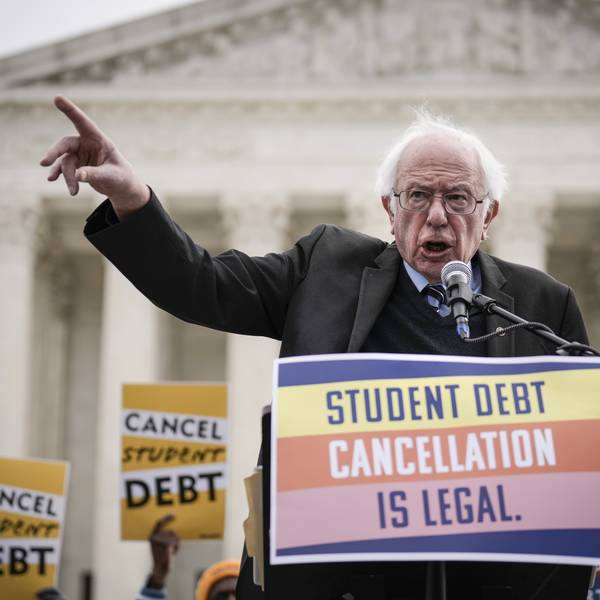
Fifty years ago students burned their draft cards to protest an immoral war against the people of Vietnam. Today it's a different kind of war, immoral in another way, waged against young Americans of approximately the same age, and threatening them in a manner that endangers not their lives but their livelihoods.
'Hell No, We Won't Go' -- 1967
'No Way, We Won't Pay' -- 2015
Fifty years ago students burned their draft cards to protest an immoral war against the people of Vietnam. Today it's a different kind of war, immoral in another way, waged against young Americans of approximately the same age, and threatening them in a manner that endangers not their lives but their livelihoods.
There are at least four good reasons why America's young adults-- and their parents--should take up the fight against financial firms who are holding high-interest student loans that total more than the nation's credit card debt, and more than the total income of the poorer half of America.
1. The Protest Has Already Begun
Fifteen former students of for-profit Corinthian Colleges recently announced a debt strike against the company and its predatory loan practices. The 15 students, members of the Debt Collective initiative of debt abolisher Rolling Jubilee, have refused to repay their loans. Corinthian, which has been accused of false marketing, grade tampering, and recruitment improprieties, and which has 60 percent of its students default on loans, was sued in 2013 for employing a "predatory scheme" to recruit students.
2. For-Profit Colleges Use Taxpayer Money for False Marketing to Get MORE Taxpayer Money
Corinthian isn't the only loan predator. Of 15 for-profit colleges investigated by the Government Accountability Office, 13 were found guilty of deceptive marketing, with false job and salary guarantees. The 15 companies got a stunning 86 percent of their funding from the public, in the form of student loans and grants.
Worse yet, a Senate report found that they spend about a quarter of their revenue on marketing, and take 20 percent in profits, while spending only about 17 percent on instruction.
After all that, only 22 percent of students get a degree after six years.
3. Traditional Colleges Aren't Much Better: Students are Treated Like Products for Profit-Makers
Since the 1980s, the number of administrators at private universities has doubled.
To pay all the administrators, tenure-track teachers have been eliminated, and underpaid part-timers have taken their places. Adjunct and student teachers, who made up about 22 percent of instructional staff in 1969, now make up an estimated 76 percent of instructional staff in higher education, with a median wage in 2010 of about $2,700 per course, and with little or no benefits.
To further pay for all the administrators, and to pay for amenities like recreations centers, dining halls, and athletics, tuition has been steadily increasing, to twelve times its cost in 1978.
4. College Graduates Have Been Cheated out of Good Jobs
The unemployment rate may be going down, but the available jobs are well below the skill levels of college-trained adults. According to the New York Federal Reserve, 44 percent of recent college graduates are underemployed, holding jobs that are normally held by high school graduates.
College graduates have not recovered from the recession. They took a 19 percent pay cut in the two years after the recession, and by 2013 they were part of the only age group with lower average wages in early 2013 than in 2000. As recently as July of 2014 the Federal Reserve of San Francisco wrote that recent college graduates "were and continue to be hit hard."
Progressive Unity
Progressives have no shortage of important causes, but an attack on predatory student loan policies could be a unifying force for us, particularly if the power of social networking is employed.
An Apple executive said, "The U.S. has stopped producing people with the skills we need." But almost the entirety of corporate profits are being spent on stock buybacks to enrich executives and shareholders, rather than on job training.
The proposal for an America Permanent Fund of $10,000 per household, based on the corporate debt to society for public research, is about the same, in numbers, as the $1.16 trillion of student loan debt. A protest against student loans is a good way to earn the first dividend.
Dear Common Dreams reader, It’s been nearly 30 years since I co-founded Common Dreams with my late wife, Lina Newhouser. We had the radical notion that journalism should serve the public good, not corporate profits. It was clear to us from the outset what it would take to build such a project. No paid advertisements. No corporate sponsors. No millionaire publisher telling us what to think or do. Many people said we wouldn't last a year, but we proved those doubters wrong. Together with a tremendous team of journalists and dedicated staff, we built an independent media outlet free from the constraints of profits and corporate control. Our mission has always been simple: To inform. To inspire. To ignite change for the common good. Building Common Dreams was not easy. Our survival was never guaranteed. When you take on the most powerful forces—Wall Street greed, fossil fuel industry destruction, Big Tech lobbyists, and uber-rich oligarchs who have spent billions upon billions rigging the economy and democracy in their favor—the only bulwark you have is supporters who believe in your work. But here’s the urgent message from me today. It's never been this bad out there. And it's never been this hard to keep us going. At the very moment Common Dreams is most needed, the threats we face are intensifying. We need your support now more than ever. We don't accept corporate advertising and never will. We don't have a paywall because we don't think people should be blocked from critical news based on their ability to pay. Everything we do is funded by the donations of readers like you. When everyone does the little they can afford, we are strong. But if that support retreats or dries up, so do we. Will you donate now to make sure Common Dreams not only survives but thrives? —Craig Brown, Co-founder |
'Hell No, We Won't Go' -- 1967
'No Way, We Won't Pay' -- 2015
Fifty years ago students burned their draft cards to protest an immoral war against the people of Vietnam. Today it's a different kind of war, immoral in another way, waged against young Americans of approximately the same age, and threatening them in a manner that endangers not their lives but their livelihoods.
There are at least four good reasons why America's young adults-- and their parents--should take up the fight against financial firms who are holding high-interest student loans that total more than the nation's credit card debt, and more than the total income of the poorer half of America.
1. The Protest Has Already Begun
Fifteen former students of for-profit Corinthian Colleges recently announced a debt strike against the company and its predatory loan practices. The 15 students, members of the Debt Collective initiative of debt abolisher Rolling Jubilee, have refused to repay their loans. Corinthian, which has been accused of false marketing, grade tampering, and recruitment improprieties, and which has 60 percent of its students default on loans, was sued in 2013 for employing a "predatory scheme" to recruit students.
2. For-Profit Colleges Use Taxpayer Money for False Marketing to Get MORE Taxpayer Money
Corinthian isn't the only loan predator. Of 15 for-profit colleges investigated by the Government Accountability Office, 13 were found guilty of deceptive marketing, with false job and salary guarantees. The 15 companies got a stunning 86 percent of their funding from the public, in the form of student loans and grants.
Worse yet, a Senate report found that they spend about a quarter of their revenue on marketing, and take 20 percent in profits, while spending only about 17 percent on instruction.
After all that, only 22 percent of students get a degree after six years.
3. Traditional Colleges Aren't Much Better: Students are Treated Like Products for Profit-Makers
Since the 1980s, the number of administrators at private universities has doubled.
To pay all the administrators, tenure-track teachers have been eliminated, and underpaid part-timers have taken their places. Adjunct and student teachers, who made up about 22 percent of instructional staff in 1969, now make up an estimated 76 percent of instructional staff in higher education, with a median wage in 2010 of about $2,700 per course, and with little or no benefits.
To further pay for all the administrators, and to pay for amenities like recreations centers, dining halls, and athletics, tuition has been steadily increasing, to twelve times its cost in 1978.
4. College Graduates Have Been Cheated out of Good Jobs
The unemployment rate may be going down, but the available jobs are well below the skill levels of college-trained adults. According to the New York Federal Reserve, 44 percent of recent college graduates are underemployed, holding jobs that are normally held by high school graduates.
College graduates have not recovered from the recession. They took a 19 percent pay cut in the two years after the recession, and by 2013 they were part of the only age group with lower average wages in early 2013 than in 2000. As recently as July of 2014 the Federal Reserve of San Francisco wrote that recent college graduates "were and continue to be hit hard."
Progressive Unity
Progressives have no shortage of important causes, but an attack on predatory student loan policies could be a unifying force for us, particularly if the power of social networking is employed.
An Apple executive said, "The U.S. has stopped producing people with the skills we need." But almost the entirety of corporate profits are being spent on stock buybacks to enrich executives and shareholders, rather than on job training.
The proposal for an America Permanent Fund of $10,000 per household, based on the corporate debt to society for public research, is about the same, in numbers, as the $1.16 trillion of student loan debt. A protest against student loans is a good way to earn the first dividend.
'Hell No, We Won't Go' -- 1967
'No Way, We Won't Pay' -- 2015
Fifty years ago students burned their draft cards to protest an immoral war against the people of Vietnam. Today it's a different kind of war, immoral in another way, waged against young Americans of approximately the same age, and threatening them in a manner that endangers not their lives but their livelihoods.
There are at least four good reasons why America's young adults-- and their parents--should take up the fight against financial firms who are holding high-interest student loans that total more than the nation's credit card debt, and more than the total income of the poorer half of America.
1. The Protest Has Already Begun
Fifteen former students of for-profit Corinthian Colleges recently announced a debt strike against the company and its predatory loan practices. The 15 students, members of the Debt Collective initiative of debt abolisher Rolling Jubilee, have refused to repay their loans. Corinthian, which has been accused of false marketing, grade tampering, and recruitment improprieties, and which has 60 percent of its students default on loans, was sued in 2013 for employing a "predatory scheme" to recruit students.
2. For-Profit Colleges Use Taxpayer Money for False Marketing to Get MORE Taxpayer Money
Corinthian isn't the only loan predator. Of 15 for-profit colleges investigated by the Government Accountability Office, 13 were found guilty of deceptive marketing, with false job and salary guarantees. The 15 companies got a stunning 86 percent of their funding from the public, in the form of student loans and grants.
Worse yet, a Senate report found that they spend about a quarter of their revenue on marketing, and take 20 percent in profits, while spending only about 17 percent on instruction.
After all that, only 22 percent of students get a degree after six years.
3. Traditional Colleges Aren't Much Better: Students are Treated Like Products for Profit-Makers
Since the 1980s, the number of administrators at private universities has doubled.
To pay all the administrators, tenure-track teachers have been eliminated, and underpaid part-timers have taken their places. Adjunct and student teachers, who made up about 22 percent of instructional staff in 1969, now make up an estimated 76 percent of instructional staff in higher education, with a median wage in 2010 of about $2,700 per course, and with little or no benefits.
To further pay for all the administrators, and to pay for amenities like recreations centers, dining halls, and athletics, tuition has been steadily increasing, to twelve times its cost in 1978.
4. College Graduates Have Been Cheated out of Good Jobs
The unemployment rate may be going down, but the available jobs are well below the skill levels of college-trained adults. According to the New York Federal Reserve, 44 percent of recent college graduates are underemployed, holding jobs that are normally held by high school graduates.
College graduates have not recovered from the recession. They took a 19 percent pay cut in the two years after the recession, and by 2013 they were part of the only age group with lower average wages in early 2013 than in 2000. As recently as July of 2014 the Federal Reserve of San Francisco wrote that recent college graduates "were and continue to be hit hard."
Progressive Unity
Progressives have no shortage of important causes, but an attack on predatory student loan policies could be a unifying force for us, particularly if the power of social networking is employed.
An Apple executive said, "The U.S. has stopped producing people with the skills we need." But almost the entirety of corporate profits are being spent on stock buybacks to enrich executives and shareholders, rather than on job training.
The proposal for an America Permanent Fund of $10,000 per household, based on the corporate debt to society for public research, is about the same, in numbers, as the $1.16 trillion of student loan debt. A protest against student loans is a good way to earn the first dividend.