
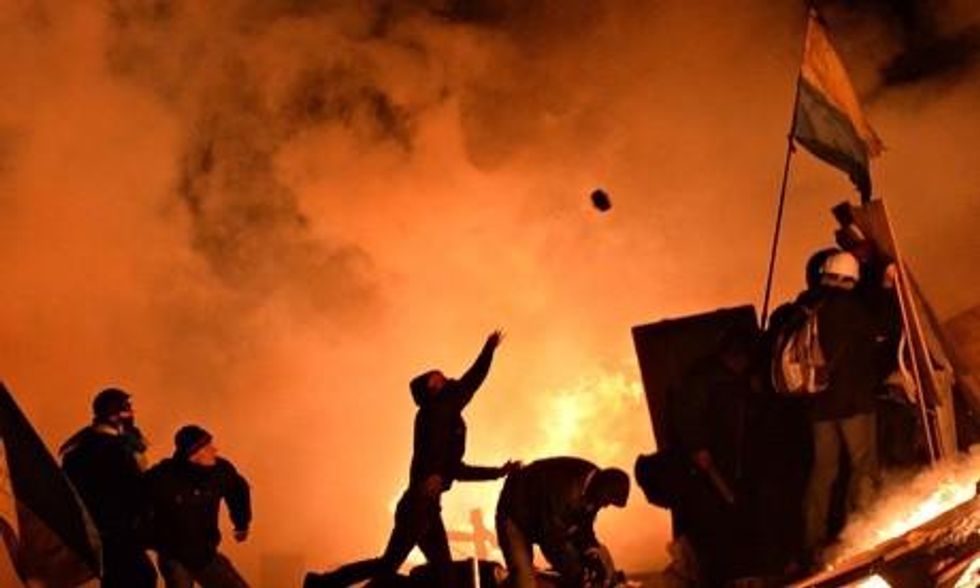
- The situation is now more dangerous than it has ever been. Ukraine voted for independence and separated from the dying Soviet Union peacefully in the autumn of 1991. Its Orange Revolution in 2004-5, a street response to rigged elections, was also completed without bloodshed, though some panicky reactions on both sides brought it pretty close. Since then, Ukrainian politics have been messy and tainted by corruption, but more spontaneous and democratic in many ways than in the countries around it. It has now descended, for the first time, into violence, and that may be hard to reverse.
- On the positive side, despite doom-laden forecasts about an east-west split - broadly between those whose first language is Russian and those whose first language is Ukrainian - Ukrainians in both camps have been unanimous in support of independence. Yes, the eastern part of the country may look culturally, economically and in its religious orthodoxy towards Russia, and the mainly Catholic western part, centered in Lviv, towards Poland and Europe, but everyone is more mixed up than this simple division would suggest. More to the point, polls have never shown any appetite, even in the east, either for seceding or - still less - for returning to Russia's administrative embrace.
- Alas, this does not mean that fighting might not spread. The protests were initially restricted to the capital, Kiev, but this started to change about a month ago when mini-protests started replicating themselves across the country. Not just in Lviv, where that might have been expected, but in cities in Yanukovych's eastern heartland.
- This geographical change was linked to another change. Although the conflict has largely been presented outside Ukraine as about east and west, and was precipitated in November by Yanukovych's decision to accept an economic package offered by Russia rather than the association agreement held out by the EU, this is no longer what the struggle is about. In Ukraine, Europe still stands - unrealistically, many EU citizens might think - as a cypher for clean government, order and high living standards. But the protests have evolved into an internal struggle against the corruption and general inadequacy of the Kiev government. The calls are not for Yanukovych to change his mind, but for him to go.
- This is a potentially revolutionary situation - we are watching violent street protests that could force out a government that was, whether we like it or not, reasonably democratically elected. It is also an emergency in which an ill-informed EU policy played a role. In demanding an all or nothing, now or never, decision from a Ukraine that needed emergency financing more than it needed European promises, it badly misplayed its hand.
- The fact that this is now an internal, Ukrainian conflict - and that the proxy Russia v EU element seems to have receded - ought to make it possible for Moscow and Brussels to co-operate in trying to find a solution. Bringing forward next year's presidential election might be part of a solution, but first Yanukovych and the Ukrainian parliament will have to honor their promises.
© 2023 The Guardian
- The situation is now more dangerous than it has ever been. Ukraine voted for independence and separated from the dying Soviet Union peacefully in the autumn of 1991. Its Orange Revolution in 2004-5, a street response to rigged elections, was also completed without bloodshed, though some panicky reactions on both sides brought it pretty close. Since then, Ukrainian politics have been messy and tainted by corruption, but more spontaneous and democratic in many ways than in the countries around it. It has now descended, for the first time, into violence, and that may be hard to reverse.
- On the positive side, despite doom-laden forecasts about an east-west split - broadly between those whose first language is Russian and those whose first language is Ukrainian - Ukrainians in both camps have been unanimous in support of independence. Yes, the eastern part of the country may look culturally, economically and in its religious orthodoxy towards Russia, and the mainly Catholic western part, centered in Lviv, towards Poland and Europe, but everyone is more mixed up than this simple division would suggest. More to the point, polls have never shown any appetite, even in the east, either for seceding or - still less - for returning to Russia's administrative embrace.
- Alas, this does not mean that fighting might not spread. The protests were initially restricted to the capital, Kiev, but this started to change about a month ago when mini-protests started replicating themselves across the country. Not just in Lviv, where that might have been expected, but in cities in Yanukovych's eastern heartland.
- This geographical change was linked to another change. Although the conflict has largely been presented outside Ukraine as about east and west, and was precipitated in November by Yanukovych's decision to accept an economic package offered by Russia rather than the association agreement held out by the EU, this is no longer what the struggle is about. In Ukraine, Europe still stands - unrealistically, many EU citizens might think - as a cypher for clean government, order and high living standards. But the protests have evolved into an internal struggle against the corruption and general inadequacy of the Kiev government. The calls are not for Yanukovych to change his mind, but for him to go.
- This is a potentially revolutionary situation - we are watching violent street protests that could force out a government that was, whether we like it or not, reasonably democratically elected. It is also an emergency in which an ill-informed EU policy played a role. In demanding an all or nothing, now or never, decision from a Ukraine that needed emergency financing more than it needed European promises, it badly misplayed its hand.
- The fact that this is now an internal, Ukrainian conflict - and that the proxy Russia v EU element seems to have receded - ought to make it possible for Moscow and Brussels to co-operate in trying to find a solution. Bringing forward next year's presidential election might be part of a solution, but first Yanukovych and the Ukrainian parliament will have to honor their promises.
- The situation is now more dangerous than it has ever been. Ukraine voted for independence and separated from the dying Soviet Union peacefully in the autumn of 1991. Its Orange Revolution in 2004-5, a street response to rigged elections, was also completed without bloodshed, though some panicky reactions on both sides brought it pretty close. Since then, Ukrainian politics have been messy and tainted by corruption, but more spontaneous and democratic in many ways than in the countries around it. It has now descended, for the first time, into violence, and that may be hard to reverse.
- On the positive side, despite doom-laden forecasts about an east-west split - broadly between those whose first language is Russian and those whose first language is Ukrainian - Ukrainians in both camps have been unanimous in support of independence. Yes, the eastern part of the country may look culturally, economically and in its religious orthodoxy towards Russia, and the mainly Catholic western part, centered in Lviv, towards Poland and Europe, but everyone is more mixed up than this simple division would suggest. More to the point, polls have never shown any appetite, even in the east, either for seceding or - still less - for returning to Russia's administrative embrace.
- Alas, this does not mean that fighting might not spread. The protests were initially restricted to the capital, Kiev, but this started to change about a month ago when mini-protests started replicating themselves across the country. Not just in Lviv, where that might have been expected, but in cities in Yanukovych's eastern heartland.
- This geographical change was linked to another change. Although the conflict has largely been presented outside Ukraine as about east and west, and was precipitated in November by Yanukovych's decision to accept an economic package offered by Russia rather than the association agreement held out by the EU, this is no longer what the struggle is about. In Ukraine, Europe still stands - unrealistically, many EU citizens might think - as a cypher for clean government, order and high living standards. But the protests have evolved into an internal struggle against the corruption and general inadequacy of the Kiev government. The calls are not for Yanukovych to change his mind, but for him to go.
- This is a potentially revolutionary situation - we are watching violent street protests that could force out a government that was, whether we like it or not, reasonably democratically elected. It is also an emergency in which an ill-informed EU policy played a role. In demanding an all or nothing, now or never, decision from a Ukraine that needed emergency financing more than it needed European promises, it badly misplayed its hand.
- The fact that this is now an internal, Ukrainian conflict - and that the proxy Russia v EU element seems to have receded - ought to make it possible for Moscow and Brussels to co-operate in trying to find a solution. Bringing forward next year's presidential election might be part of a solution, but first Yanukovych and the Ukrainian parliament will have to honor their promises.