SUBSCRIBE TO OUR FREE NEWSLETTER
Daily news & progressive opinion—funded by the people, not the corporations—delivered straight to your inbox.
5
#000000
#FFFFFF
To donate by check, phone, or other method, see our More Ways to Give page.
Update: The death toll in the deadly incident outside the Republican Guards barracks in Cairo has risen to over 50, with 300 wounded. Firm details of how the clash began are still not available. The pro-Brotherhood press, such as Aljazeera, is calling it a premeditated military massacre of peaceful praying civilians. The Egyptian military maintains that its troops were attacked by an armed commando squad seeking to free deposed President Muhammad Morsi from the barracks, and defended themselves. Western reporters in Cairo are said to face restrictions in moving around because of the danger of being attacked (both sides in Egypt's struggle blame the US and the West for supporting the other), and that difficulty may be impeding their ability to get solid eyewitness accounts of how it all began.
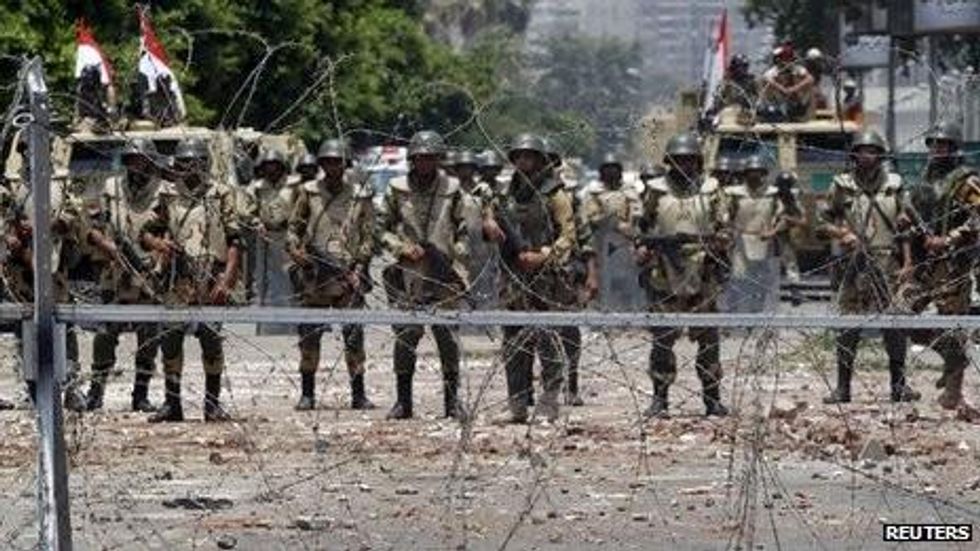
There were two narratives about what happened. The army maintained that armed individuals tried to raid the military barracks, where they think deposed President Muhammad Morsi is being held. In this telling, there was an attempted violent jailbreak by Morsi's militant followers, which the troops fought off, returning fire. The army said that an officer was killed and 40 military men were wounded in the "terrorist attack."
The other narrative, from the Muslim Brotherhood side, is that the Brothers were peacefully praying near the barracks, when suddenly Egyptian military troops fell on them and massacred them. (Some Brotherhood sources were claiming 40 dead and dozens wounded early Monday morning).
Both narratives are problematic. The army's description of a "terrorist attack" sounds propagandistic. The Brotherhood account doesn't indicate a motive for the army abruptly to launch an attack on peaceful demonstrators.
The Muslim religious Right is charging the government with an unprovoked massacre. Even the liberal Muslim politician, Abdel Moneim Aboul Futouh, a former presidential candidate who broke with the Muslim Brotherhood years ago, called on interim president Adly Mansour to step down over the incident.
The Salafi Nour Party (hard line fundamentalists), who had earlier been willing to entertain the idea of cooperating with the transitional government in the wake of the military coup/ popular uprising against Morsi, withdrew from the dialogue.
Nour had already been unhappy by Mansour's proposed appointments on Sunday, of Ziad Baha-al-Din, head of the Social Democratic Party, as prime minister, and Mohamed Elbaradei a interim vice president. Nour considers Elbaradei too "secular," and doesn't want Baha-al-Din because he is prominent in a political party; they had wanted a non-party technocrat. But it already appeared that President Adly Mansour had made all the concesions to Nour he was going to, when he gave up a plan to appoint Elbaradei as prime minister. Mansour would have liked to keep the Salafis in his coalition if he could have, because then it looks like a joint Muslim, liberal and leftist alliance against Morsi's authoritarian streak, rather than looking like a social democratic attempt at revolution.
Elsewhere in the country, thousands of protesters came out in the Upper Egyptian city of Luxor, site of the Pharaonic Valley of the Kings, in support of the army and of the deposing of Morsi. Morsi had angered Luxor by appointing as its governor a member of the al-Gama'a al-Islamiya, which had been a terrorist group in the 1990s (in 1997, Muslim radicals killed 77 tourists in Luxor). (MENA)
In another town in Upper Egypt, Qena, pro-Brotherhood crowds are said to have assembled (MENA).
There was also a huge crowd of left-liberal youth at Tahrir Square on Sunday, and the Muslim Brotherhood supporters were camped out in the square in front of the Rabia al-Adawiya Mosque in Nasr City.
An enormous crowd in Alexandria supported the military and the left-liberal youth on deposing Morsi. In dozens of marches throughout the city they expressed support of Defense Minister Brig. Gen. Abdel Fattah al-Sisi.
Update: The death toll in the deadly incident outside the Republican Guards barracks in Cairo has risen to over 50, with 300 wounded. Firm details of how the clash began are still not available. The pro-Brotherhood press, such as Aljazeera, is calling it a premeditated military massacre of peaceful praying civilians. The Egyptian military maintains that its troops were attacked by an armed commando squad seeking to free deposed President Muhammad Morsi from the barracks, and defended themselves. Western reporters in Cairo are said to face restrictions in moving around because of the danger of being attacked (both sides in Egypt's struggle blame the US and the West for supporting the other), and that difficulty may be impeding their ability to get solid eyewitness accounts of how it all began.
There were two narratives about what happened. The army maintained that armed individuals tried to raid the military barracks, where they think deposed President Muhammad Morsi is being held. In this telling, there was an attempted violent jailbreak by Morsi's militant followers, which the troops fought off, returning fire. The army said that an officer was killed and 40 military men were wounded in the "terrorist attack."
The other narrative, from the Muslim Brotherhood side, is that the Brothers were peacefully praying near the barracks, when suddenly Egyptian military troops fell on them and massacred them. (Some Brotherhood sources were claiming 40 dead and dozens wounded early Monday morning).
Both narratives are problematic. The army's description of a "terrorist attack" sounds propagandistic. The Brotherhood account doesn't indicate a motive for the army abruptly to launch an attack on peaceful demonstrators.
The Muslim religious Right is charging the government with an unprovoked massacre. Even the liberal Muslim politician, Abdel Moneim Aboul Futouh, a former presidential candidate who broke with the Muslim Brotherhood years ago, called on interim president Adly Mansour to step down over the incident.
The Salafi Nour Party (hard line fundamentalists), who had earlier been willing to entertain the idea of cooperating with the transitional government in the wake of the military coup/ popular uprising against Morsi, withdrew from the dialogue.
Nour had already been unhappy by Mansour's proposed appointments on Sunday, of Ziad Baha-al-Din, head of the Social Democratic Party, as prime minister, and Mohamed Elbaradei a interim vice president. Nour considers Elbaradei too "secular," and doesn't want Baha-al-Din because he is prominent in a political party; they had wanted a non-party technocrat. But it already appeared that President Adly Mansour had made all the concesions to Nour he was going to, when he gave up a plan to appoint Elbaradei as prime minister. Mansour would have liked to keep the Salafis in his coalition if he could have, because then it looks like a joint Muslim, liberal and leftist alliance against Morsi's authoritarian streak, rather than looking like a social democratic attempt at revolution.
Elsewhere in the country, thousands of protesters came out in the Upper Egyptian city of Luxor, site of the Pharaonic Valley of the Kings, in support of the army and of the deposing of Morsi. Morsi had angered Luxor by appointing as its governor a member of the al-Gama'a al-Islamiya, which had been a terrorist group in the 1990s (in 1997, Muslim radicals killed 77 tourists in Luxor). (MENA)
In another town in Upper Egypt, Qena, pro-Brotherhood crowds are said to have assembled (MENA).
There was also a huge crowd of left-liberal youth at Tahrir Square on Sunday, and the Muslim Brotherhood supporters were camped out in the square in front of the Rabia al-Adawiya Mosque in Nasr City.
An enormous crowd in Alexandria supported the military and the left-liberal youth on deposing Morsi. In dozens of marches throughout the city they expressed support of Defense Minister Brig. Gen. Abdel Fattah al-Sisi.
Update: The death toll in the deadly incident outside the Republican Guards barracks in Cairo has risen to over 50, with 300 wounded. Firm details of how the clash began are still not available. The pro-Brotherhood press, such as Aljazeera, is calling it a premeditated military massacre of peaceful praying civilians. The Egyptian military maintains that its troops were attacked by an armed commando squad seeking to free deposed President Muhammad Morsi from the barracks, and defended themselves. Western reporters in Cairo are said to face restrictions in moving around because of the danger of being attacked (both sides in Egypt's struggle blame the US and the West for supporting the other), and that difficulty may be impeding their ability to get solid eyewitness accounts of how it all began.
There were two narratives about what happened. The army maintained that armed individuals tried to raid the military barracks, where they think deposed President Muhammad Morsi is being held. In this telling, there was an attempted violent jailbreak by Morsi's militant followers, which the troops fought off, returning fire. The army said that an officer was killed and 40 military men were wounded in the "terrorist attack."
The other narrative, from the Muslim Brotherhood side, is that the Brothers were peacefully praying near the barracks, when suddenly Egyptian military troops fell on them and massacred them. (Some Brotherhood sources were claiming 40 dead and dozens wounded early Monday morning).
Both narratives are problematic. The army's description of a "terrorist attack" sounds propagandistic. The Brotherhood account doesn't indicate a motive for the army abruptly to launch an attack on peaceful demonstrators.
The Muslim religious Right is charging the government with an unprovoked massacre. Even the liberal Muslim politician, Abdel Moneim Aboul Futouh, a former presidential candidate who broke with the Muslim Brotherhood years ago, called on interim president Adly Mansour to step down over the incident.
The Salafi Nour Party (hard line fundamentalists), who had earlier been willing to entertain the idea of cooperating with the transitional government in the wake of the military coup/ popular uprising against Morsi, withdrew from the dialogue.
Nour had already been unhappy by Mansour's proposed appointments on Sunday, of Ziad Baha-al-Din, head of the Social Democratic Party, as prime minister, and Mohamed Elbaradei a interim vice president. Nour considers Elbaradei too "secular," and doesn't want Baha-al-Din because he is prominent in a political party; they had wanted a non-party technocrat. But it already appeared that President Adly Mansour had made all the concesions to Nour he was going to, when he gave up a plan to appoint Elbaradei as prime minister. Mansour would have liked to keep the Salafis in his coalition if he could have, because then it looks like a joint Muslim, liberal and leftist alliance against Morsi's authoritarian streak, rather than looking like a social democratic attempt at revolution.
Elsewhere in the country, thousands of protesters came out in the Upper Egyptian city of Luxor, site of the Pharaonic Valley of the Kings, in support of the army and of the deposing of Morsi. Morsi had angered Luxor by appointing as its governor a member of the al-Gama'a al-Islamiya, which had been a terrorist group in the 1990s (in 1997, Muslim radicals killed 77 tourists in Luxor). (MENA)
In another town in Upper Egypt, Qena, pro-Brotherhood crowds are said to have assembled (MENA).
There was also a huge crowd of left-liberal youth at Tahrir Square on Sunday, and the Muslim Brotherhood supporters were camped out in the square in front of the Rabia al-Adawiya Mosque in Nasr City.
An enormous crowd in Alexandria supported the military and the left-liberal youth on deposing Morsi. In dozens of marches throughout the city they expressed support of Defense Minister Brig. Gen. Abdel Fattah al-Sisi.