SUBSCRIBE TO OUR FREE NEWSLETTER
Daily news & progressive opinion—funded by the people, not the corporations—delivered straight to your inbox.
5
#000000
#FFFFFF
To donate by check, phone, or other method, see our More Ways to Give page.
A few evenings ago, as the sky began to darken here in Kabul, Afghanistan, a small group of the Afghan Peace Volunteers gathered for an informal presentation about WikiLeaks, its chief editor Julian Assange, and its most prominent contributor, Bradley Manning.
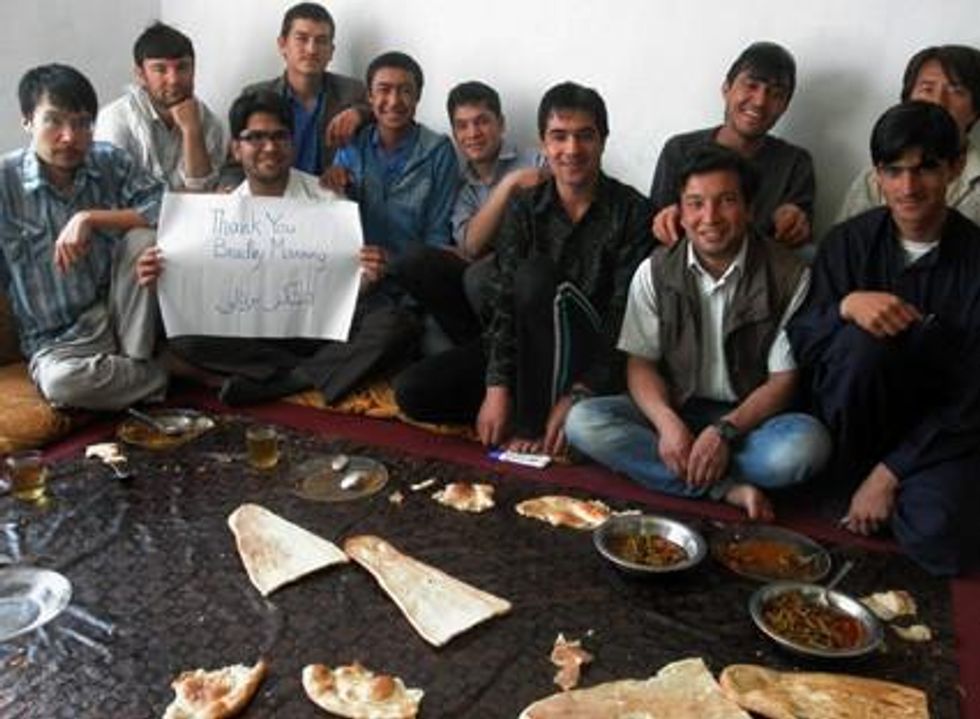
Basir Bita began the evening's discussion noting that June 1st will mark the beginning of Bradley Manning's fourth year in prison.
Two days later his trial will begin, a trial that could sadly result in his imprisonment for a life sentence.
June 1st also begins an international week of support and solidarity, aimed at thanking Bradley Manning. (#ThankManning)
Basir believes that the vast majority of Afghans are among myriads worldwide who have Manning to thank for information they will need in struggles for freedom, security, and peace. He wishes that more people would find the courage to stand up to military and government forces, especially their own, and act as whistle-blowers.
I often hear Afghan individuals and groups express longing for a far more democratic process than is allowed them in a country dominated by warlords, the U.S./NATO militaries, and their commanders.
In the U.S., a lack of crucial information increasingly threatens democratic processes.
How can people make informed choices if their leaders deliberately withhold crucial information from them? Manning's disclosures have brought desperately needed light to the U.S. and to countries around the world, including struggling countries like Afghanistan.
Hakim, who mentors the Afghan Peace Volunteers, recalled that Bradley Manning passed on documents that record 91,730 "Significant Actions," or "SIGACTS" undertaken here by the U.S. /ISAF forces, of which 75,000 were released by WikiLeaks.
These SIGACTS include attacks by drones and night raids.
Our group turned to discussing the history of WikiLeaks, how it formed and how it now functions. Those most familiar with computers and Internet explained the process of disclosing information by anonymously following a computerized route to a "dropbox."
And the Afghan Peace Volunteers themselves have been communicating with Julian Assange.
Last winter, Nobel peace laureate Mairead Maguire had stayed with them shortly before she traveled to London for a visit to Julian Assange. Through Mairead, they had sent Assange a letter of solidarity.
The Afghan Peace Volunteers heard that Manning has been more isolated than Assange; they all shook their heads when Basir reminded them that Bradley Manning was initially in solitary confinement for eleven months.
There was a keen conversation about who Bradley Manning was and what he did. Bradley Manning's own words, which journalists had to actually smuggle out of his pre-trial hearing, described how Bradley's mind had largely been made up by watching the secret video that he would come to release under the title "Collateral Murder:"
"They dehumanized the individuals they were engaging and seemed to not value human life by referring to them as quote 'dead bastards' unquote and congratulating each other on the ability to kill in large numbers," Manning said. "At one point in the video there's an individual on the ground attempting to crawl to safety. The individual is seriously wounded. Instead of calling for medical attention to the location, one of the aerial weapons team crew members verbally asks for the wounded person to pick up a weapon so that he can have a reason to engage. For me, this seems similar to a child torturing ants with a magnifying glass."
Together, the Afghan Peace Volunteers watched the deeply disturbing "Collateral Damage" video itself. They were avid to learn what they could do to support and thank Bradley Manning.
Yet they're aware of the risks faced by people who organize public demonstrations in Afghanistan.
It's far easier to stand up for Bradley where I live, back in the U.S.
I hope many more of us will devote the time and energy we owe this young man for risking everything, as he did, to enlighten us and the world.
A few evenings ago, as the sky began to darken here in Kabul, Afghanistan, a small group of the Afghan Peace Volunteers gathered for an informal presentation about WikiLeaks, its chief editor Julian Assange, and its most prominent contributor, Bradley Manning.
Basir Bita began the evening's discussion noting that June 1st will mark the beginning of Bradley Manning's fourth year in prison.
Two days later his trial will begin, a trial that could sadly result in his imprisonment for a life sentence.
June 1st also begins an international week of support and solidarity, aimed at thanking Bradley Manning. (#ThankManning)
Basir believes that the vast majority of Afghans are among myriads worldwide who have Manning to thank for information they will need in struggles for freedom, security, and peace. He wishes that more people would find the courage to stand up to military and government forces, especially their own, and act as whistle-blowers.
I often hear Afghan individuals and groups express longing for a far more democratic process than is allowed them in a country dominated by warlords, the U.S./NATO militaries, and their commanders.
In the U.S., a lack of crucial information increasingly threatens democratic processes.
How can people make informed choices if their leaders deliberately withhold crucial information from them? Manning's disclosures have brought desperately needed light to the U.S. and to countries around the world, including struggling countries like Afghanistan.
Hakim, who mentors the Afghan Peace Volunteers, recalled that Bradley Manning passed on documents that record 91,730 "Significant Actions," or "SIGACTS" undertaken here by the U.S. /ISAF forces, of which 75,000 were released by WikiLeaks.
These SIGACTS include attacks by drones and night raids.
Our group turned to discussing the history of WikiLeaks, how it formed and how it now functions. Those most familiar with computers and Internet explained the process of disclosing information by anonymously following a computerized route to a "dropbox."
And the Afghan Peace Volunteers themselves have been communicating with Julian Assange.
Last winter, Nobel peace laureate Mairead Maguire had stayed with them shortly before she traveled to London for a visit to Julian Assange. Through Mairead, they had sent Assange a letter of solidarity.
The Afghan Peace Volunteers heard that Manning has been more isolated than Assange; they all shook their heads when Basir reminded them that Bradley Manning was initially in solitary confinement for eleven months.
There was a keen conversation about who Bradley Manning was and what he did. Bradley Manning's own words, which journalists had to actually smuggle out of his pre-trial hearing, described how Bradley's mind had largely been made up by watching the secret video that he would come to release under the title "Collateral Murder:"
"They dehumanized the individuals they were engaging and seemed to not value human life by referring to them as quote 'dead bastards' unquote and congratulating each other on the ability to kill in large numbers," Manning said. "At one point in the video there's an individual on the ground attempting to crawl to safety. The individual is seriously wounded. Instead of calling for medical attention to the location, one of the aerial weapons team crew members verbally asks for the wounded person to pick up a weapon so that he can have a reason to engage. For me, this seems similar to a child torturing ants with a magnifying glass."
Together, the Afghan Peace Volunteers watched the deeply disturbing "Collateral Damage" video itself. They were avid to learn what they could do to support and thank Bradley Manning.
Yet they're aware of the risks faced by people who organize public demonstrations in Afghanistan.
It's far easier to stand up for Bradley where I live, back in the U.S.
I hope many more of us will devote the time and energy we owe this young man for risking everything, as he did, to enlighten us and the world.
A few evenings ago, as the sky began to darken here in Kabul, Afghanistan, a small group of the Afghan Peace Volunteers gathered for an informal presentation about WikiLeaks, its chief editor Julian Assange, and its most prominent contributor, Bradley Manning.
Basir Bita began the evening's discussion noting that June 1st will mark the beginning of Bradley Manning's fourth year in prison.
Two days later his trial will begin, a trial that could sadly result in his imprisonment for a life sentence.
June 1st also begins an international week of support and solidarity, aimed at thanking Bradley Manning. (#ThankManning)
Basir believes that the vast majority of Afghans are among myriads worldwide who have Manning to thank for information they will need in struggles for freedom, security, and peace. He wishes that more people would find the courage to stand up to military and government forces, especially their own, and act as whistle-blowers.
I often hear Afghan individuals and groups express longing for a far more democratic process than is allowed them in a country dominated by warlords, the U.S./NATO militaries, and their commanders.
In the U.S., a lack of crucial information increasingly threatens democratic processes.
How can people make informed choices if their leaders deliberately withhold crucial information from them? Manning's disclosures have brought desperately needed light to the U.S. and to countries around the world, including struggling countries like Afghanistan.
Hakim, who mentors the Afghan Peace Volunteers, recalled that Bradley Manning passed on documents that record 91,730 "Significant Actions," or "SIGACTS" undertaken here by the U.S. /ISAF forces, of which 75,000 were released by WikiLeaks.
These SIGACTS include attacks by drones and night raids.
Our group turned to discussing the history of WikiLeaks, how it formed and how it now functions. Those most familiar with computers and Internet explained the process of disclosing information by anonymously following a computerized route to a "dropbox."
And the Afghan Peace Volunteers themselves have been communicating with Julian Assange.
Last winter, Nobel peace laureate Mairead Maguire had stayed with them shortly before she traveled to London for a visit to Julian Assange. Through Mairead, they had sent Assange a letter of solidarity.
The Afghan Peace Volunteers heard that Manning has been more isolated than Assange; they all shook their heads when Basir reminded them that Bradley Manning was initially in solitary confinement for eleven months.
There was a keen conversation about who Bradley Manning was and what he did. Bradley Manning's own words, which journalists had to actually smuggle out of his pre-trial hearing, described how Bradley's mind had largely been made up by watching the secret video that he would come to release under the title "Collateral Murder:"
"They dehumanized the individuals they were engaging and seemed to not value human life by referring to them as quote 'dead bastards' unquote and congratulating each other on the ability to kill in large numbers," Manning said. "At one point in the video there's an individual on the ground attempting to crawl to safety. The individual is seriously wounded. Instead of calling for medical attention to the location, one of the aerial weapons team crew members verbally asks for the wounded person to pick up a weapon so that he can have a reason to engage. For me, this seems similar to a child torturing ants with a magnifying glass."
Together, the Afghan Peace Volunteers watched the deeply disturbing "Collateral Damage" video itself. They were avid to learn what they could do to support and thank Bradley Manning.
Yet they're aware of the risks faced by people who organize public demonstrations in Afghanistan.
It's far easier to stand up for Bradley where I live, back in the U.S.
I hope many more of us will devote the time and energy we owe this young man for risking everything, as he did, to enlighten us and the world.