SUBSCRIBE TO OUR FREE NEWSLETTER
Daily news & progressive opinion—funded by the people, not the corporations—delivered straight to your inbox.
5
#000000
#FFFFFF
To donate by check, phone, or other method, see our More Ways to Give page.
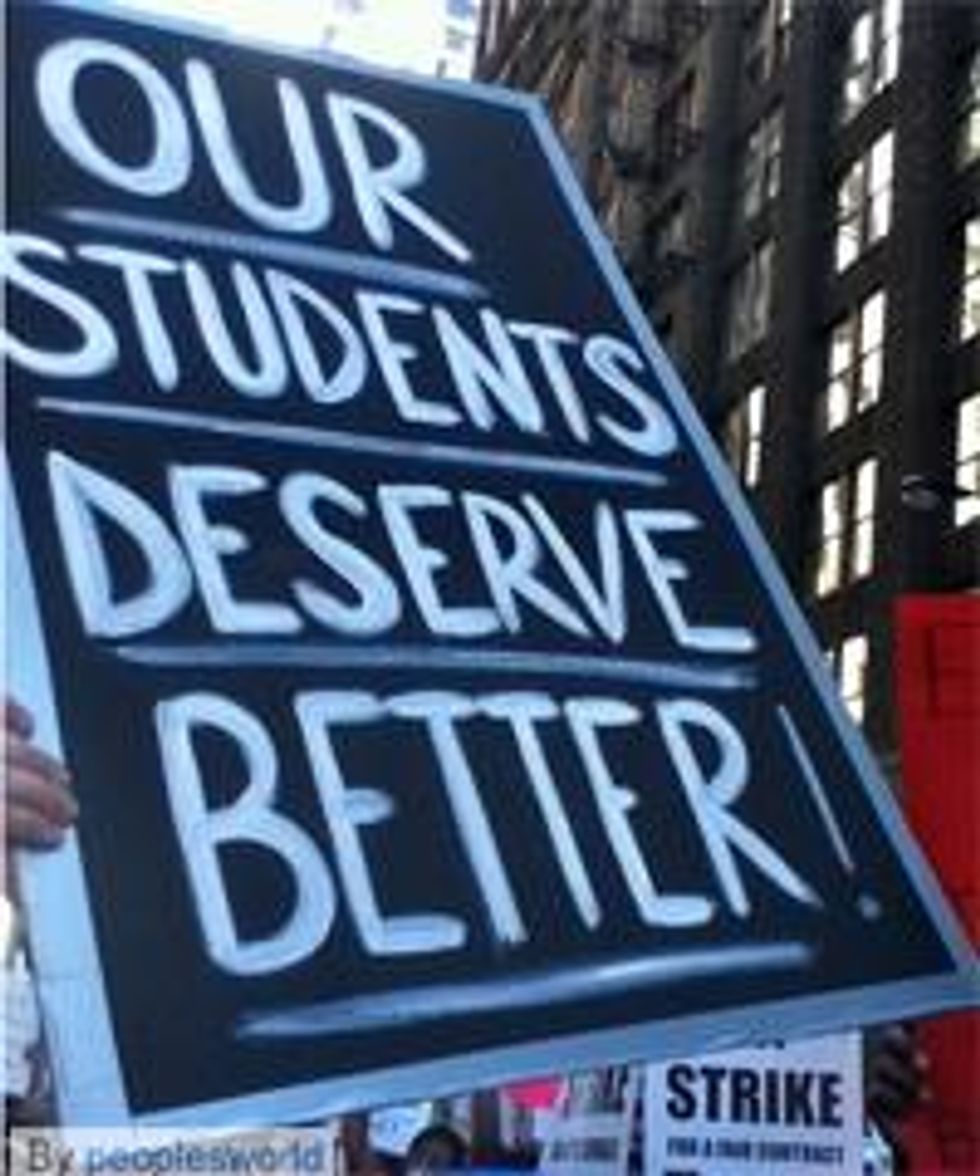
The Chicago teachers' strike put President Obama in an awkward position. Caught between his own former chief of staff, Chicago Mayor Rahm Emanuel, and his base of support in the teachers' union, he was easy prey for Mitt Romney, who declared that the President had taken the teachers' side (not true) and that Democrats and unionized teachers are the enemies of parents, school children, and quality education.
Romney's attack was dumb and misleading.
But the big problem for Obama was that he was trying to play both sides of this highly charged issue.
Obama wanted no part of the Chicago teachers' fight. He didn't want to antagonize Emanuel--a major campaign fundraiser and political ally. Nor did he want to alienate labor as he heads into the homestretch in this Presidential election.
But what tripped up Obama the most is that he has essentially adopted George W. Bush's free-market, live-and-let-die education policies--but is running with the support of people who desperately want him to defend public schools against increasingly aggressive rightwing attacks.
For years, Obama and other Democrats who back a competitive, high-stakes approach to education reform have been at odds with the fundamental, traditional values of their party.
Not just labor rights, but the whole idea of a high-quality, free, public education system that meets the needs of all children (not just those whose families can cobble together the funds, the out-of-district transfer forms, or the vouchers to get them into the "winning" schools).
Race To the Top, Obama's education initiative (also known as "No Child Left Behind on steroids,") focuses on firing teachers and closing schools if student test scores drop below a certain threshold.
Groups like Democrats for Education Reform, backed by a handful of hedge fund managers who love the idea of firing those dull, fat-ass union teachers and replacing them with Teach For America recruits with the can-do spirit of a corporate takeover, have set the tone on this issue in snazzy Democratic circles for years.
After all, as anyone who writes for The New Republic can tell you, there is nothing more uncool than old, blue-collar labor to New Democrats.
Journalist and media star Stephen Brill wrote a whole book about the need to smash teachers unions, called "Class Warfare," in which he blamed lazy, unmotivated, unionized teachers for the plight of inner city kids in New York schools, and made the case that a handful of 21-year-old Ivy League grads could remake education in America.
A funny thing happened by the end of Brill's book, though. The young teachers he so admired, deeming them "the best and the brightest," burned out and quit. By the last chapter he was admitting that unions--along with the decent pay and benefits they bargain for--might be essential after all. He even suggested that the reformers' nemesis, Randi Weingarten, head of the American Federation of Teachers, should be put in charge of the New York City schools.
The whole education reform issue was notable for its absence from the Democratic convention in Charlotte this year.
That is, in part, because of what happened in Wisconsin.
Here in Madison we saw how galvanizing Governor Scott Walker's attack on teachers unions and public employees in general was for a broad cross-section of the state.
After so many people rallied and worked to turn back the Walker attack, beating up on teachers seemed more like bullying than cool, "third-way" thinking.
Matt Damon stood by his mother's side and stuck up for hardworking, self-sacrificing teachers like her.
Jon Stewart made the ludicrousness of the charge that teachers are corrupt, lazy, and overpaid a running gag on his show.
Suddenly, beating up on teachers was definitely not a safe motif for the primetime speeches at the DNC.
In his convention speech, Obama steered clear of Race to the Top altogether.
Race to the Top, instead of a broad investment in public education, creates a duke-it-out model, with mass firings of teachers in schools in "decline," and a competition that leaves some kids and their schools winners while others lose big. Ayn Rand and Paul Ryan would approve.
Yet at the convention, Obama declared: "I don't believe that firing teachers or kicking students off financial aid will grow the economy, or help us compete with the scientists and engineers coming out of China."
The progressive tone on education was noticed on Twitter by Diane Ravitch--who led the No Child Left Behind initiative for President Bush, before she became the program's chief critic and a defender of public schools and teachers -- and Randi Weingarten, president of the American Federation of Teachers.
"Good news: President didn't mention Race to Top. No decline talk. Small step forward," Ravitch tweeted during Obama's speech.
"Just maybe we are seeing a change...comments on firing teachers and Race to the Top are inconsistent," Weingarten tweeted.
The Chicago teachers' strike puts Weingarten's optimism to the test.
In Wisconsin, Obama managed to finesse the issue--he made some statements supporting the recall, and teachers and education generally, but he didn't have to commit himself to this fundamental fight on the values of his party.
That can't go on forever.
The stakes are so high--for labor, for public investment in education, for the struggling poor and working class. The Democrats, at their convention, got a huge bump by defending these core elements of our civil society.
If they want to keep that energy flowing, the Dems are going to have to take a stand for teachers and school kids. A stand that genuinely opposes the Romney/Ryan vision.
The Chicago teachers' strike put President Obama in an awkward position. Caught between his own former chief of staff, Chicago Mayor Rahm Emanuel, and his base of support in the teachers' union, he was easy prey for Mitt Romney, who declared that the President had taken the teachers' side (not true) and that Democrats and unionized teachers are the enemies of parents, school children, and quality education.
Romney's attack was dumb and misleading.
But the big problem for Obama was that he was trying to play both sides of this highly charged issue.
Obama wanted no part of the Chicago teachers' fight. He didn't want to antagonize Emanuel--a major campaign fundraiser and political ally. Nor did he want to alienate labor as he heads into the homestretch in this Presidential election.
But what tripped up Obama the most is that he has essentially adopted George W. Bush's free-market, live-and-let-die education policies--but is running with the support of people who desperately want him to defend public schools against increasingly aggressive rightwing attacks.
For years, Obama and other Democrats who back a competitive, high-stakes approach to education reform have been at odds with the fundamental, traditional values of their party.
Not just labor rights, but the whole idea of a high-quality, free, public education system that meets the needs of all children (not just those whose families can cobble together the funds, the out-of-district transfer forms, or the vouchers to get them into the "winning" schools).
Race To the Top, Obama's education initiative (also known as "No Child Left Behind on steroids,") focuses on firing teachers and closing schools if student test scores drop below a certain threshold.
Groups like Democrats for Education Reform, backed by a handful of hedge fund managers who love the idea of firing those dull, fat-ass union teachers and replacing them with Teach For America recruits with the can-do spirit of a corporate takeover, have set the tone on this issue in snazzy Democratic circles for years.
After all, as anyone who writes for The New Republic can tell you, there is nothing more uncool than old, blue-collar labor to New Democrats.
Journalist and media star Stephen Brill wrote a whole book about the need to smash teachers unions, called "Class Warfare," in which he blamed lazy, unmotivated, unionized teachers for the plight of inner city kids in New York schools, and made the case that a handful of 21-year-old Ivy League grads could remake education in America.
A funny thing happened by the end of Brill's book, though. The young teachers he so admired, deeming them "the best and the brightest," burned out and quit. By the last chapter he was admitting that unions--along with the decent pay and benefits they bargain for--might be essential after all. He even suggested that the reformers' nemesis, Randi Weingarten, head of the American Federation of Teachers, should be put in charge of the New York City schools.
The whole education reform issue was notable for its absence from the Democratic convention in Charlotte this year.
That is, in part, because of what happened in Wisconsin.
Here in Madison we saw how galvanizing Governor Scott Walker's attack on teachers unions and public employees in general was for a broad cross-section of the state.
After so many people rallied and worked to turn back the Walker attack, beating up on teachers seemed more like bullying than cool, "third-way" thinking.
Matt Damon stood by his mother's side and stuck up for hardworking, self-sacrificing teachers like her.
Jon Stewart made the ludicrousness of the charge that teachers are corrupt, lazy, and overpaid a running gag on his show.
Suddenly, beating up on teachers was definitely not a safe motif for the primetime speeches at the DNC.
In his convention speech, Obama steered clear of Race to the Top altogether.
Race to the Top, instead of a broad investment in public education, creates a duke-it-out model, with mass firings of teachers in schools in "decline," and a competition that leaves some kids and their schools winners while others lose big. Ayn Rand and Paul Ryan would approve.
Yet at the convention, Obama declared: "I don't believe that firing teachers or kicking students off financial aid will grow the economy, or help us compete with the scientists and engineers coming out of China."
The progressive tone on education was noticed on Twitter by Diane Ravitch--who led the No Child Left Behind initiative for President Bush, before she became the program's chief critic and a defender of public schools and teachers -- and Randi Weingarten, president of the American Federation of Teachers.
"Good news: President didn't mention Race to Top. No decline talk. Small step forward," Ravitch tweeted during Obama's speech.
"Just maybe we are seeing a change...comments on firing teachers and Race to the Top are inconsistent," Weingarten tweeted.
The Chicago teachers' strike puts Weingarten's optimism to the test.
In Wisconsin, Obama managed to finesse the issue--he made some statements supporting the recall, and teachers and education generally, but he didn't have to commit himself to this fundamental fight on the values of his party.
That can't go on forever.
The stakes are so high--for labor, for public investment in education, for the struggling poor and working class. The Democrats, at their convention, got a huge bump by defending these core elements of our civil society.
If they want to keep that energy flowing, the Dems are going to have to take a stand for teachers and school kids. A stand that genuinely opposes the Romney/Ryan vision.
The Chicago teachers' strike put President Obama in an awkward position. Caught between his own former chief of staff, Chicago Mayor Rahm Emanuel, and his base of support in the teachers' union, he was easy prey for Mitt Romney, who declared that the President had taken the teachers' side (not true) and that Democrats and unionized teachers are the enemies of parents, school children, and quality education.
Romney's attack was dumb and misleading.
But the big problem for Obama was that he was trying to play both sides of this highly charged issue.
Obama wanted no part of the Chicago teachers' fight. He didn't want to antagonize Emanuel--a major campaign fundraiser and political ally. Nor did he want to alienate labor as he heads into the homestretch in this Presidential election.
But what tripped up Obama the most is that he has essentially adopted George W. Bush's free-market, live-and-let-die education policies--but is running with the support of people who desperately want him to defend public schools against increasingly aggressive rightwing attacks.
For years, Obama and other Democrats who back a competitive, high-stakes approach to education reform have been at odds with the fundamental, traditional values of their party.
Not just labor rights, but the whole idea of a high-quality, free, public education system that meets the needs of all children (not just those whose families can cobble together the funds, the out-of-district transfer forms, or the vouchers to get them into the "winning" schools).
Race To the Top, Obama's education initiative (also known as "No Child Left Behind on steroids,") focuses on firing teachers and closing schools if student test scores drop below a certain threshold.
Groups like Democrats for Education Reform, backed by a handful of hedge fund managers who love the idea of firing those dull, fat-ass union teachers and replacing them with Teach For America recruits with the can-do spirit of a corporate takeover, have set the tone on this issue in snazzy Democratic circles for years.
After all, as anyone who writes for The New Republic can tell you, there is nothing more uncool than old, blue-collar labor to New Democrats.
Journalist and media star Stephen Brill wrote a whole book about the need to smash teachers unions, called "Class Warfare," in which he blamed lazy, unmotivated, unionized teachers for the plight of inner city kids in New York schools, and made the case that a handful of 21-year-old Ivy League grads could remake education in America.
A funny thing happened by the end of Brill's book, though. The young teachers he so admired, deeming them "the best and the brightest," burned out and quit. By the last chapter he was admitting that unions--along with the decent pay and benefits they bargain for--might be essential after all. He even suggested that the reformers' nemesis, Randi Weingarten, head of the American Federation of Teachers, should be put in charge of the New York City schools.
The whole education reform issue was notable for its absence from the Democratic convention in Charlotte this year.
That is, in part, because of what happened in Wisconsin.
Here in Madison we saw how galvanizing Governor Scott Walker's attack on teachers unions and public employees in general was for a broad cross-section of the state.
After so many people rallied and worked to turn back the Walker attack, beating up on teachers seemed more like bullying than cool, "third-way" thinking.
Matt Damon stood by his mother's side and stuck up for hardworking, self-sacrificing teachers like her.
Jon Stewart made the ludicrousness of the charge that teachers are corrupt, lazy, and overpaid a running gag on his show.
Suddenly, beating up on teachers was definitely not a safe motif for the primetime speeches at the DNC.
In his convention speech, Obama steered clear of Race to the Top altogether.
Race to the Top, instead of a broad investment in public education, creates a duke-it-out model, with mass firings of teachers in schools in "decline," and a competition that leaves some kids and their schools winners while others lose big. Ayn Rand and Paul Ryan would approve.
Yet at the convention, Obama declared: "I don't believe that firing teachers or kicking students off financial aid will grow the economy, or help us compete with the scientists and engineers coming out of China."
The progressive tone on education was noticed on Twitter by Diane Ravitch--who led the No Child Left Behind initiative for President Bush, before she became the program's chief critic and a defender of public schools and teachers -- and Randi Weingarten, president of the American Federation of Teachers.
"Good news: President didn't mention Race to Top. No decline talk. Small step forward," Ravitch tweeted during Obama's speech.
"Just maybe we are seeing a change...comments on firing teachers and Race to the Top are inconsistent," Weingarten tweeted.
The Chicago teachers' strike puts Weingarten's optimism to the test.
In Wisconsin, Obama managed to finesse the issue--he made some statements supporting the recall, and teachers and education generally, but he didn't have to commit himself to this fundamental fight on the values of his party.
That can't go on forever.
The stakes are so high--for labor, for public investment in education, for the struggling poor and working class. The Democrats, at their convention, got a huge bump by defending these core elements of our civil society.
If they want to keep that energy flowing, the Dems are going to have to take a stand for teachers and school kids. A stand that genuinely opposes the Romney/Ryan vision.