

SUBSCRIBE TO OUR FREE NEWSLETTER
Daily news & progressive opinion—funded by the people, not the corporations—delivered straight to your inbox.
5
#000000
#FFFFFF
To donate by check, phone, or other method, see our More Ways to Give page.
Daily news & progressive opinion—funded by the people, not the corporations—delivered straight to your inbox.
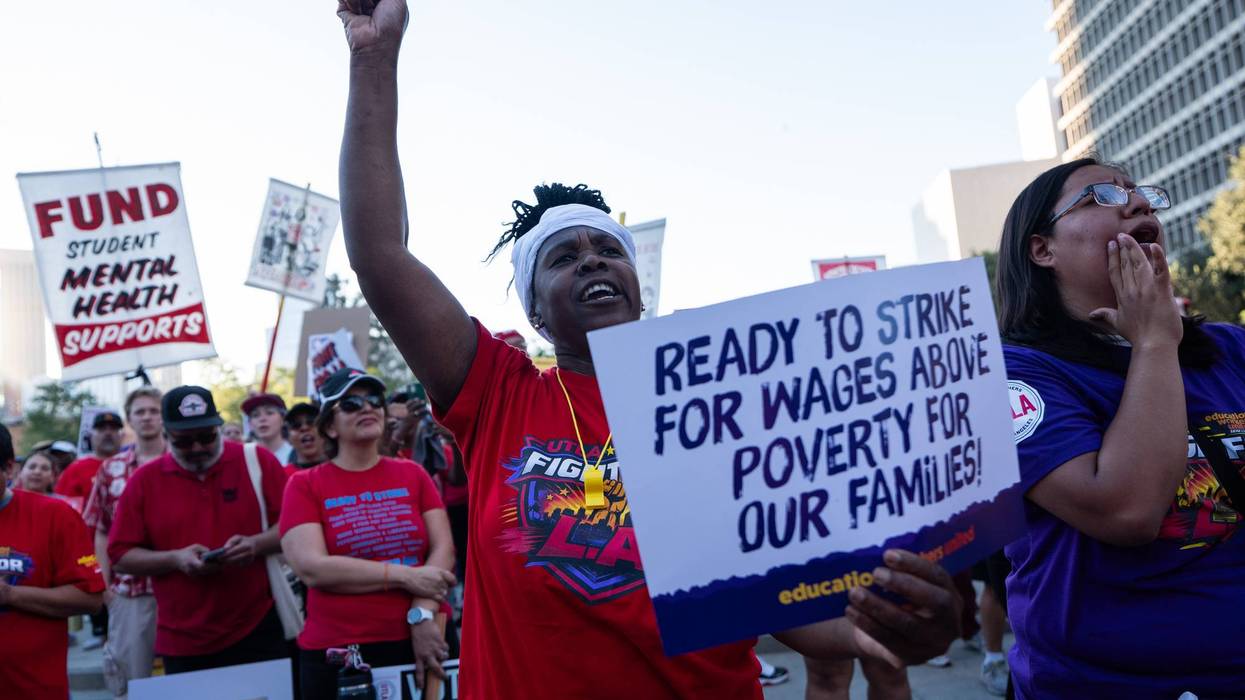
For too long, the narrative has been that we cannot afford to support teachers. We’ve just shown we cannot afford not to.
Before stepping into the classroom, I spent 12 years as an investigator with the California State Bar, examining cases of attorney misconduct. I chose to teach because I saw a meaningful way to serve my community, and I understood there would be sacrifice. Still, it took 10 years before my salary caught up to what I earned in my final year as an investigator.
In California, becoming an educator is neither easy nor inexpensive. In fact, it is one of the most challenging states to obtain a teaching license. Despite this, teachers remain among the most underpaid professionals relative to their level of education. According to the US Census Bureau, teacher earnings have not only lagged behind comparable fields, but have experienced a steady annual decline.
The debate is not whether schools have enough money, it is about what we choose to spend it on. Today, many educators cannot afford to live where they teach. Teaching, while never lucrative, used to offer a stable path to a middle class life. Educators could buy a home, live in the communities where they worked, and maintain the financial stability expected of other professions with similar levels of education. Sadly, even the most modest of those expectations are rapidly disappearing. I only own a home because I purchased it prior to switching my career.
Most educators did not choose this career for the money, but there is a clear difference between modest compensation and exploitation. Nearly 1 in 5 teachers in Los Angeles are housing insecure. And nearly 60% of educators across the country take on second jobs outside of teaching to make ends meet. It is unacceptable that the people responsible for educating our children are struggling to hold their head above water.
These victories for Los Angeles educators are not perks. They are the foundation of a functioning school system, and a respected career.
Teachers are also expected to subsidize their classrooms out of their own pockets. These stories are often framed as heartwarming and altruistic, but they reflect systemic failure and a lack of meaningful investment in public education. Few other professions require employees to pay out of pocket while already being underpaid.
The consequences of this underinvestment are becoming impossible to ignore. As the cost of living rises, fewer educators can afford to remain in the classroom. A teacher shortage has already hit Southern California, and the impact is profound. Nationally, teaching shortages have led to larger class sizes, burnout, and financial strain on the education system.
Education is expected to operate in scarcity while other sectors experience enormous growth. The education technology market alone is projected to grow by $170.8 billion by 2029. In the Los Angeles Unified School District alone, more than $1.6 billion has been spent on edtech. Framing this as a funding problem misses the point; it is a question of priorities. We are told we can’t make investments in educators, while billions continue to flow toward technology and outside contracts instead of the classrooms they are meant to serve.
And yet, during recent labor negotiations in Los Angeles, we were told a familiar refrain: There is no money.
This was the backdrop of three educational unions, representing more than 70,000 workers, on the brink of striking across Los Angeles. At the center of the dispute for United Teachers Los Angeles was a straightforward demand: a salary structure that reflects economic reality. As negotiations stretched over 14 months, frustration grew not only among educators but across school communities, culminating in escalating public pressure, organizing efforts at school sites, and an overwhelming strike authorization vote that made clear teachers were prepared to act if necessary.
Only when the possibility of a strike became real did the district return to the table with urgency. We ultimately won the majority of our demands, including overhauling the outdated pay system that kept incoming educators at artificially low salaries, raising the starting salary from $68,966 to $77,000 for teachers, and securing an average salary increase of 13.86% across the board. This is evidence that the “no money” claim is negotiable, not factual.
Just as significantly, for the first time in California, educators in Los Angeles have secured four weeks of paid parental leave. This is a historic breakthrough that now sets a precedent for teachers across the state of California, as well as the entire country. Additionally, we won a major expansion of student support, including more than 450 additional social workers, to address the growing mental health crisis among our youth.
These victories for Los Angeles educators are not perks. They are the foundation of a functioning school system, and a respected career.
When teachers are paid a living wage, they stay. When they can afford to live in the communities they serve, schools are more stable. And when students have access to trained mental health professionals, they are better able to learn. Investment is what makes public schools strong. Without it, everything else collapses.
For too long, the narrative has been that we cannot afford to support teachers. We’ve just shown we cannot afford not to. The lesson from Los Angeles is simple: School funding is not fixed by scarcity, but by priorities. And when educators and school workers organize, those priorities can change—for the better.
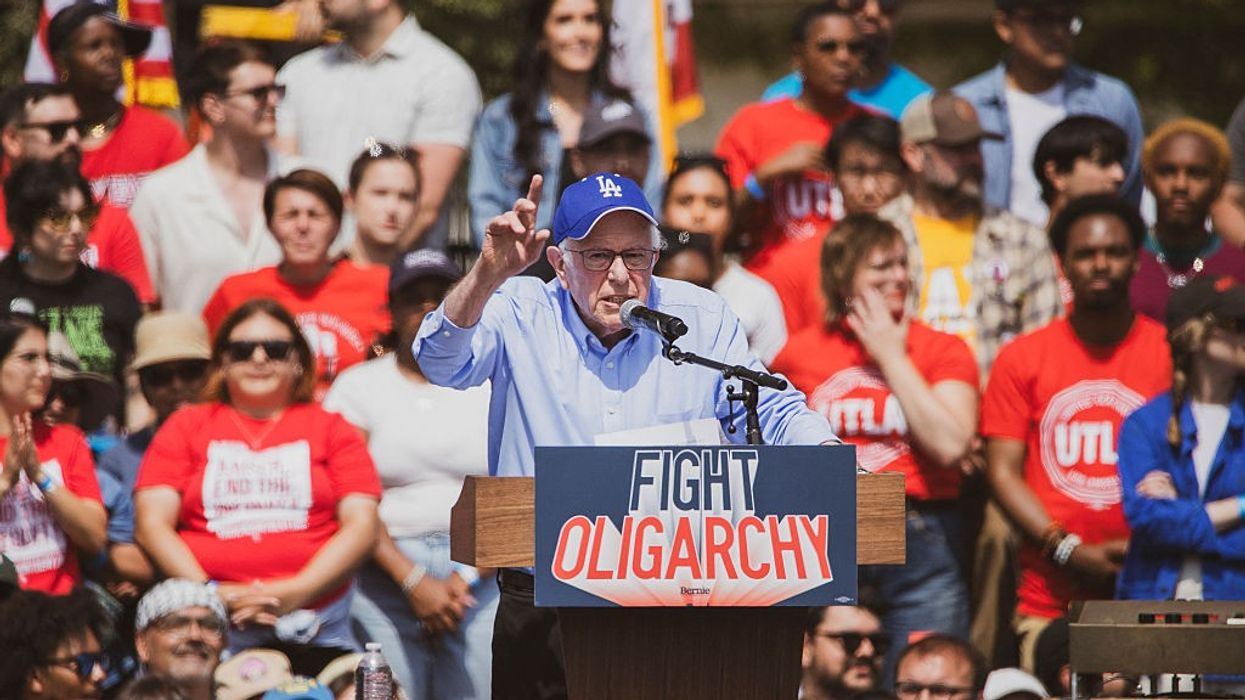
"Our country needs access to hospitals and emergency rooms, not more tax breaks for billionaires."
US Sen. Bernie Sanders is headed to Los Angeles next week to lead a campaign kickoff for a bill that would impose a one-time 5% tax on the assets of California's billionaires to support the state's healthcare system, including by keeping hospitals and emergency departments open.
Economists, healthcare workers, and unions launched the fight for the tax last year, after Republicans in Congress and President Donald Trump enacted a budget package that included massive Medicaid cuts. Service Employees International Union-United Healthcare Workers West (SEIU-UHW) is spearheading the battle for the California Billionaire Tax Act.
Sanders (I-Vt.) endorsed the proposal in December, calling it "a model that should be emulated throughout the country." He is now set to appear at the Wiltern in Los Angeles alongside musical acts and other supporters of the ballot measure for the bill on Wednesday, February 18.
"At a time of unprecedented and growing wealth consolidation and income inequality, I strongly support the grassroots effort in California to impose this reasonable and necessary 5% wealth tax on about 200 California billionaires," Sanders said in a Tuesday statement.
"This initiative would provide the necessary funding to prevent over 3 million working-class Californians from losing the healthcare they currently have—and would help prevent the closures of California hospitals and emergency rooms," noted the senator, a longtime leading advocate of higher taxes for the ultrarich and Medicare for All.
"It should be common sense that the billionaires pay just slightly more so that entire communities can preserve access to lifesaving medical care," he added. "Our country needs access to hospitals and emergency rooms, not more tax breaks for billionaires."
Mayra Castaneda, an ultrasound technologist at St. Francis Medical Center in Lynwood, said that "we are very grateful for the support of US Sen. Sanders, who for years has been telling the truth about the threat that income inequality poses to our nation—and to working people."
"If we let these healthcare cuts stand, my patients will suffer," Castaneda stressed. "Hospitals and ERs will close, others will be strained by taking on more patients, and people will lose access to lifesaving care."
"This is all avoidable if billionaires just pay their fair share in California, so I'm going to do whatever is in my power to see this proposal pass in November," Castaneda continued. "I'll be telling my story alongside Sen. Sanders and urging my fellow Californians to take action to save lives."
Healthcare experts warn a crisis is here. Congress’s “Big, Beautiful Bill” cuts $100B from CA healthcare. LA Times: “People will die.” A one-time 5% billionaire tax can backfill the cuts and protect care.https://lat.ms/4amFfYK
[image or embed]
— SEIU-United Healthcare Workers West (@seiu-uhw.bsky.social) February 4, 2026 at 7:00 PM
According to the Los Angeles Times, which first reported on the upcoming event: "The supporters need to gather the signatures of nearly 875,000 registered voters and submit them to county elections officials by June 24 for the measure to qualify for the November ballot. They began gathering signatures in January."
While the bill targeting the state's billionaires is backed by Sanders—who caucuses with Democrats in Congress and twice sought the party's presidential nomination—its opponents include Democratic California Gov. Gavin Newsom, who is expected to run for president in 2028.
"Gavin Newsom is on the side of the billionaires, not the millions of working people who stand to lose healthcare because of the Trump cuts," progressive organizer Jonathan Rosenblum said after the governor made his position clear last month. "Shamefully typical of the Democratic establishment."
The Times noted Tuesday that other opponents include "San Jose Mayor Matt Mahan, who is among a dozen candidates running in November to replace the termed-out governor."

The victim—whose skull was fractured and nearly died—said federal agents mocked him, saying, "You're going to lose your eye."
A young protester in Santa Ana is permanently blind in one eye after being hit in the face at close range by a "nonlethal" round fired by a Department of Homeland Security agent last week amid nationwide protests against an immigration agent's killing of US citizen Renee Good in Minneapolis.
According to a report from the Los Angeles Times on Tuesday, the 21-year-old "underwent six hours of surgery and... doctors found shards of plastic, glass, and metal embedded in his eyes and around his face, including a metal piece lodged 7 mm from a carotid artery."
His aunt, Jeri Rees, told the Times that doctors feared removing the shrapnel from her nephew's face, concerned it could kill him, and that he had also suffered a skull fracture around his eyes and nose and had permanently lost vision in his left eye.
The shooting outside the Civic Center Plaza that took his sight on Friday evening was caught on film and has circulated widely on social media, and came hours after an earlier protest, organized by the organization Dare to Struggle, saw hundreds of demonstrators gather in downtown Santa Ana to oppose President Donald Trump's flooding of US cities with immigration agents.
The video shows a group of protesters standing on the steps of the center, with several chanting and holding signs and one holding a megaphone. An officer then grabbed one of the young demonstrators—who appeared to be standing peacefully—by the arm, and dragged him up the steps.
As he attempted to wrest himself free from the agent's grip, one of the protesters in the crowd threw an orange traffic cone in the direction of the struggle. This prompted at least one other officer to begin firing their weapons toward the crowd, striking one woman before striking Rees' nephew in the face, causing him to drop to the ground.
The agent then grabbed him by the hood of his sweatshirt, dragging him across the ground. His face is visibly bloody and he appears to be struggling to breathe as he is dragged away by the neck.
According to the Times, another video shows Rees' nephew lying bloodied on the ground inside the building while another agent fires pepper balls at another person who approached the building, attempting to film the incident.
Under Trump's watch, a DHS agent shot a protestor in the face with a non-lethal round at close range, fractured his skull, and then dragged him around as he choked and bled. He is now permanently blind in his left eye.
[image or embed]
— Rep. Judy Chu (@chu.house.gov) January 13, 2026 at 12:32 PM
While such projectiles are often described as "nonlethal," Ed Obayashi, the Modoc County sheriff’s deputy and legal adviser to police agencies, told the paper that firing one just feet away from a person's face "constitutes as deadly force as far as the law is concerned" because "these projectiles can cause serious injury [or] death.”
He added that officers are only supposed to deploy deadly force in situations where they believe their lives are in imminent danger or that they are at risk of grave bodily harm.
Rees said that her nephew told her agents pressed his face into the pool of blood and did not immediately call paramedics. She said her nephew also told her that "the other officers were mocking him, saying, ‘You’re going to lose your eye.'"
"This is an egregious abuse of power," said Rep. Judy Chu (D-Calif.). "Americans have the right to protest without fear of retaliation or worse. Trump's violence must stop now."