SUBSCRIBE TO OUR FREE NEWSLETTER
Daily news & progressive opinion—funded by the people, not the corporations—delivered straight to your inbox.
5
#000000
#FFFFFF
To donate by check, phone, or other method, see our More Ways to Give page.
Daily news & progressive opinion—funded by the people, not the corporations—delivered straight to your inbox.
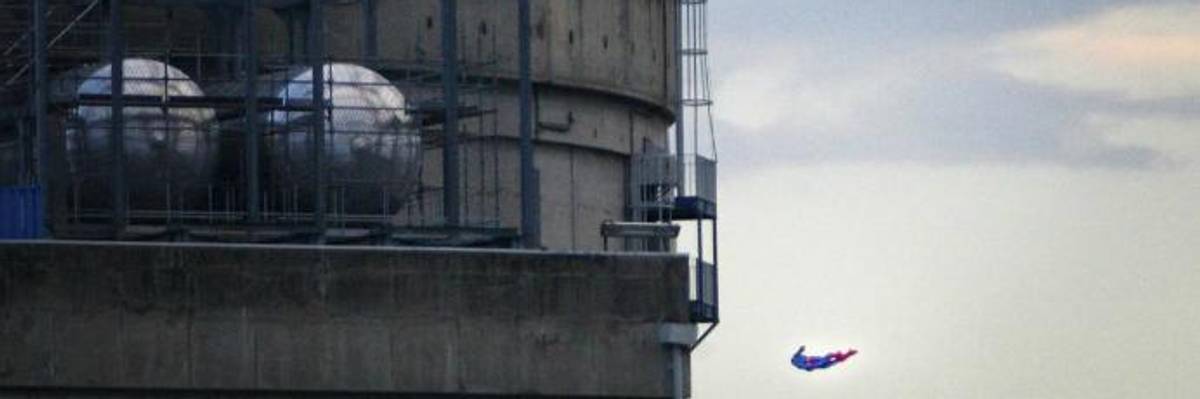
Greenpeace France crashed a drone decked out in a Superman costume into a nuclear power facility on July 3, 2018. (Photo: Nicolas Chauveau/Greenpeace)
Greenpeace France on Tuesday crashed a drone dressed as Superman into the Bugey nuclear energy plant, located about 20 miles east of Lyon, to expose how vulnerable that facility is to a terrorist attack and highlight the broader dangers of this type of power generation.
The activists told AFP that the drone struck "a storage pool for spent nuclear fuel next to a reactor, one of the most radioactive areas at the site."
"This is a highly symbolic action: it shows that spent fuel pools are very accessible, this time from the air, and therefore extremely vulnerable to attack," Yannick Rousselet, head of Greenpeace France's anti-nuclear campaign, said in a statement.
Watch:
Greenpeace France spokesman Cyril Cornier told Le Parisien, in French, that the action itself did not pose any danger to the plant, its workers, or the public, but insisted that by crashing the flying device into the plant's "most fragile point," they had proven beyond any doubt that the security of the facility "is absolutely not assured."
Responding to the action, the French electricity group EDF said that police had intercepted one of two drones piloted by Greenpeace and announced plans to file a formal complaint with authorities. EDF also claimed, "The fuel building is key for security, designed in particular to withstand natural or accidental damage."
Greenpeace EU, on Twitter, called EDF's response "worrying."
France derives about 75 percent of its electricity from 19 state-controlled plants, according to the World Nuclear Association. Activists worldwide have repeatedly sought to draw attention to the dangers of this type of power generation--but particularly in France, where it is so prevalent.
Last October, Greenpeace France activists entered another of EDF's nuclear plants and set off fireworks. At the time, the group emphasized on Twitter, "These installations are vulnerable." AFP reports that in February, "eight activists were sentenced to jail terms or fines" for participating in the firework action.
Dear Common Dreams reader, It’s been nearly 30 years since I co-founded Common Dreams with my late wife, Lina Newhouser. We had the radical notion that journalism should serve the public good, not corporate profits. It was clear to us from the outset what it would take to build such a project. No paid advertisements. No corporate sponsors. No millionaire publisher telling us what to think or do. Many people said we wouldn't last a year, but we proved those doubters wrong. Together with a tremendous team of journalists and dedicated staff, we built an independent media outlet free from the constraints of profits and corporate control. Our mission has always been simple: To inform. To inspire. To ignite change for the common good. Building Common Dreams was not easy. Our survival was never guaranteed. When you take on the most powerful forces—Wall Street greed, fossil fuel industry destruction, Big Tech lobbyists, and uber-rich oligarchs who have spent billions upon billions rigging the economy and democracy in their favor—the only bulwark you have is supporters who believe in your work. But here’s the urgent message from me today. It's never been this bad out there. And it's never been this hard to keep us going. At the very moment Common Dreams is most needed, the threats we face are intensifying. We need your support now more than ever. We don't accept corporate advertising and never will. We don't have a paywall because we don't think people should be blocked from critical news based on their ability to pay. Everything we do is funded by the donations of readers like you. When everyone does the little they can afford, we are strong. But if that support retreats or dries up, so do we. Will you donate now to make sure Common Dreams not only survives but thrives? —Craig Brown, Co-founder |
Greenpeace France on Tuesday crashed a drone dressed as Superman into the Bugey nuclear energy plant, located about 20 miles east of Lyon, to expose how vulnerable that facility is to a terrorist attack and highlight the broader dangers of this type of power generation.
The activists told AFP that the drone struck "a storage pool for spent nuclear fuel next to a reactor, one of the most radioactive areas at the site."
"This is a highly symbolic action: it shows that spent fuel pools are very accessible, this time from the air, and therefore extremely vulnerable to attack," Yannick Rousselet, head of Greenpeace France's anti-nuclear campaign, said in a statement.
Watch:
Greenpeace France spokesman Cyril Cornier told Le Parisien, in French, that the action itself did not pose any danger to the plant, its workers, or the public, but insisted that by crashing the flying device into the plant's "most fragile point," they had proven beyond any doubt that the security of the facility "is absolutely not assured."
Responding to the action, the French electricity group EDF said that police had intercepted one of two drones piloted by Greenpeace and announced plans to file a formal complaint with authorities. EDF also claimed, "The fuel building is key for security, designed in particular to withstand natural or accidental damage."
Greenpeace EU, on Twitter, called EDF's response "worrying."
France derives about 75 percent of its electricity from 19 state-controlled plants, according to the World Nuclear Association. Activists worldwide have repeatedly sought to draw attention to the dangers of this type of power generation--but particularly in France, where it is so prevalent.
Last October, Greenpeace France activists entered another of EDF's nuclear plants and set off fireworks. At the time, the group emphasized on Twitter, "These installations are vulnerable." AFP reports that in February, "eight activists were sentenced to jail terms or fines" for participating in the firework action.
Greenpeace France on Tuesday crashed a drone dressed as Superman into the Bugey nuclear energy plant, located about 20 miles east of Lyon, to expose how vulnerable that facility is to a terrorist attack and highlight the broader dangers of this type of power generation.
The activists told AFP that the drone struck "a storage pool for spent nuclear fuel next to a reactor, one of the most radioactive areas at the site."
"This is a highly symbolic action: it shows that spent fuel pools are very accessible, this time from the air, and therefore extremely vulnerable to attack," Yannick Rousselet, head of Greenpeace France's anti-nuclear campaign, said in a statement.
Watch:
Greenpeace France spokesman Cyril Cornier told Le Parisien, in French, that the action itself did not pose any danger to the plant, its workers, or the public, but insisted that by crashing the flying device into the plant's "most fragile point," they had proven beyond any doubt that the security of the facility "is absolutely not assured."
Responding to the action, the French electricity group EDF said that police had intercepted one of two drones piloted by Greenpeace and announced plans to file a formal complaint with authorities. EDF also claimed, "The fuel building is key for security, designed in particular to withstand natural or accidental damage."
Greenpeace EU, on Twitter, called EDF's response "worrying."
France derives about 75 percent of its electricity from 19 state-controlled plants, according to the World Nuclear Association. Activists worldwide have repeatedly sought to draw attention to the dangers of this type of power generation--but particularly in France, where it is so prevalent.
Last October, Greenpeace France activists entered another of EDF's nuclear plants and set off fireworks. At the time, the group emphasized on Twitter, "These installations are vulnerable." AFP reports that in February, "eight activists were sentenced to jail terms or fines" for participating in the firework action.