SUBSCRIBE TO OUR FREE NEWSLETTER
Daily news & progressive opinion—funded by the people, not the corporations—delivered straight to your inbox.
5
#000000
#FFFFFF
To donate by check, phone, or other method, see our More Ways to Give page.


Daily news & progressive opinion—funded by the people, not the corporations—delivered straight to your inbox.
For the third year in a row, the world experienced its warmest year on the books, global scientists have determined.
The new assessments come from the National Oceanic and Atmospheric Administration (NOAA), the National Aeronautics and Space Administration (NASA), and the UK's Met Office, as well as the World Meteorological Organization (WMO), which relies in part on data from those agencies. The findings also back up the declaration made earlier this month by the EU's Copernicus Climate Change Service.
"2016 is remarkably the third record year in a row in this series," said Gavin Schmidt, director of NASA's Goddard Institute for Space Studies (GISS). "We don't expect record years every year, but the ongoing long-term warming trend is clear."
NOAA's calculations put the average temperature across global land and ocean surfaces at 1.69degF (0.94degC) above the 20th century average, while NASA puts the globally-averaged temperatures for the year at 1.78degF (0.99degC) warmer than the mid-20th century average.
NOAA produced the visualization below showing annual temperatures since 1880 compared to the 20th-century average, and the graphic below it:

From January through December 31, 2016, a total of 22 nations or territories tied or set all-time records for their hottest temperature in recorded history. This breaks the record of eighteen all-time heat records in 2010 for the greatest number of such records set in one year. Just one nation or territory--Hong Kong--set an all-time cold temperature record in 2016.
NOAA also lists as highlights of its global assessment for the year:
Reacting to the record warmth, David Titley, director of the Center for Solutions to Weather and Climate Risk at Penn State University, told the Washington Post:
We are heading into a new unknown. It's like driving on a new road, at night, at speed, without headlights, and looking only through the rearview mirror. Hope we don't meet Thelma and Louise along the way.
For climate advocacy group 350.org, the findings from the agencies further ground its call to keep fossil fuels in the ground--a call whose urgency is made more clear by the incoming Trump administration, which, as Common Dreams wrote,
has given signs that it will go full-speed ahead at driving further climate change. Among other things, Donald Trump has chosen climate change skeptic and "fossil fuel industry puppet" Scott Pruitt to head the EPA, while the president-elect himself falsely declared last month that "nobody really knows" if climate change is real, and has also threatened to cancel the Paris climate deal.
And as Astrid Caldas, climate scientist with the Climate and Energy program at the Union of Concerned Scientists, writes Wednesday, "many of the Cabinet nominees in the new administration insist that yeah, there may be warming, but we don't know the actual role of human emissions, and/or we cannot tell what is going to happen. Those are absurd statements." She adds:
To deny scientific facts and data to make a misleading point meant to cater to one's interests will NOT change the facts or the data--and yet, we are seeing it every day at the nominations hearings, especially when it relates to climate (not to mention for the past decade or longer). To say that "we don't know what will happen" is an actual lie. We DO know what will happen, temperatures will keep going up. What we don't know is the pace and magnitude of global warming--because it depends on the actual amount of emissions dumped in the atmosphere, an obviously unknown fact which depends on our energy choices, which in turn depend on the implementation of the Paris Agreement, on the fulfillment of each nation's pledges, the successful transition to renewable energy, and the timeline of all these actions.
"2016 was the year climate change took hold of the world more clearly than ever, with serious humanitarian and environmental consequences. No part of the world can now avoid the fact that climate change is striking harder and faster than many scientists predicted, and that its impacts are taking a higher toll on the most vulnerable communities," said 350.org Climate Impacts Program coordinator Aaron Packard. "As important as marking that the record is yet again broken, we need to loudly mark what needs to be done to hold back such destruction: we need to keep fossil fuels in the ground. To make that clear, that means no new oil, coal, or gas projects."
"Decades of progress from scientists and engineers has made renewable energy the cheapest and cleanest source of energy in the world, creating the technological momentum that is matched by the millions of people in all parts of the world demanding climate action," Packard continued. "Elected representatives must heed this momentum--it won't cost the earth to keep fossil fuels in the ground, but it will cost the earth if they are dug up."

Dear Common Dreams reader, It’s been nearly 30 years since I co-founded Common Dreams with my late wife, Lina Newhouser. We had the radical notion that journalism should serve the public good, not corporate profits. It was clear to us from the outset what it would take to build such a project. No paid advertisements. No corporate sponsors. No millionaire publisher telling us what to think or do. Many people said we wouldn't last a year, but we proved those doubters wrong. Together with a tremendous team of journalists and dedicated staff, we built an independent media outlet free from the constraints of profits and corporate control. Our mission has always been simple: To inform. To inspire. To ignite change for the common good. Building Common Dreams was not easy. Our survival was never guaranteed. When you take on the most powerful forces—Wall Street greed, fossil fuel industry destruction, Big Tech lobbyists, and uber-rich oligarchs who have spent billions upon billions rigging the economy and democracy in their favor—the only bulwark you have is supporters who believe in your work. But here’s the urgent message from me today. It's never been this bad out there. And it's never been this hard to keep us going. At the very moment Common Dreams is most needed, the threats we face are intensifying. We need your support now more than ever. We don't accept corporate advertising and never will. We don't have a paywall because we don't think people should be blocked from critical news based on their ability to pay. Everything we do is funded by the donations of readers like you. When everyone does the little they can afford, we are strong. But if that support retreats or dries up, so do we. Will you donate now to make sure Common Dreams not only survives but thrives? —Craig Brown, Co-founder |
For the third year in a row, the world experienced its warmest year on the books, global scientists have determined.
The new assessments come from the National Oceanic and Atmospheric Administration (NOAA), the National Aeronautics and Space Administration (NASA), and the UK's Met Office, as well as the World Meteorological Organization (WMO), which relies in part on data from those agencies. The findings also back up the declaration made earlier this month by the EU's Copernicus Climate Change Service.
"2016 is remarkably the third record year in a row in this series," said Gavin Schmidt, director of NASA's Goddard Institute for Space Studies (GISS). "We don't expect record years every year, but the ongoing long-term warming trend is clear."
NOAA's calculations put the average temperature across global land and ocean surfaces at 1.69degF (0.94degC) above the 20th century average, while NASA puts the globally-averaged temperatures for the year at 1.78degF (0.99degC) warmer than the mid-20th century average.
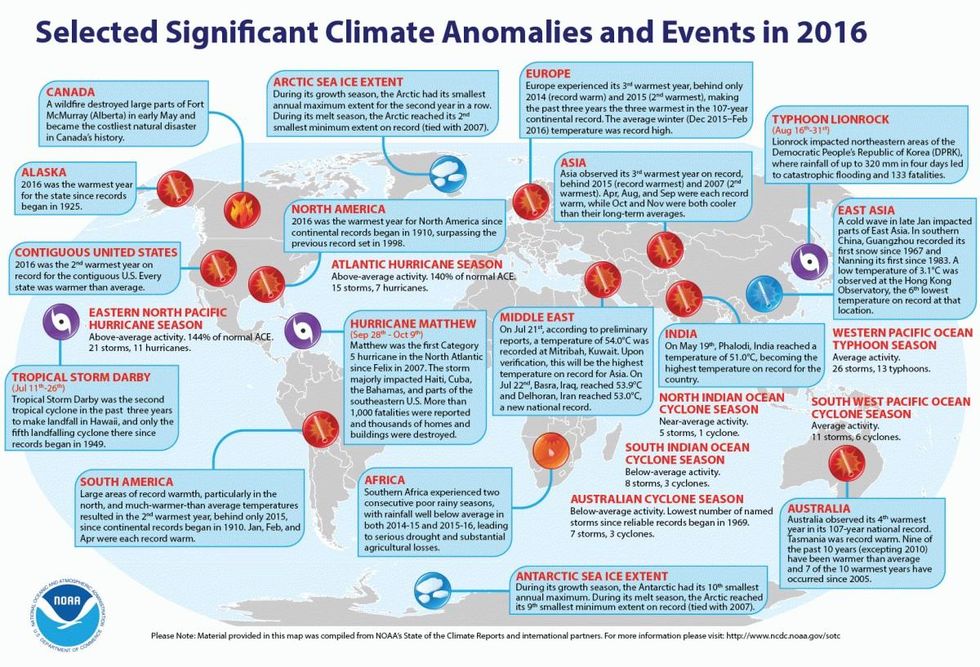
NOAA produced the visualization below showing annual temperatures since 1880 compared to the 20th-century average, and the graphic below it:

From January through December 31, 2016, a total of 22 nations or territories tied or set all-time records for their hottest temperature in recorded history. This breaks the record of eighteen all-time heat records in 2010 for the greatest number of such records set in one year. Just one nation or territory--Hong Kong--set an all-time cold temperature record in 2016.
NOAA also lists as highlights of its global assessment for the year:
Reacting to the record warmth, David Titley, director of the Center for Solutions to Weather and Climate Risk at Penn State University, told the Washington Post:
We are heading into a new unknown. It's like driving on a new road, at night, at speed, without headlights, and looking only through the rearview mirror. Hope we don't meet Thelma and Louise along the way.
For climate advocacy group 350.org, the findings from the agencies further ground its call to keep fossil fuels in the ground--a call whose urgency is made more clear by the incoming Trump administration, which, as Common Dreams wrote,
has given signs that it will go full-speed ahead at driving further climate change. Among other things, Donald Trump has chosen climate change skeptic and "fossil fuel industry puppet" Scott Pruitt to head the EPA, while the president-elect himself falsely declared last month that "nobody really knows" if climate change is real, and has also threatened to cancel the Paris climate deal.
And as Astrid Caldas, climate scientist with the Climate and Energy program at the Union of Concerned Scientists, writes Wednesday, "many of the Cabinet nominees in the new administration insist that yeah, there may be warming, but we don't know the actual role of human emissions, and/or we cannot tell what is going to happen. Those are absurd statements." She adds:
To deny scientific facts and data to make a misleading point meant to cater to one's interests will NOT change the facts or the data--and yet, we are seeing it every day at the nominations hearings, especially when it relates to climate (not to mention for the past decade or longer). To say that "we don't know what will happen" is an actual lie. We DO know what will happen, temperatures will keep going up. What we don't know is the pace and magnitude of global warming--because it depends on the actual amount of emissions dumped in the atmosphere, an obviously unknown fact which depends on our energy choices, which in turn depend on the implementation of the Paris Agreement, on the fulfillment of each nation's pledges, the successful transition to renewable energy, and the timeline of all these actions.
"2016 was the year climate change took hold of the world more clearly than ever, with serious humanitarian and environmental consequences. No part of the world can now avoid the fact that climate change is striking harder and faster than many scientists predicted, and that its impacts are taking a higher toll on the most vulnerable communities," said 350.org Climate Impacts Program coordinator Aaron Packard. "As important as marking that the record is yet again broken, we need to loudly mark what needs to be done to hold back such destruction: we need to keep fossil fuels in the ground. To make that clear, that means no new oil, coal, or gas projects."
"Decades of progress from scientists and engineers has made renewable energy the cheapest and cleanest source of energy in the world, creating the technological momentum that is matched by the millions of people in all parts of the world demanding climate action," Packard continued. "Elected representatives must heed this momentum--it won't cost the earth to keep fossil fuels in the ground, but it will cost the earth if they are dug up."
For the third year in a row, the world experienced its warmest year on the books, global scientists have determined.
The new assessments come from the National Oceanic and Atmospheric Administration (NOAA), the National Aeronautics and Space Administration (NASA), and the UK's Met Office, as well as the World Meteorological Organization (WMO), which relies in part on data from those agencies. The findings also back up the declaration made earlier this month by the EU's Copernicus Climate Change Service.
"2016 is remarkably the third record year in a row in this series," said Gavin Schmidt, director of NASA's Goddard Institute for Space Studies (GISS). "We don't expect record years every year, but the ongoing long-term warming trend is clear."
NOAA's calculations put the average temperature across global land and ocean surfaces at 1.69degF (0.94degC) above the 20th century average, while NASA puts the globally-averaged temperatures for the year at 1.78degF (0.99degC) warmer than the mid-20th century average.
NOAA produced the visualization below showing annual temperatures since 1880 compared to the 20th-century average, and the graphic below it:

From January through December 31, 2016, a total of 22 nations or territories tied or set all-time records for their hottest temperature in recorded history. This breaks the record of eighteen all-time heat records in 2010 for the greatest number of such records set in one year. Just one nation or territory--Hong Kong--set an all-time cold temperature record in 2016.
NOAA also lists as highlights of its global assessment for the year:
Reacting to the record warmth, David Titley, director of the Center for Solutions to Weather and Climate Risk at Penn State University, told the Washington Post:
We are heading into a new unknown. It's like driving on a new road, at night, at speed, without headlights, and looking only through the rearview mirror. Hope we don't meet Thelma and Louise along the way.
For climate advocacy group 350.org, the findings from the agencies further ground its call to keep fossil fuels in the ground--a call whose urgency is made more clear by the incoming Trump administration, which, as Common Dreams wrote,
has given signs that it will go full-speed ahead at driving further climate change. Among other things, Donald Trump has chosen climate change skeptic and "fossil fuel industry puppet" Scott Pruitt to head the EPA, while the president-elect himself falsely declared last month that "nobody really knows" if climate change is real, and has also threatened to cancel the Paris climate deal.
And as Astrid Caldas, climate scientist with the Climate and Energy program at the Union of Concerned Scientists, writes Wednesday, "many of the Cabinet nominees in the new administration insist that yeah, there may be warming, but we don't know the actual role of human emissions, and/or we cannot tell what is going to happen. Those are absurd statements." She adds:
To deny scientific facts and data to make a misleading point meant to cater to one's interests will NOT change the facts or the data--and yet, we are seeing it every day at the nominations hearings, especially when it relates to climate (not to mention for the past decade or longer). To say that "we don't know what will happen" is an actual lie. We DO know what will happen, temperatures will keep going up. What we don't know is the pace and magnitude of global warming--because it depends on the actual amount of emissions dumped in the atmosphere, an obviously unknown fact which depends on our energy choices, which in turn depend on the implementation of the Paris Agreement, on the fulfillment of each nation's pledges, the successful transition to renewable energy, and the timeline of all these actions.
"2016 was the year climate change took hold of the world more clearly than ever, with serious humanitarian and environmental consequences. No part of the world can now avoid the fact that climate change is striking harder and faster than many scientists predicted, and that its impacts are taking a higher toll on the most vulnerable communities," said 350.org Climate Impacts Program coordinator Aaron Packard. "As important as marking that the record is yet again broken, we need to loudly mark what needs to be done to hold back such destruction: we need to keep fossil fuels in the ground. To make that clear, that means no new oil, coal, or gas projects."
"Decades of progress from scientists and engineers has made renewable energy the cheapest and cleanest source of energy in the world, creating the technological momentum that is matched by the millions of people in all parts of the world demanding climate action," Packard continued. "Elected representatives must heed this momentum--it won't cost the earth to keep fossil fuels in the ground, but it will cost the earth if they are dug up."