SUBSCRIBE TO OUR FREE NEWSLETTER
Daily news & progressive opinion—funded by the people, not the corporations—delivered straight to your inbox.
5
#000000
#FFFFFF
To donate by check, phone, or other method, see our More Ways to Give page.


Daily news & progressive opinion—funded by the people, not the corporations—delivered straight to your inbox.
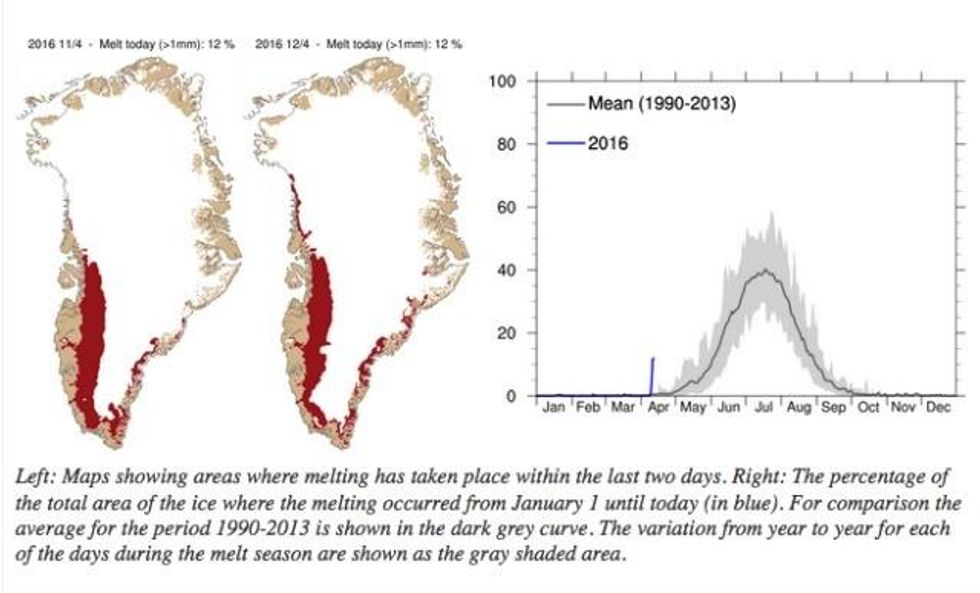
Greenland's ice sheet has started melting so early that scientists initially thought their models had broken when they saw the record-breaking measurements.
Melt in Greenland, over this wide an area, this early in the season, is not supposed to happen.
--Climate scientist Mike MacFarrin
"To say the 2016 Greenland melt season is off to the races is an understatement," reported Climate Central's Brian Kahn on Tuesday. "Warm, wet conditions rapidly kicked off the melt season this weekend, more than a month-and-a-half ahead of schedule."
The annual melting of Greenland's ice sheet officially starts when at least 10 percent of the ice sheet has melted. "The former top 3 earliest dates for a melt area larger than 10 percent were previously all in May," wrote Danish ice monitoring research outlet Polar Portal.
In average years, the melt season in Greenland begins in late May or early June. On Tuesday, however, the temperature in a small village in southwest Greenland hit a record-setting high of 64.4degF, and "heavy rain also inundated local communities," Kahn reported. The high temperatures and rainy conditions are contributing to the ice sheet's melt.
"Melt in Greenland, over this wide an area, this early in the season, is not supposed to happen," wrote climate scientist Mike MacFarrin in a response posted on the Cooperative Institute for Research in Environmental Sciences (CIRES) website, detailing how the early melt may derail critical ice monitoring plans.

"Scientists at the [Danish Meteorological Institute (DMI)] were at first incredulous due to the early date," reported Polar Portal.
Indeed, the melt season's early onset is so unusual that scientists at first thought a technical malfunction was to blame. "We had to check that our models were still working properly," said Peter Langen, a climate scientist at DMI, to Polar Portal.
The measurements were accurate, however, and the record-breaking early melt season in Greenland will have adverse effects around the world.
As Kahn writes, "The Greenland ice sheet represents one of the most massive stores of ice on the planet. If it were all to melt, it would raise oceans about 20 feet. Melting ice is also affecting ocean circulation and even the drift of the North Pole."
"Despite the ice sheet's remote location, its slushy fingers reach across the globe, influencing sea levels and how fast the Gulf Stream current moves," observed Kahn last year, when the ice sheet melted unusually quickly under hot summer temperatures.
The melt season's start previously broke records in 2012, 2010, 2007, and 2002, noted MacFerrin, pointing to an obvious trend as the globe warms faster than most experts predicted.
Dear Common Dreams reader, It’s been nearly 30 years since I co-founded Common Dreams with my late wife, Lina Newhouser. We had the radical notion that journalism should serve the public good, not corporate profits. It was clear to us from the outset what it would take to build such a project. No paid advertisements. No corporate sponsors. No millionaire publisher telling us what to think or do. Many people said we wouldn't last a year, but we proved those doubters wrong. Together with a tremendous team of journalists and dedicated staff, we built an independent media outlet free from the constraints of profits and corporate control. Our mission has always been simple: To inform. To inspire. To ignite change for the common good. Building Common Dreams was not easy. Our survival was never guaranteed. When you take on the most powerful forces—Wall Street greed, fossil fuel industry destruction, Big Tech lobbyists, and uber-rich oligarchs who have spent billions upon billions rigging the economy and democracy in their favor—the only bulwark you have is supporters who believe in your work. But here’s the urgent message from me today. It's never been this bad out there. And it's never been this hard to keep us going. At the very moment Common Dreams is most needed, the threats we face are intensifying. We need your support now more than ever. We don't accept corporate advertising and never will. We don't have a paywall because we don't think people should be blocked from critical news based on their ability to pay. Everything we do is funded by the donations of readers like you. When everyone does the little they can afford, we are strong. But if that support retreats or dries up, so do we. Will you donate now to make sure Common Dreams not only survives but thrives? —Craig Brown, Co-founder |
Greenland's ice sheet has started melting so early that scientists initially thought their models had broken when they saw the record-breaking measurements.
Melt in Greenland, over this wide an area, this early in the season, is not supposed to happen.
--Climate scientist Mike MacFarrin
"To say the 2016 Greenland melt season is off to the races is an understatement," reported Climate Central's Brian Kahn on Tuesday. "Warm, wet conditions rapidly kicked off the melt season this weekend, more than a month-and-a-half ahead of schedule."
The annual melting of Greenland's ice sheet officially starts when at least 10 percent of the ice sheet has melted. "The former top 3 earliest dates for a melt area larger than 10 percent were previously all in May," wrote Danish ice monitoring research outlet Polar Portal.
In average years, the melt season in Greenland begins in late May or early June. On Tuesday, however, the temperature in a small village in southwest Greenland hit a record-setting high of 64.4degF, and "heavy rain also inundated local communities," Kahn reported. The high temperatures and rainy conditions are contributing to the ice sheet's melt.
"Melt in Greenland, over this wide an area, this early in the season, is not supposed to happen," wrote climate scientist Mike MacFarrin in a response posted on the Cooperative Institute for Research in Environmental Sciences (CIRES) website, detailing how the early melt may derail critical ice monitoring plans.

"Scientists at the [Danish Meteorological Institute (DMI)] were at first incredulous due to the early date," reported Polar Portal.
Indeed, the melt season's early onset is so unusual that scientists at first thought a technical malfunction was to blame. "We had to check that our models were still working properly," said Peter Langen, a climate scientist at DMI, to Polar Portal.
The measurements were accurate, however, and the record-breaking early melt season in Greenland will have adverse effects around the world.
As Kahn writes, "The Greenland ice sheet represents one of the most massive stores of ice on the planet. If it were all to melt, it would raise oceans about 20 feet. Melting ice is also affecting ocean circulation and even the drift of the North Pole."
"Despite the ice sheet's remote location, its slushy fingers reach across the globe, influencing sea levels and how fast the Gulf Stream current moves," observed Kahn last year, when the ice sheet melted unusually quickly under hot summer temperatures.
The melt season's start previously broke records in 2012, 2010, 2007, and 2002, noted MacFerrin, pointing to an obvious trend as the globe warms faster than most experts predicted.

Greenland's ice sheet has started melting so early that scientists initially thought their models had broken when they saw the record-breaking measurements.
Melt in Greenland, over this wide an area, this early in the season, is not supposed to happen.
--Climate scientist Mike MacFarrin
"To say the 2016 Greenland melt season is off to the races is an understatement," reported Climate Central's Brian Kahn on Tuesday. "Warm, wet conditions rapidly kicked off the melt season this weekend, more than a month-and-a-half ahead of schedule."
The annual melting of Greenland's ice sheet officially starts when at least 10 percent of the ice sheet has melted. "The former top 3 earliest dates for a melt area larger than 10 percent were previously all in May," wrote Danish ice monitoring research outlet Polar Portal.
In average years, the melt season in Greenland begins in late May or early June. On Tuesday, however, the temperature in a small village in southwest Greenland hit a record-setting high of 64.4degF, and "heavy rain also inundated local communities," Kahn reported. The high temperatures and rainy conditions are contributing to the ice sheet's melt.
"Melt in Greenland, over this wide an area, this early in the season, is not supposed to happen," wrote climate scientist Mike MacFarrin in a response posted on the Cooperative Institute for Research in Environmental Sciences (CIRES) website, detailing how the early melt may derail critical ice monitoring plans.

"Scientists at the [Danish Meteorological Institute (DMI)] were at first incredulous due to the early date," reported Polar Portal.
Indeed, the melt season's early onset is so unusual that scientists at first thought a technical malfunction was to blame. "We had to check that our models were still working properly," said Peter Langen, a climate scientist at DMI, to Polar Portal.
The measurements were accurate, however, and the record-breaking early melt season in Greenland will have adverse effects around the world.
As Kahn writes, "The Greenland ice sheet represents one of the most massive stores of ice on the planet. If it were all to melt, it would raise oceans about 20 feet. Melting ice is also affecting ocean circulation and even the drift of the North Pole."
"Despite the ice sheet's remote location, its slushy fingers reach across the globe, influencing sea levels and how fast the Gulf Stream current moves," observed Kahn last year, when the ice sheet melted unusually quickly under hot summer temperatures.
The melt season's start previously broke records in 2012, 2010, 2007, and 2002, noted MacFerrin, pointing to an obvious trend as the globe warms faster than most experts predicted.