SUBSCRIBE TO OUR FREE NEWSLETTER
Daily news & progressive opinion—funded by the people, not the corporations—delivered straight to your inbox.
5
#000000
#FFFFFF
To donate by check, phone, or other method, see our More Ways to Give page.
Daily news & progressive opinion—funded by the people, not the corporations—delivered straight to your inbox.
Despite creating a world where you have to take off your shoes, empty every drop out of a water bottle, dispose of toenail scissors, and expose yourself to a full-body scanner (or submit to a physical pat-down) every time you want to get on an airplane, the Transportation Safety Administration failed to find a full 95 percent of fake weapons which passed through airport security checkpoints during covert tests performed recently by the Department of Homeland Security.
As ABC News, which broke the story on Monday, reports:
An internal investigation of the Transportation Security Administration revealed security failures at dozens of the nation's busiest airports, where undercover investigators were able to smuggle mock explosives or banned weapons through checkpoints in 95 percent of trials, ABC News has learned.
The series of tests were conducted by Homeland Security Red Teams who pose as passengers, setting out to beat the system.
According to officials briefed on the results of a recent Homeland Security Inspector General's report, TSA agents failed 67 out of 70 tests, with Red Team members repeatedly able to get potential weapons through checkpoints.
In one test an undercover agent was stopped after setting off an alarm at a magnetometer, but TSA screeners failed to detect a fake explosive device that was taped to his back during a follow-on pat down.
As a result of the high failure rate, Secretary of Homeland Security Jeh Johnson has reassigned the TSA chief to a new role at the agency and ordered a full review of security procedures and ordered immediate improvements.
Strikingly, as ABC noted, the review by DHS determined that "despite spending $540 million for checked baggage screening equipment and another $11 million for training since a previous review in 2009, the TSA failed to make any noticeable improvements in that time."
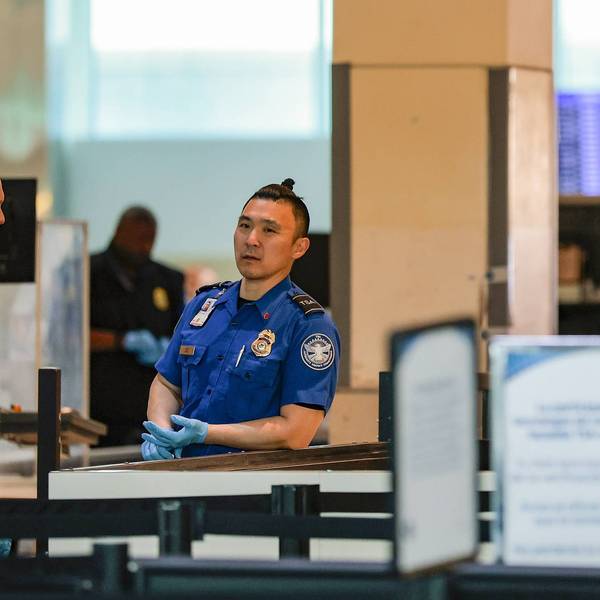
Created after the attacks of 9/11, DHS has spearheaded the vast security apparatus that has now become everyday life for anyone who travels by air in the United States. The TSA, of course, is the army of blue-shirted guards who administer the checkpoints. For nearly fifteen years since 2001, critics of the TSA and civil liberties advocates have contended that the unchecked rise of airport security has done much to invade the privacy of travelers while also giving rise to a lucrative, and largely unnecessary, industry that has put billions of federal dollars into the pockets of private companies who benefit from the security-industrial complex.
Just this weekend, journalist Lee Fang reported how a former lobbyist for one of the companies that builds full-body scanners, and aggressively Congress to pass laws making them mandatory at U.S. airports, was hired as a staffer for one of the key congressional committees responsible for the oversight and funding of the TSA.
According to Fang:
Rapiscan Systems lobbied aggressively to win a major contract with the Transportation Security Administration to provide X-ray body scanners at airports, only to lose the contract in 2013 after the company failed to deliver software to protect the privacy of passengers.
Rapiscan now has a friend on the inside.
Earlier this month, Rapiscan lobbyist Christopher Romig took a job with the House Appropriations Committee's Homeland Security Subcommittee, which oversees the TSA budget.
The entryways to U.S. airports are heavily (if poorly) monitored, it seems, while the ones entering Congress continue to be the revolving kind.
Dear Common Dreams reader, It’s been nearly 30 years since I co-founded Common Dreams with my late wife, Lina Newhouser. We had the radical notion that journalism should serve the public good, not corporate profits. It was clear to us from the outset what it would take to build such a project. No paid advertisements. No corporate sponsors. No millionaire publisher telling us what to think or do. Many people said we wouldn't last a year, but we proved those doubters wrong. Together with a tremendous team of journalists and dedicated staff, we built an independent media outlet free from the constraints of profits and corporate control. Our mission has always been simple: To inform. To inspire. To ignite change for the common good. Building Common Dreams was not easy. Our survival was never guaranteed. When you take on the most powerful forces—Wall Street greed, fossil fuel industry destruction, Big Tech lobbyists, and uber-rich oligarchs who have spent billions upon billions rigging the economy and democracy in their favor—the only bulwark you have is supporters who believe in your work. But here’s the urgent message from me today. It's never been this bad out there. And it's never been this hard to keep us going. At the very moment Common Dreams is most needed, the threats we face are intensifying. We need your support now more than ever. We don't accept corporate advertising and never will. We don't have a paywall because we don't think people should be blocked from critical news based on their ability to pay. Everything we do is funded by the donations of readers like you. When everyone does the little they can afford, we are strong. But if that support retreats or dries up, so do we. Will you donate now to make sure Common Dreams not only survives but thrives? —Craig Brown, Co-founder |
Despite creating a world where you have to take off your shoes, empty every drop out of a water bottle, dispose of toenail scissors, and expose yourself to a full-body scanner (or submit to a physical pat-down) every time you want to get on an airplane, the Transportation Safety Administration failed to find a full 95 percent of fake weapons which passed through airport security checkpoints during covert tests performed recently by the Department of Homeland Security.
As ABC News, which broke the story on Monday, reports:
An internal investigation of the Transportation Security Administration revealed security failures at dozens of the nation's busiest airports, where undercover investigators were able to smuggle mock explosives or banned weapons through checkpoints in 95 percent of trials, ABC News has learned.
The series of tests were conducted by Homeland Security Red Teams who pose as passengers, setting out to beat the system.
According to officials briefed on the results of a recent Homeland Security Inspector General's report, TSA agents failed 67 out of 70 tests, with Red Team members repeatedly able to get potential weapons through checkpoints.
In one test an undercover agent was stopped after setting off an alarm at a magnetometer, but TSA screeners failed to detect a fake explosive device that was taped to his back during a follow-on pat down.
As a result of the high failure rate, Secretary of Homeland Security Jeh Johnson has reassigned the TSA chief to a new role at the agency and ordered a full review of security procedures and ordered immediate improvements.
Strikingly, as ABC noted, the review by DHS determined that "despite spending $540 million for checked baggage screening equipment and another $11 million for training since a previous review in 2009, the TSA failed to make any noticeable improvements in that time."
Created after the attacks of 9/11, DHS has spearheaded the vast security apparatus that has now become everyday life for anyone who travels by air in the United States. The TSA, of course, is the army of blue-shirted guards who administer the checkpoints. For nearly fifteen years since 2001, critics of the TSA and civil liberties advocates have contended that the unchecked rise of airport security has done much to invade the privacy of travelers while also giving rise to a lucrative, and largely unnecessary, industry that has put billions of federal dollars into the pockets of private companies who benefit from the security-industrial complex.
Just this weekend, journalist Lee Fang reported how a former lobbyist for one of the companies that builds full-body scanners, and aggressively Congress to pass laws making them mandatory at U.S. airports, was hired as a staffer for one of the key congressional committees responsible for the oversight and funding of the TSA.
According to Fang:
Rapiscan Systems lobbied aggressively to win a major contract with the Transportation Security Administration to provide X-ray body scanners at airports, only to lose the contract in 2013 after the company failed to deliver software to protect the privacy of passengers.
Rapiscan now has a friend on the inside.
Earlier this month, Rapiscan lobbyist Christopher Romig took a job with the House Appropriations Committee's Homeland Security Subcommittee, which oversees the TSA budget.
The entryways to U.S. airports are heavily (if poorly) monitored, it seems, while the ones entering Congress continue to be the revolving kind.
Despite creating a world where you have to take off your shoes, empty every drop out of a water bottle, dispose of toenail scissors, and expose yourself to a full-body scanner (or submit to a physical pat-down) every time you want to get on an airplane, the Transportation Safety Administration failed to find a full 95 percent of fake weapons which passed through airport security checkpoints during covert tests performed recently by the Department of Homeland Security.
As ABC News, which broke the story on Monday, reports:
An internal investigation of the Transportation Security Administration revealed security failures at dozens of the nation's busiest airports, where undercover investigators were able to smuggle mock explosives or banned weapons through checkpoints in 95 percent of trials, ABC News has learned.
The series of tests were conducted by Homeland Security Red Teams who pose as passengers, setting out to beat the system.
According to officials briefed on the results of a recent Homeland Security Inspector General's report, TSA agents failed 67 out of 70 tests, with Red Team members repeatedly able to get potential weapons through checkpoints.
In one test an undercover agent was stopped after setting off an alarm at a magnetometer, but TSA screeners failed to detect a fake explosive device that was taped to his back during a follow-on pat down.
As a result of the high failure rate, Secretary of Homeland Security Jeh Johnson has reassigned the TSA chief to a new role at the agency and ordered a full review of security procedures and ordered immediate improvements.
Strikingly, as ABC noted, the review by DHS determined that "despite spending $540 million for checked baggage screening equipment and another $11 million for training since a previous review in 2009, the TSA failed to make any noticeable improvements in that time."
Created after the attacks of 9/11, DHS has spearheaded the vast security apparatus that has now become everyday life for anyone who travels by air in the United States. The TSA, of course, is the army of blue-shirted guards who administer the checkpoints. For nearly fifteen years since 2001, critics of the TSA and civil liberties advocates have contended that the unchecked rise of airport security has done much to invade the privacy of travelers while also giving rise to a lucrative, and largely unnecessary, industry that has put billions of federal dollars into the pockets of private companies who benefit from the security-industrial complex.
Just this weekend, journalist Lee Fang reported how a former lobbyist for one of the companies that builds full-body scanners, and aggressively Congress to pass laws making them mandatory at U.S. airports, was hired as a staffer for one of the key congressional committees responsible for the oversight and funding of the TSA.
According to Fang:
Rapiscan Systems lobbied aggressively to win a major contract with the Transportation Security Administration to provide X-ray body scanners at airports, only to lose the contract in 2013 after the company failed to deliver software to protect the privacy of passengers.
Rapiscan now has a friend on the inside.
Earlier this month, Rapiscan lobbyist Christopher Romig took a job with the House Appropriations Committee's Homeland Security Subcommittee, which oversees the TSA budget.
The entryways to U.S. airports are heavily (if poorly) monitored, it seems, while the ones entering Congress continue to be the revolving kind.