SUBSCRIBE TO OUR FREE NEWSLETTER
Daily news & progressive opinion—funded by the people, not the corporations—delivered straight to your inbox.
5
#000000
#FFFFFF
To donate by check, phone, or other method, see our More Ways to Give page.
As the gap between the rich and poor in the U.S. continues to grow with more and more wealth being held by fewer people, 63 percent of Americans say that this distribution is unfair, according to a new Gallup survey (pdf) published Monday.
Additionally, 52 percent of respondents say that the problem of inequality should be solved with "heavy taxes on the rich," a proportion that has risen from 45 percent since Gallup first began asking that question in 1998.
Based on the response to both questions, Gallup concludes that roughly half (46%) of all Americans are "strong redistributionists," and thus believe that the government should have a hand in shifting the disproportionate distribution of wealth away from the top one-percent of earners.
Based on on telephone interviews conducted April 9-12 with a sample of 1,015 adults living in all 50 states as well as the District of Columbia, the poll comes as political candidates vying for both the Republican and Democratic presidential nominations have begun stumping on possible ways to solve America's worsening inequality.
Writing about the implication of the survey findings, Gallup editor in chief Frank Newport says that it is an issue members of both parties must be willing to address in their campaigns for president, noting that the 29 percent of Republicans who also backed redistribution is a "not insubstantial" amount.
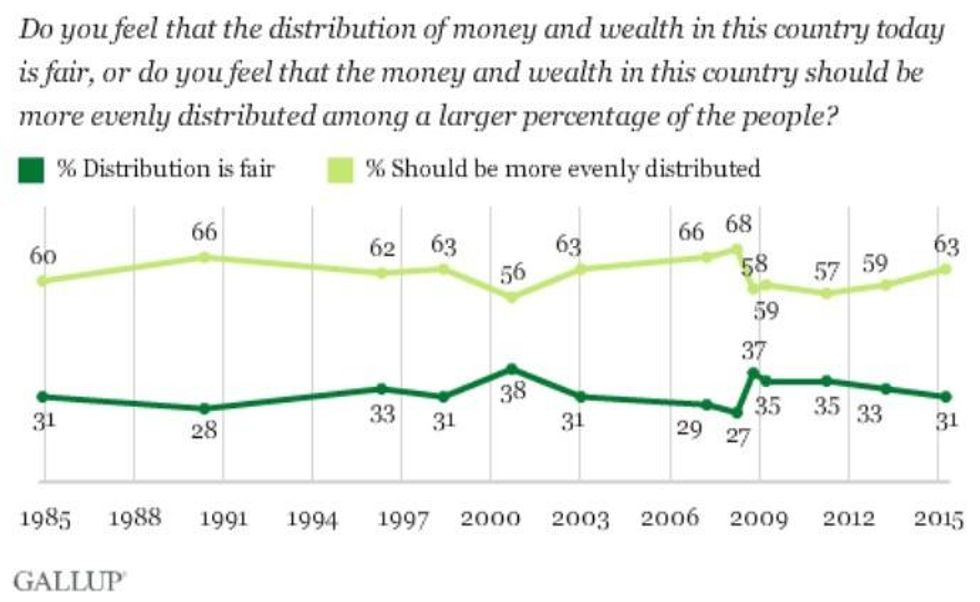
As the gap between the rich and poor in the U.S. continues to grow with more and more wealth being held by fewer people, 63 percent of Americans say that this distribution is unfair, according to a new Gallup survey (pdf) published Monday.
Additionally, 52 percent of respondents say that the problem of inequality should be solved with "heavy taxes on the rich," a proportion that has risen from 45 percent since Gallup first began asking that question in 1998.
Based on the response to both questions, Gallup concludes that roughly half (46%) of all Americans are "strong redistributionists," and thus believe that the government should have a hand in shifting the disproportionate distribution of wealth away from the top one-percent of earners.
Based on on telephone interviews conducted April 9-12 with a sample of 1,015 adults living in all 50 states as well as the District of Columbia, the poll comes as political candidates vying for both the Republican and Democratic presidential nominations have begun stumping on possible ways to solve America's worsening inequality.
Writing about the implication of the survey findings, Gallup editor in chief Frank Newport says that it is an issue members of both parties must be willing to address in their campaigns for president, noting that the 29 percent of Republicans who also backed redistribution is a "not insubstantial" amount.
As the gap between the rich and poor in the U.S. continues to grow with more and more wealth being held by fewer people, 63 percent of Americans say that this distribution is unfair, according to a new Gallup survey (pdf) published Monday.
Additionally, 52 percent of respondents say that the problem of inequality should be solved with "heavy taxes on the rich," a proportion that has risen from 45 percent since Gallup first began asking that question in 1998.
Based on the response to both questions, Gallup concludes that roughly half (46%) of all Americans are "strong redistributionists," and thus believe that the government should have a hand in shifting the disproportionate distribution of wealth away from the top one-percent of earners.
Based on on telephone interviews conducted April 9-12 with a sample of 1,015 adults living in all 50 states as well as the District of Columbia, the poll comes as political candidates vying for both the Republican and Democratic presidential nominations have begun stumping on possible ways to solve America's worsening inequality.
Writing about the implication of the survey findings, Gallup editor in chief Frank Newport says that it is an issue members of both parties must be willing to address in their campaigns for president, noting that the 29 percent of Republicans who also backed redistribution is a "not insubstantial" amount.