Seizing on Latest Police Killing, National Protests Declare: 'This Must Stop!'
Mass demonstrations held in 30 cities calling for end to police brutality against people of color
Seizing on the growing backlash against police brutalization and discriminatory mass incarceration, people across the country on Tuesday took to the streets. With mass demonstrations, sit-ins, and blockades, protesters in 30 cities demanded an end to "business as usual" within the U.S. criminal justice system.
According to organizers, 1,500 people marched in the streets of New York City, stopping traffic on the Brooklyn Bridge, while close to 1,000 rallied outside police headquarters in Los Angeles and hundreds converged on Daley Center Plaza in Chicago. And in smaller cities like Springfield, Mass.; Cleveland, Ohio; Stockton, Calif.; and Gainesville, Fla., community members also joined in the growing chorus of voices calling for change.
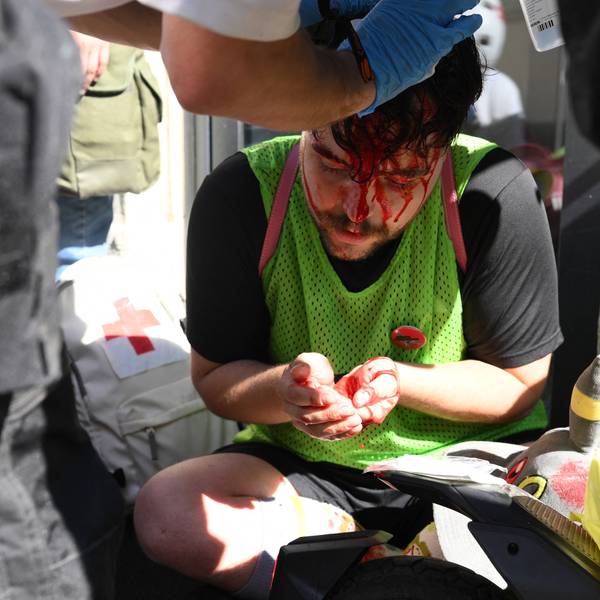
The police, however, came out in force against the largely peaceful demonstrations, with numerous reports of injuries and arrests: 15 arrested in Springfield; 3 in Birmingham, Alabama; and roughly a dozen detained in New York City with reported incidents of violence against protesters.
"After a winter of murder after murder, video upon video, passivity has been cracked," protest organizer Carl Dix, of the Stop Mass Incarceration Network, said in a statement. "A door opened to a new wave of defiant resistance to say that this murder of Black and Latino people must STOP."
These latest demonstrations come one week after an unarmed black man was shot in the back by a police officer in North Charleston, South Carolina.
The movement--which was sparked in August 2014 after officer Darren Wilson shot and killed black teenager Michael Brown in Ferguson, Missouri--has captured national attention, with the rallying cry "Black Lives Matter" gracing the most recent cover of Time magazine.
However, activists say growing awareness is not enough and are vowing to keep up the pressure until systemic changes are made.
"We've got a black president, a black attorney general, a black Cabinet secretary of Homeland Security, but we haven't had one federal prosecution of a policeman for killing all of those folks," professor and activist Dr. Cornel West, who along with Dix organized the day of action, declared before the New York City crowd.
Throughout the day, images were shared online under the hashtag #ShutdownA14.
We are at a crossroads
This country and this world are at a monumental crossroads. In a few short weeks, US voters will have an opportunity to beat back the forces of fascism and confront the billionaires who are rigging the economy, our media system, and our democracy, making it increasingly impossible for ordinary people to get by. We’re not just talking about the election. We’re talking about what must be done once these fascist elements are vanquished from power. We need a bolder set of solutions than what either major party has so far been willing to offer and a working-class movement ready to fight like hell for it. Trump didn't emerge from nowhere. The conditions that fueled MAGA authoritarianism were created by decades of radical neoliberal economic policies and a corrupt political system dominated by corporate interests. They slashed taxes on the super-rich, promising that the benefits would trickle down. They said giveaways to the corporate titans would make life more affordable for the rest of us. It was all bullshit. And when a bitter, betrayed populace searches for someone to blame, right-wing demagogues have little trouble finding scapegoats. People know when they're being lied to, but you won't hear any of this from the corporate media. Only independent journalism—powered and funded by people who believe in building a better world—can deliver truly trustworthy daily news. Our Fall Campaign is underway, and we need your help. To power our newsroom through the rest of the year, we need to raise $125,000 by midnight on October 31. So if you share our vision, please contribute whatever you can to sustain our work. |
Seizing on the growing backlash against police brutalization and discriminatory mass incarceration, people across the country on Tuesday took to the streets. With mass demonstrations, sit-ins, and blockades, protesters in 30 cities demanded an end to "business as usual" within the U.S. criminal justice system.
According to organizers, 1,500 people marched in the streets of New York City, stopping traffic on the Brooklyn Bridge, while close to 1,000 rallied outside police headquarters in Los Angeles and hundreds converged on Daley Center Plaza in Chicago. And in smaller cities like Springfield, Mass.; Cleveland, Ohio; Stockton, Calif.; and Gainesville, Fla., community members also joined in the growing chorus of voices calling for change.
The police, however, came out in force against the largely peaceful demonstrations, with numerous reports of injuries and arrests: 15 arrested in Springfield; 3 in Birmingham, Alabama; and roughly a dozen detained in New York City with reported incidents of violence against protesters.
"After a winter of murder after murder, video upon video, passivity has been cracked," protest organizer Carl Dix, of the Stop Mass Incarceration Network, said in a statement. "A door opened to a new wave of defiant resistance to say that this murder of Black and Latino people must STOP."
These latest demonstrations come one week after an unarmed black man was shot in the back by a police officer in North Charleston, South Carolina.
The movement--which was sparked in August 2014 after officer Darren Wilson shot and killed black teenager Michael Brown in Ferguson, Missouri--has captured national attention, with the rallying cry "Black Lives Matter" gracing the most recent cover of Time magazine.
However, activists say growing awareness is not enough and are vowing to keep up the pressure until systemic changes are made.
"We've got a black president, a black attorney general, a black Cabinet secretary of Homeland Security, but we haven't had one federal prosecution of a policeman for killing all of those folks," professor and activist Dr. Cornel West, who along with Dix organized the day of action, declared before the New York City crowd.
Throughout the day, images were shared online under the hashtag #ShutdownA14.
Seizing on the growing backlash against police brutalization and discriminatory mass incarceration, people across the country on Tuesday took to the streets. With mass demonstrations, sit-ins, and blockades, protesters in 30 cities demanded an end to "business as usual" within the U.S. criminal justice system.
According to organizers, 1,500 people marched in the streets of New York City, stopping traffic on the Brooklyn Bridge, while close to 1,000 rallied outside police headquarters in Los Angeles and hundreds converged on Daley Center Plaza in Chicago. And in smaller cities like Springfield, Mass.; Cleveland, Ohio; Stockton, Calif.; and Gainesville, Fla., community members also joined in the growing chorus of voices calling for change.
The police, however, came out in force against the largely peaceful demonstrations, with numerous reports of injuries and arrests: 15 arrested in Springfield; 3 in Birmingham, Alabama; and roughly a dozen detained in New York City with reported incidents of violence against protesters.
"After a winter of murder after murder, video upon video, passivity has been cracked," protest organizer Carl Dix, of the Stop Mass Incarceration Network, said in a statement. "A door opened to a new wave of defiant resistance to say that this murder of Black and Latino people must STOP."
These latest demonstrations come one week after an unarmed black man was shot in the back by a police officer in North Charleston, South Carolina.
The movement--which was sparked in August 2014 after officer Darren Wilson shot and killed black teenager Michael Brown in Ferguson, Missouri--has captured national attention, with the rallying cry "Black Lives Matter" gracing the most recent cover of Time magazine.
However, activists say growing awareness is not enough and are vowing to keep up the pressure until systemic changes are made.
"We've got a black president, a black attorney general, a black Cabinet secretary of Homeland Security, but we haven't had one federal prosecution of a policeman for killing all of those folks," professor and activist Dr. Cornel West, who along with Dix organized the day of action, declared before the New York City crowd.
Throughout the day, images were shared online under the hashtag #ShutdownA14.