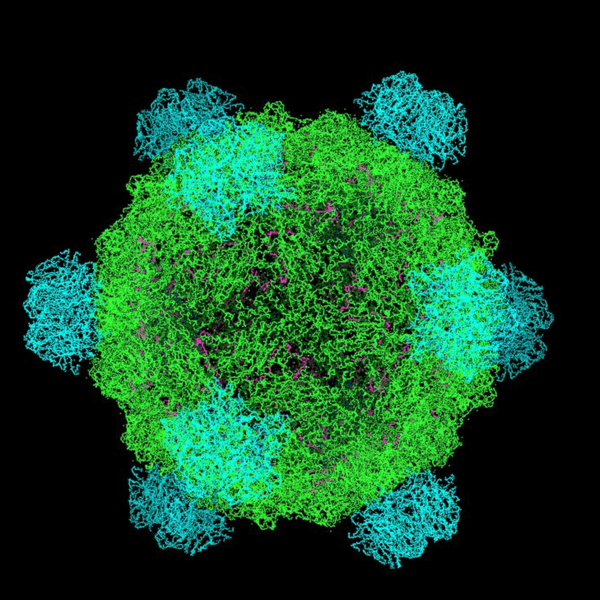

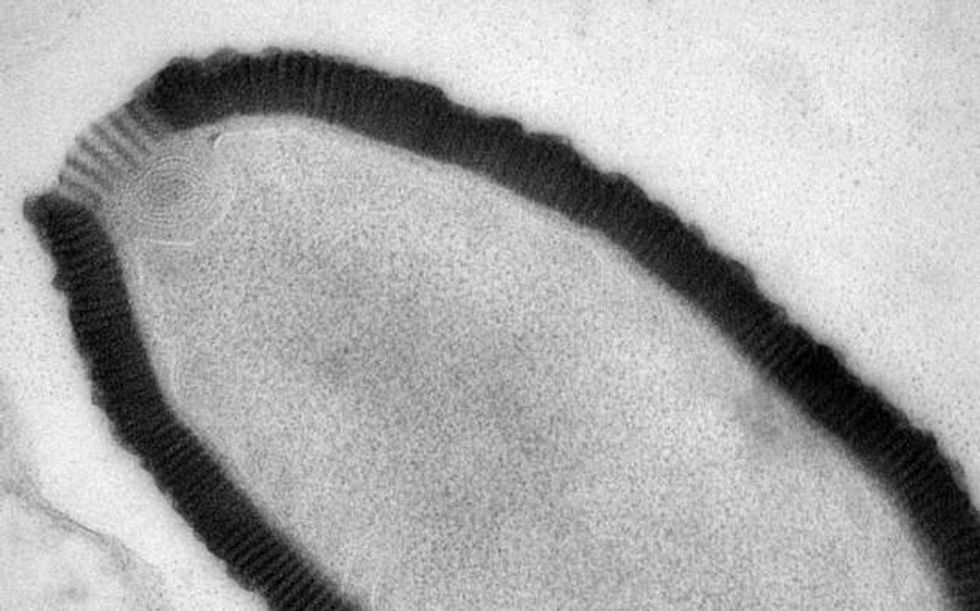
Husband and wife evolutionary biologists Jean-Michel Claverie and Chantal Abergel have revived a giant virus trapped in 30,000 Siberian permafrost, according to research published in Monday's print issue of Proceedings of the National Academy of Sciences.
After learning that a team of Russian scientists had resurrected an ancient plant from fruits buried in Siberian permafrost, Claverie and Abergel were compelled to see if it was possible to revive a virus, said Claverie. Using permafrost samples provided by the Russian team, the pair "fished for giant viruses by using amoebae--the typical targets of these pathogens--as bait," the journal Nature reports. "The amoebae started dying, and the team found giant-virus particles inside them."
The revival of the "ancestral amoeba-infecting virus," the research abstract notes, "suggests that the thawing of permafrost either from global warming or industrial exploitation of circumpolar regions might not be exempt from future threats to human or animal health."
Responding to the study, Curtis Suttle, a virologist at the University of British Columbia in Vancouver, Canada--who was not involved in the work--cautioned that the projected impact on human health by an ice-thawed virus "stretches scientific rationality to the breaking point." He added, "I would be much more concerned about the hundreds of millions of people who will be displaced by rising sea levels."
_____________________
Husband and wife evolutionary biologists Jean-Michel Claverie and Chantal Abergel have revived a giant virus trapped in 30,000 Siberian permafrost, according to research published in Monday's print issue of Proceedings of the National Academy of Sciences.
After learning that a team of Russian scientists had resurrected an ancient plant from fruits buried in Siberian permafrost, Claverie and Abergel were compelled to see if it was possible to revive a virus, said Claverie. Using permafrost samples provided by the Russian team, the pair "fished for giant viruses by using amoebae--the typical targets of these pathogens--as bait," the journal Nature reports. "The amoebae started dying, and the team found giant-virus particles inside them."
The revival of the "ancestral amoeba-infecting virus," the research abstract notes, "suggests that the thawing of permafrost either from global warming or industrial exploitation of circumpolar regions might not be exempt from future threats to human or animal health."
Responding to the study, Curtis Suttle, a virologist at the University of British Columbia in Vancouver, Canada--who was not involved in the work--cautioned that the projected impact on human health by an ice-thawed virus "stretches scientific rationality to the breaking point." He added, "I would be much more concerned about the hundreds of millions of people who will be displaced by rising sea levels."
_____________________
Husband and wife evolutionary biologists Jean-Michel Claverie and Chantal Abergel have revived a giant virus trapped in 30,000 Siberian permafrost, according to research published in Monday's print issue of Proceedings of the National Academy of Sciences.
After learning that a team of Russian scientists had resurrected an ancient plant from fruits buried in Siberian permafrost, Claverie and Abergel were compelled to see if it was possible to revive a virus, said Claverie. Using permafrost samples provided by the Russian team, the pair "fished for giant viruses by using amoebae--the typical targets of these pathogens--as bait," the journal Nature reports. "The amoebae started dying, and the team found giant-virus particles inside them."
The revival of the "ancestral amoeba-infecting virus," the research abstract notes, "suggests that the thawing of permafrost either from global warming or industrial exploitation of circumpolar regions might not be exempt from future threats to human or animal health."
Responding to the study, Curtis Suttle, a virologist at the University of British Columbia in Vancouver, Canada--who was not involved in the work--cautioned that the projected impact on human health by an ice-thawed virus "stretches scientific rationality to the breaking point." He added, "I would be much more concerned about the hundreds of millions of people who will be displaced by rising sea levels."
_____________________