SUBSCRIBE TO OUR FREE NEWSLETTER
Daily news & progressive opinion—funded by the people, not the corporations—delivered straight to your inbox.
5
#000000
#FFFFFF
To donate by check, phone, or other method, see our More Ways to Give page.
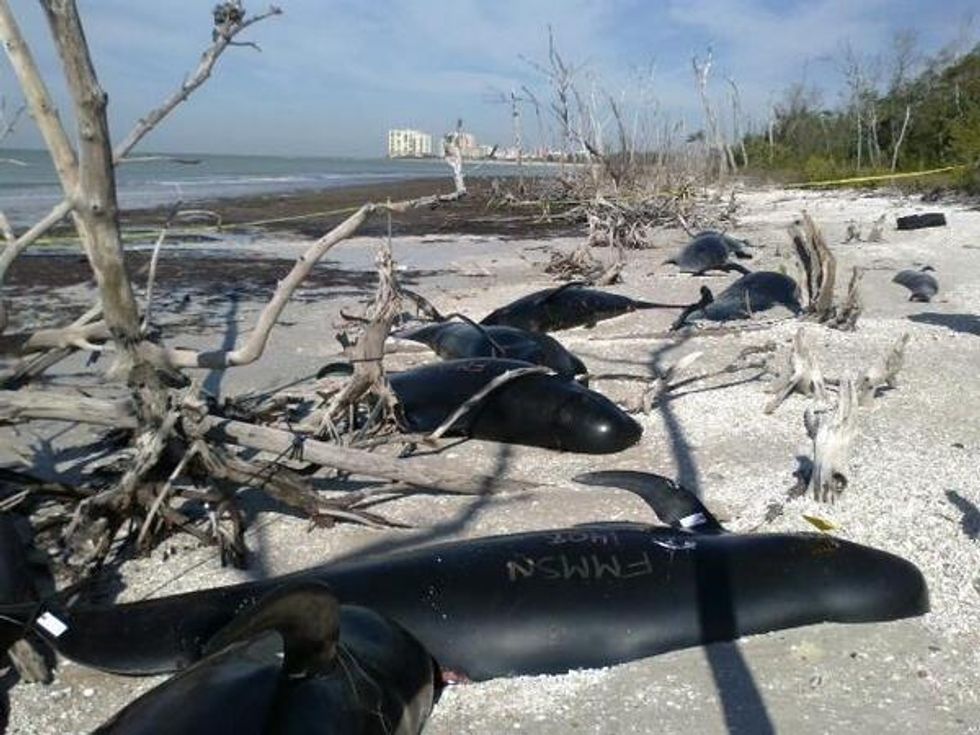
The NOAA Fisheries reports that 25 deceased pilot whales were discovered Thursday near Kice Island off southwestern Florida.
Eight other pilot whales died or were humanely euthanized earlier in the week when they were stranded further north near Lover's Key State Park.
Contributing to the stranding situation, the NOAA says, are the close bonds the whales have. If one is sick, others may stay close by it even at the risk of getting stranded.
The NOAA says that the these events coupled with a mass stranding in December have sparked scientists to closely investigate the situation.
"This is unusual and something we're looking into and monitoring," Blair Mase, a marine mammal specialist with NOAA, told reporters.
Other marine mammals in Florida waters have taken a hit recently as well.
In 2013, a record number of manatees died, and dolphins struggled along the eastern seaboard last year as well, with eight times the historical average washing up on shores from New Jersey to Florida.
The NOAA also declared an "unusual mortality event" in the state's Indian River Lagoon system for bottlenose dolphins in 2013. The mass deaths prompted the area to be called a "killing zone."
The marine mammals' deaths may be ushering a warning about the environment.
"Marine mammals are very good sentinels for ocean and human health, and they really act like the proverbial canaries in a coal mine," the New York Times quotes Dr. Greg Bossart, a veterinary pathologist and senior vice president in charge of animal health at the Georgia Aquarium, as saying. "They give us an idea of what's occurring in the environment."
______________
The NOAA Fisheries reports that 25 deceased pilot whales were discovered Thursday near Kice Island off southwestern Florida.
Eight other pilot whales died or were humanely euthanized earlier in the week when they were stranded further north near Lover's Key State Park.
Contributing to the stranding situation, the NOAA says, are the close bonds the whales have. If one is sick, others may stay close by it even at the risk of getting stranded.
The NOAA says that the these events coupled with a mass stranding in December have sparked scientists to closely investigate the situation.
"This is unusual and something we're looking into and monitoring," Blair Mase, a marine mammal specialist with NOAA, told reporters.
Other marine mammals in Florida waters have taken a hit recently as well.
In 2013, a record number of manatees died, and dolphins struggled along the eastern seaboard last year as well, with eight times the historical average washing up on shores from New Jersey to Florida.
The NOAA also declared an "unusual mortality event" in the state's Indian River Lagoon system for bottlenose dolphins in 2013. The mass deaths prompted the area to be called a "killing zone."
The marine mammals' deaths may be ushering a warning about the environment.
"Marine mammals are very good sentinels for ocean and human health, and they really act like the proverbial canaries in a coal mine," the New York Times quotes Dr. Greg Bossart, a veterinary pathologist and senior vice president in charge of animal health at the Georgia Aquarium, as saying. "They give us an idea of what's occurring in the environment."
______________
The NOAA Fisheries reports that 25 deceased pilot whales were discovered Thursday near Kice Island off southwestern Florida.
Eight other pilot whales died or were humanely euthanized earlier in the week when they were stranded further north near Lover's Key State Park.
Contributing to the stranding situation, the NOAA says, are the close bonds the whales have. If one is sick, others may stay close by it even at the risk of getting stranded.
The NOAA says that the these events coupled with a mass stranding in December have sparked scientists to closely investigate the situation.
"This is unusual and something we're looking into and monitoring," Blair Mase, a marine mammal specialist with NOAA, told reporters.
Other marine mammals in Florida waters have taken a hit recently as well.
In 2013, a record number of manatees died, and dolphins struggled along the eastern seaboard last year as well, with eight times the historical average washing up on shores from New Jersey to Florida.
The NOAA also declared an "unusual mortality event" in the state's Indian River Lagoon system for bottlenose dolphins in 2013. The mass deaths prompted the area to be called a "killing zone."
The marine mammals' deaths may be ushering a warning about the environment.
"Marine mammals are very good sentinels for ocean and human health, and they really act like the proverbial canaries in a coal mine," the New York Times quotes Dr. Greg Bossart, a veterinary pathologist and senior vice president in charge of animal health at the Georgia Aquarium, as saying. "They give us an idea of what's occurring in the environment."
______________