
Low wage fast food employees across the country are joining forces Thursday, taking to the streets to say: "Low pay is not okay."
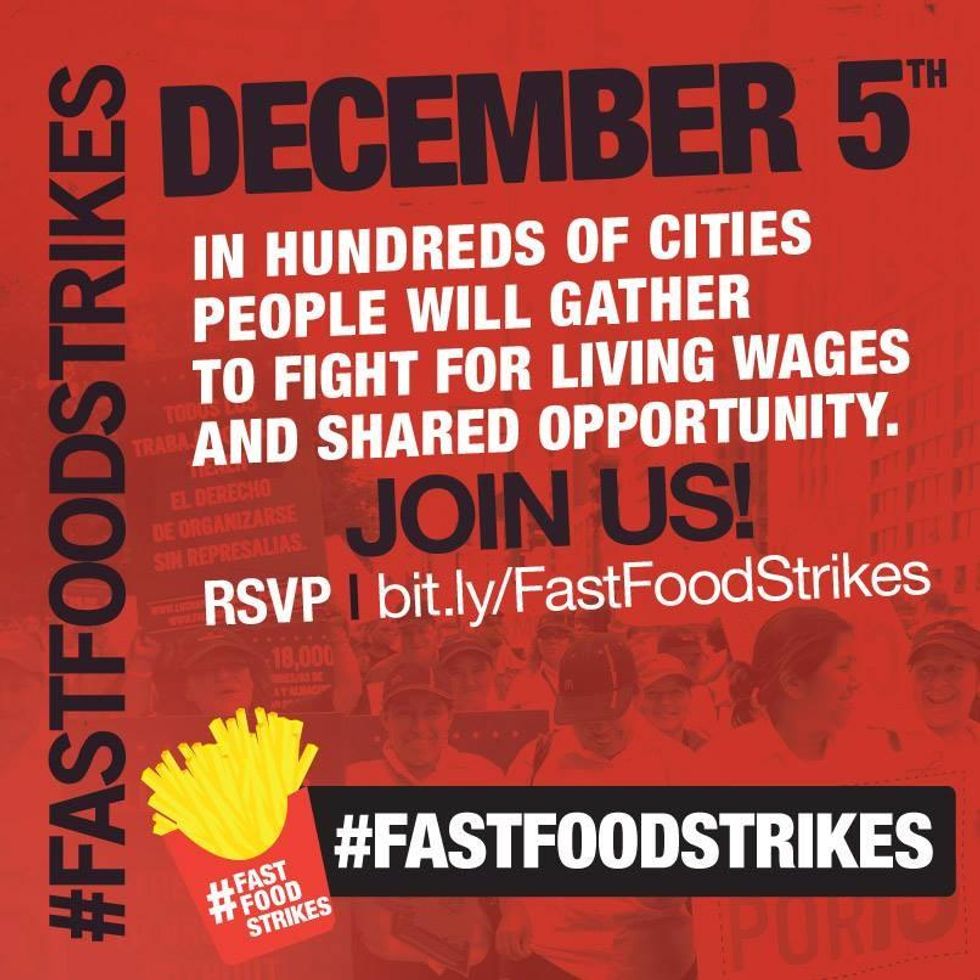
What began with a series of actions led by roughly 200 workers in New York last November has grown into a national movement for a livable wage. Workers for such corporate giants as McDonald's Corp., Burger King Worldwide Inc. and Yum! Brands (which includes Pizza Hut, Taco Bell, and KFC) in over 100 cities are expected to walk off the job Thursday.
"We work for corporations that are making tremendous profits, but do not pay employees enough to support our families and to cover basic needs like food, health care, rent and transportation," write the protest organizers. "Too many of us are forced to rely on public assistance to scrape by."
According to the UC Berkeley Labor Center, the average fast food worker makes $8.69 an hour with 87 percent receiving no health benefits.
On the Campaign for America's Future blog, economist Richard Eskow writes that the 10 largest fast food companies cost taxpayers an estimated $3.9 billion in government health assistance and $1.04 billion in food assistance as low wage employees have been forced onto government programs. According to Eskow, roughly half of all fast food workers receive some sort of public assistance.
Meanwhile, as evidenced by an IPS study published Monday, the CEOs of those same companies are pocketing hundreds of millions in taxpayer subsidized benefits as they exploit tax loopholes, deducting "unlimited amounts from their income taxes for the cost of stock options, certain stock grants, and other forms of so-called 'performance pay' for top executives."
"I'm tired of working for $7.25," Mary Coleman, a Milwaukee Popeye's employee told independent journalist Allison Kilkenny. "I can't take care of my household, I can't even take care of myself."
"Everyday struggles are being able to keep food on the table, being able to get the necessities that's needed for every day living," Coleman adds. "And then if you need to go to the doctor, you can't afford that either."
Ahead of the strikes, members of Congress including Rep. Linda Sanchez (D-Calif.), Rep. Keith Ellison (D-Minn.) and Rep. Raul Grijalva (D-Ariz.) issued a letter to the CEOs of the leading fast food chains urging them to raise the minimum wage for their employees.
"Too many people who work all day feeding fast-food customers don't make enough money to feed their own children when they get home," said Ellison. "No one working full-time should live in poverty. It's time for fast-food corporations to raise wages for their employees."
And as Eskow points out, the workforce for the 10 largest fast food changes is greater than the populations of Nebraska, West Virginia, Idaho, Hawaii, Maine, New Hampshire, Rhode Island, Montana, Delaware, South Dakota, Alaska, North Dakota, Vermont, and Wyoming--"states which hold 28 seats in the United States Senate."
He asks, "Shouldn't they have a voice of some kind too?"
Strike information is available on the site Low Pay is Not Okay with support from the Service Employees International Union, Fast Food Forward and Fight for 15.
_____________________
Low wage fast food employees across the country are joining forces Thursday, taking to the streets to say: "Low pay is not okay."
What began with a series of actions led by roughly 200 workers in New York last November has grown into a national movement for a livable wage. Workers for such corporate giants as McDonald's Corp., Burger King Worldwide Inc. and Yum! Brands (which includes Pizza Hut, Taco Bell, and KFC) in over 100 cities are expected to walk off the job Thursday.
"We work for corporations that are making tremendous profits, but do not pay employees enough to support our families and to cover basic needs like food, health care, rent and transportation," write the protest organizers. "Too many of us are forced to rely on public assistance to scrape by."
According to the UC Berkeley Labor Center, the average fast food worker makes $8.69 an hour with 87 percent receiving no health benefits.
On the Campaign for America's Future blog, economist Richard Eskow writes that the 10 largest fast food companies cost taxpayers an estimated $3.9 billion in government health assistance and $1.04 billion in food assistance as low wage employees have been forced onto government programs. According to Eskow, roughly half of all fast food workers receive some sort of public assistance.
Meanwhile, as evidenced by an IPS study published Monday, the CEOs of those same companies are pocketing hundreds of millions in taxpayer subsidized benefits as they exploit tax loopholes, deducting "unlimited amounts from their income taxes for the cost of stock options, certain stock grants, and other forms of so-called 'performance pay' for top executives."
"I'm tired of working for $7.25," Mary Coleman, a Milwaukee Popeye's employee told independent journalist Allison Kilkenny. "I can't take care of my household, I can't even take care of myself."
"Everyday struggles are being able to keep food on the table, being able to get the necessities that's needed for every day living," Coleman adds. "And then if you need to go to the doctor, you can't afford that either."
Ahead of the strikes, members of Congress including Rep. Linda Sanchez (D-Calif.), Rep. Keith Ellison (D-Minn.) and Rep. Raul Grijalva (D-Ariz.) issued a letter to the CEOs of the leading fast food chains urging them to raise the minimum wage for their employees.
"Too many people who work all day feeding fast-food customers don't make enough money to feed their own children when they get home," said Ellison. "No one working full-time should live in poverty. It's time for fast-food corporations to raise wages for their employees."
And as Eskow points out, the workforce for the 10 largest fast food changes is greater than the populations of Nebraska, West Virginia, Idaho, Hawaii, Maine, New Hampshire, Rhode Island, Montana, Delaware, South Dakota, Alaska, North Dakota, Vermont, and Wyoming--"states which hold 28 seats in the United States Senate."
He asks, "Shouldn't they have a voice of some kind too?"
Strike information is available on the site Low Pay is Not Okay with support from the Service Employees International Union, Fast Food Forward and Fight for 15.
_____________________
Low wage fast food employees across the country are joining forces Thursday, taking to the streets to say: "Low pay is not okay."
What began with a series of actions led by roughly 200 workers in New York last November has grown into a national movement for a livable wage. Workers for such corporate giants as McDonald's Corp., Burger King Worldwide Inc. and Yum! Brands (which includes Pizza Hut, Taco Bell, and KFC) in over 100 cities are expected to walk off the job Thursday.
"We work for corporations that are making tremendous profits, but do not pay employees enough to support our families and to cover basic needs like food, health care, rent and transportation," write the protest organizers. "Too many of us are forced to rely on public assistance to scrape by."
According to the UC Berkeley Labor Center, the average fast food worker makes $8.69 an hour with 87 percent receiving no health benefits.
On the Campaign for America's Future blog, economist Richard Eskow writes that the 10 largest fast food companies cost taxpayers an estimated $3.9 billion in government health assistance and $1.04 billion in food assistance as low wage employees have been forced onto government programs. According to Eskow, roughly half of all fast food workers receive some sort of public assistance.
Meanwhile, as evidenced by an IPS study published Monday, the CEOs of those same companies are pocketing hundreds of millions in taxpayer subsidized benefits as they exploit tax loopholes, deducting "unlimited amounts from their income taxes for the cost of stock options, certain stock grants, and other forms of so-called 'performance pay' for top executives."
"I'm tired of working for $7.25," Mary Coleman, a Milwaukee Popeye's employee told independent journalist Allison Kilkenny. "I can't take care of my household, I can't even take care of myself."
"Everyday struggles are being able to keep food on the table, being able to get the necessities that's needed for every day living," Coleman adds. "And then if you need to go to the doctor, you can't afford that either."
Ahead of the strikes, members of Congress including Rep. Linda Sanchez (D-Calif.), Rep. Keith Ellison (D-Minn.) and Rep. Raul Grijalva (D-Ariz.) issued a letter to the CEOs of the leading fast food chains urging them to raise the minimum wage for their employees.
"Too many people who work all day feeding fast-food customers don't make enough money to feed their own children when they get home," said Ellison. "No one working full-time should live in poverty. It's time for fast-food corporations to raise wages for their employees."
And as Eskow points out, the workforce for the 10 largest fast food changes is greater than the populations of Nebraska, West Virginia, Idaho, Hawaii, Maine, New Hampshire, Rhode Island, Montana, Delaware, South Dakota, Alaska, North Dakota, Vermont, and Wyoming--"states which hold 28 seats in the United States Senate."
He asks, "Shouldn't they have a voice of some kind too?"
Strike information is available on the site Low Pay is Not Okay with support from the Service Employees International Union, Fast Food Forward and Fight for 15.
_____________________