
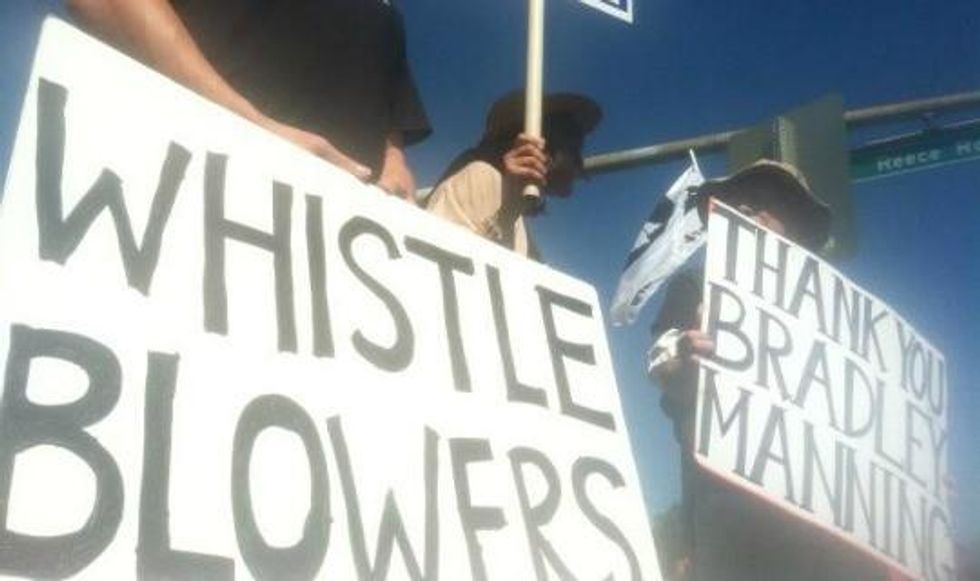
Pfc. Bradley Manning, the army whistleblower who exposed egregious U.S. war crimes after revealing military documents to the website WikiLeaks, has been found guilty of almost all of his charges in a military court in Fort Meade, Maryland and could face a maximum of more than 100 years in jail.
On Tuesday, Judge Col. Denise Lind found Manning not guilty of his most severe charge, "aiding the enemy," which supporters had feared because it held the potential for "life in prison." However, Manning's other charges, which include multiple charges under the Espionage Act, potentially hold the same sentence cumulatively.
Manning's official sentencing phase begins Wednesday morning at 9:30 EST.
Watch Democracy Now!'s coverage for reactions from journalists, lawyers, and progressive voices who have been following the trial:
Follow live tweets from journalist following the trial here:
As reporter Kevin Gosztola points out, the verdict comes on the anniversary of the U.S.'s first whistleblower protection law that declared on July 30, 1778: it is the "duty of all persons in the service of the United States, as well as all other the inhabitants thereof, to give the earliest information to Congress or other proper authority of any misconduct, frauds or misdemeanors committed by an officers or persons in the service of these states, which may come to their knowledge."
During the trial, Manning's civilian defense attorney, David Coombs, had argued, "No case has ever been prosecuted under this type of theory, that an individual by the nature of giving information to a journalistic organization would then be charged with 'aiding the enemy.'"
As Norman Solomon writes today, Manning's "moral courage" has shown throughout the lengthy trial and has highlighted the depravity of the U.S. government:
No verdict handed down by the military judge can change the moral verdict that has emerged from people all over the world, reciprocating what Bradley Manning expressed online a few days before his arrest: "I can't separate myself from others." And: "I feel connected to everybody... like they were distant family."
The problem for the U.S. government was not that Bradley Manning felt that way. The problem came when he acted that way. Caring was one thing. Acting on the caring, with empathy propelling solidarity, was another.
"I prefer a painful truth over any blissful fantasy," Manning had written in an online chat prior to his arrest. "I think I've been traumatized too much by reality, to care about consequences of shattering the fantasy...I want people to see the truth ... regardless of who they are ... because without information, you cannot make informed decisions as a public."
_____________________
Pfc. Bradley Manning, the army whistleblower who exposed egregious U.S. war crimes after revealing military documents to the website WikiLeaks, has been found guilty of almost all of his charges in a military court in Fort Meade, Maryland and could face a maximum of more than 100 years in jail.
On Tuesday, Judge Col. Denise Lind found Manning not guilty of his most severe charge, "aiding the enemy," which supporters had feared because it held the potential for "life in prison." However, Manning's other charges, which include multiple charges under the Espionage Act, potentially hold the same sentence cumulatively.
Manning's official sentencing phase begins Wednesday morning at 9:30 EST.
Watch Democracy Now!'s coverage for reactions from journalists, lawyers, and progressive voices who have been following the trial:
Follow live tweets from journalist following the trial here:
As reporter Kevin Gosztola points out, the verdict comes on the anniversary of the U.S.'s first whistleblower protection law that declared on July 30, 1778: it is the "duty of all persons in the service of the United States, as well as all other the inhabitants thereof, to give the earliest information to Congress or other proper authority of any misconduct, frauds or misdemeanors committed by an officers or persons in the service of these states, which may come to their knowledge."
During the trial, Manning's civilian defense attorney, David Coombs, had argued, "No case has ever been prosecuted under this type of theory, that an individual by the nature of giving information to a journalistic organization would then be charged with 'aiding the enemy.'"
As Norman Solomon writes today, Manning's "moral courage" has shown throughout the lengthy trial and has highlighted the depravity of the U.S. government:
No verdict handed down by the military judge can change the moral verdict that has emerged from people all over the world, reciprocating what Bradley Manning expressed online a few days before his arrest: "I can't separate myself from others." And: "I feel connected to everybody... like they were distant family."
The problem for the U.S. government was not that Bradley Manning felt that way. The problem came when he acted that way. Caring was one thing. Acting on the caring, with empathy propelling solidarity, was another.
"I prefer a painful truth over any blissful fantasy," Manning had written in an online chat prior to his arrest. "I think I've been traumatized too much by reality, to care about consequences of shattering the fantasy...I want people to see the truth ... regardless of who they are ... because without information, you cannot make informed decisions as a public."
_____________________
Pfc. Bradley Manning, the army whistleblower who exposed egregious U.S. war crimes after revealing military documents to the website WikiLeaks, has been found guilty of almost all of his charges in a military court in Fort Meade, Maryland and could face a maximum of more than 100 years in jail.
On Tuesday, Judge Col. Denise Lind found Manning not guilty of his most severe charge, "aiding the enemy," which supporters had feared because it held the potential for "life in prison." However, Manning's other charges, which include multiple charges under the Espionage Act, potentially hold the same sentence cumulatively.
Manning's official sentencing phase begins Wednesday morning at 9:30 EST.
Watch Democracy Now!'s coverage for reactions from journalists, lawyers, and progressive voices who have been following the trial:
Follow live tweets from journalist following the trial here:
As reporter Kevin Gosztola points out, the verdict comes on the anniversary of the U.S.'s first whistleblower protection law that declared on July 30, 1778: it is the "duty of all persons in the service of the United States, as well as all other the inhabitants thereof, to give the earliest information to Congress or other proper authority of any misconduct, frauds or misdemeanors committed by an officers or persons in the service of these states, which may come to their knowledge."
During the trial, Manning's civilian defense attorney, David Coombs, had argued, "No case has ever been prosecuted under this type of theory, that an individual by the nature of giving information to a journalistic organization would then be charged with 'aiding the enemy.'"
As Norman Solomon writes today, Manning's "moral courage" has shown throughout the lengthy trial and has highlighted the depravity of the U.S. government:
No verdict handed down by the military judge can change the moral verdict that has emerged from people all over the world, reciprocating what Bradley Manning expressed online a few days before his arrest: "I can't separate myself from others." And: "I feel connected to everybody... like they were distant family."
The problem for the U.S. government was not that Bradley Manning felt that way. The problem came when he acted that way. Caring was one thing. Acting on the caring, with empathy propelling solidarity, was another.
"I prefer a painful truth over any blissful fantasy," Manning had written in an online chat prior to his arrest. "I think I've been traumatized too much by reality, to care about consequences of shattering the fantasy...I want people to see the truth ... regardless of who they are ... because without information, you cannot make informed decisions as a public."
_____________________