SUBSCRIBE TO OUR FREE NEWSLETTER
Daily news & progressive opinion—funded by the people, not the corporations—delivered straight to your inbox.
5
#000000
#FFFFFF
To donate by check, phone, or other method, see our More Ways to Give page.
Fueled by superheated fears generated by economic dislocation, a proliferation of demonizing conspiracy theories, and the reality of an African-American president in Barack Obama, radical hates groups and antigovernment groups grew explosively in 2011, according to a new report by the Southern Poverty Law Center. This year's report, The Year in Hate and Extremism (pdf), follows past work where the SPLC catalogs the number of 'hate groups' and other radical rightwing movements in the US and gauges their motivations and the size of their membership.
"The SPLC counted 1,018 hate groups operating the United States last year, up from 1,002 in 2010. That was the latest in a string of annual increases going all the way back to 2000, when there were 602 hate groups," reads the report. Exploiting the issue of "non-white immigration" by such groups was cited as the driving force behind such growth.
The most stunning growth among all groups came among the rightwing anti-government "Patriot" groups, which the report classifies as those groups which perceive the "federal government as their primary enemy." The "Patriot" groups grew from 149 groups in 2008, skyrocketed to 512 in 2009, jumped to 824 in 2010, and last year continued to surge to 1,274. That's a 755% growth spurt in just three years.
"The increase has just been astounding," Mark Potok, editor-in-chief of the SPLC report, told the Murrow News Service. "The reality is that many of these groups are becoming more and more fearful that Barack Obama will win the re-election. You can see the anger rising along with that fear."
And the New York Times reports:
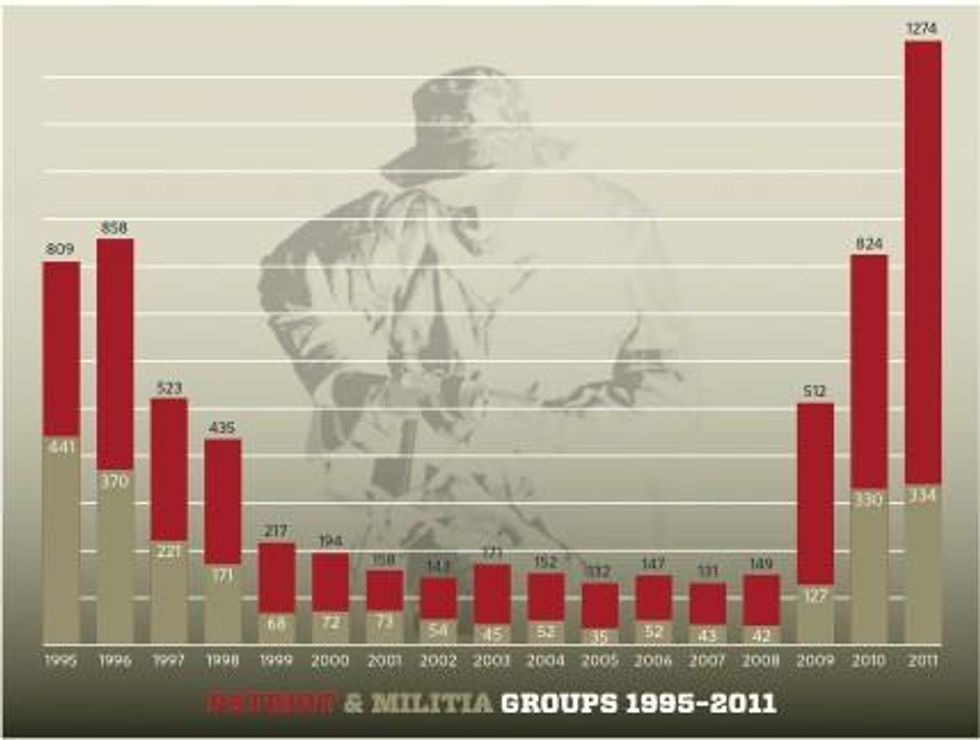
The far-right patriot movement gained steam in 1994 after the government used violence to shut down groups at Ruby Ridge, Idaho, and Waco, Tex. It peaked after the 1995 Oklahoma City bombing and began to fade. Its rise began anew in 2008, after the election of Mr. Obama and the beginning of the recession.
There have been declines in some hate groups, including native extremist groups like the Militiamen, which focused on illegal immigration. Chapters of the Ku Klux Klan fell to 152, from 221.
Among the states with the most active hate groups were California, Florida, Georgia, New Jersey and New York. The federal government does not focus on groups that engage in hate-based speech, but rather monitors paramilitary groups and others that have shown some indication of violence, said Daryl Johnson, a former senior domestic terrorism analyst for the Department of Homeland Security.
The Justice Department does not comment on the center's annual report, but a spokeswoman said the agency had increased prosecution of hate crimes by 35 percent during the first three years of Mr. Obama's presidency.
###
Fueled by superheated fears generated by economic dislocation, a proliferation of demonizing conspiracy theories, and the reality of an African-American president in Barack Obama, radical hates groups and antigovernment groups grew explosively in 2011, according to a new report by the Southern Poverty Law Center. This year's report, The Year in Hate and Extremism (pdf), follows past work where the SPLC catalogs the number of 'hate groups' and other radical rightwing movements in the US and gauges their motivations and the size of their membership.
"The SPLC counted 1,018 hate groups operating the United States last year, up from 1,002 in 2010. That was the latest in a string of annual increases going all the way back to 2000, when there were 602 hate groups," reads the report. Exploiting the issue of "non-white immigration" by such groups was cited as the driving force behind such growth.
The most stunning growth among all groups came among the rightwing anti-government "Patriot" groups, which the report classifies as those groups which perceive the "federal government as their primary enemy." The "Patriot" groups grew from 149 groups in 2008, skyrocketed to 512 in 2009, jumped to 824 in 2010, and last year continued to surge to 1,274. That's a 755% growth spurt in just three years.
"The increase has just been astounding," Mark Potok, editor-in-chief of the SPLC report, told the Murrow News Service. "The reality is that many of these groups are becoming more and more fearful that Barack Obama will win the re-election. You can see the anger rising along with that fear."
And the New York Times reports:
The far-right patriot movement gained steam in 1994 after the government used violence to shut down groups at Ruby Ridge, Idaho, and Waco, Tex. It peaked after the 1995 Oklahoma City bombing and began to fade. Its rise began anew in 2008, after the election of Mr. Obama and the beginning of the recession.
There have been declines in some hate groups, including native extremist groups like the Militiamen, which focused on illegal immigration. Chapters of the Ku Klux Klan fell to 152, from 221.
Among the states with the most active hate groups were California, Florida, Georgia, New Jersey and New York. The federal government does not focus on groups that engage in hate-based speech, but rather monitors paramilitary groups and others that have shown some indication of violence, said Daryl Johnson, a former senior domestic terrorism analyst for the Department of Homeland Security.
The Justice Department does not comment on the center's annual report, but a spokeswoman said the agency had increased prosecution of hate crimes by 35 percent during the first three years of Mr. Obama's presidency.
###
Fueled by superheated fears generated by economic dislocation, a proliferation of demonizing conspiracy theories, and the reality of an African-American president in Barack Obama, radical hates groups and antigovernment groups grew explosively in 2011, according to a new report by the Southern Poverty Law Center. This year's report, The Year in Hate and Extremism (pdf), follows past work where the SPLC catalogs the number of 'hate groups' and other radical rightwing movements in the US and gauges their motivations and the size of their membership.
"The SPLC counted 1,018 hate groups operating the United States last year, up from 1,002 in 2010. That was the latest in a string of annual increases going all the way back to 2000, when there were 602 hate groups," reads the report. Exploiting the issue of "non-white immigration" by such groups was cited as the driving force behind such growth.
The most stunning growth among all groups came among the rightwing anti-government "Patriot" groups, which the report classifies as those groups which perceive the "federal government as their primary enemy." The "Patriot" groups grew from 149 groups in 2008, skyrocketed to 512 in 2009, jumped to 824 in 2010, and last year continued to surge to 1,274. That's a 755% growth spurt in just three years.
"The increase has just been astounding," Mark Potok, editor-in-chief of the SPLC report, told the Murrow News Service. "The reality is that many of these groups are becoming more and more fearful that Barack Obama will win the re-election. You can see the anger rising along with that fear."
And the New York Times reports:
The far-right patriot movement gained steam in 1994 after the government used violence to shut down groups at Ruby Ridge, Idaho, and Waco, Tex. It peaked after the 1995 Oklahoma City bombing and began to fade. Its rise began anew in 2008, after the election of Mr. Obama and the beginning of the recession.
There have been declines in some hate groups, including native extremist groups like the Militiamen, which focused on illegal immigration. Chapters of the Ku Klux Klan fell to 152, from 221.
Among the states with the most active hate groups were California, Florida, Georgia, New Jersey and New York. The federal government does not focus on groups that engage in hate-based speech, but rather monitors paramilitary groups and others that have shown some indication of violence, said Daryl Johnson, a former senior domestic terrorism analyst for the Department of Homeland Security.
The Justice Department does not comment on the center's annual report, but a spokeswoman said the agency had increased prosecution of hate crimes by 35 percent during the first three years of Mr. Obama's presidency.
###