SUBSCRIBE TO OUR FREE NEWSLETTER
Daily news & progressive opinion—funded by the people, not the corporations—delivered straight to your inbox.
5
#000000
#FFFFFF
To donate by check, phone, or other method, see our More Ways to Give page.
Daily news & progressive opinion—funded by the people, not the corporations—delivered straight to your inbox.
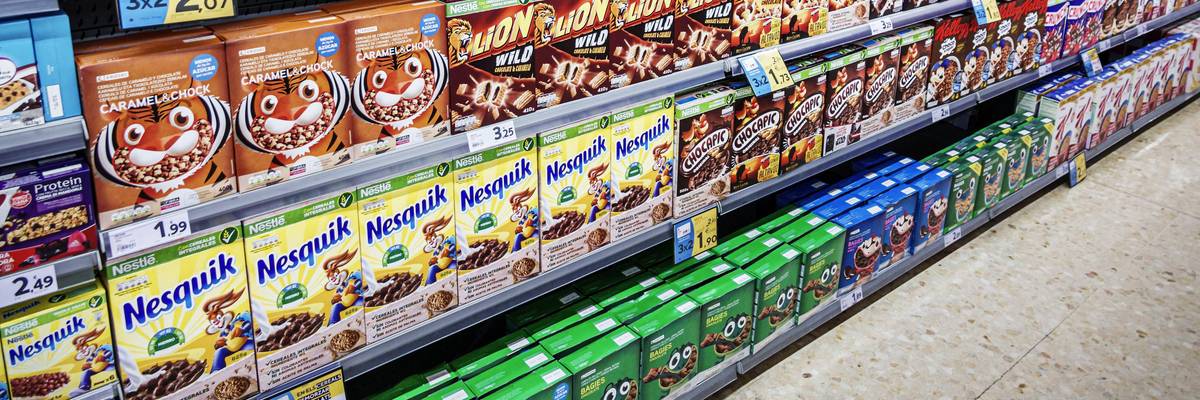
Breakfast cereal aisle in Spain. (Photo by: Jeff Greenberg/Education Images/Universal Images Group via Getty Images)
The world's biggest food companies have paid out nearly PS15bn to shareholders as spiralling prices leave desperate families struggling to afford to eat, openDemocracy can reveal.
"Food is not a commodity--it's what everyone of us depends on to survive, and these corporations' need for ever-growing profits poses existential questions for humanity."
Nestle, Unilever, Associated British Foods, Mondelez and Archer-Daniels-Midland Company (ADM) have raked in PS20bn in profits in the space of a year while all raising average food prices.
Four of the five multinationals--which between them own thousands of popular brands such as Twinings, Kingsmill and Cheerios--have also signalled that consumers should expect further price rises. Only ADM has not.
The firms' profits would be enough to fill the PS9.8bn funding gap twice over that is currently facing the United Nations' World Food Programme (WFP)--which aims to provide food for 160 million people facing poverty by the end of the year. The WFP said it costs 44% more for it to buy food than it did in 2020.
The bonanza for food corporations comes amid a 40% increase in the number of people in the UK forced to turn to food banks since April, according to the Trussell Trust. The charity, which supports food banks nationwide, has warned it can no longer rely on donations to meet rising demand for emergency food parcels.
Frederic Mousseau, an economist who has worked for international relief agencies including Oxfam and Action Against Hunger, told openDemocracy: "How can we accept that a handful of corporations record such huge profits while you have billions of people who are already struggling to survive?"
Food prices in the UK have increased by an average of 16% in the past year, with the costs of some staples--such as bread and milk--rising by a third. The prices of vegetable oil and pasta have soared by more than 60%, the highest increases among the lowest-cost groceries tracked by the Office of National Statistics.
The UK's biggest producer of vegetable oil, Edible Oils Limited, is jointly owned by American grain giant Archer-Daniels-Midland and Princes, a UK subsidiary of Mitsubishi Corporation. The former has seen its profits rise by 48% this year and paid out the equivalent of PS1.5bn to its shareholders in dividends and share buybacks in the first half of this year alone.
The UK's highest grossing food company, Associated British Foods (ABF), has also paid out PS500m to shareholders.
This month, ABF's chief executive George G Weston, who will receive PS2.2m in remuneration this year, told investors at the firm's annual results presentation: "Revenues benefiting from price increases and operating profit was solid [sic]. We've had to recover a huge amount of input cost from customers that don't like giving you price rises and we've done that job really well--but it's not finished."
Some food multinationals have claimed they have tried to soften the blow to consumers when passing on costs. Nestle chief executive Mark Schneider said the company had "made a point of acting responsibly with our price increases" when announcing its half-year results in July.
Nestle reported half-year profits of PS4.5bn, a 11% fall from the same period last year. But the firm has paid out PS8.5bn to shareholders in the form of share buybacks this year, while raising prices by up to 7.5% on its products, which include a top-selling baby formula.
"These corporations are very adept at rhetoric that doesn't have a lot of substance," Philip Howard, a professor at the department of community sustainability at Michigan State University, told openDemocracy.
"They talk about balance but if there's a choice between increasing their power and doing the right thing, increasing power is going to win every time. That's what the shareholders demand."
Unilever, a British-Dutch multinational that also produces household cleaning and personal care products, has made PS4.3bn in profits this year--a 4% increase on last year. The company told investors it has raised its prices by 12% to cover increased costs. At the same time, it has paid out PS1.3bn to shareholders.
The US snack firm Mondelez, which owns Cadbury, has reported a 10% rise in profits this year--bringing in PS6.9bn. The company has handed PS2.8bn to shareholders in the form of share buybacks and dividends, while raising its prices by 11% in the last quarter.
"The shareholders who own these companies expect growth every year and a return on their investment. Maybe that makes sense for companies selling phones or TVs, but food is not a commodity--it's what everyone of us depends on to survive, and these corporations' need for ever-growing profits poses existential questions for humanity," said Mousseau, who is also a policy director at the Oakland Institute, a US think tank.
Supply chain disruptions caused by the pandemic, the war in Ukraine, rising fuel costs, and the impact of heatwaves on crop yields have all contributed to increased costs for producing and processing food. But food experts argue "excessive commodity speculation" rather than shortages remains largely to blame for spiralling costs.
A Unilever spokesperson said: "In this challenging environment, when we are facing the highest input cost inflation in over a decade, making price increases is not easy and we're very mindful of the pressure that consumers are under.
"We always take a responsible and considered approach to pricing and there are a number of levers we pull to offset input cost inflation, such as promotions, pack sizes and ingredient changes."
A Nestle spokesperson told openDemocracy: "We are absorbing costs to the tune of billions of dollars as reflected in the notable decline of our gross profit margin. We have been doing everything we can to find cost-saving measures--for example, cutting marketing expenses and finding new efficiencies in production and distribution.
"Our priority remains to ensure that consumers have affordable access to the products and brands they know and love while still paying fair prices to our suppliers, including farmers and small companies for their sustainably produced raw materials."
A spokesperson for ABF, which reported PS399m profits from its grocery division for the year ending September 30--a 3% decrease on the previous year--said: "We strive to make our food as affordable as possible. Like a lot of businesses, we are encountering extreme inflation and increased energy prices. Last year ABF had to absorb inflation of PS1bn and the group will have to absorb the same amount in the current year.
"As a result, we have unfortunately had no choice but to increase prices to retailers and, despite this, the margin in our grocery business is clearly down. Businesses have no choice but to pass costs on where they can given the scale of the inflation. As we sell to retailers, we do not set the shelf price for goods, the retailers do."
Mondelez and ADM did not respond to a request for comment.
Dear Common Dreams reader, It’s been nearly 30 years since I co-founded Common Dreams with my late wife, Lina Newhouser. We had the radical notion that journalism should serve the public good, not corporate profits. It was clear to us from the outset what it would take to build such a project. No paid advertisements. No corporate sponsors. No millionaire publisher telling us what to think or do. Many people said we wouldn't last a year, but we proved those doubters wrong. Together with a tremendous team of journalists and dedicated staff, we built an independent media outlet free from the constraints of profits and corporate control. Our mission has always been simple: To inform. To inspire. To ignite change for the common good. Building Common Dreams was not easy. Our survival was never guaranteed. When you take on the most powerful forces—Wall Street greed, fossil fuel industry destruction, Big Tech lobbyists, and uber-rich oligarchs who have spent billions upon billions rigging the economy and democracy in their favor—the only bulwark you have is supporters who believe in your work. But here’s the urgent message from me today. It's never been this bad out there. And it's never been this hard to keep us going. At the very moment Common Dreams is most needed, the threats we face are intensifying. We need your support now more than ever. We don't accept corporate advertising and never will. We don't have a paywall because we don't think people should be blocked from critical news based on their ability to pay. Everything we do is funded by the donations of readers like you. When everyone does the little they can afford, we are strong. But if that support retreats or dries up, so do we. Will you donate now to make sure Common Dreams not only survives but thrives? —Craig Brown, Co-founder |
The world's biggest food companies have paid out nearly PS15bn to shareholders as spiralling prices leave desperate families struggling to afford to eat, openDemocracy can reveal.
"Food is not a commodity--it's what everyone of us depends on to survive, and these corporations' need for ever-growing profits poses existential questions for humanity."
Nestle, Unilever, Associated British Foods, Mondelez and Archer-Daniels-Midland Company (ADM) have raked in PS20bn in profits in the space of a year while all raising average food prices.
Four of the five multinationals--which between them own thousands of popular brands such as Twinings, Kingsmill and Cheerios--have also signalled that consumers should expect further price rises. Only ADM has not.
The firms' profits would be enough to fill the PS9.8bn funding gap twice over that is currently facing the United Nations' World Food Programme (WFP)--which aims to provide food for 160 million people facing poverty by the end of the year. The WFP said it costs 44% more for it to buy food than it did in 2020.
The bonanza for food corporations comes amid a 40% increase in the number of people in the UK forced to turn to food banks since April, according to the Trussell Trust. The charity, which supports food banks nationwide, has warned it can no longer rely on donations to meet rising demand for emergency food parcels.
Frederic Mousseau, an economist who has worked for international relief agencies including Oxfam and Action Against Hunger, told openDemocracy: "How can we accept that a handful of corporations record such huge profits while you have billions of people who are already struggling to survive?"
Food prices in the UK have increased by an average of 16% in the past year, with the costs of some staples--such as bread and milk--rising by a third. The prices of vegetable oil and pasta have soared by more than 60%, the highest increases among the lowest-cost groceries tracked by the Office of National Statistics.
The UK's biggest producer of vegetable oil, Edible Oils Limited, is jointly owned by American grain giant Archer-Daniels-Midland and Princes, a UK subsidiary of Mitsubishi Corporation. The former has seen its profits rise by 48% this year and paid out the equivalent of PS1.5bn to its shareholders in dividends and share buybacks in the first half of this year alone.
The UK's highest grossing food company, Associated British Foods (ABF), has also paid out PS500m to shareholders.
This month, ABF's chief executive George G Weston, who will receive PS2.2m in remuneration this year, told investors at the firm's annual results presentation: "Revenues benefiting from price increases and operating profit was solid [sic]. We've had to recover a huge amount of input cost from customers that don't like giving you price rises and we've done that job really well--but it's not finished."
Some food multinationals have claimed they have tried to soften the blow to consumers when passing on costs. Nestle chief executive Mark Schneider said the company had "made a point of acting responsibly with our price increases" when announcing its half-year results in July.
Nestle reported half-year profits of PS4.5bn, a 11% fall from the same period last year. But the firm has paid out PS8.5bn to shareholders in the form of share buybacks this year, while raising prices by up to 7.5% on its products, which include a top-selling baby formula.
"These corporations are very adept at rhetoric that doesn't have a lot of substance," Philip Howard, a professor at the department of community sustainability at Michigan State University, told openDemocracy.
"They talk about balance but if there's a choice between increasing their power and doing the right thing, increasing power is going to win every time. That's what the shareholders demand."
Unilever, a British-Dutch multinational that also produces household cleaning and personal care products, has made PS4.3bn in profits this year--a 4% increase on last year. The company told investors it has raised its prices by 12% to cover increased costs. At the same time, it has paid out PS1.3bn to shareholders.
The US snack firm Mondelez, which owns Cadbury, has reported a 10% rise in profits this year--bringing in PS6.9bn. The company has handed PS2.8bn to shareholders in the form of share buybacks and dividends, while raising its prices by 11% in the last quarter.
"The shareholders who own these companies expect growth every year and a return on their investment. Maybe that makes sense for companies selling phones or TVs, but food is not a commodity--it's what everyone of us depends on to survive, and these corporations' need for ever-growing profits poses existential questions for humanity," said Mousseau, who is also a policy director at the Oakland Institute, a US think tank.
Supply chain disruptions caused by the pandemic, the war in Ukraine, rising fuel costs, and the impact of heatwaves on crop yields have all contributed to increased costs for producing and processing food. But food experts argue "excessive commodity speculation" rather than shortages remains largely to blame for spiralling costs.
A Unilever spokesperson said: "In this challenging environment, when we are facing the highest input cost inflation in over a decade, making price increases is not easy and we're very mindful of the pressure that consumers are under.
"We always take a responsible and considered approach to pricing and there are a number of levers we pull to offset input cost inflation, such as promotions, pack sizes and ingredient changes."
A Nestle spokesperson told openDemocracy: "We are absorbing costs to the tune of billions of dollars as reflected in the notable decline of our gross profit margin. We have been doing everything we can to find cost-saving measures--for example, cutting marketing expenses and finding new efficiencies in production and distribution.
"Our priority remains to ensure that consumers have affordable access to the products and brands they know and love while still paying fair prices to our suppliers, including farmers and small companies for their sustainably produced raw materials."
A spokesperson for ABF, which reported PS399m profits from its grocery division for the year ending September 30--a 3% decrease on the previous year--said: "We strive to make our food as affordable as possible. Like a lot of businesses, we are encountering extreme inflation and increased energy prices. Last year ABF had to absorb inflation of PS1bn and the group will have to absorb the same amount in the current year.
"As a result, we have unfortunately had no choice but to increase prices to retailers and, despite this, the margin in our grocery business is clearly down. Businesses have no choice but to pass costs on where they can given the scale of the inflation. As we sell to retailers, we do not set the shelf price for goods, the retailers do."
Mondelez and ADM did not respond to a request for comment.
The world's biggest food companies have paid out nearly PS15bn to shareholders as spiralling prices leave desperate families struggling to afford to eat, openDemocracy can reveal.
"Food is not a commodity--it's what everyone of us depends on to survive, and these corporations' need for ever-growing profits poses existential questions for humanity."
Nestle, Unilever, Associated British Foods, Mondelez and Archer-Daniels-Midland Company (ADM) have raked in PS20bn in profits in the space of a year while all raising average food prices.
Four of the five multinationals--which between them own thousands of popular brands such as Twinings, Kingsmill and Cheerios--have also signalled that consumers should expect further price rises. Only ADM has not.
The firms' profits would be enough to fill the PS9.8bn funding gap twice over that is currently facing the United Nations' World Food Programme (WFP)--which aims to provide food for 160 million people facing poverty by the end of the year. The WFP said it costs 44% more for it to buy food than it did in 2020.
The bonanza for food corporations comes amid a 40% increase in the number of people in the UK forced to turn to food banks since April, according to the Trussell Trust. The charity, which supports food banks nationwide, has warned it can no longer rely on donations to meet rising demand for emergency food parcels.
Frederic Mousseau, an economist who has worked for international relief agencies including Oxfam and Action Against Hunger, told openDemocracy: "How can we accept that a handful of corporations record such huge profits while you have billions of people who are already struggling to survive?"
Food prices in the UK have increased by an average of 16% in the past year, with the costs of some staples--such as bread and milk--rising by a third. The prices of vegetable oil and pasta have soared by more than 60%, the highest increases among the lowest-cost groceries tracked by the Office of National Statistics.
The UK's biggest producer of vegetable oil, Edible Oils Limited, is jointly owned by American grain giant Archer-Daniels-Midland and Princes, a UK subsidiary of Mitsubishi Corporation. The former has seen its profits rise by 48% this year and paid out the equivalent of PS1.5bn to its shareholders in dividends and share buybacks in the first half of this year alone.
The UK's highest grossing food company, Associated British Foods (ABF), has also paid out PS500m to shareholders.
This month, ABF's chief executive George G Weston, who will receive PS2.2m in remuneration this year, told investors at the firm's annual results presentation: "Revenues benefiting from price increases and operating profit was solid [sic]. We've had to recover a huge amount of input cost from customers that don't like giving you price rises and we've done that job really well--but it's not finished."
Some food multinationals have claimed they have tried to soften the blow to consumers when passing on costs. Nestle chief executive Mark Schneider said the company had "made a point of acting responsibly with our price increases" when announcing its half-year results in July.
Nestle reported half-year profits of PS4.5bn, a 11% fall from the same period last year. But the firm has paid out PS8.5bn to shareholders in the form of share buybacks this year, while raising prices by up to 7.5% on its products, which include a top-selling baby formula.
"These corporations are very adept at rhetoric that doesn't have a lot of substance," Philip Howard, a professor at the department of community sustainability at Michigan State University, told openDemocracy.
"They talk about balance but if there's a choice between increasing their power and doing the right thing, increasing power is going to win every time. That's what the shareholders demand."
Unilever, a British-Dutch multinational that also produces household cleaning and personal care products, has made PS4.3bn in profits this year--a 4% increase on last year. The company told investors it has raised its prices by 12% to cover increased costs. At the same time, it has paid out PS1.3bn to shareholders.
The US snack firm Mondelez, which owns Cadbury, has reported a 10% rise in profits this year--bringing in PS6.9bn. The company has handed PS2.8bn to shareholders in the form of share buybacks and dividends, while raising its prices by 11% in the last quarter.
"The shareholders who own these companies expect growth every year and a return on their investment. Maybe that makes sense for companies selling phones or TVs, but food is not a commodity--it's what everyone of us depends on to survive, and these corporations' need for ever-growing profits poses existential questions for humanity," said Mousseau, who is also a policy director at the Oakland Institute, a US think tank.
Supply chain disruptions caused by the pandemic, the war in Ukraine, rising fuel costs, and the impact of heatwaves on crop yields have all contributed to increased costs for producing and processing food. But food experts argue "excessive commodity speculation" rather than shortages remains largely to blame for spiralling costs.
A Unilever spokesperson said: "In this challenging environment, when we are facing the highest input cost inflation in over a decade, making price increases is not easy and we're very mindful of the pressure that consumers are under.
"We always take a responsible and considered approach to pricing and there are a number of levers we pull to offset input cost inflation, such as promotions, pack sizes and ingredient changes."
A Nestle spokesperson told openDemocracy: "We are absorbing costs to the tune of billions of dollars as reflected in the notable decline of our gross profit margin. We have been doing everything we can to find cost-saving measures--for example, cutting marketing expenses and finding new efficiencies in production and distribution.
"Our priority remains to ensure that consumers have affordable access to the products and brands they know and love while still paying fair prices to our suppliers, including farmers and small companies for their sustainably produced raw materials."
A spokesperson for ABF, which reported PS399m profits from its grocery division for the year ending September 30--a 3% decrease on the previous year--said: "We strive to make our food as affordable as possible. Like a lot of businesses, we are encountering extreme inflation and increased energy prices. Last year ABF had to absorb inflation of PS1bn and the group will have to absorb the same amount in the current year.
"As a result, we have unfortunately had no choice but to increase prices to retailers and, despite this, the margin in our grocery business is clearly down. Businesses have no choice but to pass costs on where they can given the scale of the inflation. As we sell to retailers, we do not set the shelf price for goods, the retailers do."
Mondelez and ADM did not respond to a request for comment.