SUBSCRIBE TO OUR FREE NEWSLETTER
Daily news & progressive opinion—funded by the people, not the corporations—delivered straight to your inbox.
5
#000000
#FFFFFF
To donate by check, phone, or other method, see our More Ways to Give page.
Daily news & progressive opinion—funded by the people, not the corporations—delivered straight to your inbox.

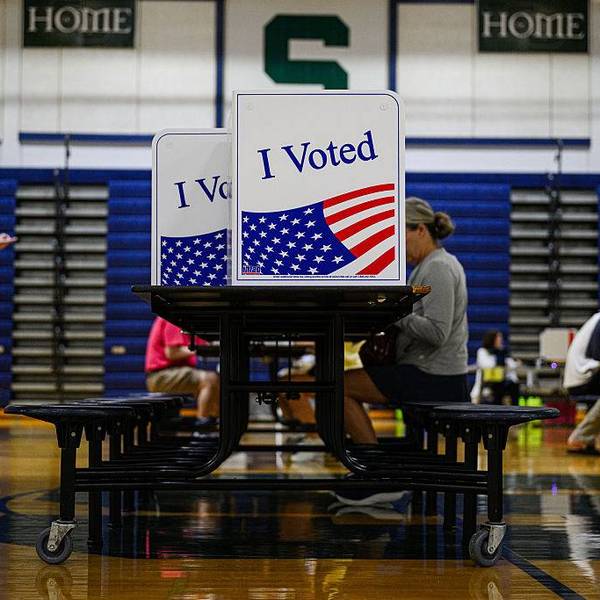
Every eligible voter must make a plan to vote. (Photo: Chuck Burton / Associated Press)
In the past week, reports have emerged of armed actors showing up at ballot drop boxes, spouting "big lie" messaging and other conspiracy theories, with the express aim of intimidation.
Their goal is to intimidate voters-to intimidate all Americans who oppose bigotry and authoritarianism. But we must refuse to be intimidated.
It's no surprise. The 2020 election was marked by the activities of bigoted groups and elected officials promoting dangerous disinformation, with Trump as their ringleader. Over the last two years, that threat has only grown. White nationalist and other bigoted and anti-democracy groups have continued to further embed themselves in our national politics, using conspiracy theories as the accelerant for their growth. Now, instances of electoral disinformation, voter intimidation, and the targeting of public officials have become disturbingly regular occurrences.
We learned in 2020 that those of us who believe in democracy cannot ignore these threats. Unfortunately, bigoted and anti-democracy actors also learned from 2020, and this time around they are more organized. Groups intent on subverting democracy have worked to install their supporters as formal election observers and organized groups of people to monitor and intimidate voters at ballot drop boxes.
Their goal is to intimidate voters-to intimidate all Americans who oppose bigotry and authoritarianism. But we must refuse to be intimidated.
I know, from years of countering bigoted and anti-democracy groups, that there is a lot we can do to resist their efforts. We need every level of government-and the full power of our civil society-to truly defend inclusive democracy, and each of us can be part of that effort, even as individuals.
First and foremost, every eligible voter must make a plan to vote. Whether the ballot is cast in person early, on Election Day in person, by mail, or by absentee ballot, figure out ahead of time which option works best and plan to get the transportation and time off needed to vote for democracy itself and against those who prefer bigotry to inclusion, authoritarianism to full representation.
Next, help friends, family, and neighbors to do the same. Speak out in your networks about democracy, inclusion, and safe voting so that people know they can ask you questions. Ask your community members if they have a plan to vote and help them make one if they don't. Ensuring that everyone-especially those with particular challenges-is familiar with the process can do a lot to remove barriers. That allows election officials to turn their attention to any surprises that pop up at the last minute. (For that matter, if you and your community can vote early, so much the better. That means shorter lines on Election Day and, again, more capacity for election workers to address shocks to the system.)
If you encounter voter intimidation, document it if it is safe to do so and report it immediately. You can contact local authorities or organizations like the Lawyers' Committee for Civil Rights Under Law, which operates the 1-866-OUR-VOTE hotline in English as well as hotlines in several other languages.
In addition to individual acts, working to support institutions to take strong action against bigoted groups is essential. White nationalist and other anti-democracy groups often act with the specific intention of undermining democratic institutions, sapping them of their legitimacy when they struggle to respond to conspiracy theories and bigoted assaults. You can help your networks understand this, and you can speak out in support of local democratic institutions when they get things right.
Similarly, in working with your community in the weeks surrounding an election, it's important to ask local elected officials and law enforcement to make proactive statements about the importance of safe and accessible voting and the consequences of intimidation and harassment. We must support our institutions to confront these challenges to democracy head-on. That's as true in advance of an election as afterwards, as we know from 2020 that some strategies of the anti-democracy coalition only come online after votes begin to be counted.
Consider emailing your city council members and asking them to consistently speak out in support of inclusive democracy and condemn attempts at voter intimidation. Community groups, clubs, or organizations should loudly set the standard that their neighborhoods, towns, and cities will not tolerate any election intimidation or harassment. If you're a member of a rotary club or any other local group, you can ask them to speak out.
Finally, and once again: don't be intimidated! While the risk of bigoted activity to our nation is serious, the chance of activity at the ballot box is very low and voting is still overwhelmingly safe. If voters stop participating in our elections, then the efforts to create a bigoted and anti-democracy country will win, so vote with pride!
And remember: the threats we're seeing to our inclusive democracy are backlash against important victories we've won through inclusive democracy. Making changes is hard, but it is happening-and participating in our democratic systems is a powerful way to make sure it keeps happening.
Dear Common Dreams reader, It’s been nearly 30 years since I co-founded Common Dreams with my late wife, Lina Newhouser. We had the radical notion that journalism should serve the public good, not corporate profits. It was clear to us from the outset what it would take to build such a project. No paid advertisements. No corporate sponsors. No millionaire publisher telling us what to think or do. Many people said we wouldn't last a year, but we proved those doubters wrong. Together with a tremendous team of journalists and dedicated staff, we built an independent media outlet free from the constraints of profits and corporate control. Our mission has always been simple: To inform. To inspire. To ignite change for the common good. Building Common Dreams was not easy. Our survival was never guaranteed. When you take on the most powerful forces—Wall Street greed, fossil fuel industry destruction, Big Tech lobbyists, and uber-rich oligarchs who have spent billions upon billions rigging the economy and democracy in their favor—the only bulwark you have is supporters who believe in your work. But here’s the urgent message from me today. It's never been this bad out there. And it's never been this hard to keep us going. At the very moment Common Dreams is most needed, the threats we face are intensifying. We need your support now more than ever. We don't accept corporate advertising and never will. We don't have a paywall because we don't think people should be blocked from critical news based on their ability to pay. Everything we do is funded by the donations of readers like you. When everyone does the little they can afford, we are strong. But if that support retreats or dries up, so do we. Will you donate now to make sure Common Dreams not only survives but thrives? —Craig Brown, Co-founder |
In the past week, reports have emerged of armed actors showing up at ballot drop boxes, spouting "big lie" messaging and other conspiracy theories, with the express aim of intimidation.
Their goal is to intimidate voters-to intimidate all Americans who oppose bigotry and authoritarianism. But we must refuse to be intimidated.
It's no surprise. The 2020 election was marked by the activities of bigoted groups and elected officials promoting dangerous disinformation, with Trump as their ringleader. Over the last two years, that threat has only grown. White nationalist and other bigoted and anti-democracy groups have continued to further embed themselves in our national politics, using conspiracy theories as the accelerant for their growth. Now, instances of electoral disinformation, voter intimidation, and the targeting of public officials have become disturbingly regular occurrences.
We learned in 2020 that those of us who believe in democracy cannot ignore these threats. Unfortunately, bigoted and anti-democracy actors also learned from 2020, and this time around they are more organized. Groups intent on subverting democracy have worked to install their supporters as formal election observers and organized groups of people to monitor and intimidate voters at ballot drop boxes.
Their goal is to intimidate voters-to intimidate all Americans who oppose bigotry and authoritarianism. But we must refuse to be intimidated.
I know, from years of countering bigoted and anti-democracy groups, that there is a lot we can do to resist their efforts. We need every level of government-and the full power of our civil society-to truly defend inclusive democracy, and each of us can be part of that effort, even as individuals.
First and foremost, every eligible voter must make a plan to vote. Whether the ballot is cast in person early, on Election Day in person, by mail, or by absentee ballot, figure out ahead of time which option works best and plan to get the transportation and time off needed to vote for democracy itself and against those who prefer bigotry to inclusion, authoritarianism to full representation.
Next, help friends, family, and neighbors to do the same. Speak out in your networks about democracy, inclusion, and safe voting so that people know they can ask you questions. Ask your community members if they have a plan to vote and help them make one if they don't. Ensuring that everyone-especially those with particular challenges-is familiar with the process can do a lot to remove barriers. That allows election officials to turn their attention to any surprises that pop up at the last minute. (For that matter, if you and your community can vote early, so much the better. That means shorter lines on Election Day and, again, more capacity for election workers to address shocks to the system.)
If you encounter voter intimidation, document it if it is safe to do so and report it immediately. You can contact local authorities or organizations like the Lawyers' Committee for Civil Rights Under Law, which operates the 1-866-OUR-VOTE hotline in English as well as hotlines in several other languages.
In addition to individual acts, working to support institutions to take strong action against bigoted groups is essential. White nationalist and other anti-democracy groups often act with the specific intention of undermining democratic institutions, sapping them of their legitimacy when they struggle to respond to conspiracy theories and bigoted assaults. You can help your networks understand this, and you can speak out in support of local democratic institutions when they get things right.
Similarly, in working with your community in the weeks surrounding an election, it's important to ask local elected officials and law enforcement to make proactive statements about the importance of safe and accessible voting and the consequences of intimidation and harassment. We must support our institutions to confront these challenges to democracy head-on. That's as true in advance of an election as afterwards, as we know from 2020 that some strategies of the anti-democracy coalition only come online after votes begin to be counted.
Consider emailing your city council members and asking them to consistently speak out in support of inclusive democracy and condemn attempts at voter intimidation. Community groups, clubs, or organizations should loudly set the standard that their neighborhoods, towns, and cities will not tolerate any election intimidation or harassment. If you're a member of a rotary club or any other local group, you can ask them to speak out.
Finally, and once again: don't be intimidated! While the risk of bigoted activity to our nation is serious, the chance of activity at the ballot box is very low and voting is still overwhelmingly safe. If voters stop participating in our elections, then the efforts to create a bigoted and anti-democracy country will win, so vote with pride!
And remember: the threats we're seeing to our inclusive democracy are backlash against important victories we've won through inclusive democracy. Making changes is hard, but it is happening-and participating in our democratic systems is a powerful way to make sure it keeps happening.
In the past week, reports have emerged of armed actors showing up at ballot drop boxes, spouting "big lie" messaging and other conspiracy theories, with the express aim of intimidation.
Their goal is to intimidate voters-to intimidate all Americans who oppose bigotry and authoritarianism. But we must refuse to be intimidated.
It's no surprise. The 2020 election was marked by the activities of bigoted groups and elected officials promoting dangerous disinformation, with Trump as their ringleader. Over the last two years, that threat has only grown. White nationalist and other bigoted and anti-democracy groups have continued to further embed themselves in our national politics, using conspiracy theories as the accelerant for their growth. Now, instances of electoral disinformation, voter intimidation, and the targeting of public officials have become disturbingly regular occurrences.
We learned in 2020 that those of us who believe in democracy cannot ignore these threats. Unfortunately, bigoted and anti-democracy actors also learned from 2020, and this time around they are more organized. Groups intent on subverting democracy have worked to install their supporters as formal election observers and organized groups of people to monitor and intimidate voters at ballot drop boxes.
Their goal is to intimidate voters-to intimidate all Americans who oppose bigotry and authoritarianism. But we must refuse to be intimidated.
I know, from years of countering bigoted and anti-democracy groups, that there is a lot we can do to resist their efforts. We need every level of government-and the full power of our civil society-to truly defend inclusive democracy, and each of us can be part of that effort, even as individuals.
First and foremost, every eligible voter must make a plan to vote. Whether the ballot is cast in person early, on Election Day in person, by mail, or by absentee ballot, figure out ahead of time which option works best and plan to get the transportation and time off needed to vote for democracy itself and against those who prefer bigotry to inclusion, authoritarianism to full representation.
Next, help friends, family, and neighbors to do the same. Speak out in your networks about democracy, inclusion, and safe voting so that people know they can ask you questions. Ask your community members if they have a plan to vote and help them make one if they don't. Ensuring that everyone-especially those with particular challenges-is familiar with the process can do a lot to remove barriers. That allows election officials to turn their attention to any surprises that pop up at the last minute. (For that matter, if you and your community can vote early, so much the better. That means shorter lines on Election Day and, again, more capacity for election workers to address shocks to the system.)
If you encounter voter intimidation, document it if it is safe to do so and report it immediately. You can contact local authorities or organizations like the Lawyers' Committee for Civil Rights Under Law, which operates the 1-866-OUR-VOTE hotline in English as well as hotlines in several other languages.
In addition to individual acts, working to support institutions to take strong action against bigoted groups is essential. White nationalist and other anti-democracy groups often act with the specific intention of undermining democratic institutions, sapping them of their legitimacy when they struggle to respond to conspiracy theories and bigoted assaults. You can help your networks understand this, and you can speak out in support of local democratic institutions when they get things right.
Similarly, in working with your community in the weeks surrounding an election, it's important to ask local elected officials and law enforcement to make proactive statements about the importance of safe and accessible voting and the consequences of intimidation and harassment. We must support our institutions to confront these challenges to democracy head-on. That's as true in advance of an election as afterwards, as we know from 2020 that some strategies of the anti-democracy coalition only come online after votes begin to be counted.
Consider emailing your city council members and asking them to consistently speak out in support of inclusive democracy and condemn attempts at voter intimidation. Community groups, clubs, or organizations should loudly set the standard that their neighborhoods, towns, and cities will not tolerate any election intimidation or harassment. If you're a member of a rotary club or any other local group, you can ask them to speak out.
Finally, and once again: don't be intimidated! While the risk of bigoted activity to our nation is serious, the chance of activity at the ballot box is very low and voting is still overwhelmingly safe. If voters stop participating in our elections, then the efforts to create a bigoted and anti-democracy country will win, so vote with pride!
And remember: the threats we're seeing to our inclusive democracy are backlash against important victories we've won through inclusive democracy. Making changes is hard, but it is happening-and participating in our democratic systems is a powerful way to make sure it keeps happening.