SUBSCRIBE TO OUR FREE NEWSLETTER
Daily news & progressive opinion—funded by the people, not the corporations—delivered straight to your inbox.
5
#000000
#FFFFFF
To donate by check, phone, or other method, see our More Ways to Give page.
Daily news & progressive opinion—funded by the people, not the corporations—delivered straight to your inbox.
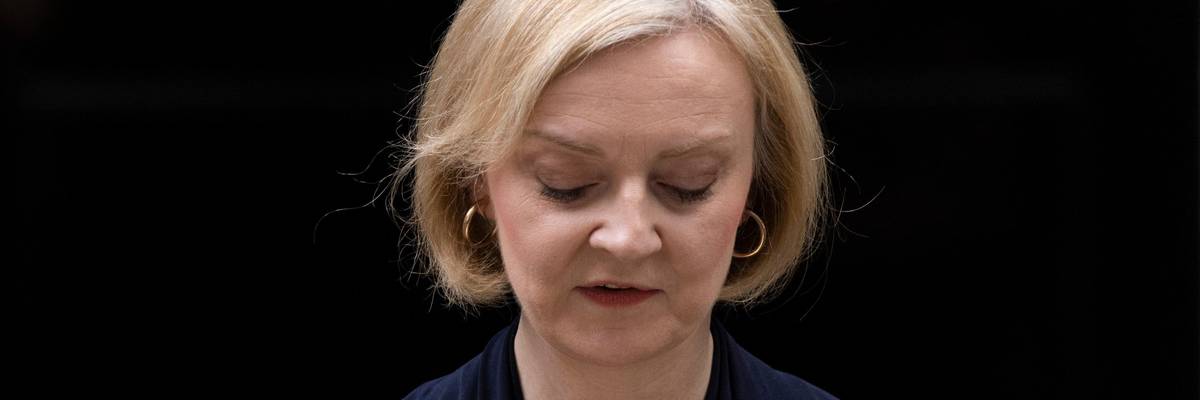
Liz Truss speaks in Downing Street, as she resigns as Prime Minister Of The United Kingdom on October 20, 2022 in London, England. (Photo: Dan Kitwood/Getty Images)
It would take longer to properly account for all the myriad ways Liz Truss leaves Britain worse off than when she entered office than the amount of time she spent inside Number 10.
Their vision promptly dissolved on contact with reality, immediately tanking the economy and requiring a humiliating and abrupt halt to the experiment after all of 44 days.
Her brief tenure has been characterised by an exhilaratingly rapid pace of record-breaking, from establishing an unprecedented Labour lead in the polls to presiding over the highest rates of inflation in 40 years, to driving the pound down to its lowest-ever level against the dollar, and culminating in her resignation as the shortest-serving prime minister in UK history.
The story of the Free Enterprise Group (FEG)--the neo-Thatcherite Tory faction founded by Liz Truss in 2011 and closely associated with Tufton Street think tanks such as the Institute for Economic Affairs (IEA)--makes for satisfying schadenfreude. A decade after a gaggle of newly elected Tory MPs, among them Truss and Kwasi Kwarteng, co-authored 'Britannia Unchained', which outlined the FEG's vision for the country, the group's internal politicking saw them slowly ascend to the head of the table.
Twelve long-time supporters of the FEG would occupy cabinet positions in Truss's government, with Kwarteng, Therese Coffey and Nadhim Zahawi rewarded with some of the choice senior roles. The head of IEA's public policy openly and gleefully boasted about dictating the political course. At last, it was time for them to realise the hyper-neoliberal Britain they'd dreamed about for so long, one which could boast of the bare minimum in taxation, regulation and public spending.
Their vision promptly dissolved on contact with reality, immediately tanking the economy and requiring a humiliating and abrupt halt to the experiment after all of 44 days. Their hubris might make for an enjoyable bit of political theatre, but beyond the spectacle, the consequences of Truss' fleeting premiership cannot be neatly undone.
Though the pound began to rally against the dollar almost instantly after her resignation, the damage caused by Trussonomics, which led to a collapse in gilt government prices, have only thrown fuel on the raging fire of the cost of living crisis. Britain is by no means alone in facing such crises--particularly in the wake of various economic and supply chain shocks resulting from Russia's invasion of Ukraine--but economists have begun to refer to the upshot of Truss' response as a 'moron risk premium', the country becoming a cautionary tale in how to exacerbate an already perilous economic situation.
The Bank of England had to pledge that it was prepared to spend up to PS5bn a day over 13 days (to a total PS65bn) in an attempt to prevent various pension funds from going under. It is now expected to raise interest rates from 0.25% to 5% by early 2023, with the Resolution Foundation anticipating that five million households could be facing an average mortgage bill increase of PS5,100 annually.
Many homeowners may be forced to sell up. But since lenders responded to the mini-budget by withdrawing 1,700 products (roughly 40% of the market) before reintroducing 900 of them at far higher prices, eligible buyers might be in much shorter supply. As well as exposing mortgage-owners to a much higher risk of defaulting (the bank has already warned of increases in the coming months) this could have a severe short-term effect on renters, too, should these rising costs be passed on by landlords. The knock-on effect of a sharp increase in tenants and homeowners being unable to afford rent and mortgages--particularly as other living costs simultaneously soar in tandem--has the potential to not only lead to a large spike in homelessness, but to collapse the property market; a market with which many pension funds are also inextricably linked.
There is a potential that interest rates might not be raised in line with market expectations to avoid such a scenario, but this carries a risk of higher inflation, which has already climbed to 10.1% under Truss--the highest in 40 years. Annual food prices have risen by almost 15%, the highest rise since 1980, which has certainly not been helped by the weakening of the pound leading to significantly increased import costs.
The true impact of spiralling energy costs hasn't been truly felt yet, given we are only in October and winter hasn't really drawn in. Consumers being battered on numerous fronts of essential costs (housing, fuel, food) are likely to make spending cutbacks, meaning many employers could see a significant downturn in business, which--when combined with their own increases in energy and supply costs--might have disastrous consequences for their staff, whether in depressed wages or cutbacks. Losses in earnings beget losses in spending power begets more losses in earnings. Truss' 'Growth Plan' ostensibly sought to prevent a recession, but looks only to have made one more inevitable, and more sharply felt.
It would be unfair to lay blame for all of these scenarios squarely at the feet of Liz Truss. She is a symptom, rather than a direct cause, of our current situation--and of an ideology that has for decades been busy organising the economy in such a precarious way for the benefit of all those she last month sought to hand tax cuts to. In just 44 days, Truss has given us all a glimpse of what that 40+ year political project could look like if allowed to be taken to its logical conclusion.
Dear Common Dreams reader, It’s been nearly 30 years since I co-founded Common Dreams with my late wife, Lina Newhouser. We had the radical notion that journalism should serve the public good, not corporate profits. It was clear to us from the outset what it would take to build such a project. No paid advertisements. No corporate sponsors. No millionaire publisher telling us what to think or do. Many people said we wouldn't last a year, but we proved those doubters wrong. Together with a tremendous team of journalists and dedicated staff, we built an independent media outlet free from the constraints of profits and corporate control. Our mission has always been simple: To inform. To inspire. To ignite change for the common good. Building Common Dreams was not easy. Our survival was never guaranteed. When you take on the most powerful forces—Wall Street greed, fossil fuel industry destruction, Big Tech lobbyists, and uber-rich oligarchs who have spent billions upon billions rigging the economy and democracy in their favor—the only bulwark you have is supporters who believe in your work. But here’s the urgent message from me today. It's never been this bad out there. And it's never been this hard to keep us going. At the very moment Common Dreams is most needed, the threats we face are intensifying. We need your support now more than ever. We don't accept corporate advertising and never will. We don't have a paywall because we don't think people should be blocked from critical news based on their ability to pay. Everything we do is funded by the donations of readers like you. When everyone does the little they can afford, we are strong. But if that support retreats or dries up, so do we. Will you donate now to make sure Common Dreams not only survives but thrives? —Craig Brown, Co-founder |
It would take longer to properly account for all the myriad ways Liz Truss leaves Britain worse off than when she entered office than the amount of time she spent inside Number 10.
Their vision promptly dissolved on contact with reality, immediately tanking the economy and requiring a humiliating and abrupt halt to the experiment after all of 44 days.
Her brief tenure has been characterised by an exhilaratingly rapid pace of record-breaking, from establishing an unprecedented Labour lead in the polls to presiding over the highest rates of inflation in 40 years, to driving the pound down to its lowest-ever level against the dollar, and culminating in her resignation as the shortest-serving prime minister in UK history.
The story of the Free Enterprise Group (FEG)--the neo-Thatcherite Tory faction founded by Liz Truss in 2011 and closely associated with Tufton Street think tanks such as the Institute for Economic Affairs (IEA)--makes for satisfying schadenfreude. A decade after a gaggle of newly elected Tory MPs, among them Truss and Kwasi Kwarteng, co-authored 'Britannia Unchained', which outlined the FEG's vision for the country, the group's internal politicking saw them slowly ascend to the head of the table.
Twelve long-time supporters of the FEG would occupy cabinet positions in Truss's government, with Kwarteng, Therese Coffey and Nadhim Zahawi rewarded with some of the choice senior roles. The head of IEA's public policy openly and gleefully boasted about dictating the political course. At last, it was time for them to realise the hyper-neoliberal Britain they'd dreamed about for so long, one which could boast of the bare minimum in taxation, regulation and public spending.
Their vision promptly dissolved on contact with reality, immediately tanking the economy and requiring a humiliating and abrupt halt to the experiment after all of 44 days. Their hubris might make for an enjoyable bit of political theatre, but beyond the spectacle, the consequences of Truss' fleeting premiership cannot be neatly undone.
Though the pound began to rally against the dollar almost instantly after her resignation, the damage caused by Trussonomics, which led to a collapse in gilt government prices, have only thrown fuel on the raging fire of the cost of living crisis. Britain is by no means alone in facing such crises--particularly in the wake of various economic and supply chain shocks resulting from Russia's invasion of Ukraine--but economists have begun to refer to the upshot of Truss' response as a 'moron risk premium', the country becoming a cautionary tale in how to exacerbate an already perilous economic situation.
The Bank of England had to pledge that it was prepared to spend up to PS5bn a day over 13 days (to a total PS65bn) in an attempt to prevent various pension funds from going under. It is now expected to raise interest rates from 0.25% to 5% by early 2023, with the Resolution Foundation anticipating that five million households could be facing an average mortgage bill increase of PS5,100 annually.
Many homeowners may be forced to sell up. But since lenders responded to the mini-budget by withdrawing 1,700 products (roughly 40% of the market) before reintroducing 900 of them at far higher prices, eligible buyers might be in much shorter supply. As well as exposing mortgage-owners to a much higher risk of defaulting (the bank has already warned of increases in the coming months) this could have a severe short-term effect on renters, too, should these rising costs be passed on by landlords. The knock-on effect of a sharp increase in tenants and homeowners being unable to afford rent and mortgages--particularly as other living costs simultaneously soar in tandem--has the potential to not only lead to a large spike in homelessness, but to collapse the property market; a market with which many pension funds are also inextricably linked.
There is a potential that interest rates might not be raised in line with market expectations to avoid such a scenario, but this carries a risk of higher inflation, which has already climbed to 10.1% under Truss--the highest in 40 years. Annual food prices have risen by almost 15%, the highest rise since 1980, which has certainly not been helped by the weakening of the pound leading to significantly increased import costs.
The true impact of spiralling energy costs hasn't been truly felt yet, given we are only in October and winter hasn't really drawn in. Consumers being battered on numerous fronts of essential costs (housing, fuel, food) are likely to make spending cutbacks, meaning many employers could see a significant downturn in business, which--when combined with their own increases in energy and supply costs--might have disastrous consequences for their staff, whether in depressed wages or cutbacks. Losses in earnings beget losses in spending power begets more losses in earnings. Truss' 'Growth Plan' ostensibly sought to prevent a recession, but looks only to have made one more inevitable, and more sharply felt.
It would be unfair to lay blame for all of these scenarios squarely at the feet of Liz Truss. She is a symptom, rather than a direct cause, of our current situation--and of an ideology that has for decades been busy organising the economy in such a precarious way for the benefit of all those she last month sought to hand tax cuts to. In just 44 days, Truss has given us all a glimpse of what that 40+ year political project could look like if allowed to be taken to its logical conclusion.
It would take longer to properly account for all the myriad ways Liz Truss leaves Britain worse off than when she entered office than the amount of time she spent inside Number 10.
Their vision promptly dissolved on contact with reality, immediately tanking the economy and requiring a humiliating and abrupt halt to the experiment after all of 44 days.
Her brief tenure has been characterised by an exhilaratingly rapid pace of record-breaking, from establishing an unprecedented Labour lead in the polls to presiding over the highest rates of inflation in 40 years, to driving the pound down to its lowest-ever level against the dollar, and culminating in her resignation as the shortest-serving prime minister in UK history.
The story of the Free Enterprise Group (FEG)--the neo-Thatcherite Tory faction founded by Liz Truss in 2011 and closely associated with Tufton Street think tanks such as the Institute for Economic Affairs (IEA)--makes for satisfying schadenfreude. A decade after a gaggle of newly elected Tory MPs, among them Truss and Kwasi Kwarteng, co-authored 'Britannia Unchained', which outlined the FEG's vision for the country, the group's internal politicking saw them slowly ascend to the head of the table.
Twelve long-time supporters of the FEG would occupy cabinet positions in Truss's government, with Kwarteng, Therese Coffey and Nadhim Zahawi rewarded with some of the choice senior roles. The head of IEA's public policy openly and gleefully boasted about dictating the political course. At last, it was time for them to realise the hyper-neoliberal Britain they'd dreamed about for so long, one which could boast of the bare minimum in taxation, regulation and public spending.
Their vision promptly dissolved on contact with reality, immediately tanking the economy and requiring a humiliating and abrupt halt to the experiment after all of 44 days. Their hubris might make for an enjoyable bit of political theatre, but beyond the spectacle, the consequences of Truss' fleeting premiership cannot be neatly undone.
Though the pound began to rally against the dollar almost instantly after her resignation, the damage caused by Trussonomics, which led to a collapse in gilt government prices, have only thrown fuel on the raging fire of the cost of living crisis. Britain is by no means alone in facing such crises--particularly in the wake of various economic and supply chain shocks resulting from Russia's invasion of Ukraine--but economists have begun to refer to the upshot of Truss' response as a 'moron risk premium', the country becoming a cautionary tale in how to exacerbate an already perilous economic situation.
The Bank of England had to pledge that it was prepared to spend up to PS5bn a day over 13 days (to a total PS65bn) in an attempt to prevent various pension funds from going under. It is now expected to raise interest rates from 0.25% to 5% by early 2023, with the Resolution Foundation anticipating that five million households could be facing an average mortgage bill increase of PS5,100 annually.
Many homeowners may be forced to sell up. But since lenders responded to the mini-budget by withdrawing 1,700 products (roughly 40% of the market) before reintroducing 900 of them at far higher prices, eligible buyers might be in much shorter supply. As well as exposing mortgage-owners to a much higher risk of defaulting (the bank has already warned of increases in the coming months) this could have a severe short-term effect on renters, too, should these rising costs be passed on by landlords. The knock-on effect of a sharp increase in tenants and homeowners being unable to afford rent and mortgages--particularly as other living costs simultaneously soar in tandem--has the potential to not only lead to a large spike in homelessness, but to collapse the property market; a market with which many pension funds are also inextricably linked.
There is a potential that interest rates might not be raised in line with market expectations to avoid such a scenario, but this carries a risk of higher inflation, which has already climbed to 10.1% under Truss--the highest in 40 years. Annual food prices have risen by almost 15%, the highest rise since 1980, which has certainly not been helped by the weakening of the pound leading to significantly increased import costs.
The true impact of spiralling energy costs hasn't been truly felt yet, given we are only in October and winter hasn't really drawn in. Consumers being battered on numerous fronts of essential costs (housing, fuel, food) are likely to make spending cutbacks, meaning many employers could see a significant downturn in business, which--when combined with their own increases in energy and supply costs--might have disastrous consequences for their staff, whether in depressed wages or cutbacks. Losses in earnings beget losses in spending power begets more losses in earnings. Truss' 'Growth Plan' ostensibly sought to prevent a recession, but looks only to have made one more inevitable, and more sharply felt.
It would be unfair to lay blame for all of these scenarios squarely at the feet of Liz Truss. She is a symptom, rather than a direct cause, of our current situation--and of an ideology that has for decades been busy organising the economy in such a precarious way for the benefit of all those she last month sought to hand tax cuts to. In just 44 days, Truss has given us all a glimpse of what that 40+ year political project could look like if allowed to be taken to its logical conclusion.