SUBSCRIBE TO OUR FREE NEWSLETTER
Daily news & progressive opinion—funded by the people, not the corporations—delivered straight to your inbox.
5
#000000
#FFFFFF
To donate by check, phone, or other method, see our More Ways to Give page.
Daily news & progressive opinion—funded by the people, not the corporations—delivered straight to your inbox.
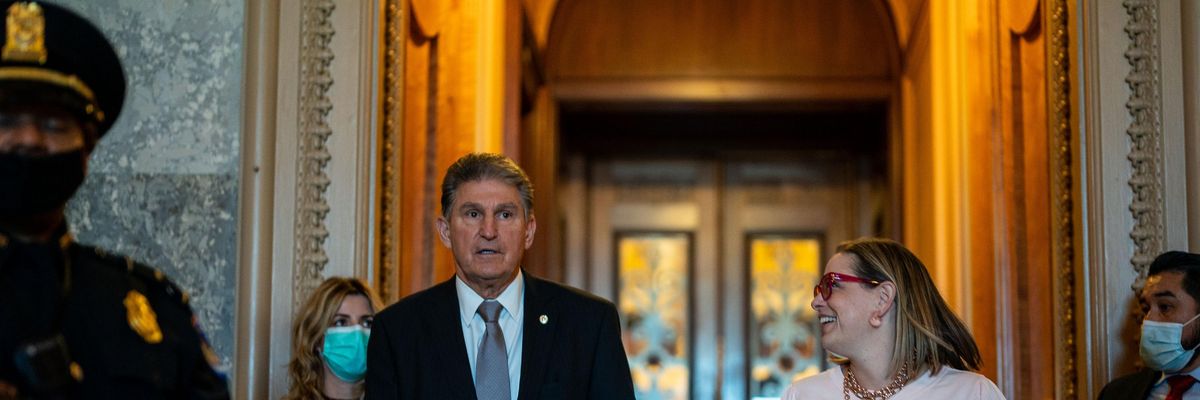
Sen. Joe Manchin (D-W.Va.) leaves the Senate chamber with Sen. Kyrsten Sinema (D-Ariz.) following a vote on November 3, 2021 in Washington, D.C. (Photo: Kent Nishimura / Los Angeles Times via Getty Images)
This week, the spotlight once again will be on Democratic senators Joe Manchin and Kyrsten Sinema (dubbed "Manchinema" by the Washington press corps as the two blocked much of Biden's agenda). It's the Democrats' last chance for a large package--Manchin has agreed to $790 billion--on the climate and healthcare, financed by a tax increase on the rich and big corporations.
But will Sinema go along?
It has been said that the word "politics" is derived from the Latin "poli," meaning "many," and "tics," small blood-sucking insects. I don't hold such a cynical view. But I do know, from fifty year's experience in and around Washington, that most of the people who serve in our nation's capital have very, very large--shall we say?--ego's.
Yesterday, Manchin made the rounds of every Sunday talk show--doing what's known as a "full Ginsburg" (named after William Ginsburg, the lawyer for Monica Lewinsky, who first appeared on all five Sunday morning talk shows on February 1, 1998). Record-keepers note that Manchin is only the 31st newsmaker to have accomplished this feat, but purists dispute his accomplishment because Manchin appeared remotely.
Manchin treated it as a victory lap. He took credit for his newly-named "Inflation Reduction Act" (he refused to allow it to be named "Build Back Better" because he's still smarting over what he viewed as the Biden administration's criticism of him for blocking the original BBB).
One interesting sidebar: When Manchin was asked by "Meet the Press" host Chuck Todd whether he wanted Democrats to keep control of the House and Senate after the midterms, Manchin declined to answer. (Does he want to hold out the possibility of becoming a Republican kingmaker if the Dems lose?)
Tellingly, Manchin wouldn't even use the pronoun "we" when talking about the Democrats.
I've always made it a point to listen to the pronouns politicians use. The use of pronouns tells you a lot about where a politician's loyalties lie. Manchin almost never uses "we" when he refers to Democrats. Sometimes, it's "they." When Trump was president, he used "we" to refer to the people who voted for him, and "they" for everyone else.
Which brings me to Kristyn Sinema--who uses the pronoun "I" perhaps more frequently than any other contemporary politician. ("I'm always surprised when people say, 'Oh, she's an enigma,'" said Sinema in an interview with the Washington Post. "I'm, like, not at all, actually. I'm very straightforward about what I believe in and why I'm doing what I do.")
"What good would politics be," Thomas Mann wrote in The Magic Mountain, "if it didn't give everyone the opportunity to make moral compromises?" Sinema seems to relish that opportunity.
Although not up for reelection until 2024, she is one of the senate's major recipients of Wall Street cash (the finance industry has donated $2.2 million to her since she took office in 2017). She has obliged by, among other things, refusing to close the so-called "carried interest" tax loophole that mostly benefits private-equity investors and hedge fund managers by treating their pay as capital gains (at a tax rate of 20 percent) rather than as ordinary income (36 percent)--even though their pay is ordinary income, since they risk none of their own capital.
By contrast, Manchin wants to close the loophole--or nearly so. (Manchin's bill would lengthen the amount of time private-equity and hedge-fund managers must hold their investments to qualify them for capital gains.) "The only thing I was adamant about was the carried interest," he told reporters last Thursday. Manchin's aversion to the loophole isn't new. Last year he joined two other Senate Democrats in sponsoring a bill to close it.
Closing the carried-interest loophole is the only tax increase on rich individuals in Manchin's compromise bill. The rest of the tax hikes are on corporations.
The carried-interest loophole is a blatant giveaway to the super-rich. It has no redeeming social value. Even Trump promised to eliminate it. So did Barack Obama. So has Joe Biden. Yet it's still there, in the tax code. Why? Because lobbyists for the private-equity and hedge fund industries care about little else, and pour lots of money into the campaigns of both Democratic and Republican members of Congress to maintain it. (Democratic House Ways and Means Committee Chair Richard Neal is a powerful supporter of the loophole. I don't believe it a coincidence that the private equity industry is one of Neal's biggest donors.)
Sinema's office says she's still reviewing Manchin's bill. How long will Democrats have to wait until she breaks her silence on it? If there's one thing Sinema loves more than Wall Street dollars, it's national media attention. So it could be a while.
Dear Common Dreams reader, It’s been nearly 30 years since I co-founded Common Dreams with my late wife, Lina Newhouser. We had the radical notion that journalism should serve the public good, not corporate profits. It was clear to us from the outset what it would take to build such a project. No paid advertisements. No corporate sponsors. No millionaire publisher telling us what to think or do. Many people said we wouldn't last a year, but we proved those doubters wrong. Together with a tremendous team of journalists and dedicated staff, we built an independent media outlet free from the constraints of profits and corporate control. Our mission has always been simple: To inform. To inspire. To ignite change for the common good. Building Common Dreams was not easy. Our survival was never guaranteed. When you take on the most powerful forces—Wall Street greed, fossil fuel industry destruction, Big Tech lobbyists, and uber-rich oligarchs who have spent billions upon billions rigging the economy and democracy in their favor—the only bulwark you have is supporters who believe in your work. But here’s the urgent message from me today. It's never been this bad out there. And it's never been this hard to keep us going. At the very moment Common Dreams is most needed, the threats we face are intensifying. We need your support now more than ever. We don't accept corporate advertising and never will. We don't have a paywall because we don't think people should be blocked from critical news based on their ability to pay. Everything we do is funded by the donations of readers like you. When everyone does the little they can afford, we are strong. But if that support retreats or dries up, so do we. Will you donate now to make sure Common Dreams not only survives but thrives? —Craig Brown, Co-founder |
This week, the spotlight once again will be on Democratic senators Joe Manchin and Kyrsten Sinema (dubbed "Manchinema" by the Washington press corps as the two blocked much of Biden's agenda). It's the Democrats' last chance for a large package--Manchin has agreed to $790 billion--on the climate and healthcare, financed by a tax increase on the rich and big corporations.
But will Sinema go along?
It has been said that the word "politics" is derived from the Latin "poli," meaning "many," and "tics," small blood-sucking insects. I don't hold such a cynical view. But I do know, from fifty year's experience in and around Washington, that most of the people who serve in our nation's capital have very, very large--shall we say?--ego's.
Yesterday, Manchin made the rounds of every Sunday talk show--doing what's known as a "full Ginsburg" (named after William Ginsburg, the lawyer for Monica Lewinsky, who first appeared on all five Sunday morning talk shows on February 1, 1998). Record-keepers note that Manchin is only the 31st newsmaker to have accomplished this feat, but purists dispute his accomplishment because Manchin appeared remotely.
Manchin treated it as a victory lap. He took credit for his newly-named "Inflation Reduction Act" (he refused to allow it to be named "Build Back Better" because he's still smarting over what he viewed as the Biden administration's criticism of him for blocking the original BBB).
One interesting sidebar: When Manchin was asked by "Meet the Press" host Chuck Todd whether he wanted Democrats to keep control of the House and Senate after the midterms, Manchin declined to answer. (Does he want to hold out the possibility of becoming a Republican kingmaker if the Dems lose?)
Tellingly, Manchin wouldn't even use the pronoun "we" when talking about the Democrats.
I've always made it a point to listen to the pronouns politicians use. The use of pronouns tells you a lot about where a politician's loyalties lie. Manchin almost never uses "we" when he refers to Democrats. Sometimes, it's "they." When Trump was president, he used "we" to refer to the people who voted for him, and "they" for everyone else.
Which brings me to Kristyn Sinema--who uses the pronoun "I" perhaps more frequently than any other contemporary politician. ("I'm always surprised when people say, 'Oh, she's an enigma,'" said Sinema in an interview with the Washington Post. "I'm, like, not at all, actually. I'm very straightforward about what I believe in and why I'm doing what I do.")
"What good would politics be," Thomas Mann wrote in The Magic Mountain, "if it didn't give everyone the opportunity to make moral compromises?" Sinema seems to relish that opportunity.
Although not up for reelection until 2024, she is one of the senate's major recipients of Wall Street cash (the finance industry has donated $2.2 million to her since she took office in 2017). She has obliged by, among other things, refusing to close the so-called "carried interest" tax loophole that mostly benefits private-equity investors and hedge fund managers by treating their pay as capital gains (at a tax rate of 20 percent) rather than as ordinary income (36 percent)--even though their pay is ordinary income, since they risk none of their own capital.
By contrast, Manchin wants to close the loophole--or nearly so. (Manchin's bill would lengthen the amount of time private-equity and hedge-fund managers must hold their investments to qualify them for capital gains.) "The only thing I was adamant about was the carried interest," he told reporters last Thursday. Manchin's aversion to the loophole isn't new. Last year he joined two other Senate Democrats in sponsoring a bill to close it.
Closing the carried-interest loophole is the only tax increase on rich individuals in Manchin's compromise bill. The rest of the tax hikes are on corporations.
The carried-interest loophole is a blatant giveaway to the super-rich. It has no redeeming social value. Even Trump promised to eliminate it. So did Barack Obama. So has Joe Biden. Yet it's still there, in the tax code. Why? Because lobbyists for the private-equity and hedge fund industries care about little else, and pour lots of money into the campaigns of both Democratic and Republican members of Congress to maintain it. (Democratic House Ways and Means Committee Chair Richard Neal is a powerful supporter of the loophole. I don't believe it a coincidence that the private equity industry is one of Neal's biggest donors.)
Sinema's office says she's still reviewing Manchin's bill. How long will Democrats have to wait until she breaks her silence on it? If there's one thing Sinema loves more than Wall Street dollars, it's national media attention. So it could be a while.
This week, the spotlight once again will be on Democratic senators Joe Manchin and Kyrsten Sinema (dubbed "Manchinema" by the Washington press corps as the two blocked much of Biden's agenda). It's the Democrats' last chance for a large package--Manchin has agreed to $790 billion--on the climate and healthcare, financed by a tax increase on the rich and big corporations.
But will Sinema go along?
It has been said that the word "politics" is derived from the Latin "poli," meaning "many," and "tics," small blood-sucking insects. I don't hold such a cynical view. But I do know, from fifty year's experience in and around Washington, that most of the people who serve in our nation's capital have very, very large--shall we say?--ego's.
Yesterday, Manchin made the rounds of every Sunday talk show--doing what's known as a "full Ginsburg" (named after William Ginsburg, the lawyer for Monica Lewinsky, who first appeared on all five Sunday morning talk shows on February 1, 1998). Record-keepers note that Manchin is only the 31st newsmaker to have accomplished this feat, but purists dispute his accomplishment because Manchin appeared remotely.
Manchin treated it as a victory lap. He took credit for his newly-named "Inflation Reduction Act" (he refused to allow it to be named "Build Back Better" because he's still smarting over what he viewed as the Biden administration's criticism of him for blocking the original BBB).
One interesting sidebar: When Manchin was asked by "Meet the Press" host Chuck Todd whether he wanted Democrats to keep control of the House and Senate after the midterms, Manchin declined to answer. (Does he want to hold out the possibility of becoming a Republican kingmaker if the Dems lose?)
Tellingly, Manchin wouldn't even use the pronoun "we" when talking about the Democrats.
I've always made it a point to listen to the pronouns politicians use. The use of pronouns tells you a lot about where a politician's loyalties lie. Manchin almost never uses "we" when he refers to Democrats. Sometimes, it's "they." When Trump was president, he used "we" to refer to the people who voted for him, and "they" for everyone else.
Which brings me to Kristyn Sinema--who uses the pronoun "I" perhaps more frequently than any other contemporary politician. ("I'm always surprised when people say, 'Oh, she's an enigma,'" said Sinema in an interview with the Washington Post. "I'm, like, not at all, actually. I'm very straightforward about what I believe in and why I'm doing what I do.")
"What good would politics be," Thomas Mann wrote in The Magic Mountain, "if it didn't give everyone the opportunity to make moral compromises?" Sinema seems to relish that opportunity.
Although not up for reelection until 2024, she is one of the senate's major recipients of Wall Street cash (the finance industry has donated $2.2 million to her since she took office in 2017). She has obliged by, among other things, refusing to close the so-called "carried interest" tax loophole that mostly benefits private-equity investors and hedge fund managers by treating their pay as capital gains (at a tax rate of 20 percent) rather than as ordinary income (36 percent)--even though their pay is ordinary income, since they risk none of their own capital.
By contrast, Manchin wants to close the loophole--or nearly so. (Manchin's bill would lengthen the amount of time private-equity and hedge-fund managers must hold their investments to qualify them for capital gains.) "The only thing I was adamant about was the carried interest," he told reporters last Thursday. Manchin's aversion to the loophole isn't new. Last year he joined two other Senate Democrats in sponsoring a bill to close it.
Closing the carried-interest loophole is the only tax increase on rich individuals in Manchin's compromise bill. The rest of the tax hikes are on corporations.
The carried-interest loophole is a blatant giveaway to the super-rich. It has no redeeming social value. Even Trump promised to eliminate it. So did Barack Obama. So has Joe Biden. Yet it's still there, in the tax code. Why? Because lobbyists for the private-equity and hedge fund industries care about little else, and pour lots of money into the campaigns of both Democratic and Republican members of Congress to maintain it. (Democratic House Ways and Means Committee Chair Richard Neal is a powerful supporter of the loophole. I don't believe it a coincidence that the private equity industry is one of Neal's biggest donors.)
Sinema's office says she's still reviewing Manchin's bill. How long will Democrats have to wait until she breaks her silence on it? If there's one thing Sinema loves more than Wall Street dollars, it's national media attention. So it could be a while.