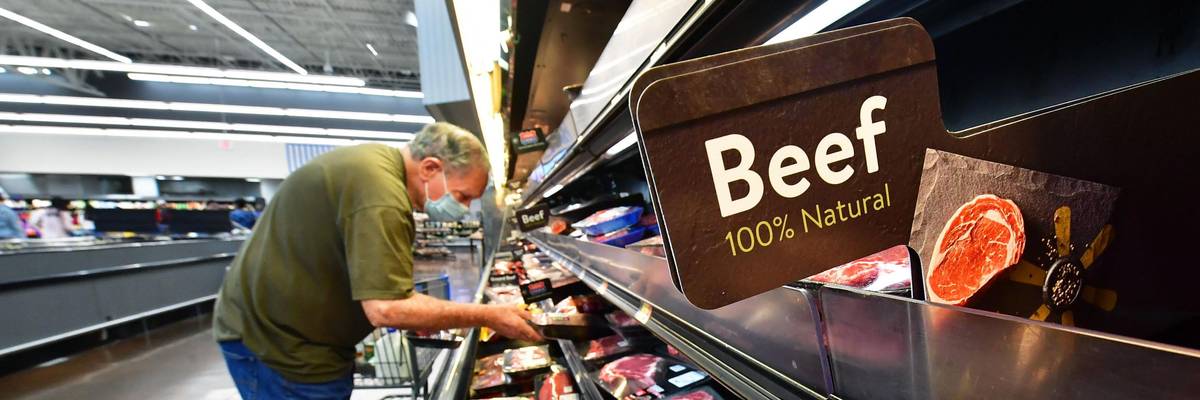
Grocery shopping in Rosemead, California on April 21, 2022. (Photo: Frederic J. Brown/AFP via Getty Images)
Why Food Prices Are Rising Even More
Monopolists control nearly every part of the food production process, from selling feed to farmers, to packaging the meat and poultry for supermarkets.
Monopolies are slowly killing rural America--and driving up the price you pay for food.
Just four firms control 85% of all beef, 66% of all pork, and 54% of all poultry. This degree of monopolization is hurting farmers--and you.
Corporations are using their monopoly power to fix prices.
Monopolists control nearly every part of the food production process, from selling feed to farmers, to packaging the meat and poultry for supermarkets. Half of all chicken farmers report having just one or two processors to sell to.
Farmers are essentially forced to buy from and sell to monopolies at whatever price the corporation wants - often taking on crushing debt to do so. They are trapped in long-term binding contracts, with no way out but losing their livelihood altogether.
[Either I sign it or I ain't got no chickens. Without any chickens, I can't pay any bills.]
Meatpackers used to compete at cattle auctions for what ranchers produced - which helped ranchers get a reasonable return on their investment. Now, with so few buyers, ranchers have no choice but to sign contracts with meatpackers, and sell their cattle for a lower price than if the market were truly competitive.
In 1980, 62 cents of every dollar consumers spent on beef went to ranchers. Today, only 37 cents do. Most of the profits are going into the pockets of the monopolists.
And here's the kicker: Even though farmers are getting squeezed, the ag monopolists are also charging you higher prices. During the pandemic, beef prices rose nearly 16%--and the four biggest beef companies' profits rose more than 300 percent.
These corporations are using their monopoly power to fix prices. Just recently, beef giant JBS settled--without admitting guilt, of course--a beef price-fixing case for $52.5 million.
Monopolization is happening across the food sector. In corn, soybeans, dairy, pesticides, and farm machinery. The result is the same: lower pay to farmers, bigger profits for the monopolists, higher prices for you.
A better way to hold these monopolies accountable would be to break them up, and stop future mergers. But it won't be easy. They flex their political muscle through powerful lobbies like the North American Meat Institute, and maintain a revolving door with regulatory agencies like the US Department of Agriculture.
Well, I say, take them on. Rural America is hurting, farmers are getting squeezed, and consumers are being shafted. Notwithstanding the power of food monopolies, taking them on is wildly popular--especially in Rural America.
But don't just listen to me, listen to what farmers are saying about this:
"I'm here to tell the powers at be to enforce the antitrust laws for the world of agriculture."
"The laws are on the books. We have to strengthen those laws and do what Teddy Roosevelt did to break up the monopolies."
"Don't let these boys who come to Washington with pockets of money set there and bribe our congressman year after year after year."
"Who will stand up for me if you don't?"
For the good of us all, America needs to enforce antitrust laws, and break up Big Ag.
Watch:
We are at a crossroads
This country and this world are at a monumental crossroads. In a few short weeks, US voters will have an opportunity to beat back the forces of fascism and confront the billionaires who are rigging the economy, our media system, and our democracy, making it increasingly impossible for ordinary people to get by. We’re not just talking about the election. We’re talking about what must be done once these fascist elements are vanquished from power. We need a bolder set of solutions than what either major party has so far been willing to offer and a working-class movement ready to fight like hell for it. Trump didn't emerge from nowhere. The conditions that fueled MAGA authoritarianism were created by decades of radical neoliberal economic policies and a corrupt political system dominated by corporate interests. They slashed taxes on the super-rich, promising that the benefits would trickle down. They said giveaways to the corporate titans would make life more affordable for the rest of us. It was all bullshit. And when a bitter, betrayed populace searches for someone to blame, right-wing demagogues have little trouble finding scapegoats. People know when they're being lied to, but you won't hear any of this from the corporate media. Only independent journalism—powered and funded by people who believe in building a better world—can deliver truly trustworthy daily news. Our Fall Campaign is underway, and we need your help. To power our newsroom through the rest of the year, we need to raise $125,000 by midnight on October 31. So if you share our vision, please contribute whatever you can to sustain our work. |
Monopolies are slowly killing rural America--and driving up the price you pay for food.
Just four firms control 85% of all beef, 66% of all pork, and 54% of all poultry. This degree of monopolization is hurting farmers--and you.
Corporations are using their monopoly power to fix prices.
Monopolists control nearly every part of the food production process, from selling feed to farmers, to packaging the meat and poultry for supermarkets. Half of all chicken farmers report having just one or two processors to sell to.
Farmers are essentially forced to buy from and sell to monopolies at whatever price the corporation wants - often taking on crushing debt to do so. They are trapped in long-term binding contracts, with no way out but losing their livelihood altogether.
[Either I sign it or I ain't got no chickens. Without any chickens, I can't pay any bills.]
Meatpackers used to compete at cattle auctions for what ranchers produced - which helped ranchers get a reasonable return on their investment. Now, with so few buyers, ranchers have no choice but to sign contracts with meatpackers, and sell their cattle for a lower price than if the market were truly competitive.
In 1980, 62 cents of every dollar consumers spent on beef went to ranchers. Today, only 37 cents do. Most of the profits are going into the pockets of the monopolists.
And here's the kicker: Even though farmers are getting squeezed, the ag monopolists are also charging you higher prices. During the pandemic, beef prices rose nearly 16%--and the four biggest beef companies' profits rose more than 300 percent.
These corporations are using their monopoly power to fix prices. Just recently, beef giant JBS settled--without admitting guilt, of course--a beef price-fixing case for $52.5 million.
Monopolization is happening across the food sector. In corn, soybeans, dairy, pesticides, and farm machinery. The result is the same: lower pay to farmers, bigger profits for the monopolists, higher prices for you.
A better way to hold these monopolies accountable would be to break them up, and stop future mergers. But it won't be easy. They flex their political muscle through powerful lobbies like the North American Meat Institute, and maintain a revolving door with regulatory agencies like the US Department of Agriculture.
Well, I say, take them on. Rural America is hurting, farmers are getting squeezed, and consumers are being shafted. Notwithstanding the power of food monopolies, taking them on is wildly popular--especially in Rural America.
But don't just listen to me, listen to what farmers are saying about this:
"I'm here to tell the powers at be to enforce the antitrust laws for the world of agriculture."
"The laws are on the books. We have to strengthen those laws and do what Teddy Roosevelt did to break up the monopolies."
"Don't let these boys who come to Washington with pockets of money set there and bribe our congressman year after year after year."
"Who will stand up for me if you don't?"
For the good of us all, America needs to enforce antitrust laws, and break up Big Ag.
Watch:
Monopolies are slowly killing rural America--and driving up the price you pay for food.
Just four firms control 85% of all beef, 66% of all pork, and 54% of all poultry. This degree of monopolization is hurting farmers--and you.
Corporations are using their monopoly power to fix prices.
Monopolists control nearly every part of the food production process, from selling feed to farmers, to packaging the meat and poultry for supermarkets. Half of all chicken farmers report having just one or two processors to sell to.
Farmers are essentially forced to buy from and sell to monopolies at whatever price the corporation wants - often taking on crushing debt to do so. They are trapped in long-term binding contracts, with no way out but losing their livelihood altogether.
[Either I sign it or I ain't got no chickens. Without any chickens, I can't pay any bills.]
Meatpackers used to compete at cattle auctions for what ranchers produced - which helped ranchers get a reasonable return on their investment. Now, with so few buyers, ranchers have no choice but to sign contracts with meatpackers, and sell their cattle for a lower price than if the market were truly competitive.
In 1980, 62 cents of every dollar consumers spent on beef went to ranchers. Today, only 37 cents do. Most of the profits are going into the pockets of the monopolists.
And here's the kicker: Even though farmers are getting squeezed, the ag monopolists are also charging you higher prices. During the pandemic, beef prices rose nearly 16%--and the four biggest beef companies' profits rose more than 300 percent.
These corporations are using their monopoly power to fix prices. Just recently, beef giant JBS settled--without admitting guilt, of course--a beef price-fixing case for $52.5 million.
Monopolization is happening across the food sector. In corn, soybeans, dairy, pesticides, and farm machinery. The result is the same: lower pay to farmers, bigger profits for the monopolists, higher prices for you.
A better way to hold these monopolies accountable would be to break them up, and stop future mergers. But it won't be easy. They flex their political muscle through powerful lobbies like the North American Meat Institute, and maintain a revolving door with regulatory agencies like the US Department of Agriculture.
Well, I say, take them on. Rural America is hurting, farmers are getting squeezed, and consumers are being shafted. Notwithstanding the power of food monopolies, taking them on is wildly popular--especially in Rural America.
But don't just listen to me, listen to what farmers are saying about this:
"I'm here to tell the powers at be to enforce the antitrust laws for the world of agriculture."
"The laws are on the books. We have to strengthen those laws and do what Teddy Roosevelt did to break up the monopolies."
"Don't let these boys who come to Washington with pockets of money set there and bribe our congressman year after year after year."
"Who will stand up for me if you don't?"
For the good of us all, America needs to enforce antitrust laws, and break up Big Ag.
Watch: