

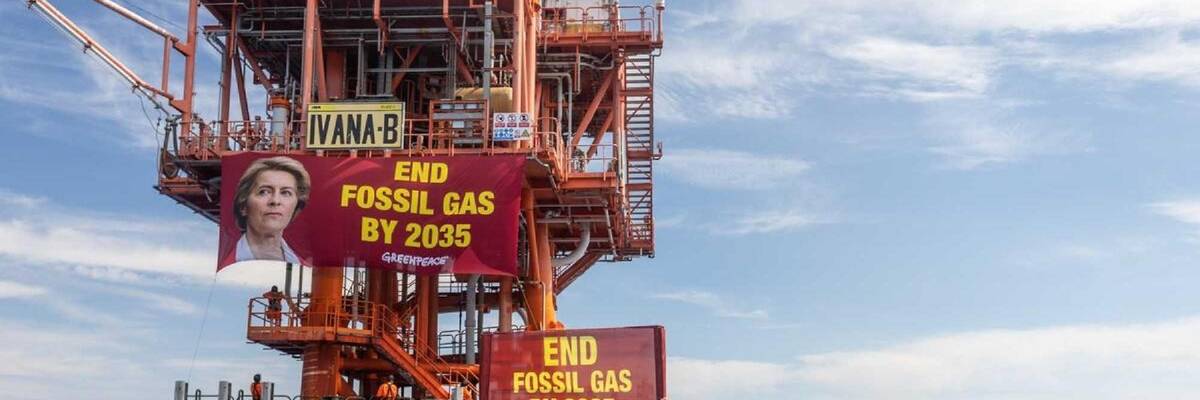
Activists from Croatia, Hungary, Poland and Ireland scale the gas rig Ivana B in the north of the Adriatic Sea, some 50 kilometres away from the Croatian coast. (Photo: (c) Bojan-Haron Markicevic / Greenpeace)
Climate Killer: How to Get Out of the Fossil Fuel Trap
Despite this overwhelming evidence, European politicians are still falling for the fossil fuel industry's greenwashing, calling gas the 'bridging fuel' that will eventually lead to clean energy.
Let's be brutally honest here, fossil gas is a climate killer. But that's not its only problem. Gas is also fuelling the Russian war on Ukraine, it's expensive, causing millions of Europeans to worry about heating up their homes, and it's dangerous for our health. So why does the European Union want to label it 'green' and funnel billions of public money into it?
Gas: the war enabler
Since the beginning of the war in Ukraine, EU member states have paid over 60 billion euros for Russian fossil fuels. Gas is a large part of this package, with EU member states paying some 200-300 million euros per day for Russian gas alone. In contrast to the EU embargoes on coal and oil imports from Russia, a similar embargo on gas is nowhere to be seen. The humanitarian crisis and the atrocities of war in Ukraine are tangible, soul-wrenching evidence that a policy of reliance on Russian fossil fuels was bound for failure.
Gas, the climate killer
36% of greenhouse gas emissions in Europe comes from fossil gas, making it the largest source of greenhouse gases on the continent, even before oil. A large part of these emissions are related to methane, the main constituent of fossil gas, which is 80 times more potent than CO2 in contributing to planetary warming.
The recent scandal unveiled by Greenpeace Croatia is a perfect example of the attitude fossil fuel companies have when it comes to their environmental responsibility. In December 2020 Croatian INA (controlled by Hungarian MOL) literally 'lost' a 65-metre high gas rig in the Adriatic Sea. It turned out that the rig was washed away by a storm and lies at the bottom of the sea, forgotten by its owner. In June 2022, one and a half years after the mysterious disappearance, Greenpeace Croatia unveiled that the sunken gas rig not only has not been cleared from the bottom of the Adriatic, but that there is deeply harmful methane still leaking from the wreck.
Gas, the poverty enhancer
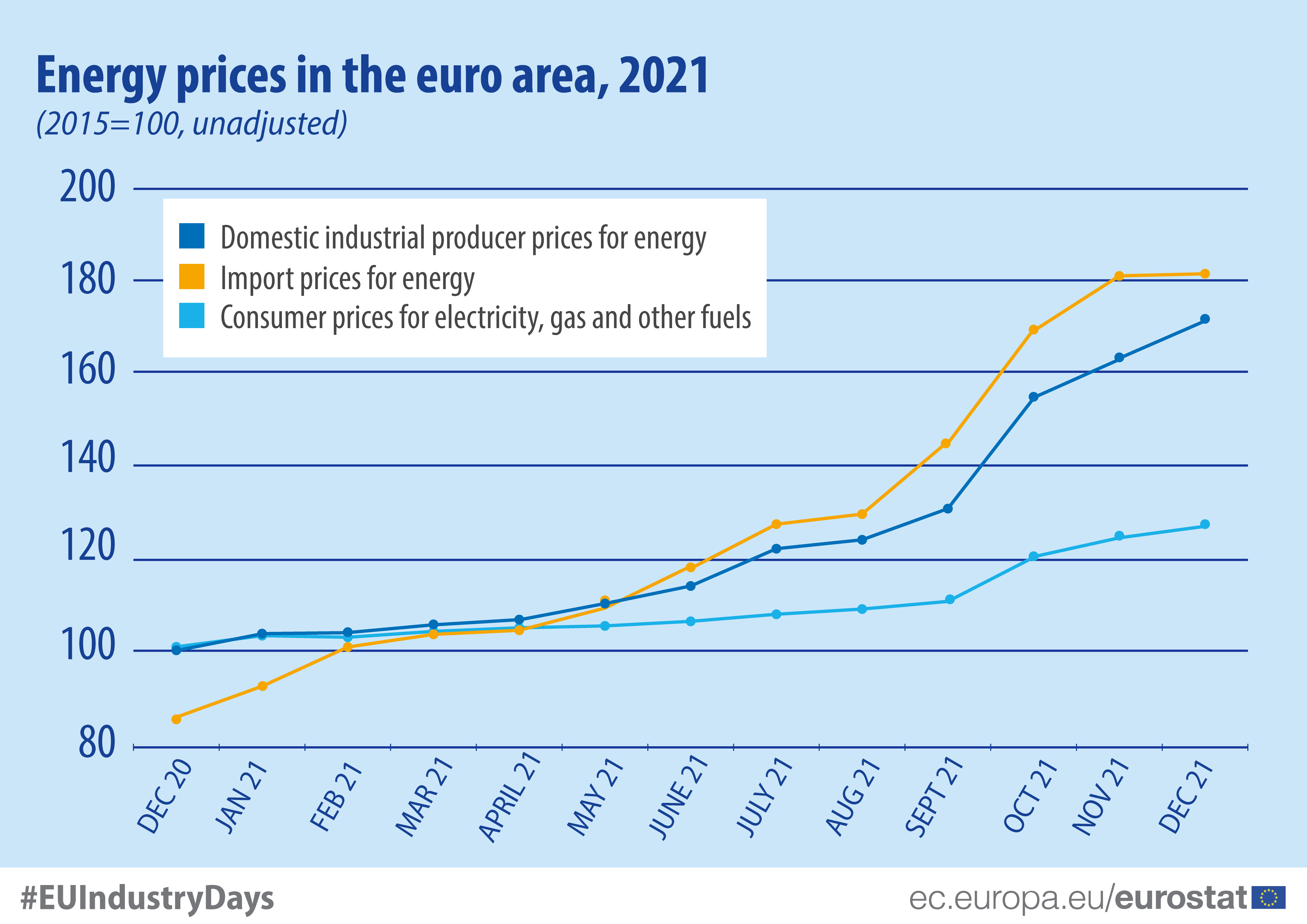
Our dependence on gas is also a major factor of increasing energy poverty in Europe. Many Europeans rely on gas to heat their homes, and struggle to pay their energy bills. In 2019 an estimated 50 million households in the European Union lived in energy poverty and experienced inadequate levels of essential energy services. Between December 2020 and December 2021, consumer energy prices in the euro area for electricity, gas and other fuels increased by 25%. Since the start of the war in Ukraine the energy crisis in the EU has further intensified. As heating is the largest part of our energy bills, this leaves many living in fear for the coming winter.
Gas, the health hazard
Buildings are the biggest consumer of fossil gas in Europe. What we often don't realise when using gas in our homes is that it is actually a major health hazard. Gas appliances are a source of air pollutants, which can cause asthma and other respiratory diseases. Gas heating can also be deadly: In Italy, the second largest consumer of fossil gas in Europe, gas caused 153 accidents, killing 23 and injuring 308 in 2019 alone.
Gas, the great greenwasher
Despite this overwhelming evidence, European politicians are still falling for the fossil fuel industry's greenwashing, calling gas the 'bridging fuel' that will eventually lead to clean energy. The EU still hasn't introduced an embargo against Russian fossil gas imports in response to the Ukrainian war. Meanwhile, the EU Commission has proposed the RePowerEU package, a collection of measures which aims at 'reducing Europe's reliance on Russian gas by diversifying supply, energy savings and a faster rollout of renewables'.
The problem is that all these measures will achieve is to substitute Russian gas with gas from other sources: Europe will still rely on this climate killer. This is evident from the EU's proposal to assign gas a 'green label' in the EU taxonomy. A green label for fossil gas will translate into streamlined investment into further gas infrastructure in Europe. Investing more public money into fossil gas will create a lock-in effect. Instead of building a lasting energy security through renewables and energy efficiency, we will spend billions of euros on gas pipelines, gas power plants and gas terminals.
EU, wake up!
EU leaders must keep in mind that every cubic metre of fossil gas used is fueling the climate crisis and posing a threat to our health and energy security, regardless of where it originates. It will always pose a threat to our health and energy security. Luckily, clean solutions like solar, wind, heat pumps, and home insulation or electrification are now mature and can be used across Europe to reduce demand for fossil gas. If we want to stay on track for 1.5 degrees and secure a liveable climate for all, we need to phase out gas in the EU by 2035 at the latest. It is within our reach and the only thing between us and ending gas is political will. Political leaders must finally realise that we will never be safe in a world fuelled with fossil fuels.
An Urgent Message From Our Co-Founder
Dear Common Dreams reader, It’s been nearly 30 years since I co-founded Common Dreams with my late wife, Lina Newhouser. We had the radical notion that journalism should serve the public good, not corporate profits. It was clear to us from the outset what it would take to build such a project. No paid advertisements. No corporate sponsors. No millionaire publisher telling us what to think or do. Many people said we wouldn't last a year, but we proved those doubters wrong. Together with a tremendous team of journalists and dedicated staff, we built an independent media outlet free from the constraints of profits and corporate control. Our mission has always been simple: To inform. To inspire. To ignite change for the common good. Building Common Dreams was not easy. Our survival was never guaranteed. When you take on the most powerful forces—Wall Street greed, fossil fuel industry destruction, Big Tech lobbyists, and uber-rich oligarchs who have spent billions upon billions rigging the economy and democracy in their favor—the only bulwark you have is supporters who believe in your work. But here’s the urgent message from me today. It's never been this bad out there. And it's never been this hard to keep us going. At the very moment Common Dreams is most needed, the threats we face are intensifying. We need your support now more than ever. We don't accept corporate advertising and never will. We don't have a paywall because we don't think people should be blocked from critical news based on their ability to pay. Everything we do is funded by the donations of readers like you. When everyone does the little they can afford, we are strong. But if that support retreats or dries up, so do we. Will you donate now to make sure Common Dreams not only survives but thrives? —Craig Brown, Co-founder |
Let's be brutally honest here, fossil gas is a climate killer. But that's not its only problem. Gas is also fuelling the Russian war on Ukraine, it's expensive, causing millions of Europeans to worry about heating up their homes, and it's dangerous for our health. So why does the European Union want to label it 'green' and funnel billions of public money into it?
Gas: the war enabler
Since the beginning of the war in Ukraine, EU member states have paid over 60 billion euros for Russian fossil fuels. Gas is a large part of this package, with EU member states paying some 200-300 million euros per day for Russian gas alone. In contrast to the EU embargoes on coal and oil imports from Russia, a similar embargo on gas is nowhere to be seen. The humanitarian crisis and the atrocities of war in Ukraine are tangible, soul-wrenching evidence that a policy of reliance on Russian fossil fuels was bound for failure.
Gas, the climate killer
36% of greenhouse gas emissions in Europe comes from fossil gas, making it the largest source of greenhouse gases on the continent, even before oil. A large part of these emissions are related to methane, the main constituent of fossil gas, which is 80 times more potent than CO2 in contributing to planetary warming.
The recent scandal unveiled by Greenpeace Croatia is a perfect example of the attitude fossil fuel companies have when it comes to their environmental responsibility. In December 2020 Croatian INA (controlled by Hungarian MOL) literally 'lost' a 65-metre high gas rig in the Adriatic Sea. It turned out that the rig was washed away by a storm and lies at the bottom of the sea, forgotten by its owner. In June 2022, one and a half years after the mysterious disappearance, Greenpeace Croatia unveiled that the sunken gas rig not only has not been cleared from the bottom of the Adriatic, but that there is deeply harmful methane still leaking from the wreck.
Gas, the poverty enhancer
Our dependence on gas is also a major factor of increasing energy poverty in Europe. Many Europeans rely on gas to heat their homes, and struggle to pay their energy bills. In 2019 an estimated 50 million households in the European Union lived in energy poverty and experienced inadequate levels of essential energy services. Between December 2020 and December 2021, consumer energy prices in the euro area for electricity, gas and other fuels increased by 25%. Since the start of the war in Ukraine the energy crisis in the EU has further intensified. As heating is the largest part of our energy bills, this leaves many living in fear for the coming winter.
Gas, the health hazard
Buildings are the biggest consumer of fossil gas in Europe. What we often don't realise when using gas in our homes is that it is actually a major health hazard. Gas appliances are a source of air pollutants, which can cause asthma and other respiratory diseases. Gas heating can also be deadly: In Italy, the second largest consumer of fossil gas in Europe, gas caused 153 accidents, killing 23 and injuring 308 in 2019 alone.
Gas, the great greenwasher
Despite this overwhelming evidence, European politicians are still falling for the fossil fuel industry's greenwashing, calling gas the 'bridging fuel' that will eventually lead to clean energy. The EU still hasn't introduced an embargo against Russian fossil gas imports in response to the Ukrainian war. Meanwhile, the EU Commission has proposed the RePowerEU package, a collection of measures which aims at 'reducing Europe's reliance on Russian gas by diversifying supply, energy savings and a faster rollout of renewables'.
The problem is that all these measures will achieve is to substitute Russian gas with gas from other sources: Europe will still rely on this climate killer. This is evident from the EU's proposal to assign gas a 'green label' in the EU taxonomy. A green label for fossil gas will translate into streamlined investment into further gas infrastructure in Europe. Investing more public money into fossil gas will create a lock-in effect. Instead of building a lasting energy security through renewables and energy efficiency, we will spend billions of euros on gas pipelines, gas power plants and gas terminals.
EU, wake up!
EU leaders must keep in mind that every cubic metre of fossil gas used is fueling the climate crisis and posing a threat to our health and energy security, regardless of where it originates. It will always pose a threat to our health and energy security. Luckily, clean solutions like solar, wind, heat pumps, and home insulation or electrification are now mature and can be used across Europe to reduce demand for fossil gas. If we want to stay on track for 1.5 degrees and secure a liveable climate for all, we need to phase out gas in the EU by 2035 at the latest. It is within our reach and the only thing between us and ending gas is political will. Political leaders must finally realise that we will never be safe in a world fuelled with fossil fuels.
Let's be brutally honest here, fossil gas is a climate killer. But that's not its only problem. Gas is also fuelling the Russian war on Ukraine, it's expensive, causing millions of Europeans to worry about heating up their homes, and it's dangerous for our health. So why does the European Union want to label it 'green' and funnel billions of public money into it?
Gas: the war enabler
Since the beginning of the war in Ukraine, EU member states have paid over 60 billion euros for Russian fossil fuels. Gas is a large part of this package, with EU member states paying some 200-300 million euros per day for Russian gas alone. In contrast to the EU embargoes on coal and oil imports from Russia, a similar embargo on gas is nowhere to be seen. The humanitarian crisis and the atrocities of war in Ukraine are tangible, soul-wrenching evidence that a policy of reliance on Russian fossil fuels was bound for failure.
Gas, the climate killer
36% of greenhouse gas emissions in Europe comes from fossil gas, making it the largest source of greenhouse gases on the continent, even before oil. A large part of these emissions are related to methane, the main constituent of fossil gas, which is 80 times more potent than CO2 in contributing to planetary warming.
The recent scandal unveiled by Greenpeace Croatia is a perfect example of the attitude fossil fuel companies have when it comes to their environmental responsibility. In December 2020 Croatian INA (controlled by Hungarian MOL) literally 'lost' a 65-metre high gas rig in the Adriatic Sea. It turned out that the rig was washed away by a storm and lies at the bottom of the sea, forgotten by its owner. In June 2022, one and a half years after the mysterious disappearance, Greenpeace Croatia unveiled that the sunken gas rig not only has not been cleared from the bottom of the Adriatic, but that there is deeply harmful methane still leaking from the wreck.
Gas, the poverty enhancer
Our dependence on gas is also a major factor of increasing energy poverty in Europe. Many Europeans rely on gas to heat their homes, and struggle to pay their energy bills. In 2019 an estimated 50 million households in the European Union lived in energy poverty and experienced inadequate levels of essential energy services. Between December 2020 and December 2021, consumer energy prices in the euro area for electricity, gas and other fuels increased by 25%. Since the start of the war in Ukraine the energy crisis in the EU has further intensified. As heating is the largest part of our energy bills, this leaves many living in fear for the coming winter.
Gas, the health hazard
Buildings are the biggest consumer of fossil gas in Europe. What we often don't realise when using gas in our homes is that it is actually a major health hazard. Gas appliances are a source of air pollutants, which can cause asthma and other respiratory diseases. Gas heating can also be deadly: In Italy, the second largest consumer of fossil gas in Europe, gas caused 153 accidents, killing 23 and injuring 308 in 2019 alone.
Gas, the great greenwasher
Despite this overwhelming evidence, European politicians are still falling for the fossil fuel industry's greenwashing, calling gas the 'bridging fuel' that will eventually lead to clean energy. The EU still hasn't introduced an embargo against Russian fossil gas imports in response to the Ukrainian war. Meanwhile, the EU Commission has proposed the RePowerEU package, a collection of measures which aims at 'reducing Europe's reliance on Russian gas by diversifying supply, energy savings and a faster rollout of renewables'.
The problem is that all these measures will achieve is to substitute Russian gas with gas from other sources: Europe will still rely on this climate killer. This is evident from the EU's proposal to assign gas a 'green label' in the EU taxonomy. A green label for fossil gas will translate into streamlined investment into further gas infrastructure in Europe. Investing more public money into fossil gas will create a lock-in effect. Instead of building a lasting energy security through renewables and energy efficiency, we will spend billions of euros on gas pipelines, gas power plants and gas terminals.
EU, wake up!
EU leaders must keep in mind that every cubic metre of fossil gas used is fueling the climate crisis and posing a threat to our health and energy security, regardless of where it originates. It will always pose a threat to our health and energy security. Luckily, clean solutions like solar, wind, heat pumps, and home insulation or electrification are now mature and can be used across Europe to reduce demand for fossil gas. If we want to stay on track for 1.5 degrees and secure a liveable climate for all, we need to phase out gas in the EU by 2035 at the latest. It is within our reach and the only thing between us and ending gas is political will. Political leaders must finally realise that we will never be safe in a world fuelled with fossil fuels.