

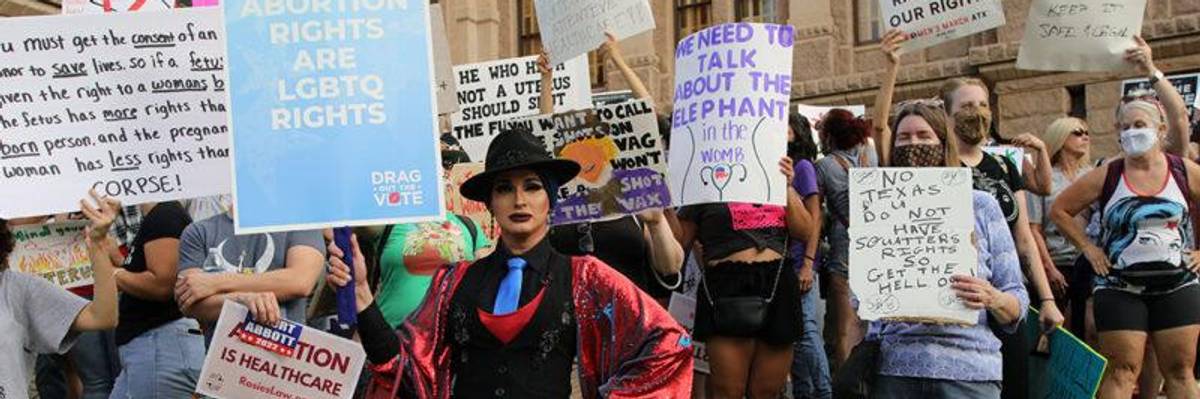
"What's scary about the Dobbs draft is not just what it does directly," writes Esseks, "but also what it previews as the next steps the court may take in the future." (Photo: Shutterstock)
The GOP War Against the LGBTQ Community Is Not Coming. It's Here.
But it must be said that the Roe draft signals a potential new and terrifying front in the already-raging assault on gay rights.
Many commentators in the LGBTQ space are talking about how the draft U.S. Supreme Court opinion in Dobbs v. Jackson Women's Health Organization might affect various constitutional rights that the LGBTQ community has secured over decades of advocacy and struggle. A common theme is that "they're coming for us next," after abortion. But make no mistake, the war against LGBTQ people in America is already raging. While the Dobbs draft opinion may preview a new front in that war (and I fear it does), attacks against LGBTQ people -- especially youth -- have been growing in intensity for several years and have already reached a fever pitch. The fight is upon us and we need to mobilize now.
First, even before the leak of the Dobbs draft, we were in the midst of the most aggressive attack on LGBTQ people -- and especially trans youth -- that our country has ever seen. Over 300 anti-trans and anti-LGBTQ bills have been proposed in state legislatures just in 2022, and over 20 new anti-trans bills have become law over the past three years. Those new laws restrict access to health care, bar trans people from restrooms, prevent any discussion of the existence of LGB or trans people in schools, bar trans youth from participating in sports, or prevent updating government-issued ID documents to reflect our actual identities.
We have even returned to a place where the primary narrative from our opponents is that LGBTQ people are child molesters, or "groomers" in today's parlance. That was the central theme of Anita Bryant's successful 1977 "Save Our Children" campaign to repeal Miami-Dade County's sexual orientation non-discrimination ordinance. Many of us thought that America had moved beyond thinking of LGBTQ people as child molesters, but Texas' governor has declared that parents who follow doctor's advice to provide necessary health care for their trans kids are child abusers, and Florida has restricted discussion of the existence of gay or trans people in schools to prevent the supposed recruitment of kids to be LGBTQ. We are going backwards on LGBTQ acceptance and understanding, not forwards. This didn't start with the Dobbs draft.
Second, the Dobbs draft does represent a new front in the ongoing anti-LGBTQ war, and its impact (if this draft becomes the decision of the court) would be immediate. That's because the restrictions on abortion that the Dobbs draft would authorize are a direct attack on LGBTQ people, who need access to abortion health care just like many cisgender and heterosexual people do. In the wake of a Dobbs decision that follows the draft, many states will ban abortion outright or start enforcing bans that are already on the books, and that will cause intense suffering for many people, including many LGBTQ people. The Dobbs draft is terrible news for everyone in America who can get pregnant, and for everyone who loves them and values their independence and autonomy. This is our fight now.
But what's scary about the Dobbs draft is not just what it does directly, but also what it previews as the next steps the court may take in the future. To be sure, the draft opinion says specifically that its holding is limited to what it calls the unique context of abortion, and it declares that the ruling does not undermine other fundamental rights cases, including both Lawrence (the right to form intimate relationships) and Obergefell (the freedom to marry for same-sex couples). But it's hard to take much comfort in that statement.
If and when the legal challenges to Obergefell and Lawrence come, we will cite those lines in Dobbs and our side will win in the lower federal courts. But when and if the issues get to this Supreme Court, I fear that the calming statements in the Dobbs draft will make little difference.
If the Supreme Court approaches the Obergefell question or the Lawrence question the same way it approaches the abortion question in the Dobbs draft, both of those rights are in danger. In the Dobbs draft, SCOTUS focused on whether there was a history of protecting the right to abortion in America, and refused to frame the right more broadly, as a right of personal autonomy and of control over one's own body. That narrow framing led to the overruling of Roe.
If the court asks the same crabbed question in the context of marriage equality or the right to form intimate relationships -- is there a long history and tradition of protecting specifically the right of same-sex couples to marry or of the right of same-sex couples to be intimate -- the extreme conservative majority on this court could easily answer that question "no." Never mind that the Supreme Court itself said in Lawrence and in Obergefell that that framing of the right was too narrow; choosing to narrow the scope of a long-established right is precisely what the Dobbs draft does. It's why I'm very concerned about what this draft opinion could mean for the freedom to marry and the right to form intimate relationships.
So let's put the Dobbs draft in perspective -- it represents a new and profoundly disturbing front in the current attack on LGBTQ people in America, but it's just one aspect of a war that is already well underway. That's not an effort to downplay the significance of this draft opinion for LGBTQ people, it just means we all need to wake up to the fact that we are already deep in the fight for our lives.
An Urgent Message From Our Co-Founder
Dear Common Dreams reader, It’s been nearly 30 years since I co-founded Common Dreams with my late wife, Lina Newhouser. We had the radical notion that journalism should serve the public good, not corporate profits. It was clear to us from the outset what it would take to build such a project. No paid advertisements. No corporate sponsors. No millionaire publisher telling us what to think or do. Many people said we wouldn't last a year, but we proved those doubters wrong. Together with a tremendous team of journalists and dedicated staff, we built an independent media outlet free from the constraints of profits and corporate control. Our mission has always been simple: To inform. To inspire. To ignite change for the common good. Building Common Dreams was not easy. Our survival was never guaranteed. When you take on the most powerful forces—Wall Street greed, fossil fuel industry destruction, Big Tech lobbyists, and uber-rich oligarchs who have spent billions upon billions rigging the economy and democracy in their favor—the only bulwark you have is supporters who believe in your work. But here’s the urgent message from me today. It's never been this bad out there. And it's never been this hard to keep us going. At the very moment Common Dreams is most needed, the threats we face are intensifying. We need your support now more than ever. We don't accept corporate advertising and never will. We don't have a paywall because we don't think people should be blocked from critical news based on their ability to pay. Everything we do is funded by the donations of readers like you. When everyone does the little they can afford, we are strong. But if that support retreats or dries up, so do we. Will you donate now to make sure Common Dreams not only survives but thrives? —Craig Brown, Co-founder |
Many commentators in the LGBTQ space are talking about how the draft U.S. Supreme Court opinion in Dobbs v. Jackson Women's Health Organization might affect various constitutional rights that the LGBTQ community has secured over decades of advocacy and struggle. A common theme is that "they're coming for us next," after abortion. But make no mistake, the war against LGBTQ people in America is already raging. While the Dobbs draft opinion may preview a new front in that war (and I fear it does), attacks against LGBTQ people -- especially youth -- have been growing in intensity for several years and have already reached a fever pitch. The fight is upon us and we need to mobilize now.
First, even before the leak of the Dobbs draft, we were in the midst of the most aggressive attack on LGBTQ people -- and especially trans youth -- that our country has ever seen. Over 300 anti-trans and anti-LGBTQ bills have been proposed in state legislatures just in 2022, and over 20 new anti-trans bills have become law over the past three years. Those new laws restrict access to health care, bar trans people from restrooms, prevent any discussion of the existence of LGB or trans people in schools, bar trans youth from participating in sports, or prevent updating government-issued ID documents to reflect our actual identities.
We have even returned to a place where the primary narrative from our opponents is that LGBTQ people are child molesters, or "groomers" in today's parlance. That was the central theme of Anita Bryant's successful 1977 "Save Our Children" campaign to repeal Miami-Dade County's sexual orientation non-discrimination ordinance. Many of us thought that America had moved beyond thinking of LGBTQ people as child molesters, but Texas' governor has declared that parents who follow doctor's advice to provide necessary health care for their trans kids are child abusers, and Florida has restricted discussion of the existence of gay or trans people in schools to prevent the supposed recruitment of kids to be LGBTQ. We are going backwards on LGBTQ acceptance and understanding, not forwards. This didn't start with the Dobbs draft.
Second, the Dobbs draft does represent a new front in the ongoing anti-LGBTQ war, and its impact (if this draft becomes the decision of the court) would be immediate. That's because the restrictions on abortion that the Dobbs draft would authorize are a direct attack on LGBTQ people, who need access to abortion health care just like many cisgender and heterosexual people do. In the wake of a Dobbs decision that follows the draft, many states will ban abortion outright or start enforcing bans that are already on the books, and that will cause intense suffering for many people, including many LGBTQ people. The Dobbs draft is terrible news for everyone in America who can get pregnant, and for everyone who loves them and values their independence and autonomy. This is our fight now.
But what's scary about the Dobbs draft is not just what it does directly, but also what it previews as the next steps the court may take in the future. To be sure, the draft opinion says specifically that its holding is limited to what it calls the unique context of abortion, and it declares that the ruling does not undermine other fundamental rights cases, including both Lawrence (the right to form intimate relationships) and Obergefell (the freedom to marry for same-sex couples). But it's hard to take much comfort in that statement.
If and when the legal challenges to Obergefell and Lawrence come, we will cite those lines in Dobbs and our side will win in the lower federal courts. But when and if the issues get to this Supreme Court, I fear that the calming statements in the Dobbs draft will make little difference.
If the Supreme Court approaches the Obergefell question or the Lawrence question the same way it approaches the abortion question in the Dobbs draft, both of those rights are in danger. In the Dobbs draft, SCOTUS focused on whether there was a history of protecting the right to abortion in America, and refused to frame the right more broadly, as a right of personal autonomy and of control over one's own body. That narrow framing led to the overruling of Roe.
If the court asks the same crabbed question in the context of marriage equality or the right to form intimate relationships -- is there a long history and tradition of protecting specifically the right of same-sex couples to marry or of the right of same-sex couples to be intimate -- the extreme conservative majority on this court could easily answer that question "no." Never mind that the Supreme Court itself said in Lawrence and in Obergefell that that framing of the right was too narrow; choosing to narrow the scope of a long-established right is precisely what the Dobbs draft does. It's why I'm very concerned about what this draft opinion could mean for the freedom to marry and the right to form intimate relationships.
So let's put the Dobbs draft in perspective -- it represents a new and profoundly disturbing front in the current attack on LGBTQ people in America, but it's just one aspect of a war that is already well underway. That's not an effort to downplay the significance of this draft opinion for LGBTQ people, it just means we all need to wake up to the fact that we are already deep in the fight for our lives.
Many commentators in the LGBTQ space are talking about how the draft U.S. Supreme Court opinion in Dobbs v. Jackson Women's Health Organization might affect various constitutional rights that the LGBTQ community has secured over decades of advocacy and struggle. A common theme is that "they're coming for us next," after abortion. But make no mistake, the war against LGBTQ people in America is already raging. While the Dobbs draft opinion may preview a new front in that war (and I fear it does), attacks against LGBTQ people -- especially youth -- have been growing in intensity for several years and have already reached a fever pitch. The fight is upon us and we need to mobilize now.
First, even before the leak of the Dobbs draft, we were in the midst of the most aggressive attack on LGBTQ people -- and especially trans youth -- that our country has ever seen. Over 300 anti-trans and anti-LGBTQ bills have been proposed in state legislatures just in 2022, and over 20 new anti-trans bills have become law over the past three years. Those new laws restrict access to health care, bar trans people from restrooms, prevent any discussion of the existence of LGB or trans people in schools, bar trans youth from participating in sports, or prevent updating government-issued ID documents to reflect our actual identities.
We have even returned to a place where the primary narrative from our opponents is that LGBTQ people are child molesters, or "groomers" in today's parlance. That was the central theme of Anita Bryant's successful 1977 "Save Our Children" campaign to repeal Miami-Dade County's sexual orientation non-discrimination ordinance. Many of us thought that America had moved beyond thinking of LGBTQ people as child molesters, but Texas' governor has declared that parents who follow doctor's advice to provide necessary health care for their trans kids are child abusers, and Florida has restricted discussion of the existence of gay or trans people in schools to prevent the supposed recruitment of kids to be LGBTQ. We are going backwards on LGBTQ acceptance and understanding, not forwards. This didn't start with the Dobbs draft.
Second, the Dobbs draft does represent a new front in the ongoing anti-LGBTQ war, and its impact (if this draft becomes the decision of the court) would be immediate. That's because the restrictions on abortion that the Dobbs draft would authorize are a direct attack on LGBTQ people, who need access to abortion health care just like many cisgender and heterosexual people do. In the wake of a Dobbs decision that follows the draft, many states will ban abortion outright or start enforcing bans that are already on the books, and that will cause intense suffering for many people, including many LGBTQ people. The Dobbs draft is terrible news for everyone in America who can get pregnant, and for everyone who loves them and values their independence and autonomy. This is our fight now.
But what's scary about the Dobbs draft is not just what it does directly, but also what it previews as the next steps the court may take in the future. To be sure, the draft opinion says specifically that its holding is limited to what it calls the unique context of abortion, and it declares that the ruling does not undermine other fundamental rights cases, including both Lawrence (the right to form intimate relationships) and Obergefell (the freedom to marry for same-sex couples). But it's hard to take much comfort in that statement.
If and when the legal challenges to Obergefell and Lawrence come, we will cite those lines in Dobbs and our side will win in the lower federal courts. But when and if the issues get to this Supreme Court, I fear that the calming statements in the Dobbs draft will make little difference.
If the Supreme Court approaches the Obergefell question or the Lawrence question the same way it approaches the abortion question in the Dobbs draft, both of those rights are in danger. In the Dobbs draft, SCOTUS focused on whether there was a history of protecting the right to abortion in America, and refused to frame the right more broadly, as a right of personal autonomy and of control over one's own body. That narrow framing led to the overruling of Roe.
If the court asks the same crabbed question in the context of marriage equality or the right to form intimate relationships -- is there a long history and tradition of protecting specifically the right of same-sex couples to marry or of the right of same-sex couples to be intimate -- the extreme conservative majority on this court could easily answer that question "no." Never mind that the Supreme Court itself said in Lawrence and in Obergefell that that framing of the right was too narrow; choosing to narrow the scope of a long-established right is precisely what the Dobbs draft does. It's why I'm very concerned about what this draft opinion could mean for the freedom to marry and the right to form intimate relationships.
So let's put the Dobbs draft in perspective -- it represents a new and profoundly disturbing front in the current attack on LGBTQ people in America, but it's just one aspect of a war that is already well underway. That's not an effort to downplay the significance of this draft opinion for LGBTQ people, it just means we all need to wake up to the fact that we are already deep in the fight for our lives.