SUBSCRIBE TO OUR FREE NEWSLETTER
Daily news & progressive opinion—funded by the people, not the corporations—delivered straight to your inbox.
5
#000000
#FFFFFF
To donate by check, phone, or other method, see our More Ways to Give page.
Daily news & progressive opinion—funded by the people, not the corporations—delivered straight to your inbox.
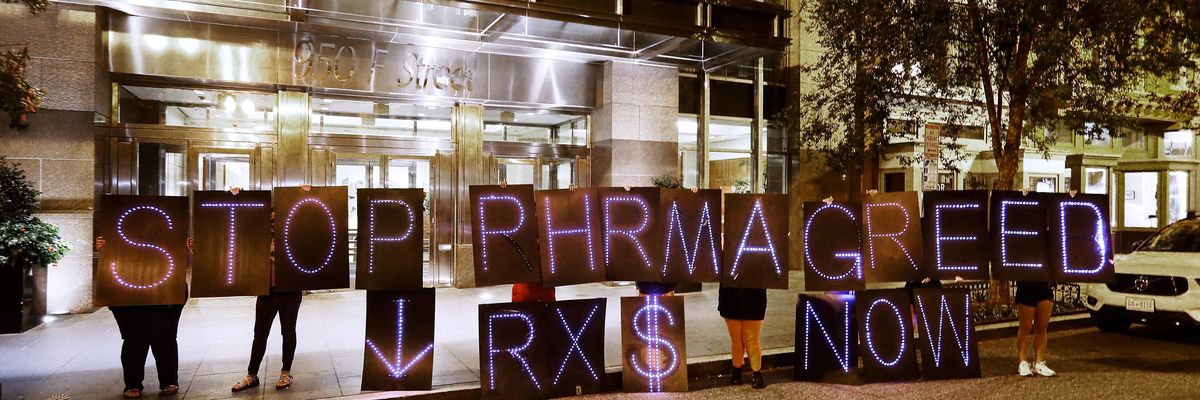
Protect Our Care sponsors Lite-Brite demonstration outside of PhRMA's headquarters calling for an end to drug company greed on September 28, 2021 in Washington, D.C. (Photo: Paul Morigi/Getty Images for Protect Our Care)
Contrary to popular belief, the government can take measures to protect Americans from exorbitant prices for drugs that were invented with U.S. taxpayers' dollars. It can, for example, march-in on the drug's patents and license them to a generic manufacturer, if the drug is not available to the public at a reasonable price. Not surprisingly, some businesses and trade associations would prefer to maintain unfettered control over their prices, and thus their profits, and simply do not want to accept this reality.
The Bayh-Dole Act of 1980 states that the government may march in on a federally-funded invention if, among other reasons, a rights holder fails to achieve "practical application" of the invention.
This reality, however, is rooted firmly in the plain language of existing federal law, and three words in particular. The Bayh-Dole Act of 1980 states that the government may march in on a federally-funded invention if, among other reasons, a rights holder fails to achieve "practical application" of the invention. "Practical application" is defined as practicing the invention "under such conditions as to establish that the invention is being utilized and that its benefits are . . . available to the public on reasonable terms." (See 35 USC 201(f))
These three words, "on reasonable terms," create an independent obligation for drug companies and other rights holders. Congress included them for a reason. Moreover, the use of the word "and" after the word "utilized" shows that practical application requires more than an invention being available for public use. The terms on which the invention is available must also be reasonable. And Congress did not have to use the word "price" to include it within the law's reach. Congress can legislate using general terms that apply to a class of things without listing every member of the class. In this case, the class was "reasonable terms," which refers to all terms on which an invention is available to the public. Inventions become available to the public through sale, and price is a term of most sales.
The words "on reasonable terms" clearly matter. This is the inconvenient truth that march-in opponents hope to avoid through deflection. In his recent opinion piece in The Hill, Joseph Allen goes the deflection route again. For decades, Allen has inserted himself into this controversy by publicly opining that the meaning of the Bayh-Dole Act was conclusively resolved by a 2002 letter to the editor in the Washington Post penned by Bayh and Dole, written in response to an op-ed written by one of us. Allen now takes umbrage that people have raised legitimate questions as to any conflicts that may have influenced the former Senators' views, hyperbolically alleging that such criticisms amount to "attacking the dead."
What really is at issue here is how much deference to afford the decades-later letter of two former senators about the meaning of legislation when those views are in conflict with the plain language of the statute. The Supreme Court's answer to that question is: not much. And the highest court of the land's view on this topic does matter. The beliefs of individual legislators about a bill they sponsored do not determine legislative meaning. As the Court ruled elsewhere, "it is ultimately the provisions of our laws rather than the principal concerns of our legislators by which we are governed."
Legislating requires more than half of the members of each house of Congress voting "yes." Bayh and Dole were two legislators, so their intent and understandings are not law, nor can they be evidence of the majority's intent. That same majority voted on a bill that included the "on reasonable terms" requirement.
There is no clearer example of the meaning of reasonable terms than the case for Xtandi, a drug approved for the treatment of prostate cancer. Xtandi was developed by scientists at UCLA with grants from the NIH and the U.S. Army. It is sold by Astellas, a Japanese-based company, and priced in excess of $189,000 per year for U.S. patients--more than three to five times what Astellas charges residents of other wealthy countries, and five times more than it charges in Japan. And it's not just cancer patients that are overcharged. Between 2015 and 2019, U.S. taxpayers paid $5.2 billion for Medicare's purchase of the drug.
Astellas and other march-in opponents answer different questions, skirting around the heart of the matter: whether extortionate pricing for U.S. consumers means Xtandi is available to the public on reasonable terms.
Practically and legally, making drugs available to the public on reasonable terms surely must mean making them available at a reasonable price. In recognizing the government's power to march in, the better indication of legislative meaning is the plain words of the Bayh-Dole Act. Three words in particular.
Dear Common Dreams reader, It’s been nearly 30 years since I co-founded Common Dreams with my late wife, Lina Newhouser. We had the radical notion that journalism should serve the public good, not corporate profits. It was clear to us from the outset what it would take to build such a project. No paid advertisements. No corporate sponsors. No millionaire publisher telling us what to think or do. Many people said we wouldn't last a year, but we proved those doubters wrong. Together with a tremendous team of journalists and dedicated staff, we built an independent media outlet free from the constraints of profits and corporate control. Our mission has always been simple: To inform. To inspire. To ignite change for the common good. Building Common Dreams was not easy. Our survival was never guaranteed. When you take on the most powerful forces—Wall Street greed, fossil fuel industry destruction, Big Tech lobbyists, and uber-rich oligarchs who have spent billions upon billions rigging the economy and democracy in their favor—the only bulwark you have is supporters who believe in your work. But here’s the urgent message from me today. It's never been this bad out there. And it's never been this hard to keep us going. At the very moment Common Dreams is most needed, the threats we face are intensifying. We need your support now more than ever. We don't accept corporate advertising and never will. We don't have a paywall because we don't think people should be blocked from critical news based on their ability to pay. Everything we do is funded by the donations of readers like you. When everyone does the little they can afford, we are strong. But if that support retreats or dries up, so do we. Will you donate now to make sure Common Dreams not only survives but thrives? —Craig Brown, Co-founder |
Contrary to popular belief, the government can take measures to protect Americans from exorbitant prices for drugs that were invented with U.S. taxpayers' dollars. It can, for example, march-in on the drug's patents and license them to a generic manufacturer, if the drug is not available to the public at a reasonable price. Not surprisingly, some businesses and trade associations would prefer to maintain unfettered control over their prices, and thus their profits, and simply do not want to accept this reality.
The Bayh-Dole Act of 1980 states that the government may march in on a federally-funded invention if, among other reasons, a rights holder fails to achieve "practical application" of the invention.
This reality, however, is rooted firmly in the plain language of existing federal law, and three words in particular. The Bayh-Dole Act of 1980 states that the government may march in on a federally-funded invention if, among other reasons, a rights holder fails to achieve "practical application" of the invention. "Practical application" is defined as practicing the invention "under such conditions as to establish that the invention is being utilized and that its benefits are . . . available to the public on reasonable terms." (See 35 USC 201(f))
These three words, "on reasonable terms," create an independent obligation for drug companies and other rights holders. Congress included them for a reason. Moreover, the use of the word "and" after the word "utilized" shows that practical application requires more than an invention being available for public use. The terms on which the invention is available must also be reasonable. And Congress did not have to use the word "price" to include it within the law's reach. Congress can legislate using general terms that apply to a class of things without listing every member of the class. In this case, the class was "reasonable terms," which refers to all terms on which an invention is available to the public. Inventions become available to the public through sale, and price is a term of most sales.
The words "on reasonable terms" clearly matter. This is the inconvenient truth that march-in opponents hope to avoid through deflection. In his recent opinion piece in The Hill, Joseph Allen goes the deflection route again. For decades, Allen has inserted himself into this controversy by publicly opining that the meaning of the Bayh-Dole Act was conclusively resolved by a 2002 letter to the editor in the Washington Post penned by Bayh and Dole, written in response to an op-ed written by one of us. Allen now takes umbrage that people have raised legitimate questions as to any conflicts that may have influenced the former Senators' views, hyperbolically alleging that such criticisms amount to "attacking the dead."
What really is at issue here is how much deference to afford the decades-later letter of two former senators about the meaning of legislation when those views are in conflict with the plain language of the statute. The Supreme Court's answer to that question is: not much. And the highest court of the land's view on this topic does matter. The beliefs of individual legislators about a bill they sponsored do not determine legislative meaning. As the Court ruled elsewhere, "it is ultimately the provisions of our laws rather than the principal concerns of our legislators by which we are governed."
Legislating requires more than half of the members of each house of Congress voting "yes." Bayh and Dole were two legislators, so their intent and understandings are not law, nor can they be evidence of the majority's intent. That same majority voted on a bill that included the "on reasonable terms" requirement.
There is no clearer example of the meaning of reasonable terms than the case for Xtandi, a drug approved for the treatment of prostate cancer. Xtandi was developed by scientists at UCLA with grants from the NIH and the U.S. Army. It is sold by Astellas, a Japanese-based company, and priced in excess of $189,000 per year for U.S. patients--more than three to five times what Astellas charges residents of other wealthy countries, and five times more than it charges in Japan. And it's not just cancer patients that are overcharged. Between 2015 and 2019, U.S. taxpayers paid $5.2 billion for Medicare's purchase of the drug.
Astellas and other march-in opponents answer different questions, skirting around the heart of the matter: whether extortionate pricing for U.S. consumers means Xtandi is available to the public on reasonable terms.
Practically and legally, making drugs available to the public on reasonable terms surely must mean making them available at a reasonable price. In recognizing the government's power to march in, the better indication of legislative meaning is the plain words of the Bayh-Dole Act. Three words in particular.
Contrary to popular belief, the government can take measures to protect Americans from exorbitant prices for drugs that were invented with U.S. taxpayers' dollars. It can, for example, march-in on the drug's patents and license them to a generic manufacturer, if the drug is not available to the public at a reasonable price. Not surprisingly, some businesses and trade associations would prefer to maintain unfettered control over their prices, and thus their profits, and simply do not want to accept this reality.
The Bayh-Dole Act of 1980 states that the government may march in on a federally-funded invention if, among other reasons, a rights holder fails to achieve "practical application" of the invention.
This reality, however, is rooted firmly in the plain language of existing federal law, and three words in particular. The Bayh-Dole Act of 1980 states that the government may march in on a federally-funded invention if, among other reasons, a rights holder fails to achieve "practical application" of the invention. "Practical application" is defined as practicing the invention "under such conditions as to establish that the invention is being utilized and that its benefits are . . . available to the public on reasonable terms." (See 35 USC 201(f))
These three words, "on reasonable terms," create an independent obligation for drug companies and other rights holders. Congress included them for a reason. Moreover, the use of the word "and" after the word "utilized" shows that practical application requires more than an invention being available for public use. The terms on which the invention is available must also be reasonable. And Congress did not have to use the word "price" to include it within the law's reach. Congress can legislate using general terms that apply to a class of things without listing every member of the class. In this case, the class was "reasonable terms," which refers to all terms on which an invention is available to the public. Inventions become available to the public through sale, and price is a term of most sales.
The words "on reasonable terms" clearly matter. This is the inconvenient truth that march-in opponents hope to avoid through deflection. In his recent opinion piece in The Hill, Joseph Allen goes the deflection route again. For decades, Allen has inserted himself into this controversy by publicly opining that the meaning of the Bayh-Dole Act was conclusively resolved by a 2002 letter to the editor in the Washington Post penned by Bayh and Dole, written in response to an op-ed written by one of us. Allen now takes umbrage that people have raised legitimate questions as to any conflicts that may have influenced the former Senators' views, hyperbolically alleging that such criticisms amount to "attacking the dead."
What really is at issue here is how much deference to afford the decades-later letter of two former senators about the meaning of legislation when those views are in conflict with the plain language of the statute. The Supreme Court's answer to that question is: not much. And the highest court of the land's view on this topic does matter. The beliefs of individual legislators about a bill they sponsored do not determine legislative meaning. As the Court ruled elsewhere, "it is ultimately the provisions of our laws rather than the principal concerns of our legislators by which we are governed."
Legislating requires more than half of the members of each house of Congress voting "yes." Bayh and Dole were two legislators, so their intent and understandings are not law, nor can they be evidence of the majority's intent. That same majority voted on a bill that included the "on reasonable terms" requirement.
There is no clearer example of the meaning of reasonable terms than the case for Xtandi, a drug approved for the treatment of prostate cancer. Xtandi was developed by scientists at UCLA with grants from the NIH and the U.S. Army. It is sold by Astellas, a Japanese-based company, and priced in excess of $189,000 per year for U.S. patients--more than three to five times what Astellas charges residents of other wealthy countries, and five times more than it charges in Japan. And it's not just cancer patients that are overcharged. Between 2015 and 2019, U.S. taxpayers paid $5.2 billion for Medicare's purchase of the drug.
Astellas and other march-in opponents answer different questions, skirting around the heart of the matter: whether extortionate pricing for U.S. consumers means Xtandi is available to the public on reasonable terms.
Practically and legally, making drugs available to the public on reasonable terms surely must mean making them available at a reasonable price. In recognizing the government's power to march in, the better indication of legislative meaning is the plain words of the Bayh-Dole Act. Three words in particular.