
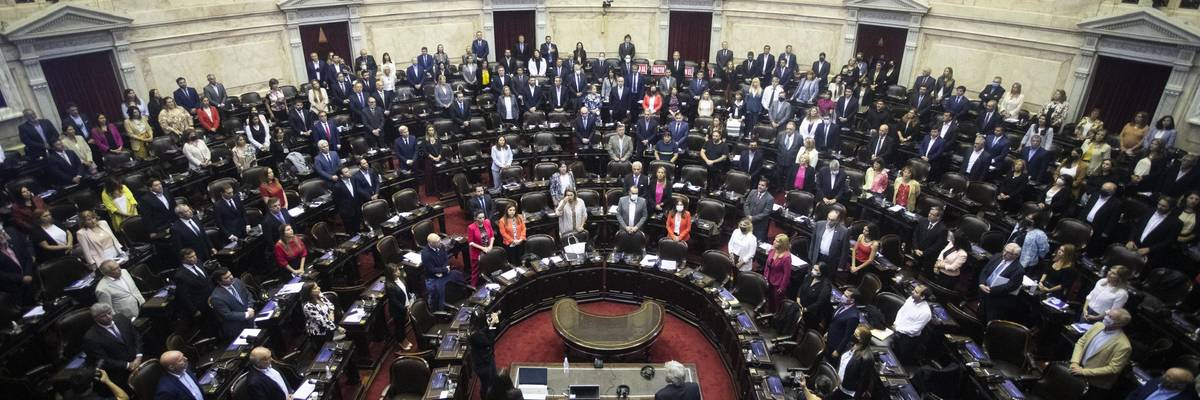
View of the lower house of Congress as lawmakers hold a special session to address the agreement between the Argentine government and the International Monetary Fund in Buenos Aires on March 10, 2022.
The IMF's New Agreement With Argentina Has Potential to Be a Game Changer
After long pushing failed belt-tightening policies, the International Monetary Fund has agreed to a deal that will allow Argentina's government to pursue a pro-growth strategy.
A new draft agreement between Argentina and the International Monetary Fund has eschewed austerity. Pending approval by Argentina's congress and the IMF board, it will allow the Argentine economy to grow while the government continues its efforts to reduce poverty and gradually bring down inflation. With so many countries facing debt distress from the pandemic, the IMF will need to adopt similar changes to its policies elsewhere.
It is well known that the old model of austerity does not work.
It is well known that the old model of austerity does not work. Not only does it cause the economy to contract and inflict excessive hardship on the population; it also fails to meet even the narrow objectives of reducing deficits and increasing a country's capacity to repay creditors.
Advocates of austerity have claimed success in a few countries. But these were small economies lucky enough to have trading partners that were enjoying a boom at the time that austerity was being implemented. Those positive spillover effects offset the cutbacks in public expenditure, but these same economies might have grown even more if they had not embraced Herbert Hoover-style austerity policies.
Argentina, meanwhile, has demonstrated the merits of an alternative strategy focused on growth. When the economy is allowed to expand, tax revenues can increase rapidly.
The announcement of a new IMF agreement with Argentina has elicited some critical comments suggesting there is something in Argentines' blood that makes their country untrustworthy--as if it were a nation of deadbeats. The assumption is that the only way to deal with a serial defaulter is to be ruthlessly tough. Otherwise, fiscally profligate "left-wing" Peronist governments supposedly will leave a mess for the next center-right administration to clean up, with the cycle repeating endlessly.
This rote criticism could not be further from the truth. When the most recent center-right president, Mauricio Macri, took office in late 2015, Argentina's foreign public debt was relatively small, at 35% of GDP, owing to the preceding governments' growth and debt-restructuring policies. Macri then went on a borrowing spree, winning praise from Wall Street lenders happy to capitalize on the high interest rates he offered. Within a couple of years, however, everything began to unravel. By 2019, Argentina's foreign public debt had risen to 69% of GDP.
The IMF made its largest loan ever to the Macri government in 2018, without even imposing conditions to prohibit the money from being used to finance capital outflows or service unsustainable debts to private creditors. What happened next was no surprise: capital flight, economic contraction, and soaring inflation, which reached 53.8% in 2019.
The same pattern had played out in the 1990s under President Carlos Menem. A darling of the IMF, Menem had been brought to Washington and showcased as an exemplar of good governance and sound economic policymaking. But following a period of massive government borrowing from abroad, Argentina fell into a devastating depression that lasted from 1998 to 2002. In 2003, Nestor Kirchner's Peronist administration was able to achieve a rapid recovery. It did so by implementing a broad-based growth strategy.
Financial markets often have an obsession with inflation, and inflation can be a problem for the workings of a market economy. Obviously, Argentine President Alberto Fernandez would have preferred not to have inherited a high-inflation economy when he took office in 2019. But every government must play the hand it is dealt, and there will always be difficult tradeoffs in economic policymaking. Traditional IMF programs have often put aside concerns about the cost to people and the economy, the loss in growth, and the increase in poverty, and pursued a slash-and-burn strategy of budget-cutting austerity.
With inflation at 50.9% in 2021, there are people who insist that Argentina needs a recessionary program to bring prices under control. But even if renewed austerity were to deliver on this objective, the cure would be worse than the disease. In a country where 40% of the population is already living below the poverty line, no program that increases unemployment enough to bring down inflation quickly would be sustainable or justifiable.
Argentina's new agreement with the IMF is just the beginning. But there will always be those who long for the old IMF, with its contractionary, often harsh or pro-cyclical conditionalities. These policies would be a disaster for Argentina and the world. They would deepen the divide between the advanced economies and developing and emerging-market countries, further undermining the credibility of the IMF, which is tasked with ensuring global financial stability, at a time when measures to improve this stability are critically needed.
During the new program's implementation, Argentina will inevitably experience shocks--positive and negative. With COVID-19 still pervasive, and in view of ongoing geopolitical conflicts, the risk of negative shocks is real. A large adverse shock would imply lower growth and larger deficits than anticipated, requiring a recalibration. In that case, the IMF's old language--"the country has gone off track"--would need to be scrapped. Here's a replacement: "The government and the IMF are continuing to work together to ensure that the country responds effectively to the shock so that shared growth is restored, because it is only through such growth that the agreed upon objectives can be attained."
Old ideas die hard (no matter how many times they are proved wrong), and rebuilding institutions is a slow process. Fortunately, the IMF's new agreement will allow Argentina to tackle the challenges it faces, rather than tying its hands.
We are at a crossroads
This country and this world are at a monumental crossroads. US voters have an opportunity to beat back the forces of fascism and confront the billionaires who are rigging the economy, our media system, and our democracy, making it increasingly impossible for ordinary people to get by. We’re not just talking about the election. We’re talking about what must be done once these fascist elements are vanquished from power. We need a bolder set of solutions than what either major party has so far been willing to offer and a working-class movement ready to fight like hell for it. Trump didn't emerge from nowhere. The conditions that fueled MAGA authoritarianism were created by decades of radical neoliberal economic policies and a corrupt political system dominated by corporate interests. They slashed taxes on the super-rich, promising that the benefits would trickle down. They said giveaways to the corporate titans would make life more affordable for the rest of us. It was all bullshit. And when a bitter, betrayed populace searches for someone to blame, right-wing demagogues have little trouble finding scapegoats. People know when they're being lied to, but you won't hear any of this from the corporate media. Only independent journalism—powered and funded by people who believe in building a better world—can deliver truly trustworthy daily news. Our Fall Campaign is underway, and we need your help. To power our newsroom through the rest of the year, we need to raise $125,000 by midnight on October 31. So if you share our vision, please contribute whatever you can to sustain our work. |
A new draft agreement between Argentina and the International Monetary Fund has eschewed austerity. Pending approval by Argentina's congress and the IMF board, it will allow the Argentine economy to grow while the government continues its efforts to reduce poverty and gradually bring down inflation. With so many countries facing debt distress from the pandemic, the IMF will need to adopt similar changes to its policies elsewhere.
It is well known that the old model of austerity does not work.
It is well known that the old model of austerity does not work. Not only does it cause the economy to contract and inflict excessive hardship on the population; it also fails to meet even the narrow objectives of reducing deficits and increasing a country's capacity to repay creditors.
Advocates of austerity have claimed success in a few countries. But these were small economies lucky enough to have trading partners that were enjoying a boom at the time that austerity was being implemented. Those positive spillover effects offset the cutbacks in public expenditure, but these same economies might have grown even more if they had not embraced Herbert Hoover-style austerity policies.
Argentina, meanwhile, has demonstrated the merits of an alternative strategy focused on growth. When the economy is allowed to expand, tax revenues can increase rapidly.
The announcement of a new IMF agreement with Argentina has elicited some critical comments suggesting there is something in Argentines' blood that makes their country untrustworthy--as if it were a nation of deadbeats. The assumption is that the only way to deal with a serial defaulter is to be ruthlessly tough. Otherwise, fiscally profligate "left-wing" Peronist governments supposedly will leave a mess for the next center-right administration to clean up, with the cycle repeating endlessly.
This rote criticism could not be further from the truth. When the most recent center-right president, Mauricio Macri, took office in late 2015, Argentina's foreign public debt was relatively small, at 35% of GDP, owing to the preceding governments' growth and debt-restructuring policies. Macri then went on a borrowing spree, winning praise from Wall Street lenders happy to capitalize on the high interest rates he offered. Within a couple of years, however, everything began to unravel. By 2019, Argentina's foreign public debt had risen to 69% of GDP.
The IMF made its largest loan ever to the Macri government in 2018, without even imposing conditions to prohibit the money from being used to finance capital outflows or service unsustainable debts to private creditors. What happened next was no surprise: capital flight, economic contraction, and soaring inflation, which reached 53.8% in 2019.
The same pattern had played out in the 1990s under President Carlos Menem. A darling of the IMF, Menem had been brought to Washington and showcased as an exemplar of good governance and sound economic policymaking. But following a period of massive government borrowing from abroad, Argentina fell into a devastating depression that lasted from 1998 to 2002. In 2003, Nestor Kirchner's Peronist administration was able to achieve a rapid recovery. It did so by implementing a broad-based growth strategy.
Financial markets often have an obsession with inflation, and inflation can be a problem for the workings of a market economy. Obviously, Argentine President Alberto Fernandez would have preferred not to have inherited a high-inflation economy when he took office in 2019. But every government must play the hand it is dealt, and there will always be difficult tradeoffs in economic policymaking. Traditional IMF programs have often put aside concerns about the cost to people and the economy, the loss in growth, and the increase in poverty, and pursued a slash-and-burn strategy of budget-cutting austerity.
With inflation at 50.9% in 2021, there are people who insist that Argentina needs a recessionary program to bring prices under control. But even if renewed austerity were to deliver on this objective, the cure would be worse than the disease. In a country where 40% of the population is already living below the poverty line, no program that increases unemployment enough to bring down inflation quickly would be sustainable or justifiable.
Argentina's new agreement with the IMF is just the beginning. But there will always be those who long for the old IMF, with its contractionary, often harsh or pro-cyclical conditionalities. These policies would be a disaster for Argentina and the world. They would deepen the divide between the advanced economies and developing and emerging-market countries, further undermining the credibility of the IMF, which is tasked with ensuring global financial stability, at a time when measures to improve this stability are critically needed.
During the new program's implementation, Argentina will inevitably experience shocks--positive and negative. With COVID-19 still pervasive, and in view of ongoing geopolitical conflicts, the risk of negative shocks is real. A large adverse shock would imply lower growth and larger deficits than anticipated, requiring a recalibration. In that case, the IMF's old language--"the country has gone off track"--would need to be scrapped. Here's a replacement: "The government and the IMF are continuing to work together to ensure that the country responds effectively to the shock so that shared growth is restored, because it is only through such growth that the agreed upon objectives can be attained."
Old ideas die hard (no matter how many times they are proved wrong), and rebuilding institutions is a slow process. Fortunately, the IMF's new agreement will allow Argentina to tackle the challenges it faces, rather than tying its hands.