SUBSCRIBE TO OUR FREE NEWSLETTER
Daily news & progressive opinion—funded by the people, not the corporations—delivered straight to your inbox.
5
#000000
#FFFFFF
To donate by check, phone, or other method, see our More Ways to Give page.
Daily news & progressive opinion—funded by the people, not the corporations—delivered straight to your inbox.
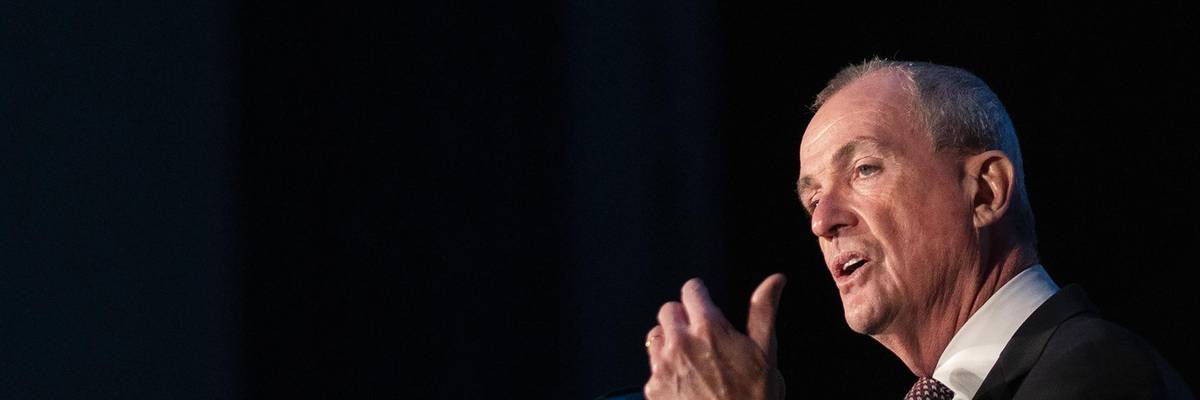
New Jersey Governor Phil Murphy delivers a victory speech to supporters at Grand Arcade at the Pavilion on November 3, 2021 in Asbury Park, New Jersey. (Photo: Eduardo Munoz Alvarez/Getty Images)
Over 800 days ago, Gov. Phil Murphy issued Executive Order 91 authorizing the creation of a public bank implementation board. At his press conference in Newark on Nov. 12, 2019, he said, "With the creation of this implementation board, I am proud to take the first step toward ensuring that our taxpayer dollars are invested here in New Jersey."
The common denominator is simple--the vast majority of board members do not want a public bank of any kind that upsets the status quo that is based entirely on borrowing money through private banks.
Sadly, today we are further away from implementing such a bank than when he made that pledge.
The board has been captured by bureaucratic and private banking interests that do not want our tax dollars invested there. Except for two brave souls, his implementation board is wedded to the status quo, which relies on private banking to fulfill New Jersey's financial needs.
As a former banker, the governor knows that more than $13.2 billion of our tax money is being loaned by the state of New Jersey Cash Management Fund to big banks and corporations, who in turn profit by moving our money all over the world.
At the same time, our local, county and state government agencies currently borrow billions from private banks and through municipal bonds arranged by Wall Street firms, who profit yet again from us.
To short-circuit this perverse cycle, the governor has proposed lending our tax dollars directly to our own state and local agencies via a public bank. In addition, as in the Public Bank of North Dakota, it also could partner with local private banks to make badly needed loans for small businesses, affordable housing as well as provide a pool of capital for low-interest student loans.
But from the very beginning, the governor's own implementation board has nixed the North Dakota model where tax dollars go directly into the public bank, which can direct them to important public policy goals. Other more modest "starter" public bank models were proposed and then dismissed along with a plan to purchase a small private bank to obtain its charter and then convert it to a public bank. The common denominator is simple--the vast majority of board members do not want a public bank of any kind that upsets the status quo that is based entirely on borrowing money through private banks.
But the implementation board must do something, doesn't it? Well, it's about to put out a $250,000 request for a proposal to create a business plan--one which, barring massive public pressure, will avoid any and all efforts to ensure "that our tax dollars are invested here in New Jersey." Instead, it will call for a revolving fund supported by donations and/or low-interest loans from private philanthropic organizations that then will be loaned at low rates to support affordable housing and the like.
One could easily imagine that large private banks through their charitable arms also could pony up for this non-threatening program. Certainly, the good work of such a fund could seamlessly become an additional program within a real public bank, but a public bank it is not and never will be.
The governor now has two options: 1. He can pretend this philanthropic option somehow marks the first step toward a public bank, and then call it a day. This might slip by given how little access the public currently has to the board's deliberations. Or 2. He can give the job of creating a real public bank plan to those who actually believe in it.
We have no shortage of public banking expertise or useful models. But what is lacking is the will to create the Public Bank of New Jersey. What is lacking is the will to challenge the governor's own bureaucracies. And what is lacking, most of all is the will to challenge the total domination of New Jersey finance by Wall Street and the private banking establishment.
Many of us still cling to the belief that Governor Murphy wants a real public bank. If so, he has the power, right now, to formulate a business plan to make it a reality. But does he have the will?
After 800 days, New Jersey taxpayers deserve an answer.
Dear Common Dreams reader, It’s been nearly 30 years since I co-founded Common Dreams with my late wife, Lina Newhouser. We had the radical notion that journalism should serve the public good, not corporate profits. It was clear to us from the outset what it would take to build such a project. No paid advertisements. No corporate sponsors. No millionaire publisher telling us what to think or do. Many people said we wouldn't last a year, but we proved those doubters wrong. Together with a tremendous team of journalists and dedicated staff, we built an independent media outlet free from the constraints of profits and corporate control. Our mission has always been simple: To inform. To inspire. To ignite change for the common good. Building Common Dreams was not easy. Our survival was never guaranteed. When you take on the most powerful forces—Wall Street greed, fossil fuel industry destruction, Big Tech lobbyists, and uber-rich oligarchs who have spent billions upon billions rigging the economy and democracy in their favor—the only bulwark you have is supporters who believe in your work. But here’s the urgent message from me today. It's never been this bad out there. And it's never been this hard to keep us going. At the very moment Common Dreams is most needed, the threats we face are intensifying. We need your support now more than ever. We don't accept corporate advertising and never will. We don't have a paywall because we don't think people should be blocked from critical news based on their ability to pay. Everything we do is funded by the donations of readers like you. When everyone does the little they can afford, we are strong. But if that support retreats or dries up, so do we. Will you donate now to make sure Common Dreams not only survives but thrives? —Craig Brown, Co-founder |
Les Leopold is the executive director of the Labor Institute and author of the new book, “The Billionaires Have Two Parties, We Need a Party of Our Own” (2026). His previous books include: “Wall Street’s War on Workers: How Mass Layoffs and Greed Are Destroying the Working Class and What to Do About It" (2024); "Runaway Inequality: An Activist's Guide to Economic Justice" (2015); and “The Man Who Hated Work and Loved Labor: The Life and Times of Tony Mazzocchi” (2007). Read more of his work on his substack here.
Over 800 days ago, Gov. Phil Murphy issued Executive Order 91 authorizing the creation of a public bank implementation board. At his press conference in Newark on Nov. 12, 2019, he said, "With the creation of this implementation board, I am proud to take the first step toward ensuring that our taxpayer dollars are invested here in New Jersey."
The common denominator is simple--the vast majority of board members do not want a public bank of any kind that upsets the status quo that is based entirely on borrowing money through private banks.
Sadly, today we are further away from implementing such a bank than when he made that pledge.
The board has been captured by bureaucratic and private banking interests that do not want our tax dollars invested there. Except for two brave souls, his implementation board is wedded to the status quo, which relies on private banking to fulfill New Jersey's financial needs.
As a former banker, the governor knows that more than $13.2 billion of our tax money is being loaned by the state of New Jersey Cash Management Fund to big banks and corporations, who in turn profit by moving our money all over the world.
At the same time, our local, county and state government agencies currently borrow billions from private banks and through municipal bonds arranged by Wall Street firms, who profit yet again from us.
To short-circuit this perverse cycle, the governor has proposed lending our tax dollars directly to our own state and local agencies via a public bank. In addition, as in the Public Bank of North Dakota, it also could partner with local private banks to make badly needed loans for small businesses, affordable housing as well as provide a pool of capital for low-interest student loans.
But from the very beginning, the governor's own implementation board has nixed the North Dakota model where tax dollars go directly into the public bank, which can direct them to important public policy goals. Other more modest "starter" public bank models were proposed and then dismissed along with a plan to purchase a small private bank to obtain its charter and then convert it to a public bank. The common denominator is simple--the vast majority of board members do not want a public bank of any kind that upsets the status quo that is based entirely on borrowing money through private banks.
But the implementation board must do something, doesn't it? Well, it's about to put out a $250,000 request for a proposal to create a business plan--one which, barring massive public pressure, will avoid any and all efforts to ensure "that our tax dollars are invested here in New Jersey." Instead, it will call for a revolving fund supported by donations and/or low-interest loans from private philanthropic organizations that then will be loaned at low rates to support affordable housing and the like.
One could easily imagine that large private banks through their charitable arms also could pony up for this non-threatening program. Certainly, the good work of such a fund could seamlessly become an additional program within a real public bank, but a public bank it is not and never will be.
The governor now has two options: 1. He can pretend this philanthropic option somehow marks the first step toward a public bank, and then call it a day. This might slip by given how little access the public currently has to the board's deliberations. Or 2. He can give the job of creating a real public bank plan to those who actually believe in it.
We have no shortage of public banking expertise or useful models. But what is lacking is the will to create the Public Bank of New Jersey. What is lacking is the will to challenge the governor's own bureaucracies. And what is lacking, most of all is the will to challenge the total domination of New Jersey finance by Wall Street and the private banking establishment.
Many of us still cling to the belief that Governor Murphy wants a real public bank. If so, he has the power, right now, to formulate a business plan to make it a reality. But does he have the will?
After 800 days, New Jersey taxpayers deserve an answer.
Les Leopold is the executive director of the Labor Institute and author of the new book, “The Billionaires Have Two Parties, We Need a Party of Our Own” (2026). His previous books include: “Wall Street’s War on Workers: How Mass Layoffs and Greed Are Destroying the Working Class and What to Do About It" (2024); "Runaway Inequality: An Activist's Guide to Economic Justice" (2015); and “The Man Who Hated Work and Loved Labor: The Life and Times of Tony Mazzocchi” (2007). Read more of his work on his substack here.
Over 800 days ago, Gov. Phil Murphy issued Executive Order 91 authorizing the creation of a public bank implementation board. At his press conference in Newark on Nov. 12, 2019, he said, "With the creation of this implementation board, I am proud to take the first step toward ensuring that our taxpayer dollars are invested here in New Jersey."
The common denominator is simple--the vast majority of board members do not want a public bank of any kind that upsets the status quo that is based entirely on borrowing money through private banks.
Sadly, today we are further away from implementing such a bank than when he made that pledge.
The board has been captured by bureaucratic and private banking interests that do not want our tax dollars invested there. Except for two brave souls, his implementation board is wedded to the status quo, which relies on private banking to fulfill New Jersey's financial needs.
As a former banker, the governor knows that more than $13.2 billion of our tax money is being loaned by the state of New Jersey Cash Management Fund to big banks and corporations, who in turn profit by moving our money all over the world.
At the same time, our local, county and state government agencies currently borrow billions from private banks and through municipal bonds arranged by Wall Street firms, who profit yet again from us.
To short-circuit this perverse cycle, the governor has proposed lending our tax dollars directly to our own state and local agencies via a public bank. In addition, as in the Public Bank of North Dakota, it also could partner with local private banks to make badly needed loans for small businesses, affordable housing as well as provide a pool of capital for low-interest student loans.
But from the very beginning, the governor's own implementation board has nixed the North Dakota model where tax dollars go directly into the public bank, which can direct them to important public policy goals. Other more modest "starter" public bank models were proposed and then dismissed along with a plan to purchase a small private bank to obtain its charter and then convert it to a public bank. The common denominator is simple--the vast majority of board members do not want a public bank of any kind that upsets the status quo that is based entirely on borrowing money through private banks.
But the implementation board must do something, doesn't it? Well, it's about to put out a $250,000 request for a proposal to create a business plan--one which, barring massive public pressure, will avoid any and all efforts to ensure "that our tax dollars are invested here in New Jersey." Instead, it will call for a revolving fund supported by donations and/or low-interest loans from private philanthropic organizations that then will be loaned at low rates to support affordable housing and the like.
One could easily imagine that large private banks through their charitable arms also could pony up for this non-threatening program. Certainly, the good work of such a fund could seamlessly become an additional program within a real public bank, but a public bank it is not and never will be.
The governor now has two options: 1. He can pretend this philanthropic option somehow marks the first step toward a public bank, and then call it a day. This might slip by given how little access the public currently has to the board's deliberations. Or 2. He can give the job of creating a real public bank plan to those who actually believe in it.
We have no shortage of public banking expertise or useful models. But what is lacking is the will to create the Public Bank of New Jersey. What is lacking is the will to challenge the governor's own bureaucracies. And what is lacking, most of all is the will to challenge the total domination of New Jersey finance by Wall Street and the private banking establishment.
Many of us still cling to the belief that Governor Murphy wants a real public bank. If so, he has the power, right now, to formulate a business plan to make it a reality. But does he have the will?
After 800 days, New Jersey taxpayers deserve an answer.