SUBSCRIBE TO OUR FREE NEWSLETTER
Daily news & progressive opinion—funded by the people, not the corporations—delivered straight to your inbox.
5
#000000
#FFFFFF
To donate by check, phone, or other method, see our More Ways to Give page.
Daily news & progressive opinion—funded by the people, not the corporations—delivered straight to your inbox.
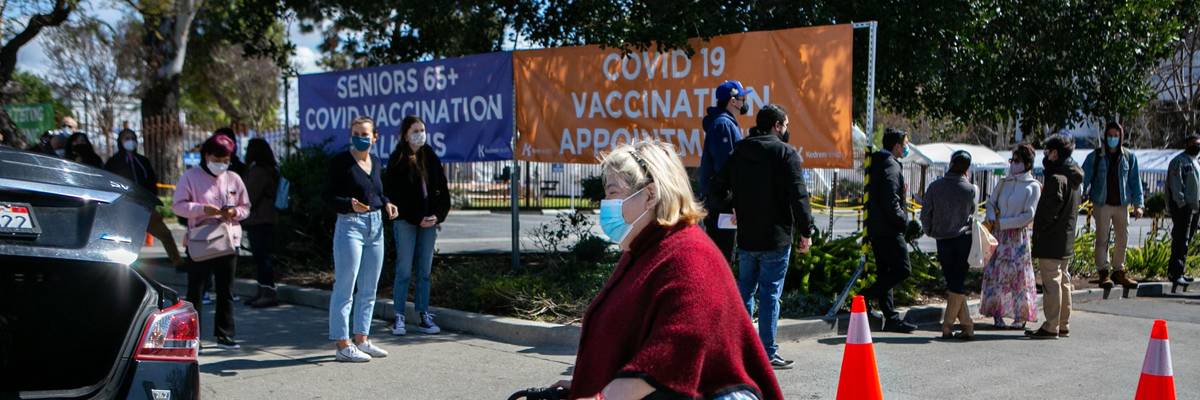
A woman leaves Kedren Community Health Center as vaccinations started today for those with disabilities on Monday, March 15, 2021 in Los Angeles, CA. (Photo: Jason Armond / Los Angeles Times via Getty Images)
Ever since the beginning of the pandemic, there's been a disturbing caveat to the casualty reports. Many of the dead, the reports say, had "comorbidities"--other conditions that left them especially vulnerable to the virus.
This is true, and it needs to factor into our public health response. Instead, it's often used to suggest that the loss of these lives is somehow less serious--and more acceptable.
At least one out of every four Americans has a disability--so if you're not disabled yourself, you probably know and love someone who is.
"The overwhelming number of deaths" among vaccinated people, CDC director Dr. Rochelle Walensky told Good Morning America about a recent study, "occurred in people who had at least four comorbidities, so really these are people who were unwell to begin with."
She added: "We're really encouraged by these results."
I have a bunch of fun "comorbidities" myself, including rheumatoid arthritis. As a vaccinated but immunocompromised person, I was less "encouraged"--and I was deeply saddened by that choice of words.
So too, I'm guessing, were people with chronic obstructive pulmonary disease or congenital heart disease. Language like this can also be incredibly hurtful to parents of children with conditions like leukemia, or caregivers of people with conditions like Alzheimers.
At least one out of every four Americans has a disability--so if you're not disabled yourself, you probably know and love someone who is. For us, it's hard not to hear the subtle messaging behind messages like these: "My disabled life is less worthy."
Unfortunately, a surprising number of people seem to agree it wouldn't be so bad if the world population were culled a bit. It's not just the Nazis, who famously exterminated people with disabilities and mental illnesses. Instead, these attitudes can appear in more subtle ways.
For example, they can show up when hospital staff are forced to prioritize who to save in emergency health situations, in part by making heart-wrenching decisions about who's more likely to survive.
Like others, I have both disabled and non-disabled family and friends who went into a hospital for non-COVID emergencies and never made it out alive. And I have multiple friends who've made advance directives during the pandemic, assuming they're more likely to face respiratory failure or intubation if they contract COVID-19.
These attitudes can also show up in the debate over pandemic school closures. A return to in-person learning may be an acceptable risk for healthy, vaccinated students and staff. But what about those who are disabled, immunocompromised, and at higher risk of death if they return to classroom instruction?
The pandemic has likely increased the number of people with serious health conditions. Alongside those suffering from prolonged COVID-19 complications, many other Americans have been forced to delay "elective" surgeries like organ transplants or cancer treatments because of our chronically full hospitals.
As these challenges touch more and more of us, we shouldn't be pitting parents, educators, patients, or health care workers against each other. Instead, we need policies that better protect all of us.
For starters, we need more chronically ill, immunocompromised, and disabled people in CDC leadership positions. And the CDC could take the advice of disabled people who've reached out since the start of the pandemic to help others learn how to protect their own health, survive, and advocate for better health policies.
Just as pressingly, we need a pandemic response that fully addresses hospitals' supply and staffing shortages, ensures access to tests and vaccines for all, and puts the voices of disabled people exactly where they should be: at the center of every health policy decision.
My disabled life is worthy. All our lives are worthy.
Dear Common Dreams reader, It’s been nearly 30 years since I co-founded Common Dreams with my late wife, Lina Newhouser. We had the radical notion that journalism should serve the public good, not corporate profits. It was clear to us from the outset what it would take to build such a project. No paid advertisements. No corporate sponsors. No millionaire publisher telling us what to think or do. Many people said we wouldn't last a year, but we proved those doubters wrong. Together with a tremendous team of journalists and dedicated staff, we built an independent media outlet free from the constraints of profits and corporate control. Our mission has always been simple: To inform. To inspire. To ignite change for the common good. Building Common Dreams was not easy. Our survival was never guaranteed. When you take on the most powerful forces—Wall Street greed, fossil fuel industry destruction, Big Tech lobbyists, and uber-rich oligarchs who have spent billions upon billions rigging the economy and democracy in their favor—the only bulwark you have is supporters who believe in your work. But here’s the urgent message from me today. It's never been this bad out there. And it's never been this hard to keep us going. At the very moment Common Dreams is most needed, the threats we face are intensifying. We need your support now more than ever. We don't accept corporate advertising and never will. We don't have a paywall because we don't think people should be blocked from critical news based on their ability to pay. Everything we do is funded by the donations of readers like you. When everyone does the little they can afford, we are strong. But if that support retreats or dries up, so do we. Will you donate now to make sure Common Dreams not only survives but thrives? —Craig Brown, Co-founder |
Ever since the beginning of the pandemic, there's been a disturbing caveat to the casualty reports. Many of the dead, the reports say, had "comorbidities"--other conditions that left them especially vulnerable to the virus.
This is true, and it needs to factor into our public health response. Instead, it's often used to suggest that the loss of these lives is somehow less serious--and more acceptable.
At least one out of every four Americans has a disability--so if you're not disabled yourself, you probably know and love someone who is.
"The overwhelming number of deaths" among vaccinated people, CDC director Dr. Rochelle Walensky told Good Morning America about a recent study, "occurred in people who had at least four comorbidities, so really these are people who were unwell to begin with."
She added: "We're really encouraged by these results."
I have a bunch of fun "comorbidities" myself, including rheumatoid arthritis. As a vaccinated but immunocompromised person, I was less "encouraged"--and I was deeply saddened by that choice of words.
So too, I'm guessing, were people with chronic obstructive pulmonary disease or congenital heart disease. Language like this can also be incredibly hurtful to parents of children with conditions like leukemia, or caregivers of people with conditions like Alzheimers.
At least one out of every four Americans has a disability--so if you're not disabled yourself, you probably know and love someone who is. For us, it's hard not to hear the subtle messaging behind messages like these: "My disabled life is less worthy."
Unfortunately, a surprising number of people seem to agree it wouldn't be so bad if the world population were culled a bit. It's not just the Nazis, who famously exterminated people with disabilities and mental illnesses. Instead, these attitudes can appear in more subtle ways.
For example, they can show up when hospital staff are forced to prioritize who to save in emergency health situations, in part by making heart-wrenching decisions about who's more likely to survive.
Like others, I have both disabled and non-disabled family and friends who went into a hospital for non-COVID emergencies and never made it out alive. And I have multiple friends who've made advance directives during the pandemic, assuming they're more likely to face respiratory failure or intubation if they contract COVID-19.
These attitudes can also show up in the debate over pandemic school closures. A return to in-person learning may be an acceptable risk for healthy, vaccinated students and staff. But what about those who are disabled, immunocompromised, and at higher risk of death if they return to classroom instruction?
The pandemic has likely increased the number of people with serious health conditions. Alongside those suffering from prolonged COVID-19 complications, many other Americans have been forced to delay "elective" surgeries like organ transplants or cancer treatments because of our chronically full hospitals.
As these challenges touch more and more of us, we shouldn't be pitting parents, educators, patients, or health care workers against each other. Instead, we need policies that better protect all of us.
For starters, we need more chronically ill, immunocompromised, and disabled people in CDC leadership positions. And the CDC could take the advice of disabled people who've reached out since the start of the pandemic to help others learn how to protect their own health, survive, and advocate for better health policies.
Just as pressingly, we need a pandemic response that fully addresses hospitals' supply and staffing shortages, ensures access to tests and vaccines for all, and puts the voices of disabled people exactly where they should be: at the center of every health policy decision.
My disabled life is worthy. All our lives are worthy.
Ever since the beginning of the pandemic, there's been a disturbing caveat to the casualty reports. Many of the dead, the reports say, had "comorbidities"--other conditions that left them especially vulnerable to the virus.
This is true, and it needs to factor into our public health response. Instead, it's often used to suggest that the loss of these lives is somehow less serious--and more acceptable.
At least one out of every four Americans has a disability--so if you're not disabled yourself, you probably know and love someone who is.
"The overwhelming number of deaths" among vaccinated people, CDC director Dr. Rochelle Walensky told Good Morning America about a recent study, "occurred in people who had at least four comorbidities, so really these are people who were unwell to begin with."
She added: "We're really encouraged by these results."
I have a bunch of fun "comorbidities" myself, including rheumatoid arthritis. As a vaccinated but immunocompromised person, I was less "encouraged"--and I was deeply saddened by that choice of words.
So too, I'm guessing, were people with chronic obstructive pulmonary disease or congenital heart disease. Language like this can also be incredibly hurtful to parents of children with conditions like leukemia, or caregivers of people with conditions like Alzheimers.
At least one out of every four Americans has a disability--so if you're not disabled yourself, you probably know and love someone who is. For us, it's hard not to hear the subtle messaging behind messages like these: "My disabled life is less worthy."
Unfortunately, a surprising number of people seem to agree it wouldn't be so bad if the world population were culled a bit. It's not just the Nazis, who famously exterminated people with disabilities and mental illnesses. Instead, these attitudes can appear in more subtle ways.
For example, they can show up when hospital staff are forced to prioritize who to save in emergency health situations, in part by making heart-wrenching decisions about who's more likely to survive.
Like others, I have both disabled and non-disabled family and friends who went into a hospital for non-COVID emergencies and never made it out alive. And I have multiple friends who've made advance directives during the pandemic, assuming they're more likely to face respiratory failure or intubation if they contract COVID-19.
These attitudes can also show up in the debate over pandemic school closures. A return to in-person learning may be an acceptable risk for healthy, vaccinated students and staff. But what about those who are disabled, immunocompromised, and at higher risk of death if they return to classroom instruction?
The pandemic has likely increased the number of people with serious health conditions. Alongside those suffering from prolonged COVID-19 complications, many other Americans have been forced to delay "elective" surgeries like organ transplants or cancer treatments because of our chronically full hospitals.
As these challenges touch more and more of us, we shouldn't be pitting parents, educators, patients, or health care workers against each other. Instead, we need policies that better protect all of us.
For starters, we need more chronically ill, immunocompromised, and disabled people in CDC leadership positions. And the CDC could take the advice of disabled people who've reached out since the start of the pandemic to help others learn how to protect their own health, survive, and advocate for better health policies.
Just as pressingly, we need a pandemic response that fully addresses hospitals' supply and staffing shortages, ensures access to tests and vaccines for all, and puts the voices of disabled people exactly where they should be: at the center of every health policy decision.
My disabled life is worthy. All our lives are worthy.