SUBSCRIBE TO OUR FREE NEWSLETTER
Daily news & progressive opinion—funded by the people, not the corporations—delivered straight to your inbox.
5
#000000
#FFFFFF
To donate by check, phone, or other method, see our More Ways to Give page.
Daily news & progressive opinion—funded by the people, not the corporations—delivered straight to your inbox.
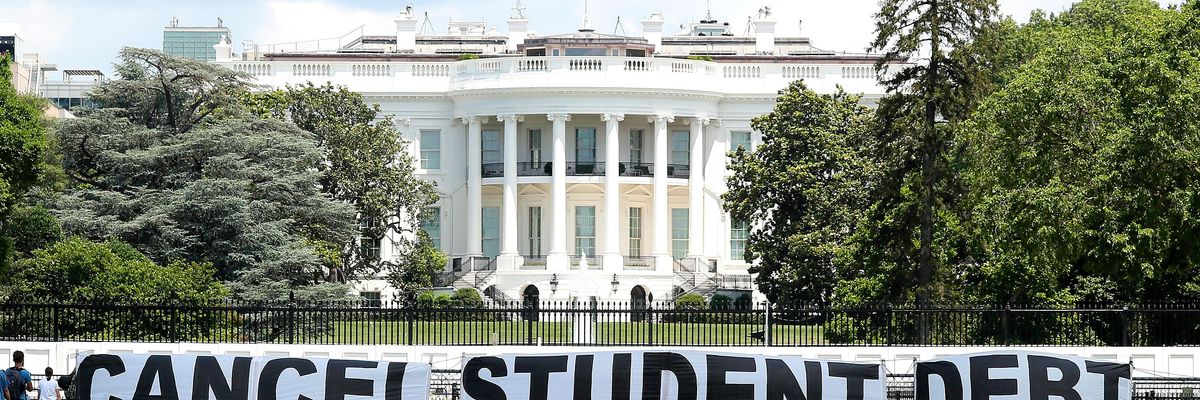
As college students around the country graduate with a massive amount of debt, advocates display a hand-painted sign on the Ellipse in front of The White House to call on President Joe Biden to sign an executive order to cancel student debt on June 15, 2021 in Washington, DC. (Photo: Paul Morigi/Getty Images for We The 45 Million)"
Economist Marshall Steinbaum recently appeared on my radio show The Zero Hour to discuss the economic and ethical issues surrounding student debt cancellation. Steinbaum, a Senior Fellow in Higher Education Finance at the Jain Family Institute and a professor at the University of Utah, is one of the authors of a seminal 2018 study from the Levy Economics Institute on the macroeconomic impact of student debt. As pressure grows for a solution, Steinbaum discussed with me both the economics and the ethics of student debt. The following selections from the interview have been lightly edited for clarity.
"We've now had a repayment pause for nearly two years," Steinbaum said, and "the President just extended it by another couple of months." (Note: Repayments have been suspended until May 1, 2022.) "And my view is that this, along with other ... emergency pandemic income support policies for households is a good reason why the period of the pandemic has not been significantly worse, economically speaking, for the United States."
Adds Steinbaum, "In that sense, I view the repayment pause as vindicating the predictions in the macroeconomic paper."
Watch the interview:
In the following exchange, Steinbaum discussed the ethical and economic dimensions of student debt:
ESKOW: We can also put a pin in ... the moral argument, which exists entirely independently of the economics ... (and ask) if, in fact, it was socially unjust to impose this debt on people in order to obtain what we might argue is a public good. (It) should arguably be addressed in some other way as we correct the injustice, perhaps by going to people with more disposable income than student debt holders. Would you agree with that?
STEINBAUM: Yeah, I definitely agree with that. I would add one further point to it ... there's definitely a moral case for student debt cancellation and a moral--an immoral case--that student debt is an unjust way to finance a higher education system... My view is that people have had to take on more student debt in order to get basically the same job that they would have previously been able to get with a smaller amount of student debt had they been born in a previous cohort--either because college was cheaper or because their jobs just didn't require higher education at all ....
ESKOW: ... You're talking about kind of a "credential inflation" ... and (you have written that) nearly all negative net worth households are in negative territory, thanks to student debt. That category is growing rapidly. Could you say something about that?
STEINBAUM: Sure. Student debt is by far and away the greatest reason why a household would ever be a negative territory ... student debt is not secured ... So, if you look at the student debt crisis, as we call it, which is just to say the mounting balances of student loans in the population... Prior to that, very few households were in negative territory.
ESKOW: So, if you believe that as a social condition households with negative net worth are a problem, then ... canceling student debt would help address that problem very significantly. Right?
STEINBAUM: Yeah. And ... I think 'credential inflation,' as you characterize it, is a fact. That is a pattern in the labor market, increasingly over time, an entirely empirical thing.
This idea that negative household net worth doesn't matter, because you should count human capital, that's more of a theoretical argument. ... especially because a lot of student debtors don't have a college degree or even any college experience at all ... (many economists) think if you go to college you earn more money than you otherwise would have earned, and that should be capitalized in your household net worth.
And that, I think, is like total economist brain.
ESKOW: And Marshall, I've been thinking about the issue of non-repayment (of student loans) ... if borrowers can't pay them back, then the only impact that not cancelling their debt has is to harm them ... it's almost Calvinistic. 'Well, you took on this debt, you should have known better. And even though there's no benefit to be gained from continuing to hold this debt over you, we want to make sure you experience extreme and prolonged pain because you dared to do it.' Am I unfair?
STEINBAUM: No, no, I think it's absolutely accurate to reinterpret what are supposedly economic arguments in light of what's actually going on, which is very much a moralistic judgment ...
ESKOW: I "stan" (American philosopher and education advocate) John Dewey. I think that education has social and cultural value that can't be put in dollars and cents terms. But, in effect, it seems to me that we're charging students usurious rates to get an education that will benefit everybody else at least as much as it benefits them, and probably more. In that sense, we are in debt to them, rather than the other way around. What do you think of that?
STEINBAUM: I definitely subscribe to the view that higher education, like all education, is a public good. And it was a mistake from the very beginning to conceive it as an investment in your future earnings. You know, this is the so-called human capital model in, in economics, that is an ideology of privatization of public goods...
But I view my role in all of this as yanking this entire debate away from the idea that people invest in education to invest in their future earnings.
The entire interview can be seen here or above.
Dear Common Dreams reader, It’s been nearly 30 years since I co-founded Common Dreams with my late wife, Lina Newhouser. We had the radical notion that journalism should serve the public good, not corporate profits. It was clear to us from the outset what it would take to build such a project. No paid advertisements. No corporate sponsors. No millionaire publisher telling us what to think or do. Many people said we wouldn't last a year, but we proved those doubters wrong. Together with a tremendous team of journalists and dedicated staff, we built an independent media outlet free from the constraints of profits and corporate control. Our mission has always been simple: To inform. To inspire. To ignite change for the common good. Building Common Dreams was not easy. Our survival was never guaranteed. When you take on the most powerful forces—Wall Street greed, fossil fuel industry destruction, Big Tech lobbyists, and uber-rich oligarchs who have spent billions upon billions rigging the economy and democracy in their favor—the only bulwark you have is supporters who believe in your work. But here’s the urgent message from me today. It's never been this bad out there. And it's never been this hard to keep us going. At the very moment Common Dreams is most needed, the threats we face are intensifying. We need your support now more than ever. We don't accept corporate advertising and never will. We don't have a paywall because we don't think people should be blocked from critical news based on their ability to pay. Everything we do is funded by the donations of readers like you. When everyone does the little they can afford, we are strong. But if that support retreats or dries up, so do we. Will you donate now to make sure Common Dreams not only survives but thrives? —Craig Brown, Co-founder |
Richard (RJ) Eskow is a journalist who has written for a number of major publications. His weekly program, The Zero Hour, can be found on cable television, radio, Spotify, and podcast media.
Economist Marshall Steinbaum recently appeared on my radio show The Zero Hour to discuss the economic and ethical issues surrounding student debt cancellation. Steinbaum, a Senior Fellow in Higher Education Finance at the Jain Family Institute and a professor at the University of Utah, is one of the authors of a seminal 2018 study from the Levy Economics Institute on the macroeconomic impact of student debt. As pressure grows for a solution, Steinbaum discussed with me both the economics and the ethics of student debt. The following selections from the interview have been lightly edited for clarity.
"We've now had a repayment pause for nearly two years," Steinbaum said, and "the President just extended it by another couple of months." (Note: Repayments have been suspended until May 1, 2022.) "And my view is that this, along with other ... emergency pandemic income support policies for households is a good reason why the period of the pandemic has not been significantly worse, economically speaking, for the United States."
Adds Steinbaum, "In that sense, I view the repayment pause as vindicating the predictions in the macroeconomic paper."
Watch the interview:
In the following exchange, Steinbaum discussed the ethical and economic dimensions of student debt:
ESKOW: We can also put a pin in ... the moral argument, which exists entirely independently of the economics ... (and ask) if, in fact, it was socially unjust to impose this debt on people in order to obtain what we might argue is a public good. (It) should arguably be addressed in some other way as we correct the injustice, perhaps by going to people with more disposable income than student debt holders. Would you agree with that?
STEINBAUM: Yeah, I definitely agree with that. I would add one further point to it ... there's definitely a moral case for student debt cancellation and a moral--an immoral case--that student debt is an unjust way to finance a higher education system... My view is that people have had to take on more student debt in order to get basically the same job that they would have previously been able to get with a smaller amount of student debt had they been born in a previous cohort--either because college was cheaper or because their jobs just didn't require higher education at all ....
ESKOW: ... You're talking about kind of a "credential inflation" ... and (you have written that) nearly all negative net worth households are in negative territory, thanks to student debt. That category is growing rapidly. Could you say something about that?
STEINBAUM: Sure. Student debt is by far and away the greatest reason why a household would ever be a negative territory ... student debt is not secured ... So, if you look at the student debt crisis, as we call it, which is just to say the mounting balances of student loans in the population... Prior to that, very few households were in negative territory.
ESKOW: So, if you believe that as a social condition households with negative net worth are a problem, then ... canceling student debt would help address that problem very significantly. Right?
STEINBAUM: Yeah. And ... I think 'credential inflation,' as you characterize it, is a fact. That is a pattern in the labor market, increasingly over time, an entirely empirical thing.
This idea that negative household net worth doesn't matter, because you should count human capital, that's more of a theoretical argument. ... especially because a lot of student debtors don't have a college degree or even any college experience at all ... (many economists) think if you go to college you earn more money than you otherwise would have earned, and that should be capitalized in your household net worth.
And that, I think, is like total economist brain.
ESKOW: And Marshall, I've been thinking about the issue of non-repayment (of student loans) ... if borrowers can't pay them back, then the only impact that not cancelling their debt has is to harm them ... it's almost Calvinistic. 'Well, you took on this debt, you should have known better. And even though there's no benefit to be gained from continuing to hold this debt over you, we want to make sure you experience extreme and prolonged pain because you dared to do it.' Am I unfair?
STEINBAUM: No, no, I think it's absolutely accurate to reinterpret what are supposedly economic arguments in light of what's actually going on, which is very much a moralistic judgment ...
ESKOW: I "stan" (American philosopher and education advocate) John Dewey. I think that education has social and cultural value that can't be put in dollars and cents terms. But, in effect, it seems to me that we're charging students usurious rates to get an education that will benefit everybody else at least as much as it benefits them, and probably more. In that sense, we are in debt to them, rather than the other way around. What do you think of that?
STEINBAUM: I definitely subscribe to the view that higher education, like all education, is a public good. And it was a mistake from the very beginning to conceive it as an investment in your future earnings. You know, this is the so-called human capital model in, in economics, that is an ideology of privatization of public goods...
But I view my role in all of this as yanking this entire debate away from the idea that people invest in education to invest in their future earnings.
The entire interview can be seen here or above.
Richard (RJ) Eskow is a journalist who has written for a number of major publications. His weekly program, The Zero Hour, can be found on cable television, radio, Spotify, and podcast media.
Economist Marshall Steinbaum recently appeared on my radio show The Zero Hour to discuss the economic and ethical issues surrounding student debt cancellation. Steinbaum, a Senior Fellow in Higher Education Finance at the Jain Family Institute and a professor at the University of Utah, is one of the authors of a seminal 2018 study from the Levy Economics Institute on the macroeconomic impact of student debt. As pressure grows for a solution, Steinbaum discussed with me both the economics and the ethics of student debt. The following selections from the interview have been lightly edited for clarity.
"We've now had a repayment pause for nearly two years," Steinbaum said, and "the President just extended it by another couple of months." (Note: Repayments have been suspended until May 1, 2022.) "And my view is that this, along with other ... emergency pandemic income support policies for households is a good reason why the period of the pandemic has not been significantly worse, economically speaking, for the United States."
Adds Steinbaum, "In that sense, I view the repayment pause as vindicating the predictions in the macroeconomic paper."
Watch the interview:
In the following exchange, Steinbaum discussed the ethical and economic dimensions of student debt:
ESKOW: We can also put a pin in ... the moral argument, which exists entirely independently of the economics ... (and ask) if, in fact, it was socially unjust to impose this debt on people in order to obtain what we might argue is a public good. (It) should arguably be addressed in some other way as we correct the injustice, perhaps by going to people with more disposable income than student debt holders. Would you agree with that?
STEINBAUM: Yeah, I definitely agree with that. I would add one further point to it ... there's definitely a moral case for student debt cancellation and a moral--an immoral case--that student debt is an unjust way to finance a higher education system... My view is that people have had to take on more student debt in order to get basically the same job that they would have previously been able to get with a smaller amount of student debt had they been born in a previous cohort--either because college was cheaper or because their jobs just didn't require higher education at all ....
ESKOW: ... You're talking about kind of a "credential inflation" ... and (you have written that) nearly all negative net worth households are in negative territory, thanks to student debt. That category is growing rapidly. Could you say something about that?
STEINBAUM: Sure. Student debt is by far and away the greatest reason why a household would ever be a negative territory ... student debt is not secured ... So, if you look at the student debt crisis, as we call it, which is just to say the mounting balances of student loans in the population... Prior to that, very few households were in negative territory.
ESKOW: So, if you believe that as a social condition households with negative net worth are a problem, then ... canceling student debt would help address that problem very significantly. Right?
STEINBAUM: Yeah. And ... I think 'credential inflation,' as you characterize it, is a fact. That is a pattern in the labor market, increasingly over time, an entirely empirical thing.
This idea that negative household net worth doesn't matter, because you should count human capital, that's more of a theoretical argument. ... especially because a lot of student debtors don't have a college degree or even any college experience at all ... (many economists) think if you go to college you earn more money than you otherwise would have earned, and that should be capitalized in your household net worth.
And that, I think, is like total economist brain.
ESKOW: And Marshall, I've been thinking about the issue of non-repayment (of student loans) ... if borrowers can't pay them back, then the only impact that not cancelling their debt has is to harm them ... it's almost Calvinistic. 'Well, you took on this debt, you should have known better. And even though there's no benefit to be gained from continuing to hold this debt over you, we want to make sure you experience extreme and prolonged pain because you dared to do it.' Am I unfair?
STEINBAUM: No, no, I think it's absolutely accurate to reinterpret what are supposedly economic arguments in light of what's actually going on, which is very much a moralistic judgment ...
ESKOW: I "stan" (American philosopher and education advocate) John Dewey. I think that education has social and cultural value that can't be put in dollars and cents terms. But, in effect, it seems to me that we're charging students usurious rates to get an education that will benefit everybody else at least as much as it benefits them, and probably more. In that sense, we are in debt to them, rather than the other way around. What do you think of that?
STEINBAUM: I definitely subscribe to the view that higher education, like all education, is a public good. And it was a mistake from the very beginning to conceive it as an investment in your future earnings. You know, this is the so-called human capital model in, in economics, that is an ideology of privatization of public goods...
But I view my role in all of this as yanking this entire debate away from the idea that people invest in education to invest in their future earnings.
The entire interview can be seen here or above.