SUBSCRIBE TO OUR FREE NEWSLETTER
Daily news & progressive opinion—funded by the people, not the corporations—delivered straight to your inbox.
5
#000000
#FFFFFF
To donate by check, phone, or other method, see our More Ways to Give page.
Daily news & progressive opinion—funded by the people, not the corporations—delivered straight to your inbox.
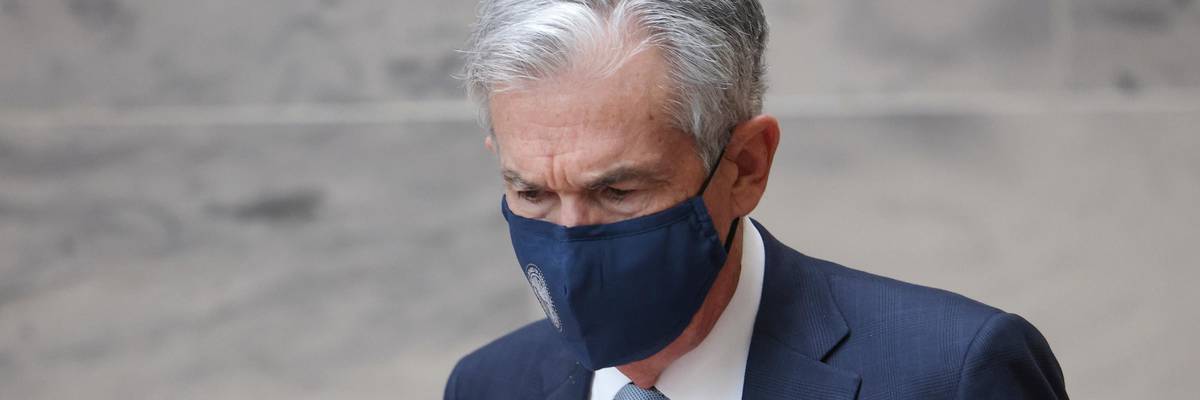
Federal Reserve Chairman Jerome Powell walks between meetings with Senators on Capitol Hill on October 06, 2021 in Washington, DC.
US President Joe Biden faces a critical decision: whom to appoint as chair of the Federal Reserve--arguably the most powerful position in the global economy.
The wrong choice can have grave consequences. Under Alan Greenspan and Ben Bernanke, the Fed failed to regulate the banking system adequately, setting the stage for the worst global economic downturn in 75 years. That crisis and policymakers' response to it have had far-reaching political consequences, exacerbating inequality and nurturing a lingering sense of grievance in those who lost their houses and jobs.
Powell would say that climate issues are not included in the Fed's mandate, but he would be wrong. Part of the Fed's mandate is to ensure financial stability, and there is no greater threat to that than climate change.
There are a host of cliches about why the current chair, Jerome Powell, should be reappointed. Doing so would be a demonstration of bipartisanship. It would reinforce the Fed's credibility. We need a seasoned hand to steer us through the post-pandemic recovery. And so on. I heard all the same arguments 25 years ago when I was chair of the US President's Council of Economic Advisers and Greenspan was being considered for reappointment. They were enough to convince Bill Clinton, and the country paid a high price for his decision.
Ironically, President Ronald Reagan gave short shrift to these arguments when he effectively fired Paul Volcker in 1987, denying him reappointment after he had tamed inflation. Reagan owed Volcker a great deal, but because he wanted to pursue deregulation, he opted for Greenspan, an acolyte of Ayn Rand.
Economic policymaking requires careful judgment and a recognition of trade-offs. How important is inflation versus jobs and growth? How confident can we be that markets are efficient, stable, fair, and competitive on their own? How concerned should we be about inequality? America's two main parties have always had markedly different but clearly articulated perspectives on these matters (at least until the Republicans' descent into populist madness).
To my mind, the Democrats are right to worry more about the consequences of joblessness. The 2008 crisis showed that unfettered markets are neither efficient nor stable. Moreover, we know that marginalized groups have been brought into the economy and wage disparities reduced only when labor markets are tight.
The coming years are likely to test any Fed chair. The United States is already facing tough judgment calls concerning inflation and what to do about it. Are recent price increases mostly hiccups resulting from an unprecedented economic shutdown? How should the Fed think about the African-American employment rate, which still has not recovered to its pre-pandemic levels? Would raising interest rates (and thus unemployment) be a cure worse than the disease?
Equally, while the mispricing of mortgage-backed securities was central to the 2008 meltdown, there is now evidence of an even greater and more pervasive mispricing of assets related to climate change. What should the Fed do about that?
Powell is not the man for the moment. For starters, he supported former President Donald Trump's deregulatory agenda, risking the world's financial health. And even now, he is reluctant to address climate risk, even though other central bankers around the world are declaring it the defining issue of the coming decades. Powell would say that climate issues are not included in the Fed's mandate, but he would be wrong. Part of the Fed's mandate is to ensure financial stability, and there is no greater threat to that than climate change.
The Fed is also responsible for approving mergers in the financial sector, and Powell's record suggests that he has never seen a bad one. Such laxity is the last thing the economy needs right now. A glaring lack of competition and the absence of adequate regulation are already allowing for outsize profits, diminishing the supply of finance for small businesses, and providing the dominant players greater scope for taking advantage of others.
Some commentators have given Powell credit for the Fed's response to the pandemic. But any college sophomore would have known not to tighten monetary policy and raise interest rates during a recession. Moreover, as Simon Johnson of MIT has argued, Powell does not have a deep commitment to full employment. On the contrary, as a member of the Fed Board of Governors for the past decade, Powell has a history of misjudgments in tightening monetary policy dating back to the "taper tantrum" of 2013.
Though many Fed watchers insist that inequality is not the central bank's business, the fact is that Fed policies have major distributional effects that cannot be ignored. Just as prematurely raising interest rates can choke off growth, weak enforcement of the Community Reinvestment Act allows for deeper concentrations of market power.
Finally, the recent ethics scandal involving market trades by top Fed officials has undermined confidence in the institution's leadership. Powell's seeming insensitivity to conflicts of interest has long worried me, including in the management of some of the Fed's pandemic-response programs. With four years of Trump having already weakened trust in US institutions, there is a real risk that confidence in the Fed's integrity will be undermined even further. No Fed official should need an ethics officer to decide when certain trades would appear unseemly.
The Fed is in some ways like the US Supreme Court. It's supposed to be above politics, but at least since Bush v. Gore, we've known that's not true. Trump clarified that for any doubters. The Fed, too, is supposed to be independent, but Powell and Greenspan, as they followed their party's deregulatory agenda, made clear that that also was not the case. But while the Board makes crucial decisions affecting every aspect of the economy, power historically has been concentrated in the chair--far more so than with the Supreme Court chief justice. It is the Fed chair who decides what to bring to a vote, and which issues to slow-roll or fast-track. The climate issue is just one example of where it absolutely matters who is at the head of the table.
The US needs a Fed that is genuinely committed to ensuring a stable, fair, efficient, and competitive financial sector. Anyone who thinks that we can rely on unfettered markets, or that regulation has already gone too far, is not seeing clearly. We need neither an ideologue like Greenspan nor a Wall Street-minded lawyer like Powell. Rather, we need someone who has a deep understanding of economics, and who shares Biden's values and concerns about both inflation and employment.
There are undoubtedly many figures who could meet these conditions. But Biden doesn't have to look far to find someone who has already shown her mettle. Lael Brainard is already on the Board, where she has demonstrated her competence and gained the respect of markets--without compromising her values. Biden can have his cake and eat it: a Fed chair who maintains continuity and won't roil markets, but shares his economic and social agenda.
Dear Common Dreams reader, It’s been nearly 30 years since I co-founded Common Dreams with my late wife, Lina Newhouser. We had the radical notion that journalism should serve the public good, not corporate profits. It was clear to us from the outset what it would take to build such a project. No paid advertisements. No corporate sponsors. No millionaire publisher telling us what to think or do. Many people said we wouldn't last a year, but we proved those doubters wrong. Together with a tremendous team of journalists and dedicated staff, we built an independent media outlet free from the constraints of profits and corporate control. Our mission has always been simple: To inform. To inspire. To ignite change for the common good. Building Common Dreams was not easy. Our survival was never guaranteed. When you take on the most powerful forces—Wall Street greed, fossil fuel industry destruction, Big Tech lobbyists, and uber-rich oligarchs who have spent billions upon billions rigging the economy and democracy in their favor—the only bulwark you have is supporters who believe in your work. But here’s the urgent message from me today. It's never been this bad out there. And it's never been this hard to keep us going. At the very moment Common Dreams is most needed, the threats we face are intensifying. We need your support now more than ever. We don't accept corporate advertising and never will. We don't have a paywall because we don't think people should be blocked from critical news based on their ability to pay. Everything we do is funded by the donations of readers like you. When everyone does the little they can afford, we are strong. But if that support retreats or dries up, so do we. Will you donate now to make sure Common Dreams not only survives but thrives? —Craig Brown, Co-founder |
US President Joe Biden faces a critical decision: whom to appoint as chair of the Federal Reserve--arguably the most powerful position in the global economy.
The wrong choice can have grave consequences. Under Alan Greenspan and Ben Bernanke, the Fed failed to regulate the banking system adequately, setting the stage for the worst global economic downturn in 75 years. That crisis and policymakers' response to it have had far-reaching political consequences, exacerbating inequality and nurturing a lingering sense of grievance in those who lost their houses and jobs.
Powell would say that climate issues are not included in the Fed's mandate, but he would be wrong. Part of the Fed's mandate is to ensure financial stability, and there is no greater threat to that than climate change.
There are a host of cliches about why the current chair, Jerome Powell, should be reappointed. Doing so would be a demonstration of bipartisanship. It would reinforce the Fed's credibility. We need a seasoned hand to steer us through the post-pandemic recovery. And so on. I heard all the same arguments 25 years ago when I was chair of the US President's Council of Economic Advisers and Greenspan was being considered for reappointment. They were enough to convince Bill Clinton, and the country paid a high price for his decision.
Ironically, President Ronald Reagan gave short shrift to these arguments when he effectively fired Paul Volcker in 1987, denying him reappointment after he had tamed inflation. Reagan owed Volcker a great deal, but because he wanted to pursue deregulation, he opted for Greenspan, an acolyte of Ayn Rand.
Economic policymaking requires careful judgment and a recognition of trade-offs. How important is inflation versus jobs and growth? How confident can we be that markets are efficient, stable, fair, and competitive on their own? How concerned should we be about inequality? America's two main parties have always had markedly different but clearly articulated perspectives on these matters (at least until the Republicans' descent into populist madness).
To my mind, the Democrats are right to worry more about the consequences of joblessness. The 2008 crisis showed that unfettered markets are neither efficient nor stable. Moreover, we know that marginalized groups have been brought into the economy and wage disparities reduced only when labor markets are tight.
The coming years are likely to test any Fed chair. The United States is already facing tough judgment calls concerning inflation and what to do about it. Are recent price increases mostly hiccups resulting from an unprecedented economic shutdown? How should the Fed think about the African-American employment rate, which still has not recovered to its pre-pandemic levels? Would raising interest rates (and thus unemployment) be a cure worse than the disease?
Equally, while the mispricing of mortgage-backed securities was central to the 2008 meltdown, there is now evidence of an even greater and more pervasive mispricing of assets related to climate change. What should the Fed do about that?
Powell is not the man for the moment. For starters, he supported former President Donald Trump's deregulatory agenda, risking the world's financial health. And even now, he is reluctant to address climate risk, even though other central bankers around the world are declaring it the defining issue of the coming decades. Powell would say that climate issues are not included in the Fed's mandate, but he would be wrong. Part of the Fed's mandate is to ensure financial stability, and there is no greater threat to that than climate change.
The Fed is also responsible for approving mergers in the financial sector, and Powell's record suggests that he has never seen a bad one. Such laxity is the last thing the economy needs right now. A glaring lack of competition and the absence of adequate regulation are already allowing for outsize profits, diminishing the supply of finance for small businesses, and providing the dominant players greater scope for taking advantage of others.
Some commentators have given Powell credit for the Fed's response to the pandemic. But any college sophomore would have known not to tighten monetary policy and raise interest rates during a recession. Moreover, as Simon Johnson of MIT has argued, Powell does not have a deep commitment to full employment. On the contrary, as a member of the Fed Board of Governors for the past decade, Powell has a history of misjudgments in tightening monetary policy dating back to the "taper tantrum" of 2013.
Though many Fed watchers insist that inequality is not the central bank's business, the fact is that Fed policies have major distributional effects that cannot be ignored. Just as prematurely raising interest rates can choke off growth, weak enforcement of the Community Reinvestment Act allows for deeper concentrations of market power.
Finally, the recent ethics scandal involving market trades by top Fed officials has undermined confidence in the institution's leadership. Powell's seeming insensitivity to conflicts of interest has long worried me, including in the management of some of the Fed's pandemic-response programs. With four years of Trump having already weakened trust in US institutions, there is a real risk that confidence in the Fed's integrity will be undermined even further. No Fed official should need an ethics officer to decide when certain trades would appear unseemly.
The Fed is in some ways like the US Supreme Court. It's supposed to be above politics, but at least since Bush v. Gore, we've known that's not true. Trump clarified that for any doubters. The Fed, too, is supposed to be independent, but Powell and Greenspan, as they followed their party's deregulatory agenda, made clear that that also was not the case. But while the Board makes crucial decisions affecting every aspect of the economy, power historically has been concentrated in the chair--far more so than with the Supreme Court chief justice. It is the Fed chair who decides what to bring to a vote, and which issues to slow-roll or fast-track. The climate issue is just one example of where it absolutely matters who is at the head of the table.
The US needs a Fed that is genuinely committed to ensuring a stable, fair, efficient, and competitive financial sector. Anyone who thinks that we can rely on unfettered markets, or that regulation has already gone too far, is not seeing clearly. We need neither an ideologue like Greenspan nor a Wall Street-minded lawyer like Powell. Rather, we need someone who has a deep understanding of economics, and who shares Biden's values and concerns about both inflation and employment.
There are undoubtedly many figures who could meet these conditions. But Biden doesn't have to look far to find someone who has already shown her mettle. Lael Brainard is already on the Board, where she has demonstrated her competence and gained the respect of markets--without compromising her values. Biden can have his cake and eat it: a Fed chair who maintains continuity and won't roil markets, but shares his economic and social agenda.
US President Joe Biden faces a critical decision: whom to appoint as chair of the Federal Reserve--arguably the most powerful position in the global economy.
The wrong choice can have grave consequences. Under Alan Greenspan and Ben Bernanke, the Fed failed to regulate the banking system adequately, setting the stage for the worst global economic downturn in 75 years. That crisis and policymakers' response to it have had far-reaching political consequences, exacerbating inequality and nurturing a lingering sense of grievance in those who lost their houses and jobs.
Powell would say that climate issues are not included in the Fed's mandate, but he would be wrong. Part of the Fed's mandate is to ensure financial stability, and there is no greater threat to that than climate change.
There are a host of cliches about why the current chair, Jerome Powell, should be reappointed. Doing so would be a demonstration of bipartisanship. It would reinforce the Fed's credibility. We need a seasoned hand to steer us through the post-pandemic recovery. And so on. I heard all the same arguments 25 years ago when I was chair of the US President's Council of Economic Advisers and Greenspan was being considered for reappointment. They were enough to convince Bill Clinton, and the country paid a high price for his decision.
Ironically, President Ronald Reagan gave short shrift to these arguments when he effectively fired Paul Volcker in 1987, denying him reappointment after he had tamed inflation. Reagan owed Volcker a great deal, but because he wanted to pursue deregulation, he opted for Greenspan, an acolyte of Ayn Rand.
Economic policymaking requires careful judgment and a recognition of trade-offs. How important is inflation versus jobs and growth? How confident can we be that markets are efficient, stable, fair, and competitive on their own? How concerned should we be about inequality? America's two main parties have always had markedly different but clearly articulated perspectives on these matters (at least until the Republicans' descent into populist madness).
To my mind, the Democrats are right to worry more about the consequences of joblessness. The 2008 crisis showed that unfettered markets are neither efficient nor stable. Moreover, we know that marginalized groups have been brought into the economy and wage disparities reduced only when labor markets are tight.
The coming years are likely to test any Fed chair. The United States is already facing tough judgment calls concerning inflation and what to do about it. Are recent price increases mostly hiccups resulting from an unprecedented economic shutdown? How should the Fed think about the African-American employment rate, which still has not recovered to its pre-pandemic levels? Would raising interest rates (and thus unemployment) be a cure worse than the disease?
Equally, while the mispricing of mortgage-backed securities was central to the 2008 meltdown, there is now evidence of an even greater and more pervasive mispricing of assets related to climate change. What should the Fed do about that?
Powell is not the man for the moment. For starters, he supported former President Donald Trump's deregulatory agenda, risking the world's financial health. And even now, he is reluctant to address climate risk, even though other central bankers around the world are declaring it the defining issue of the coming decades. Powell would say that climate issues are not included in the Fed's mandate, but he would be wrong. Part of the Fed's mandate is to ensure financial stability, and there is no greater threat to that than climate change.
The Fed is also responsible for approving mergers in the financial sector, and Powell's record suggests that he has never seen a bad one. Such laxity is the last thing the economy needs right now. A glaring lack of competition and the absence of adequate regulation are already allowing for outsize profits, diminishing the supply of finance for small businesses, and providing the dominant players greater scope for taking advantage of others.
Some commentators have given Powell credit for the Fed's response to the pandemic. But any college sophomore would have known not to tighten monetary policy and raise interest rates during a recession. Moreover, as Simon Johnson of MIT has argued, Powell does not have a deep commitment to full employment. On the contrary, as a member of the Fed Board of Governors for the past decade, Powell has a history of misjudgments in tightening monetary policy dating back to the "taper tantrum" of 2013.
Though many Fed watchers insist that inequality is not the central bank's business, the fact is that Fed policies have major distributional effects that cannot be ignored. Just as prematurely raising interest rates can choke off growth, weak enforcement of the Community Reinvestment Act allows for deeper concentrations of market power.
Finally, the recent ethics scandal involving market trades by top Fed officials has undermined confidence in the institution's leadership. Powell's seeming insensitivity to conflicts of interest has long worried me, including in the management of some of the Fed's pandemic-response programs. With four years of Trump having already weakened trust in US institutions, there is a real risk that confidence in the Fed's integrity will be undermined even further. No Fed official should need an ethics officer to decide when certain trades would appear unseemly.
The Fed is in some ways like the US Supreme Court. It's supposed to be above politics, but at least since Bush v. Gore, we've known that's not true. Trump clarified that for any doubters. The Fed, too, is supposed to be independent, but Powell and Greenspan, as they followed their party's deregulatory agenda, made clear that that also was not the case. But while the Board makes crucial decisions affecting every aspect of the economy, power historically has been concentrated in the chair--far more so than with the Supreme Court chief justice. It is the Fed chair who decides what to bring to a vote, and which issues to slow-roll or fast-track. The climate issue is just one example of where it absolutely matters who is at the head of the table.
The US needs a Fed that is genuinely committed to ensuring a stable, fair, efficient, and competitive financial sector. Anyone who thinks that we can rely on unfettered markets, or that regulation has already gone too far, is not seeing clearly. We need neither an ideologue like Greenspan nor a Wall Street-minded lawyer like Powell. Rather, we need someone who has a deep understanding of economics, and who shares Biden's values and concerns about both inflation and employment.
There are undoubtedly many figures who could meet these conditions. But Biden doesn't have to look far to find someone who has already shown her mettle. Lael Brainard is already on the Board, where she has demonstrated her competence and gained the respect of markets--without compromising her values. Biden can have his cake and eat it: a Fed chair who maintains continuity and won't roil markets, but shares his economic and social agenda.