SUBSCRIBE TO OUR FREE NEWSLETTER
Daily news & progressive opinion—funded by the people, not the corporations—delivered straight to your inbox.
5
#000000
#FFFFFF
To donate by check, phone, or other method, see our More Ways to Give page.
Daily news & progressive opinion—funded by the people, not the corporations—delivered straight to your inbox.
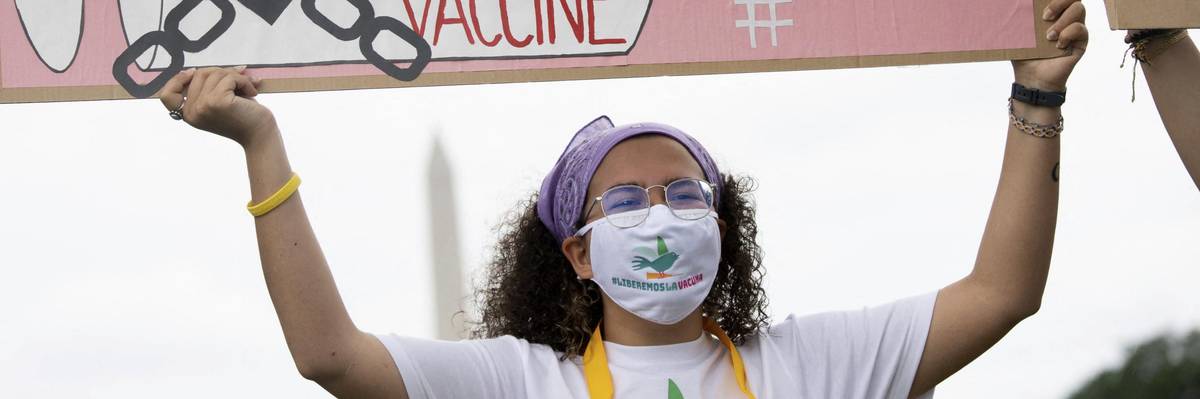
Demonstrators hold a rally to "Free the Vaccine," calling on the U.S. to commit to a global coronavirus plan that includes sharing formulas with the world to help ensure that every nation has access to a vaccine, on the National Mall in Washington, D.C., on May 5, 2021. (Photo: Saul Loeb / AFP via Getty Images)
The upsurge of COVID-19 cases, hospitalizations, and deaths in the United States serves as a bitter reminder that the pandemic is not over. The global economy will not return to normal until the disease is under control everywhere.
But the US case is a true tragedy, because what's currently happening here is so unnecessary. While those in emerging markets and developing countries are longing to get the vaccine (with many dying because they cannot get it), the US supply is ample enough to provide a double dose--and now a booster shot--to everyone in the country. And if almost everyone got vaccinated, COVID-19 would almost surely just "fade away," as former President Donald Trump memorably put it.
Even if the costs of global vaccination totaled tens of billions of dollars, the amount would pale in comparison to the costs of persistent COVID-19 outbreaks to lives, livelihoods, and the world economy.
And yet not nearly enough people in the US have been vaccinated to prevent the highly contagious Delta variant from driving case numbers in many areas to new highs. How do so many in a country with seemingly well-educated people act so irrationally, against their own interest, against science, and against the lessons of history?
Part of the answer is that the country, for all of its wealth, is not as well-educated as one might expect--which is reflected in the country's comparative international performance on standardized assessments. In many parts of the country--including some with the highest rates of resistance to vaccination--science education is particularly poor, owing to politicization of fundamental issues like evolution and climate change, which in many cases have been excluded from school curricula.
In this environment, misinformation can gain traction with many people. And social-media platforms, insulated from liability for what they transmit, have made a business model of maximizing "user engagement" by spreading misinformation, including about COVID-19 and the vaccines.
But a key part of the answer is a deep misinterpretation, especially among the right, of individual liberty. Those who refuse to wear masks or socially distance often argue that requirements to do so infringe on their freedom. But one person's freedom is another person's "unfreedom." If their refusal to wear a mask or get vaccinated results in others getting COVID-19, their behavior is denying others the more fundamental right to life itself.
The essence of the matter is that there are large externalities: In a pandemic, one person's actions affect the well-being of others. And whenever there are such externalities, the well-being of society requires collective action: regulations to restrict socially harmful behavior and to promote socially beneficial behavior.
Any ordered society entails restrictions. But while prohibitions against killing, stealing, and so on restrict an individual's freedom, we all understand that society could not function without them. In our post-COVID world, we might interpret the Ten Commandments to include: "Thou shall not kill, including by spreading infectious diseases when thou can avoid doing so."
Similarly, "Thou shall get vaccinated." Any infringement of an individual's liberty by requiring safe and highly effective COVID-19 vaccination pales in comparison to the social benefits--and consequent economic benefits--of public health. It is a no-brainer to require all individuals, with only limited medical exemptions, to be vaccinated. While many governments appear to be too timid to impose this requirement, employers, schools, and social organizations--any organized activity that brings individuals into contact with others--should do so.
As we have been learning for the last 18 months, global health is a global public good. As long as the disease rages in some parts of the world, the risk of a deadlier, more contagious, more vaccine-resistant mutation grows.
In most of the world, however, the problem is not resistance to vaccination but a severe shortage of vaccines. Evidently, the private sector is unable to scale up production to ensure an adequate supply. Is that because vaccine producers lack capital? Is there a shortage of glass vials or syringes? Or is it because they hope that fewer doses will lead to higher prices and even bigger profits? Among the key barriers to greater supply is access to the requisite intellectual property, which is why the IP waiver being discussed at the World Trade Organization is so important.
Given the urgency and scale of the challenge, more is needed: Among the steps US President Joe Biden's administration could take is to invoke the Defense Production Act and leverage the federal government's ownership of key patents. The US has been allowing the pharmaceutical companies to use this public IP freely, while they reap billions of dollars in profits. The US must use every instrument at its disposal to increase production at home and abroad.
This, too, is a no brainer. Even if the costs of global vaccination totaled tens of billions of dollars, the amount would pale in comparison to the costs of persistent COVID-19 outbreaks to lives, livelihoods, and the world economy.
Dear Common Dreams reader, It’s been nearly 30 years since I co-founded Common Dreams with my late wife, Lina Newhouser. We had the radical notion that journalism should serve the public good, not corporate profits. It was clear to us from the outset what it would take to build such a project. No paid advertisements. No corporate sponsors. No millionaire publisher telling us what to think or do. Many people said we wouldn't last a year, but we proved those doubters wrong. Together with a tremendous team of journalists and dedicated staff, we built an independent media outlet free from the constraints of profits and corporate control. Our mission has always been simple: To inform. To inspire. To ignite change for the common good. Building Common Dreams was not easy. Our survival was never guaranteed. When you take on the most powerful forces—Wall Street greed, fossil fuel industry destruction, Big Tech lobbyists, and uber-rich oligarchs who have spent billions upon billions rigging the economy and democracy in their favor—the only bulwark you have is supporters who believe in your work. But here’s the urgent message from me today. It's never been this bad out there. And it's never been this hard to keep us going. At the very moment Common Dreams is most needed, the threats we face are intensifying. We need your support now more than ever. We don't accept corporate advertising and never will. We don't have a paywall because we don't think people should be blocked from critical news based on their ability to pay. Everything we do is funded by the donations of readers like you. When everyone does the little they can afford, we are strong. But if that support retreats or dries up, so do we. Will you donate now to make sure Common Dreams not only survives but thrives? —Craig Brown, Co-founder |
The upsurge of COVID-19 cases, hospitalizations, and deaths in the United States serves as a bitter reminder that the pandemic is not over. The global economy will not return to normal until the disease is under control everywhere.
But the US case is a true tragedy, because what's currently happening here is so unnecessary. While those in emerging markets and developing countries are longing to get the vaccine (with many dying because they cannot get it), the US supply is ample enough to provide a double dose--and now a booster shot--to everyone in the country. And if almost everyone got vaccinated, COVID-19 would almost surely just "fade away," as former President Donald Trump memorably put it.
Even if the costs of global vaccination totaled tens of billions of dollars, the amount would pale in comparison to the costs of persistent COVID-19 outbreaks to lives, livelihoods, and the world economy.
And yet not nearly enough people in the US have been vaccinated to prevent the highly contagious Delta variant from driving case numbers in many areas to new highs. How do so many in a country with seemingly well-educated people act so irrationally, against their own interest, against science, and against the lessons of history?
Part of the answer is that the country, for all of its wealth, is not as well-educated as one might expect--which is reflected in the country's comparative international performance on standardized assessments. In many parts of the country--including some with the highest rates of resistance to vaccination--science education is particularly poor, owing to politicization of fundamental issues like evolution and climate change, which in many cases have been excluded from school curricula.
In this environment, misinformation can gain traction with many people. And social-media platforms, insulated from liability for what they transmit, have made a business model of maximizing "user engagement" by spreading misinformation, including about COVID-19 and the vaccines.
But a key part of the answer is a deep misinterpretation, especially among the right, of individual liberty. Those who refuse to wear masks or socially distance often argue that requirements to do so infringe on their freedom. But one person's freedom is another person's "unfreedom." If their refusal to wear a mask or get vaccinated results in others getting COVID-19, their behavior is denying others the more fundamental right to life itself.
The essence of the matter is that there are large externalities: In a pandemic, one person's actions affect the well-being of others. And whenever there are such externalities, the well-being of society requires collective action: regulations to restrict socially harmful behavior and to promote socially beneficial behavior.
Any ordered society entails restrictions. But while prohibitions against killing, stealing, and so on restrict an individual's freedom, we all understand that society could not function without them. In our post-COVID world, we might interpret the Ten Commandments to include: "Thou shall not kill, including by spreading infectious diseases when thou can avoid doing so."
Similarly, "Thou shall get vaccinated." Any infringement of an individual's liberty by requiring safe and highly effective COVID-19 vaccination pales in comparison to the social benefits--and consequent economic benefits--of public health. It is a no-brainer to require all individuals, with only limited medical exemptions, to be vaccinated. While many governments appear to be too timid to impose this requirement, employers, schools, and social organizations--any organized activity that brings individuals into contact with others--should do so.
As we have been learning for the last 18 months, global health is a global public good. As long as the disease rages in some parts of the world, the risk of a deadlier, more contagious, more vaccine-resistant mutation grows.
In most of the world, however, the problem is not resistance to vaccination but a severe shortage of vaccines. Evidently, the private sector is unable to scale up production to ensure an adequate supply. Is that because vaccine producers lack capital? Is there a shortage of glass vials or syringes? Or is it because they hope that fewer doses will lead to higher prices and even bigger profits? Among the key barriers to greater supply is access to the requisite intellectual property, which is why the IP waiver being discussed at the World Trade Organization is so important.
Given the urgency and scale of the challenge, more is needed: Among the steps US President Joe Biden's administration could take is to invoke the Defense Production Act and leverage the federal government's ownership of key patents. The US has been allowing the pharmaceutical companies to use this public IP freely, while they reap billions of dollars in profits. The US must use every instrument at its disposal to increase production at home and abroad.
This, too, is a no brainer. Even if the costs of global vaccination totaled tens of billions of dollars, the amount would pale in comparison to the costs of persistent COVID-19 outbreaks to lives, livelihoods, and the world economy.
The upsurge of COVID-19 cases, hospitalizations, and deaths in the United States serves as a bitter reminder that the pandemic is not over. The global economy will not return to normal until the disease is under control everywhere.
But the US case is a true tragedy, because what's currently happening here is so unnecessary. While those in emerging markets and developing countries are longing to get the vaccine (with many dying because they cannot get it), the US supply is ample enough to provide a double dose--and now a booster shot--to everyone in the country. And if almost everyone got vaccinated, COVID-19 would almost surely just "fade away," as former President Donald Trump memorably put it.
Even if the costs of global vaccination totaled tens of billions of dollars, the amount would pale in comparison to the costs of persistent COVID-19 outbreaks to lives, livelihoods, and the world economy.
And yet not nearly enough people in the US have been vaccinated to prevent the highly contagious Delta variant from driving case numbers in many areas to new highs. How do so many in a country with seemingly well-educated people act so irrationally, against their own interest, against science, and against the lessons of history?
Part of the answer is that the country, for all of its wealth, is not as well-educated as one might expect--which is reflected in the country's comparative international performance on standardized assessments. In many parts of the country--including some with the highest rates of resistance to vaccination--science education is particularly poor, owing to politicization of fundamental issues like evolution and climate change, which in many cases have been excluded from school curricula.
In this environment, misinformation can gain traction with many people. And social-media platforms, insulated from liability for what they transmit, have made a business model of maximizing "user engagement" by spreading misinformation, including about COVID-19 and the vaccines.
But a key part of the answer is a deep misinterpretation, especially among the right, of individual liberty. Those who refuse to wear masks or socially distance often argue that requirements to do so infringe on their freedom. But one person's freedom is another person's "unfreedom." If their refusal to wear a mask or get vaccinated results in others getting COVID-19, their behavior is denying others the more fundamental right to life itself.
The essence of the matter is that there are large externalities: In a pandemic, one person's actions affect the well-being of others. And whenever there are such externalities, the well-being of society requires collective action: regulations to restrict socially harmful behavior and to promote socially beneficial behavior.
Any ordered society entails restrictions. But while prohibitions against killing, stealing, and so on restrict an individual's freedom, we all understand that society could not function without them. In our post-COVID world, we might interpret the Ten Commandments to include: "Thou shall not kill, including by spreading infectious diseases when thou can avoid doing so."
Similarly, "Thou shall get vaccinated." Any infringement of an individual's liberty by requiring safe and highly effective COVID-19 vaccination pales in comparison to the social benefits--and consequent economic benefits--of public health. It is a no-brainer to require all individuals, with only limited medical exemptions, to be vaccinated. While many governments appear to be too timid to impose this requirement, employers, schools, and social organizations--any organized activity that brings individuals into contact with others--should do so.
As we have been learning for the last 18 months, global health is a global public good. As long as the disease rages in some parts of the world, the risk of a deadlier, more contagious, more vaccine-resistant mutation grows.
In most of the world, however, the problem is not resistance to vaccination but a severe shortage of vaccines. Evidently, the private sector is unable to scale up production to ensure an adequate supply. Is that because vaccine producers lack capital? Is there a shortage of glass vials or syringes? Or is it because they hope that fewer doses will lead to higher prices and even bigger profits? Among the key barriers to greater supply is access to the requisite intellectual property, which is why the IP waiver being discussed at the World Trade Organization is so important.
Given the urgency and scale of the challenge, more is needed: Among the steps US President Joe Biden's administration could take is to invoke the Defense Production Act and leverage the federal government's ownership of key patents. The US has been allowing the pharmaceutical companies to use this public IP freely, while they reap billions of dollars in profits. The US must use every instrument at its disposal to increase production at home and abroad.
This, too, is a no brainer. Even if the costs of global vaccination totaled tens of billions of dollars, the amount would pale in comparison to the costs of persistent COVID-19 outbreaks to lives, livelihoods, and the world economy.