SUBSCRIBE TO OUR FREE NEWSLETTER
Daily news & progressive opinion—funded by the people, not the corporations—delivered straight to your inbox.
5
#000000
#FFFFFF
To donate by check, phone, or other method, see our More Ways to Give page.
Daily news & progressive opinion—funded by the people, not the corporations—delivered straight to your inbox.

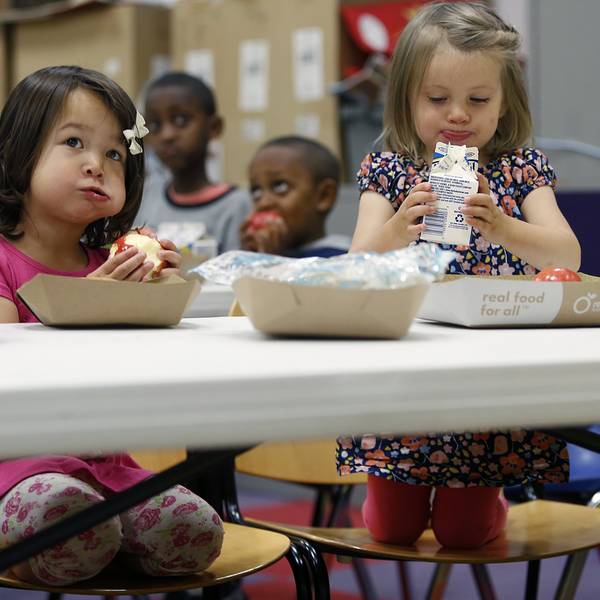
A child holds a packed lunch and breakfast as the Wyomissing Area School District in Reading, Pennsylvania handed out lunches and breakfasts on March 17, 2020. (Photo by Lauren A. Little/MediaNews Group/Reading Eagle via Getty Images)
The school board in Waukesha, Wisconsin, recently made a strange decision. They opted the school district out of a federal program "that would give free meals to all students regardless of family income," the Washington Post reports. The reason? According to one school-board member, children could "become spoiled." The school district's assistant superintendent for business services worried that there would be a "slow addiction" to the free meals. This is a fascinating way to talk about children and their families, who do possess a biological need for food. Whether that need amounts to a "slow addiction" is a matter of opinion. And opinion in this country has become badly skewed.
Low-income children and families in Waukesha may still be able to qualify for free and reduced-price school meals under pre-pandemic guidelines. There's a catch, though, as there is with any means-tested programs. There are families who don't qualify for the program but still struggle to make ends meet. And those families are now out of luck unless public opinion forces the board to reverse course. That's possible, according to the Post; the board is meeting next week to discuss the policy.
But let's examine how we got here at all.
There's no evidence that free school meals "spoil" anyone, according to an expert interviewed by the Post:
"The discussion underscores a decades-old debate in public economics," said Ioana Marinescu, an economist at the University of Pennsylvania's School of Social Policy and Practice. The importance people place on "work and pulling yourself up by your own bootstraps," she said, fuels concerns that are often exaggerated.
In fact, the benefits could be wide ranging:
According to Marinescu, the Seamless Summer Option does not require anything in return from students. Because participants do not have to prove that their families have lower incomes, she said, there is not an incentive to rely on these programs.
"If anything, it's the opposite effect," she said. "The one that's based on conditions because it's required to have low income might create the disincentives the board is talking about, but the universal one is less likely to create disincentives."
There's another clear incentive to a universal school meals program. School-board officials would be more certain that children in their district have regular access to nutritious food. Fewer kids would go hungry -- and that should be an obvious win, especially to officials who are responsible for public education. Learning is difficult for hungry children. But America has always been content to let certain children go without. Behold the concept of "school lunch debt." According to a 2019 piece in the Counter, "median lunch debt rose from $2,000 to $2,500 per district between 2016 and 2018," and the social consequences for children can be severe. Students might be blocked from important school activities. Sometimes they're served meals that are cold instead of hot and are less substantial and nutritious than what their better-off classmates consume. There's an element of shaming, too. Kids understand why their classmate is getting a cold sandwich instead of whatever everyone else is eating, and the difference can inform teasing.
Universal programs put kids on the same level, and they guarantee everyone the food they need to get through the day. That anyone, let alone a school-board member, could say out loud that free meals might "spoil" children is indicative of widespread social rot. Our obsession with means-testing runs deep, because in the end, that fixation isn't just about targeted poverty reduction or writing sound policy. It's meaner and pettier than that. The people who worry about a "slow addiction" to food believe that public aid corrupts, that the poor can drag everyone else down to their abominable level. Our collective priority should be making sure that children have enough food to eat.
Dear Common Dreams reader, It’s been nearly 30 years since I co-founded Common Dreams with my late wife, Lina Newhouser. We had the radical notion that journalism should serve the public good, not corporate profits. It was clear to us from the outset what it would take to build such a project. No paid advertisements. No corporate sponsors. No millionaire publisher telling us what to think or do. Many people said we wouldn't last a year, but we proved those doubters wrong. Together with a tremendous team of journalists and dedicated staff, we built an independent media outlet free from the constraints of profits and corporate control. Our mission has always been simple: To inform. To inspire. To ignite change for the common good. Building Common Dreams was not easy. Our survival was never guaranteed. When you take on the most powerful forces—Wall Street greed, fossil fuel industry destruction, Big Tech lobbyists, and uber-rich oligarchs who have spent billions upon billions rigging the economy and democracy in their favor—the only bulwark you have is supporters who believe in your work. But here’s the urgent message from me today. It's never been this bad out there. And it's never been this hard to keep us going. At the very moment Common Dreams is most needed, the threats we face are intensifying. We need your support now more than ever. We don't accept corporate advertising and never will. We don't have a paywall because we don't think people should be blocked from critical news based on their ability to pay. Everything we do is funded by the donations of readers like you. When everyone does the little they can afford, we are strong. But if that support retreats or dries up, so do we. Will you donate now to make sure Common Dreams not only survives but thrives? —Craig Brown, Co-founder |
The school board in Waukesha, Wisconsin, recently made a strange decision. They opted the school district out of a federal program "that would give free meals to all students regardless of family income," the Washington Post reports. The reason? According to one school-board member, children could "become spoiled." The school district's assistant superintendent for business services worried that there would be a "slow addiction" to the free meals. This is a fascinating way to talk about children and their families, who do possess a biological need for food. Whether that need amounts to a "slow addiction" is a matter of opinion. And opinion in this country has become badly skewed.
Low-income children and families in Waukesha may still be able to qualify for free and reduced-price school meals under pre-pandemic guidelines. There's a catch, though, as there is with any means-tested programs. There are families who don't qualify for the program but still struggle to make ends meet. And those families are now out of luck unless public opinion forces the board to reverse course. That's possible, according to the Post; the board is meeting next week to discuss the policy.
But let's examine how we got here at all.
There's no evidence that free school meals "spoil" anyone, according to an expert interviewed by the Post:
"The discussion underscores a decades-old debate in public economics," said Ioana Marinescu, an economist at the University of Pennsylvania's School of Social Policy and Practice. The importance people place on "work and pulling yourself up by your own bootstraps," she said, fuels concerns that are often exaggerated.
In fact, the benefits could be wide ranging:
According to Marinescu, the Seamless Summer Option does not require anything in return from students. Because participants do not have to prove that their families have lower incomes, she said, there is not an incentive to rely on these programs.
"If anything, it's the opposite effect," she said. "The one that's based on conditions because it's required to have low income might create the disincentives the board is talking about, but the universal one is less likely to create disincentives."
There's another clear incentive to a universal school meals program. School-board officials would be more certain that children in their district have regular access to nutritious food. Fewer kids would go hungry -- and that should be an obvious win, especially to officials who are responsible for public education. Learning is difficult for hungry children. But America has always been content to let certain children go without. Behold the concept of "school lunch debt." According to a 2019 piece in the Counter, "median lunch debt rose from $2,000 to $2,500 per district between 2016 and 2018," and the social consequences for children can be severe. Students might be blocked from important school activities. Sometimes they're served meals that are cold instead of hot and are less substantial and nutritious than what their better-off classmates consume. There's an element of shaming, too. Kids understand why their classmate is getting a cold sandwich instead of whatever everyone else is eating, and the difference can inform teasing.
Universal programs put kids on the same level, and they guarantee everyone the food they need to get through the day. That anyone, let alone a school-board member, could say out loud that free meals might "spoil" children is indicative of widespread social rot. Our obsession with means-testing runs deep, because in the end, that fixation isn't just about targeted poverty reduction or writing sound policy. It's meaner and pettier than that. The people who worry about a "slow addiction" to food believe that public aid corrupts, that the poor can drag everyone else down to their abominable level. Our collective priority should be making sure that children have enough food to eat.
The school board in Waukesha, Wisconsin, recently made a strange decision. They opted the school district out of a federal program "that would give free meals to all students regardless of family income," the Washington Post reports. The reason? According to one school-board member, children could "become spoiled." The school district's assistant superintendent for business services worried that there would be a "slow addiction" to the free meals. This is a fascinating way to talk about children and their families, who do possess a biological need for food. Whether that need amounts to a "slow addiction" is a matter of opinion. And opinion in this country has become badly skewed.
Low-income children and families in Waukesha may still be able to qualify for free and reduced-price school meals under pre-pandemic guidelines. There's a catch, though, as there is with any means-tested programs. There are families who don't qualify for the program but still struggle to make ends meet. And those families are now out of luck unless public opinion forces the board to reverse course. That's possible, according to the Post; the board is meeting next week to discuss the policy.
But let's examine how we got here at all.
There's no evidence that free school meals "spoil" anyone, according to an expert interviewed by the Post:
"The discussion underscores a decades-old debate in public economics," said Ioana Marinescu, an economist at the University of Pennsylvania's School of Social Policy and Practice. The importance people place on "work and pulling yourself up by your own bootstraps," she said, fuels concerns that are often exaggerated.
In fact, the benefits could be wide ranging:
According to Marinescu, the Seamless Summer Option does not require anything in return from students. Because participants do not have to prove that their families have lower incomes, she said, there is not an incentive to rely on these programs.
"If anything, it's the opposite effect," she said. "The one that's based on conditions because it's required to have low income might create the disincentives the board is talking about, but the universal one is less likely to create disincentives."
There's another clear incentive to a universal school meals program. School-board officials would be more certain that children in their district have regular access to nutritious food. Fewer kids would go hungry -- and that should be an obvious win, especially to officials who are responsible for public education. Learning is difficult for hungry children. But America has always been content to let certain children go without. Behold the concept of "school lunch debt." According to a 2019 piece in the Counter, "median lunch debt rose from $2,000 to $2,500 per district between 2016 and 2018," and the social consequences for children can be severe. Students might be blocked from important school activities. Sometimes they're served meals that are cold instead of hot and are less substantial and nutritious than what their better-off classmates consume. There's an element of shaming, too. Kids understand why their classmate is getting a cold sandwich instead of whatever everyone else is eating, and the difference can inform teasing.
Universal programs put kids on the same level, and they guarantee everyone the food they need to get through the day. That anyone, let alone a school-board member, could say out loud that free meals might "spoil" children is indicative of widespread social rot. Our obsession with means-testing runs deep, because in the end, that fixation isn't just about targeted poverty reduction or writing sound policy. It's meaner and pettier than that. The people who worry about a "slow addiction" to food believe that public aid corrupts, that the poor can drag everyone else down to their abominable level. Our collective priority should be making sure that children have enough food to eat.