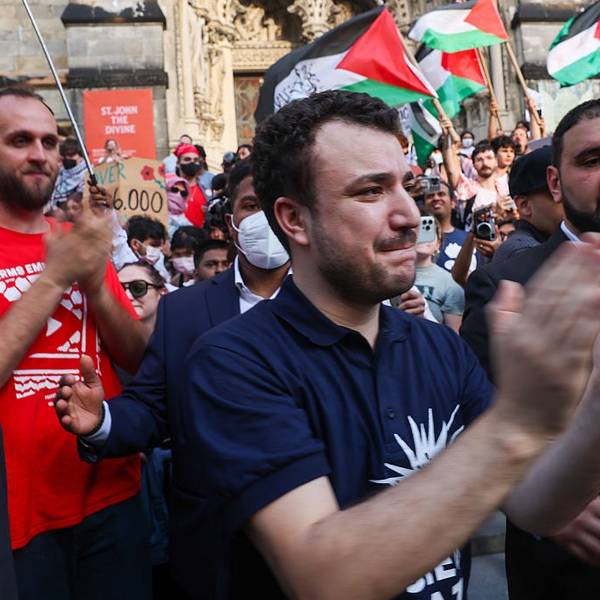
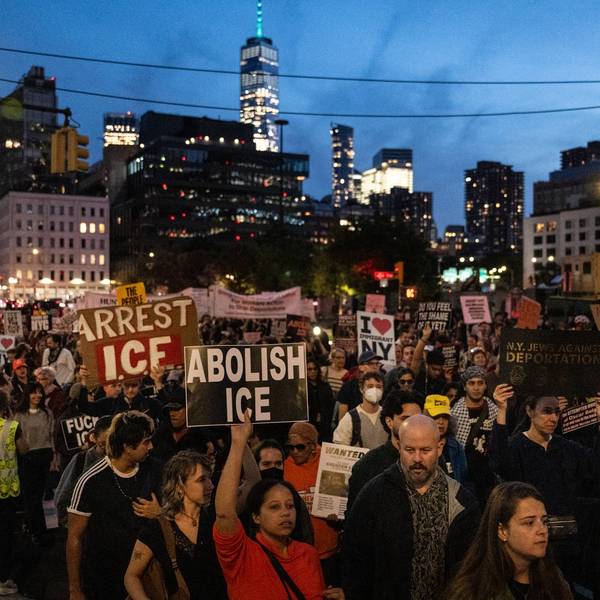
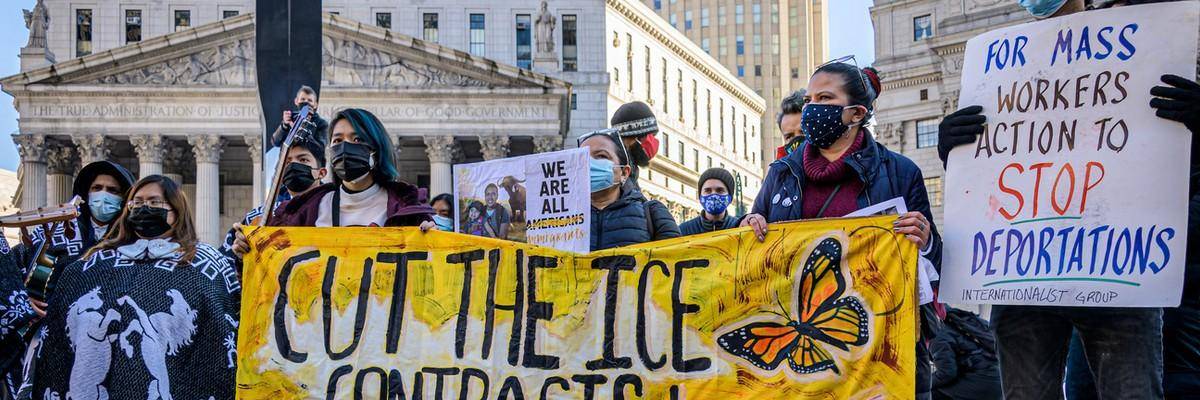
Demonstrators protest U.S. Immigration and Customs Enforcement (ICE) detention in New York City on February 6, 2021. (Photo: Erik McGregor/LightRocket via Getty Images)
LGBTQ+ Immigrants Must Be Released from Detention
The violence of the detention system falls hardest on people already facing persecution and bias because of their sexuality or gender identity.
Imagine: You are an entrepreneur with a passion for cooking who dreams of one day opening your own food truck. You have lived in the United States for 20 years. One day, Immigration and Customs Enforcement (ICE) agents knock on your door. They say you will be deported to a country you haven't seen in two decades. You know that if you are sent there, you may be threatened, arrested, jailed, beaten, or killed--with the assent of the country's police and courts--just because of your sexual identity.
You invoke your rights under international law. You say you can't be sent back to a place where you will be persecuted or tortured. A judge orders you deported anyway. You appeal the ruling, but the process drags on. Detention guards threaten you and pin you to the wall. When you speak out, they put you in solitary confinement as punishment. You remain caged for nearly a year, cut off from the friends and community you knew, with no end in sight.
There is nothing in the law--or in basic morality--that says people need to be confined in prison-like settings simply for exercising their right under international law to seek asylum or request other forms of protection.
This story isn't hypothetical. It's what really happened to Paul White, a Black bisexual immigrant from a country known to criminalize same-sex intimacy, and where violence and murder of LGBTQ+ people are common--often with the complicity of local law enforcement. Paul remains in detention to this day as he and his friends and supporters--including my organization, the Queer Detainee Empowement Project--press for his release.
Nor is Paul alone in this experience. There are many other LGBTQ+ immigrants and asylum-seekers with similar stories. Everyone's case is unique, but common themes run throughout their encounters with the immigration bureaucracy: lives and aspirations cut short and thrown into turmoil by arrest and deportation; cruel and traumatic separatons from family and loved ones; violence and discrimination at the hands of their adopted homeland.
Faby Federick was a Black transgender woman who escaped trauma and exploitation in Costa Rica to come to the United States. She survived homelessness, a global pandemic, and health problems, all while working hard to learn English, prepare for the high school equivalency exam, and train as a chef. Her friends and community knew her as a joyful, ambitious, and funny person whose laugh lit up the room.
On March 7, 2021, Faby Federick took her life after a year in immigration detention. Her dreams of higher education, making political change, and starting a family died with her. Faby's passing was the result of the trauma and dehumanization built into the immigration system of this country. For LGBTQ+ immigrants who have often faced trauma and persecution before coming to the United States, these impacts can be even more devastating.
Oliver J. Dunbar--another individual my organization works with--is a Black gay migrant from Jamaica who was detained for more than two years. After living in the United States for more than 40 years, Oliver was arrested at his family home in New Jersey, detained, and eventually transferred more than a thousand miles away from his family and loved ones to the Krome Detention Center in Miami.
In detention, Oliver was harassed and assaulted, and when he requested essential care for medical issues stemming from this abuse, ICE denied him treatment--in part because the government wishes to speed up his deportation by refusing to acknowledge any medical issues. ICE--and, ultimately, the Biden administration--could have released Oliver at any time to return to New Jersey and be with his family, but instead they deported him back to a homophobic country he hadn't visited in more than four decades. He deserves to stay in the country he calls home.
The fact that the U.S. immigration system discriminates against Black LGBTQ+ migrants like Paul, Faby, and Oliver is not new. Some of the first anti-immigrant restrictions passed into law into the United States were designed to exclude queer people. In part for this reason, the struggles for queer liberation and immigrant rights have long been intertwined. And while U.S. immigration rules may no longer single out LGBTQ+ migrants by name, they often disproportionately harm them in practice.
Jorge Rondon-Torrealba is a former DACA recipient who fears persecution in Venezuela--a country he has not seen since he was three years old--on account of his queer identity. By every definition, he should have legal status in the United States. Yet, because queer communtiies of color are often disproportionately policed and criminalized, Jorge's DACA status was revoked. He remains locked up today, facing the threat of indefinite detention due to a ban on U.S. flights into Venezuela.
There is nothing in the law--or in basic morality--that says people need to be confined in prison-like settings simply for exercising their right under international law to seek asylum or request other forms of protection. In the midst of a global pandemic, locking people up in any sort of congregate setting against their will becomes even harder to justify. The Biden administration can and should release people from detention.
This imperative to act is all the more urgent for people in detention who are already at greater risk of harassment, abuse, and violence because of who they are, the people they love, and the ways they express their sexuality and gender identity. As Paul, Faby, Oliver, and Jorge's stories all show, LGBTQ+ people have so much to offer the world, when their dreams are not being stifled by the needless violence of detention. They deserve to live in freedom with the people they choose, and in the country they call home.
We are at a crossroads
This country and this world are at a monumental crossroads. In a few short weeks, US voters will have an opportunity to beat back the forces of fascism and confront the billionaires who are rigging the economy, our media system, and our democracy, making it increasingly impossible for ordinary people to get by. We’re not just talking about the election. We’re talking about what must be done once these fascist elements are vanquished from power. We need a bolder set of solutions than what either major party has so far been willing to offer and a working-class movement ready to fight like hell for it. Trump didn't emerge from nowhere. The conditions that fueled MAGA authoritarianism were created by decades of radical neoliberal economic policies and a corrupt political system dominated by corporate interests. They slashed taxes on the super-rich, promising that the benefits would trickle down. They said giveaways to the corporate titans would make life more affordable for the rest of us. It was all bullshit. And when a bitter, betrayed populace searches for someone to blame, right-wing demagogues have little trouble finding scapegoats. People know when they're being lied to, but you won't hear any of this from the corporate media. Only independent journalism—powered and funded by people who believe in building a better world—can deliver truly trustworthy daily news. Our Fall Campaign is underway, and we need your help. To power our newsroom through the rest of the year, we need to raise $125,000 by midnight on October 31. So if you share our vision, please contribute whatever you can to sustain our work. |
Imagine: You are an entrepreneur with a passion for cooking who dreams of one day opening your own food truck. You have lived in the United States for 20 years. One day, Immigration and Customs Enforcement (ICE) agents knock on your door. They say you will be deported to a country you haven't seen in two decades. You know that if you are sent there, you may be threatened, arrested, jailed, beaten, or killed--with the assent of the country's police and courts--just because of your sexual identity.
You invoke your rights under international law. You say you can't be sent back to a place where you will be persecuted or tortured. A judge orders you deported anyway. You appeal the ruling, but the process drags on. Detention guards threaten you and pin you to the wall. When you speak out, they put you in solitary confinement as punishment. You remain caged for nearly a year, cut off from the friends and community you knew, with no end in sight.
There is nothing in the law--or in basic morality--that says people need to be confined in prison-like settings simply for exercising their right under international law to seek asylum or request other forms of protection.
This story isn't hypothetical. It's what really happened to Paul White, a Black bisexual immigrant from a country known to criminalize same-sex intimacy, and where violence and murder of LGBTQ+ people are common--often with the complicity of local law enforcement. Paul remains in detention to this day as he and his friends and supporters--including my organization, the Queer Detainee Empowement Project--press for his release.
Nor is Paul alone in this experience. There are many other LGBTQ+ immigrants and asylum-seekers with similar stories. Everyone's case is unique, but common themes run throughout their encounters with the immigration bureaucracy: lives and aspirations cut short and thrown into turmoil by arrest and deportation; cruel and traumatic separatons from family and loved ones; violence and discrimination at the hands of their adopted homeland.
Faby Federick was a Black transgender woman who escaped trauma and exploitation in Costa Rica to come to the United States. She survived homelessness, a global pandemic, and health problems, all while working hard to learn English, prepare for the high school equivalency exam, and train as a chef. Her friends and community knew her as a joyful, ambitious, and funny person whose laugh lit up the room.
On March 7, 2021, Faby Federick took her life after a year in immigration detention. Her dreams of higher education, making political change, and starting a family died with her. Faby's passing was the result of the trauma and dehumanization built into the immigration system of this country. For LGBTQ+ immigrants who have often faced trauma and persecution before coming to the United States, these impacts can be even more devastating.
Oliver J. Dunbar--another individual my organization works with--is a Black gay migrant from Jamaica who was detained for more than two years. After living in the United States for more than 40 years, Oliver was arrested at his family home in New Jersey, detained, and eventually transferred more than a thousand miles away from his family and loved ones to the Krome Detention Center in Miami.
In detention, Oliver was harassed and assaulted, and when he requested essential care for medical issues stemming from this abuse, ICE denied him treatment--in part because the government wishes to speed up his deportation by refusing to acknowledge any medical issues. ICE--and, ultimately, the Biden administration--could have released Oliver at any time to return to New Jersey and be with his family, but instead they deported him back to a homophobic country he hadn't visited in more than four decades. He deserves to stay in the country he calls home.
The fact that the U.S. immigration system discriminates against Black LGBTQ+ migrants like Paul, Faby, and Oliver is not new. Some of the first anti-immigrant restrictions passed into law into the United States were designed to exclude queer people. In part for this reason, the struggles for queer liberation and immigrant rights have long been intertwined. And while U.S. immigration rules may no longer single out LGBTQ+ migrants by name, they often disproportionately harm them in practice.
Jorge Rondon-Torrealba is a former DACA recipient who fears persecution in Venezuela--a country he has not seen since he was three years old--on account of his queer identity. By every definition, he should have legal status in the United States. Yet, because queer communtiies of color are often disproportionately policed and criminalized, Jorge's DACA status was revoked. He remains locked up today, facing the threat of indefinite detention due to a ban on U.S. flights into Venezuela.
There is nothing in the law--or in basic morality--that says people need to be confined in prison-like settings simply for exercising their right under international law to seek asylum or request other forms of protection. In the midst of a global pandemic, locking people up in any sort of congregate setting against their will becomes even harder to justify. The Biden administration can and should release people from detention.
This imperative to act is all the more urgent for people in detention who are already at greater risk of harassment, abuse, and violence because of who they are, the people they love, and the ways they express their sexuality and gender identity. As Paul, Faby, Oliver, and Jorge's stories all show, LGBTQ+ people have so much to offer the world, when their dreams are not being stifled by the needless violence of detention. They deserve to live in freedom with the people they choose, and in the country they call home.
Imagine: You are an entrepreneur with a passion for cooking who dreams of one day opening your own food truck. You have lived in the United States for 20 years. One day, Immigration and Customs Enforcement (ICE) agents knock on your door. They say you will be deported to a country you haven't seen in two decades. You know that if you are sent there, you may be threatened, arrested, jailed, beaten, or killed--with the assent of the country's police and courts--just because of your sexual identity.
You invoke your rights under international law. You say you can't be sent back to a place where you will be persecuted or tortured. A judge orders you deported anyway. You appeal the ruling, but the process drags on. Detention guards threaten you and pin you to the wall. When you speak out, they put you in solitary confinement as punishment. You remain caged for nearly a year, cut off from the friends and community you knew, with no end in sight.
There is nothing in the law--or in basic morality--that says people need to be confined in prison-like settings simply for exercising their right under international law to seek asylum or request other forms of protection.
This story isn't hypothetical. It's what really happened to Paul White, a Black bisexual immigrant from a country known to criminalize same-sex intimacy, and where violence and murder of LGBTQ+ people are common--often with the complicity of local law enforcement. Paul remains in detention to this day as he and his friends and supporters--including my organization, the Queer Detainee Empowement Project--press for his release.
Nor is Paul alone in this experience. There are many other LGBTQ+ immigrants and asylum-seekers with similar stories. Everyone's case is unique, but common themes run throughout their encounters with the immigration bureaucracy: lives and aspirations cut short and thrown into turmoil by arrest and deportation; cruel and traumatic separatons from family and loved ones; violence and discrimination at the hands of their adopted homeland.
Faby Federick was a Black transgender woman who escaped trauma and exploitation in Costa Rica to come to the United States. She survived homelessness, a global pandemic, and health problems, all while working hard to learn English, prepare for the high school equivalency exam, and train as a chef. Her friends and community knew her as a joyful, ambitious, and funny person whose laugh lit up the room.
On March 7, 2021, Faby Federick took her life after a year in immigration detention. Her dreams of higher education, making political change, and starting a family died with her. Faby's passing was the result of the trauma and dehumanization built into the immigration system of this country. For LGBTQ+ immigrants who have often faced trauma and persecution before coming to the United States, these impacts can be even more devastating.
Oliver J. Dunbar--another individual my organization works with--is a Black gay migrant from Jamaica who was detained for more than two years. After living in the United States for more than 40 years, Oliver was arrested at his family home in New Jersey, detained, and eventually transferred more than a thousand miles away from his family and loved ones to the Krome Detention Center in Miami.
In detention, Oliver was harassed and assaulted, and when he requested essential care for medical issues stemming from this abuse, ICE denied him treatment--in part because the government wishes to speed up his deportation by refusing to acknowledge any medical issues. ICE--and, ultimately, the Biden administration--could have released Oliver at any time to return to New Jersey and be with his family, but instead they deported him back to a homophobic country he hadn't visited in more than four decades. He deserves to stay in the country he calls home.
The fact that the U.S. immigration system discriminates against Black LGBTQ+ migrants like Paul, Faby, and Oliver is not new. Some of the first anti-immigrant restrictions passed into law into the United States were designed to exclude queer people. In part for this reason, the struggles for queer liberation and immigrant rights have long been intertwined. And while U.S. immigration rules may no longer single out LGBTQ+ migrants by name, they often disproportionately harm them in practice.
Jorge Rondon-Torrealba is a former DACA recipient who fears persecution in Venezuela--a country he has not seen since he was three years old--on account of his queer identity. By every definition, he should have legal status in the United States. Yet, because queer communtiies of color are often disproportionately policed and criminalized, Jorge's DACA status was revoked. He remains locked up today, facing the threat of indefinite detention due to a ban on U.S. flights into Venezuela.
There is nothing in the law--or in basic morality--that says people need to be confined in prison-like settings simply for exercising their right under international law to seek asylum or request other forms of protection. In the midst of a global pandemic, locking people up in any sort of congregate setting against their will becomes even harder to justify. The Biden administration can and should release people from detention.
This imperative to act is all the more urgent for people in detention who are already at greater risk of harassment, abuse, and violence because of who they are, the people they love, and the ways they express their sexuality and gender identity. As Paul, Faby, Oliver, and Jorge's stories all show, LGBTQ+ people have so much to offer the world, when their dreams are not being stifled by the needless violence of detention. They deserve to live in freedom with the people they choose, and in the country they call home.