SUBSCRIBE TO OUR FREE NEWSLETTER
Daily news & progressive opinion—funded by the people, not the corporations—delivered straight to your inbox.
5
#000000
#FFFFFF
To donate by check, phone, or other method, see our More Ways to Give page.

The Biden administration vowed to at least begin to address the climate crisis this year as part of its infrastructure plan. Whether it will do so depends largely on West Virginia's Sen. Joe Manchin.
Manchin, who famously shot a bullet through a copy of Barack Obama's cap-and-trade climate proposal in a 2010 campaign ad, is now the chair of the Senate's Energy and Natural Resources Committee. He has starred in countless news stories about the infrastructure bills: as the key vacillating vote needed to slip Biden's $3.5 trillion reconciliation bill--which mandates the phasing out of fossil fuels--past a Republican filibuster, and as a leading broker of the parallel bipartisan bill that stripped out climate provisions entirely.

Joe Manchin shooting a bullet through a cap-and-trade bill in a 2010 campaign ad.
As Vox (4/1/21) reported back when the infrastructure package was first shaping up:
Figuring out whether Biden will be able to make good on promises to decarbonize the economy necessarily involves an inquiry into the beliefs, motivations and intentions of one man: Manchin.
The problem is, corporate reporters don't seem so interested in Manchin's "motivations." If they were, they'd have to tell their audience that Manchin has a giant conflict of interest in the matter of fossil fuels.
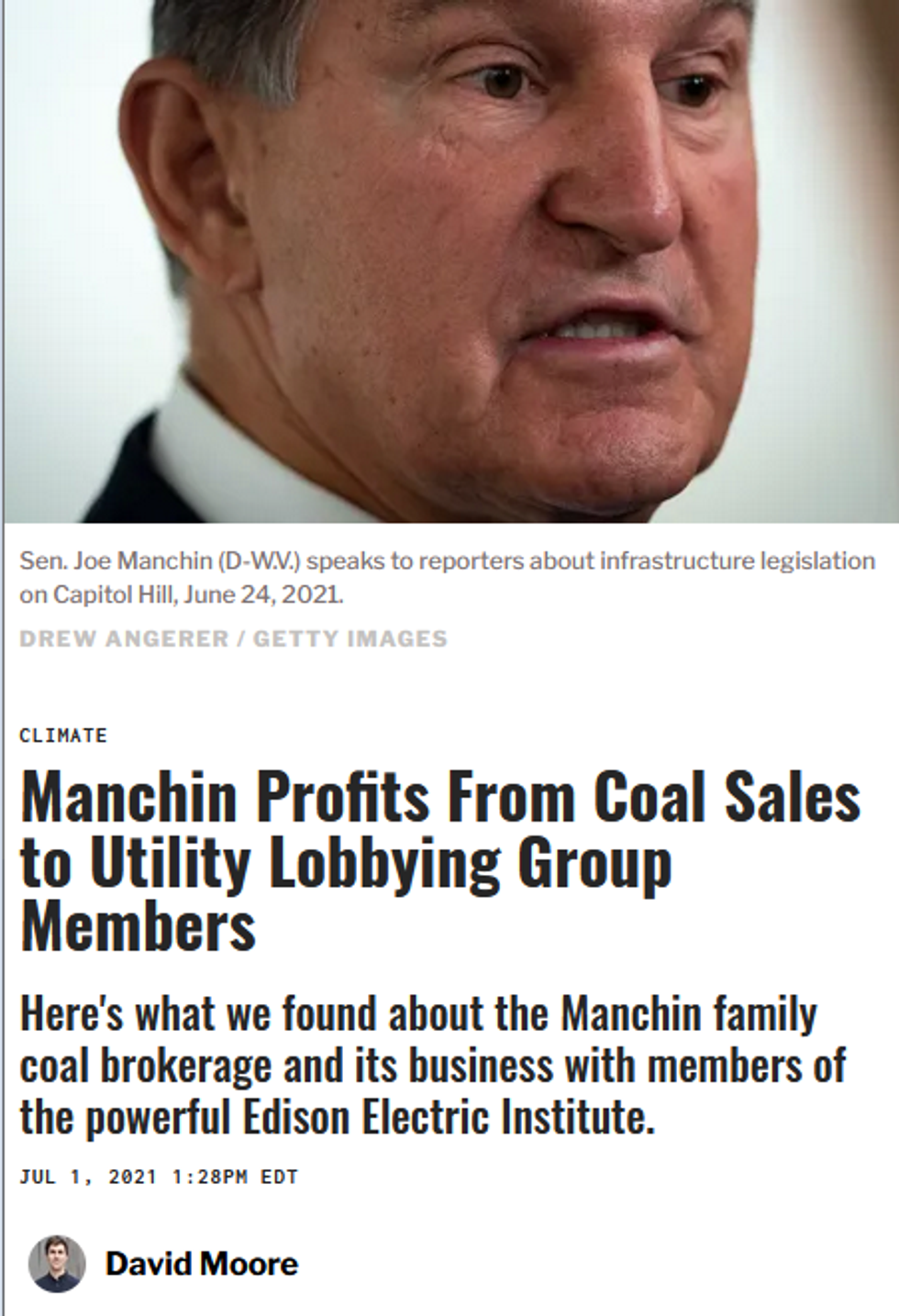
Sludge (7/1/21): "Manchin earns hundreds of thousands of dollars each year through coal sales to power plants."
As Sludge's David Moore (7/1/21) pointed out, Manchin in 1998 founded a coal brokerage firm, Enersystems, that sells coal to local power plants. He has since passed it on to his son, but it continues to be a lucrative gig for the senator: His latest financial disclosure reported $492,000 of income from Enersystems stock for 2020. Since he took office in 2010, he's made more than $4.5 million off coal.
Every single news article about Manchin and the climate bill should name this conflict. Every reporter asking Manchin how he feels about the climate provisions should also be asking about his private interests in the bill. But in the past four months, we found exactly two US news stories in the entire Nexis news database of newspapers, magazines and TV news shows that even mentioned Enersystems.
Both mentions implied that Manchin's relationship with the company was over. Neither questioned Manchin's conflict.
The first came in a lengthy New Yorker profile of Manchin (6/28/21). Out of over 8,000 words, two sentences were devoted to Enersystems:
Out of government, he had become a successful coal broker, running a firm called Enersystems. (In his most recent Senate disclosures, he and [his wife] Gayle reported a net worth of between $4 million and $13 million.)
By referring only to worth, not earnings, the parenthetical suggests that while Manchin and his wife built a fortune through coal, he no longer profits directly from it.
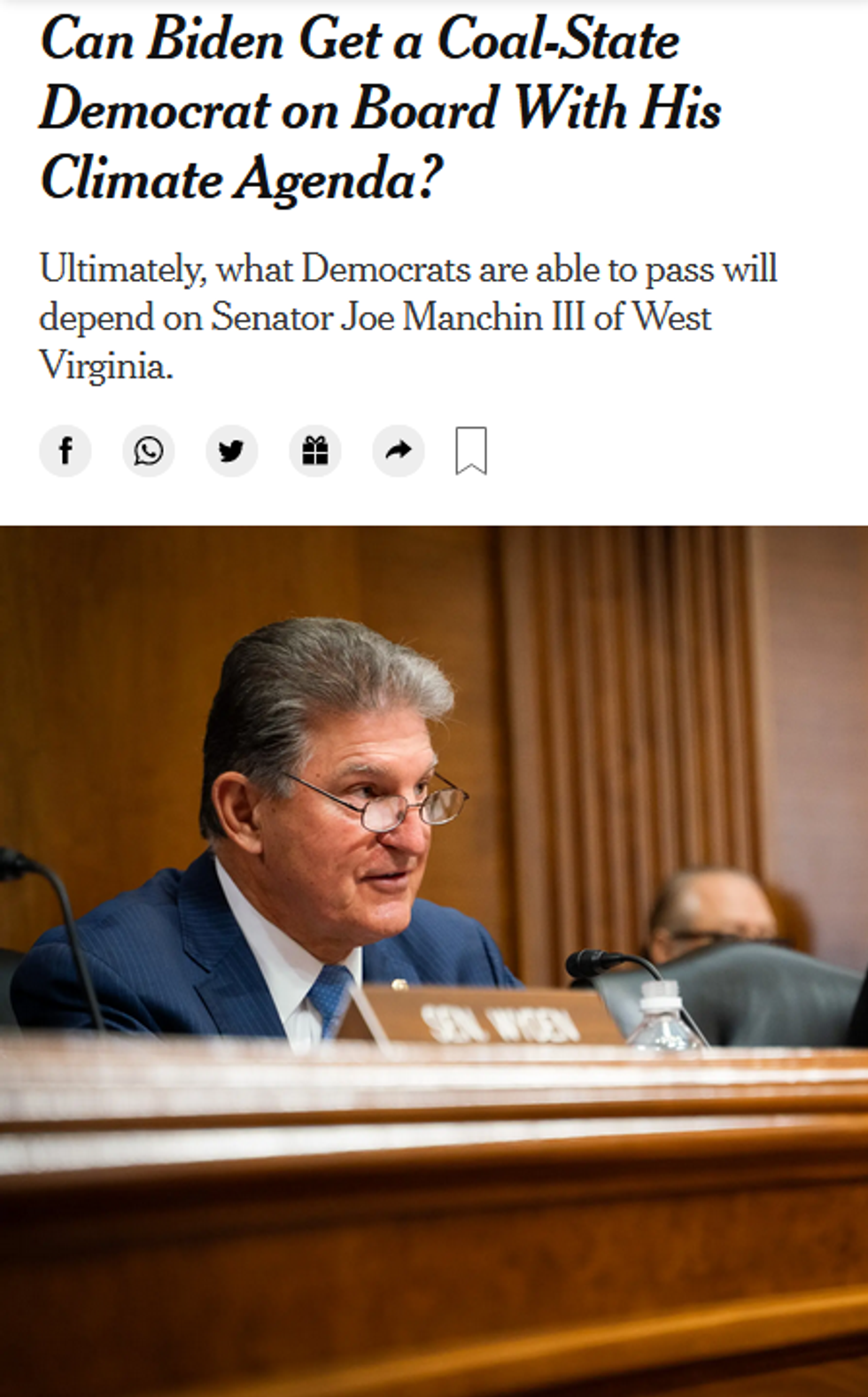
New York Times (6/28/21): Manchin's "history as an ally of the coal industry...help[s] to explain why Mr. Manchin has insisted on bipartisanship."
The other came from the New York Times in a web-only article (6/28/21): "Can Biden Get a Coal-State Democrat on Board With His Climate Agenda?" Reporter Giovanni Russonello inched close to the conflict, writing that Manchin "himself has close ties to" the energy industry, but mentioned Manchin's relationship to Enersystems as if it were past tense:
By [the time he arrived in the Senate] Mr. Manchin had already made millions from his involvement with the coal brokerage firm Enersystems, which he had helped run before entering politics, and which continued to pay him dividends thereafter.
Russonello wrote that West Virginia's deep red politics, "as well as his history as an ally of the coal industry and other business interests, help to explain why Mr. Manchin has insisted on bipartisanship." The piece only quoted observers who professed to believe that Manchin votes strictly with the interests of his constituents in mind.
With Manchin's massive financial stake in the coal industry neatly obfuscated, why would anyone doubt such pronouncements?
Perhaps the Times feels it's done its work on Manchin's conflict, since it did report on it at length--in 2011. Damningly, Russonello's piece links to that 2011 article, which detailed Manchin's ongoing "lucrative ties" to coal. But neither Russonello or his editors apparently cared enough about the conflict of interest to report on their persistence or relevance today.
In the past three months, there was a single mention of Manchin's coal earnings that actually presented them as a conflict--a column by Alex Kotch in the British Guardian (7/20/21), who also pointed out that Manchin is trying to strip conflict of interest rules from the For the People Act. (Any reporters want to inquire into Manchin's motivations there?)
When asked about the Democratic infrastructure bill last week, Manchin told CNN (7/14/21):
I'm finding out there's a lot of language in places they're eliminating fossils, which is very, very disturbing, because if you're sticking your head in the sand, and saying that fossil [fuel] has to be eliminated in America, and they want to get rid of it, and thinking that's going to clean up the global climate, it won't clean it up all. If anything, it would be worse.
The quote reverberated around the US news ecosystem. Some pointed out how wildly unfactual the statement is. None pointed out the conflict of interest.
The Biden administration vowed to at least begin to address the climate crisis this year as part of its infrastructure plan. Whether it will do so depends largely on West Virginia's Sen. Joe Manchin.
Manchin, who famously shot a bullet through a copy of Barack Obama's cap-and-trade climate proposal in a 2010 campaign ad, is now the chair of the Senate's Energy and Natural Resources Committee. He has starred in countless news stories about the infrastructure bills: as the key vacillating vote needed to slip Biden's $3.5 trillion reconciliation bill--which mandates the phasing out of fossil fuels--past a Republican filibuster, and as a leading broker of the parallel bipartisan bill that stripped out climate provisions entirely.
Joe Manchin shooting a bullet through a cap-and-trade bill in a 2010 campaign ad.
As Vox (4/1/21) reported back when the infrastructure package was first shaping up:
Figuring out whether Biden will be able to make good on promises to decarbonize the economy necessarily involves an inquiry into the beliefs, motivations and intentions of one man: Manchin.
The problem is, corporate reporters don't seem so interested in Manchin's "motivations." If they were, they'd have to tell their audience that Manchin has a giant conflict of interest in the matter of fossil fuels.
Sludge (7/1/21): "Manchin earns hundreds of thousands of dollars each year through coal sales to power plants."
As Sludge's David Moore (7/1/21) pointed out, Manchin in 1998 founded a coal brokerage firm, Enersystems, that sells coal to local power plants. He has since passed it on to his son, but it continues to be a lucrative gig for the senator: His latest financial disclosure reported $492,000 of income from Enersystems stock for 2020. Since he took office in 2010, he's made more than $4.5 million off coal.
Every single news article about Manchin and the climate bill should name this conflict. Every reporter asking Manchin how he feels about the climate provisions should also be asking about his private interests in the bill. But in the past four months, we found exactly two US news stories in the entire Nexis news database of newspapers, magazines and TV news shows that even mentioned Enersystems.
Both mentions implied that Manchin's relationship with the company was over. Neither questioned Manchin's conflict.
The first came in a lengthy New Yorker profile of Manchin (6/28/21). Out of over 8,000 words, two sentences were devoted to Enersystems:
Out of government, he had become a successful coal broker, running a firm called Enersystems. (In his most recent Senate disclosures, he and [his wife] Gayle reported a net worth of between $4 million and $13 million.)
By referring only to worth, not earnings, the parenthetical suggests that while Manchin and his wife built a fortune through coal, he no longer profits directly from it.
New York Times (6/28/21): Manchin's "history as an ally of the coal industry...help[s] to explain why Mr. Manchin has insisted on bipartisanship."
The other came from the New York Times in a web-only article (6/28/21): "Can Biden Get a Coal-State Democrat on Board With His Climate Agenda?" Reporter Giovanni Russonello inched close to the conflict, writing that Manchin "himself has close ties to" the energy industry, but mentioned Manchin's relationship to Enersystems as if it were past tense:
By [the time he arrived in the Senate] Mr. Manchin had already made millions from his involvement with the coal brokerage firm Enersystems, which he had helped run before entering politics, and which continued to pay him dividends thereafter.
Russonello wrote that West Virginia's deep red politics, "as well as his history as an ally of the coal industry and other business interests, help to explain why Mr. Manchin has insisted on bipartisanship." The piece only quoted observers who professed to believe that Manchin votes strictly with the interests of his constituents in mind.
With Manchin's massive financial stake in the coal industry neatly obfuscated, why would anyone doubt such pronouncements?
Perhaps the Times feels it's done its work on Manchin's conflict, since it did report on it at length--in 2011. Damningly, Russonello's piece links to that 2011 article, which detailed Manchin's ongoing "lucrative ties" to coal. But neither Russonello or his editors apparently cared enough about the conflict of interest to report on their persistence or relevance today.
In the past three months, there was a single mention of Manchin's coal earnings that actually presented them as a conflict--a column by Alex Kotch in the British Guardian (7/20/21), who also pointed out that Manchin is trying to strip conflict of interest rules from the For the People Act. (Any reporters want to inquire into Manchin's motivations there?)
When asked about the Democratic infrastructure bill last week, Manchin told CNN (7/14/21):
I'm finding out there's a lot of language in places they're eliminating fossils, which is very, very disturbing, because if you're sticking your head in the sand, and saying that fossil [fuel] has to be eliminated in America, and they want to get rid of it, and thinking that's going to clean up the global climate, it won't clean it up all. If anything, it would be worse.
The quote reverberated around the US news ecosystem. Some pointed out how wildly unfactual the statement is. None pointed out the conflict of interest.
The Biden administration vowed to at least begin to address the climate crisis this year as part of its infrastructure plan. Whether it will do so depends largely on West Virginia's Sen. Joe Manchin.
Manchin, who famously shot a bullet through a copy of Barack Obama's cap-and-trade climate proposal in a 2010 campaign ad, is now the chair of the Senate's Energy and Natural Resources Committee. He has starred in countless news stories about the infrastructure bills: as the key vacillating vote needed to slip Biden's $3.5 trillion reconciliation bill--which mandates the phasing out of fossil fuels--past a Republican filibuster, and as a leading broker of the parallel bipartisan bill that stripped out climate provisions entirely.
Joe Manchin shooting a bullet through a cap-and-trade bill in a 2010 campaign ad.
As Vox (4/1/21) reported back when the infrastructure package was first shaping up:
Figuring out whether Biden will be able to make good on promises to decarbonize the economy necessarily involves an inquiry into the beliefs, motivations and intentions of one man: Manchin.
The problem is, corporate reporters don't seem so interested in Manchin's "motivations." If they were, they'd have to tell their audience that Manchin has a giant conflict of interest in the matter of fossil fuels.
Sludge (7/1/21): "Manchin earns hundreds of thousands of dollars each year through coal sales to power plants."
As Sludge's David Moore (7/1/21) pointed out, Manchin in 1998 founded a coal brokerage firm, Enersystems, that sells coal to local power plants. He has since passed it on to his son, but it continues to be a lucrative gig for the senator: His latest financial disclosure reported $492,000 of income from Enersystems stock for 2020. Since he took office in 2010, he's made more than $4.5 million off coal.
Every single news article about Manchin and the climate bill should name this conflict. Every reporter asking Manchin how he feels about the climate provisions should also be asking about his private interests in the bill. But in the past four months, we found exactly two US news stories in the entire Nexis news database of newspapers, magazines and TV news shows that even mentioned Enersystems.
Both mentions implied that Manchin's relationship with the company was over. Neither questioned Manchin's conflict.
The first came in a lengthy New Yorker profile of Manchin (6/28/21). Out of over 8,000 words, two sentences were devoted to Enersystems:
Out of government, he had become a successful coal broker, running a firm called Enersystems. (In his most recent Senate disclosures, he and [his wife] Gayle reported a net worth of between $4 million and $13 million.)
By referring only to worth, not earnings, the parenthetical suggests that while Manchin and his wife built a fortune through coal, he no longer profits directly from it.
New York Times (6/28/21): Manchin's "history as an ally of the coal industry...help[s] to explain why Mr. Manchin has insisted on bipartisanship."
The other came from the New York Times in a web-only article (6/28/21): "Can Biden Get a Coal-State Democrat on Board With His Climate Agenda?" Reporter Giovanni Russonello inched close to the conflict, writing that Manchin "himself has close ties to" the energy industry, but mentioned Manchin's relationship to Enersystems as if it were past tense:
By [the time he arrived in the Senate] Mr. Manchin had already made millions from his involvement with the coal brokerage firm Enersystems, which he had helped run before entering politics, and which continued to pay him dividends thereafter.
Russonello wrote that West Virginia's deep red politics, "as well as his history as an ally of the coal industry and other business interests, help to explain why Mr. Manchin has insisted on bipartisanship." The piece only quoted observers who professed to believe that Manchin votes strictly with the interests of his constituents in mind.
With Manchin's massive financial stake in the coal industry neatly obfuscated, why would anyone doubt such pronouncements?
Perhaps the Times feels it's done its work on Manchin's conflict, since it did report on it at length--in 2011. Damningly, Russonello's piece links to that 2011 article, which detailed Manchin's ongoing "lucrative ties" to coal. But neither Russonello or his editors apparently cared enough about the conflict of interest to report on their persistence or relevance today.
In the past three months, there was a single mention of Manchin's coal earnings that actually presented them as a conflict--a column by Alex Kotch in the British Guardian (7/20/21), who also pointed out that Manchin is trying to strip conflict of interest rules from the For the People Act. (Any reporters want to inquire into Manchin's motivations there?)
When asked about the Democratic infrastructure bill last week, Manchin told CNN (7/14/21):
I'm finding out there's a lot of language in places they're eliminating fossils, which is very, very disturbing, because if you're sticking your head in the sand, and saying that fossil [fuel] has to be eliminated in America, and they want to get rid of it, and thinking that's going to clean up the global climate, it won't clean it up all. If anything, it would be worse.
The quote reverberated around the US news ecosystem. Some pointed out how wildly unfactual the statement is. None pointed out the conflict of interest.