SUBSCRIBE TO OUR FREE NEWSLETTER
Daily news & progressive opinion—funded by the people, not the corporations—delivered straight to your inbox.
5
#000000
#FFFFFF
To donate by check, phone, or other method, see our More Ways to Give page.


Daily news & progressive opinion—funded by the people, not the corporations—delivered straight to your inbox.

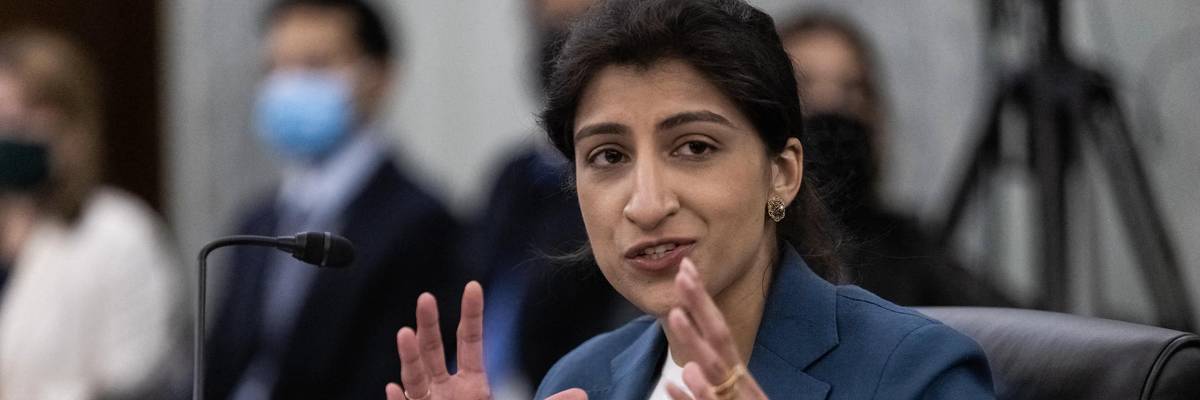
FTC Commissioner nominee Lina M. Khan testifies during a Senate Committee on Commerce, Science, and Transportation confirmation hearing on Capitol Hill in Washington, DC, April 21, 2021. (Photo by Graeme Jennings / POOL / AFP) (Photo by GRAEME JENNINGS/POOL/AFP via Getty Images)
This week a court dismissed lawsuits by the Federal Trade Commission and dozens of state attorneys general to break up Facebook and force it to allow third party applications to integrate with its dominant social network.
The FTC filing was one of the final acts of a Commission led by a relatively moderate Republican Trump appointee. It was the product of years of work by FTC commissioners Rohit Chopra and Rebecca Slaughter--and organizations like mine and coalitions that we have worked in, like Freedom from Facebook and Google. In fact, when we launched that coalition several years ago, in the midst of the Cambridge Analytica privacy and disinformation scandal, our first demand was that the FTC seek to break up Facebook on grounds similar to those upon which the FTC sued in this case.
The dismissal by Judge James Boasberg--broken down well here in Matt Stoller's newsletter--asserted that the FTC needs to more specifically define social media and the competitors in the market it says Facebook dominates.
Upon refiling, the question of whether Facebook's acquisitions of Instagram and WhatsApp should be unwound could conceptually proceed. But, concerningly, the court indicated that the claim that Facebook should be forced to allow other applications to make use of its API's will not move forward--largely resting on that scourge of anti-monopoly activists: the so-called "consumer welfare" standard upon which so much corporate concentration has been predicated in recent decades.
Antimonopoly scholar Lina Khan--whose surprising appointment not just to join the Commission, but to chair it, is probably the single most hopeful signal to date about the willingness of elements of the Biden Administration to confront outsized corporate power.
It is through the alchemy of this framework that all manner of intuitively anti-competitive acts by monopolies become virtuous--the "greed is good" of competition jurisprudence. Per the opinion, "'already large and successful firms "might be deterred from investing, innovating, or expanding . . . with the knowledge [that] anything [they] creat[e] [they] could be forced to share,' .... That equilibrium would hinder, rather than advance, consumer welfare." More on this in a moment.
The dismissal is a setback in its own right, and evidence of how unfriendly the courts remain. But the case will almost surely be refiled, by an FTC now under the leadership of antimonopoly scholar Lina Khan--whose surprising appointment not just to join the Commission, but to chair it, is probably the single most hopeful signal to date about the willingness of elements of the Biden Administration to confront outsized corporate power.
Earlier in June the House Judiciary Committee marked up a suite of six bills intended to tackle the power of Big Tech--for instance by bucking up the Federal Trade Commission, preventing the companies from owning certain conflicting lines of business, and making it harder for the tech behemoths to acquire other firms. These followed from a year-plus investigation by the committee that Khan had helped lead before she left Congress last fall.
The Boasberg ruling makes evident the imperative that Congress legislate in this space--and also that the bills be oriented to make Congress's will even more clear: Congress must restrict discretion by judges and by agencies like the FTC that, even if currently stewarded by people who are serious about the job, are subject to political vicissitudes.
The bills advanced with bipartisan support, some by large margins--but those whose intent is most ambitious passed much more narrowly and with fewer Republicans, notwithstanding that decrying the power of Big Tech is perhaps an even louder refrain on the right than the left. Minimizing delegation and deference to agencies and courts is a conservative proposition--and while Republican opponents to these bills as written should not be given the benefit of the doubt, there were insinuations in committee that tightening them up might lead more of them to sign on.
Perhaps most concerning, the consumer welfare framework has been so generous to these large companies that incorporating an "increase in consumer welfare" as a defense against being made subject to the requirements of the several bills was a priority for Big Tech second only to defeating them outright.
They succeeded, by a single vote, at inserting this language into one bill meant to make it harder for the companies to preference their own products and services above those of competitors--for instance in search results, where Google offers its own services above others', or in Amazon's online market, where Amazon white label products compete with those offered by myriad smaller businesses across the country. They failed--on a tie vote--to have similar language vest in another proposal.
Advocates will now turn to the broader House and Senate to seek to advance legislation that addresses concentration in the tech sector--ideally with the help of House and Senate leadership and even the White House if we are to ensure passage of vehicles strong enough to address the problems at hand.
The Khan FTC will likely refile the Facebook case and will otherwise seek to use all tools at its disposal to restore competition to markets, in tech and beyond. The broader Biden administration appears to want to do so as well, pursuant to a forthcoming executive order. Its choices of who will lead the Department of Justice's Antitrust Division, who will fill a likely upcoming FTC commissioner vacancy, and who it will seat on the federal bench will offer further evidence of how serious it is in these endeavours.

Dear Common Dreams reader, It’s been nearly 30 years since I co-founded Common Dreams with my late wife, Lina Newhouser. We had the radical notion that journalism should serve the public good, not corporate profits. It was clear to us from the outset what it would take to build such a project. No paid advertisements. No corporate sponsors. No millionaire publisher telling us what to think or do. Many people said we wouldn't last a year, but we proved those doubters wrong. Together with a tremendous team of journalists and dedicated staff, we built an independent media outlet free from the constraints of profits and corporate control. Our mission has always been simple: To inform. To inspire. To ignite change for the common good. Building Common Dreams was not easy. Our survival was never guaranteed. When you take on the most powerful forces—Wall Street greed, fossil fuel industry destruction, Big Tech lobbyists, and uber-rich oligarchs who have spent billions upon billions rigging the economy and democracy in their favor—the only bulwark you have is supporters who believe in your work. But here’s the urgent message from me today. It's never been this bad out there. And it's never been this hard to keep us going. At the very moment Common Dreams is most needed, the threats we face are intensifying. We need your support now more than ever. We don't accept corporate advertising and never will. We don't have a paywall because we don't think people should be blocked from critical news based on their ability to pay. Everything we do is funded by the donations of readers like you. When everyone does the little they can afford, we are strong. But if that support retreats or dries up, so do we. Will you donate now to make sure Common Dreams not only survives but thrives? —Craig Brown, Co-founder |
This week a court dismissed lawsuits by the Federal Trade Commission and dozens of state attorneys general to break up Facebook and force it to allow third party applications to integrate with its dominant social network.
The FTC filing was one of the final acts of a Commission led by a relatively moderate Republican Trump appointee. It was the product of years of work by FTC commissioners Rohit Chopra and Rebecca Slaughter--and organizations like mine and coalitions that we have worked in, like Freedom from Facebook and Google. In fact, when we launched that coalition several years ago, in the midst of the Cambridge Analytica privacy and disinformation scandal, our first demand was that the FTC seek to break up Facebook on grounds similar to those upon which the FTC sued in this case.
The dismissal by Judge James Boasberg--broken down well here in Matt Stoller's newsletter--asserted that the FTC needs to more specifically define social media and the competitors in the market it says Facebook dominates.
Upon refiling, the question of whether Facebook's acquisitions of Instagram and WhatsApp should be unwound could conceptually proceed. But, concerningly, the court indicated that the claim that Facebook should be forced to allow other applications to make use of its API's will not move forward--largely resting on that scourge of anti-monopoly activists: the so-called "consumer welfare" standard upon which so much corporate concentration has been predicated in recent decades.
Antimonopoly scholar Lina Khan--whose surprising appointment not just to join the Commission, but to chair it, is probably the single most hopeful signal to date about the willingness of elements of the Biden Administration to confront outsized corporate power.
It is through the alchemy of this framework that all manner of intuitively anti-competitive acts by monopolies become virtuous--the "greed is good" of competition jurisprudence. Per the opinion, "'already large and successful firms "might be deterred from investing, innovating, or expanding . . . with the knowledge [that] anything [they] creat[e] [they] could be forced to share,' .... That equilibrium would hinder, rather than advance, consumer welfare." More on this in a moment.
The dismissal is a setback in its own right, and evidence of how unfriendly the courts remain. But the case will almost surely be refiled, by an FTC now under the leadership of antimonopoly scholar Lina Khan--whose surprising appointment not just to join the Commission, but to chair it, is probably the single most hopeful signal to date about the willingness of elements of the Biden Administration to confront outsized corporate power.
Earlier in June the House Judiciary Committee marked up a suite of six bills intended to tackle the power of Big Tech--for instance by bucking up the Federal Trade Commission, preventing the companies from owning certain conflicting lines of business, and making it harder for the tech behemoths to acquire other firms. These followed from a year-plus investigation by the committee that Khan had helped lead before she left Congress last fall.
The Boasberg ruling makes evident the imperative that Congress legislate in this space--and also that the bills be oriented to make Congress's will even more clear: Congress must restrict discretion by judges and by agencies like the FTC that, even if currently stewarded by people who are serious about the job, are subject to political vicissitudes.
The bills advanced with bipartisan support, some by large margins--but those whose intent is most ambitious passed much more narrowly and with fewer Republicans, notwithstanding that decrying the power of Big Tech is perhaps an even louder refrain on the right than the left. Minimizing delegation and deference to agencies and courts is a conservative proposition--and while Republican opponents to these bills as written should not be given the benefit of the doubt, there were insinuations in committee that tightening them up might lead more of them to sign on.
Perhaps most concerning, the consumer welfare framework has been so generous to these large companies that incorporating an "increase in consumer welfare" as a defense against being made subject to the requirements of the several bills was a priority for Big Tech second only to defeating them outright.
They succeeded, by a single vote, at inserting this language into one bill meant to make it harder for the companies to preference their own products and services above those of competitors--for instance in search results, where Google offers its own services above others', or in Amazon's online market, where Amazon white label products compete with those offered by myriad smaller businesses across the country. They failed--on a tie vote--to have similar language vest in another proposal.
Advocates will now turn to the broader House and Senate to seek to advance legislation that addresses concentration in the tech sector--ideally with the help of House and Senate leadership and even the White House if we are to ensure passage of vehicles strong enough to address the problems at hand.
The Khan FTC will likely refile the Facebook case and will otherwise seek to use all tools at its disposal to restore competition to markets, in tech and beyond. The broader Biden administration appears to want to do so as well, pursuant to a forthcoming executive order. Its choices of who will lead the Department of Justice's Antitrust Division, who will fill a likely upcoming FTC commissioner vacancy, and who it will seat on the federal bench will offer further evidence of how serious it is in these endeavours.

This week a court dismissed lawsuits by the Federal Trade Commission and dozens of state attorneys general to break up Facebook and force it to allow third party applications to integrate with its dominant social network.
The FTC filing was one of the final acts of a Commission led by a relatively moderate Republican Trump appointee. It was the product of years of work by FTC commissioners Rohit Chopra and Rebecca Slaughter--and organizations like mine and coalitions that we have worked in, like Freedom from Facebook and Google. In fact, when we launched that coalition several years ago, in the midst of the Cambridge Analytica privacy and disinformation scandal, our first demand was that the FTC seek to break up Facebook on grounds similar to those upon which the FTC sued in this case.
The dismissal by Judge James Boasberg--broken down well here in Matt Stoller's newsletter--asserted that the FTC needs to more specifically define social media and the competitors in the market it says Facebook dominates.
Upon refiling, the question of whether Facebook's acquisitions of Instagram and WhatsApp should be unwound could conceptually proceed. But, concerningly, the court indicated that the claim that Facebook should be forced to allow other applications to make use of its API's will not move forward--largely resting on that scourge of anti-monopoly activists: the so-called "consumer welfare" standard upon which so much corporate concentration has been predicated in recent decades.
Antimonopoly scholar Lina Khan--whose surprising appointment not just to join the Commission, but to chair it, is probably the single most hopeful signal to date about the willingness of elements of the Biden Administration to confront outsized corporate power.
It is through the alchemy of this framework that all manner of intuitively anti-competitive acts by monopolies become virtuous--the "greed is good" of competition jurisprudence. Per the opinion, "'already large and successful firms "might be deterred from investing, innovating, or expanding . . . with the knowledge [that] anything [they] creat[e] [they] could be forced to share,' .... That equilibrium would hinder, rather than advance, consumer welfare." More on this in a moment.
The dismissal is a setback in its own right, and evidence of how unfriendly the courts remain. But the case will almost surely be refiled, by an FTC now under the leadership of antimonopoly scholar Lina Khan--whose surprising appointment not just to join the Commission, but to chair it, is probably the single most hopeful signal to date about the willingness of elements of the Biden Administration to confront outsized corporate power.
Earlier in June the House Judiciary Committee marked up a suite of six bills intended to tackle the power of Big Tech--for instance by bucking up the Federal Trade Commission, preventing the companies from owning certain conflicting lines of business, and making it harder for the tech behemoths to acquire other firms. These followed from a year-plus investigation by the committee that Khan had helped lead before she left Congress last fall.
The Boasberg ruling makes evident the imperative that Congress legislate in this space--and also that the bills be oriented to make Congress's will even more clear: Congress must restrict discretion by judges and by agencies like the FTC that, even if currently stewarded by people who are serious about the job, are subject to political vicissitudes.
The bills advanced with bipartisan support, some by large margins--but those whose intent is most ambitious passed much more narrowly and with fewer Republicans, notwithstanding that decrying the power of Big Tech is perhaps an even louder refrain on the right than the left. Minimizing delegation and deference to agencies and courts is a conservative proposition--and while Republican opponents to these bills as written should not be given the benefit of the doubt, there were insinuations in committee that tightening them up might lead more of them to sign on.
Perhaps most concerning, the consumer welfare framework has been so generous to these large companies that incorporating an "increase in consumer welfare" as a defense against being made subject to the requirements of the several bills was a priority for Big Tech second only to defeating them outright.
They succeeded, by a single vote, at inserting this language into one bill meant to make it harder for the companies to preference their own products and services above those of competitors--for instance in search results, where Google offers its own services above others', or in Amazon's online market, where Amazon white label products compete with those offered by myriad smaller businesses across the country. They failed--on a tie vote--to have similar language vest in another proposal.
Advocates will now turn to the broader House and Senate to seek to advance legislation that addresses concentration in the tech sector--ideally with the help of House and Senate leadership and even the White House if we are to ensure passage of vehicles strong enough to address the problems at hand.
The Khan FTC will likely refile the Facebook case and will otherwise seek to use all tools at its disposal to restore competition to markets, in tech and beyond. The broader Biden administration appears to want to do so as well, pursuant to a forthcoming executive order. Its choices of who will lead the Department of Justice's Antitrust Division, who will fill a likely upcoming FTC commissioner vacancy, and who it will seat on the federal bench will offer further evidence of how serious it is in these endeavours.