SUBSCRIBE TO OUR FREE NEWSLETTER
Daily news & progressive opinion—funded by the people, not the corporations—delivered straight to your inbox.
5
#000000
#FFFFFF
To donate by check, phone, or other method, see our More Ways to Give page.
Daily news & progressive opinion—funded by the people, not the corporations—delivered straight to your inbox.
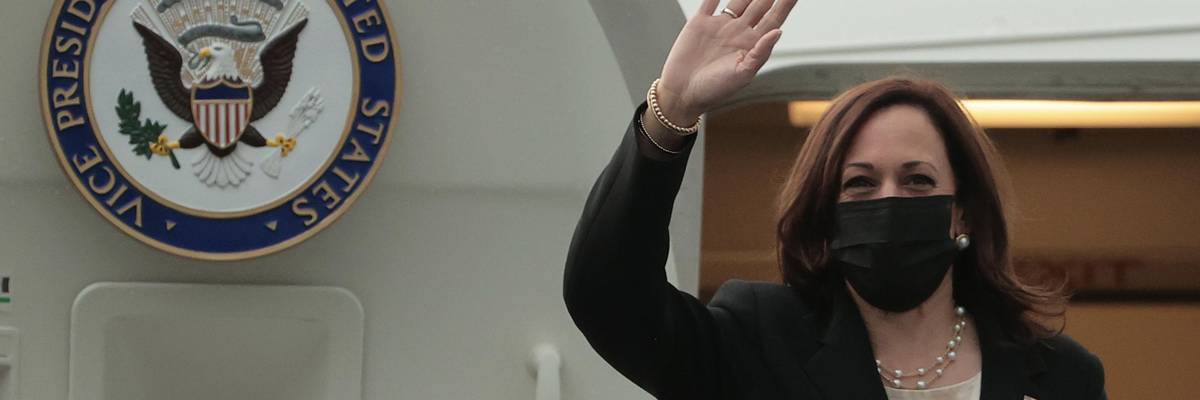
U.S. Vice President Kamala Harris acknowledges those assembled before boarding Air Force Two at Benito Juarez International Airport on June 08, 2021 in Mexico City, Mexico. The vice president was concluding her first trip abroad in an effort to address migration, declaring the need to assert control over the southern border but taking criticism for the stance at home. (Photo: Hector Vivas/Getty Images)
This week, Kamala Harris embarked on her first international trip as Vice President. The two-day trip to Latin America was also Harris's first major effort at diplomacy after being put in charge of Central American immigration policy by President Joe Biden in late March.
Harris spent Monday and Tuesday visiting Guatemala and Mexico and meeting with the leaders of those nations. On Monday, she held a press conference with Guatemalan president Alejandro Giammattei.
"I want to be clear to folks in the region who are thinking about making that dangerous trek to the United States-Mexico border: Do not come. Do not come," said Harris during the press conference. "I believe if you come to our border, you will be turned back."
This was a reversal from Harris's rhetoric during her years in the U.S. Senate, when she was a high-profile critic of the Trump Administration's migration policies. As a presidential candidate in 2020, she had even proposed a plan that would have bolstered rights of undocumented immigrants and opened up paths to citizenship.
Where Obama, Biden, and Harris cite external causes and seek external "solutions" to the "root causes" of Central American migration, there's a strong case to be made that the U.S. government is to blame.
Harris is toeing a different line now that the Biden Administration faces criticism over its handling of the Mexico-U.S. border, and as Harris considers her own political ambitions, possibly including a presidential run in 2024 or 2028.
Speaking on behalf of the President and his administration, Harris is now less interested in welcoming immigrants to the United States and more focused on dealing with the supposed "root causes" that, she argues, spur Central Americans to migrate to the United States.
"I cannot say it enough: Most people don't want to leave home," she said at the end of the trip. "And when they do, it is usually for one of two reasons: Either they are fleeing harm or to stay home means they cannot satisfy the basic needs of their families."
Harris laid out what she believed to be the key challenges in dealing with Central American migration in a public statement back in May.
"I'm thinking about people whose homes have been washed away by hurricanes," she said. "People who are parents who have sons who have been threatened by drug cartels. People who have daughters who have been targeted by human traffickers. People who do not have enough to eat. People who are out of work. People who have lost hope."
Harris went on to list what she, and presumably the administration, view as the "root causes" of Central American migration.
"First, the acute factors--the catastrophes that are causing people to leave right now: the hurricanes, the pandemic, the drought, and extreme food insecurity. And then there are the longstanding issues--the root causes--and I'm thinking of corruption, violence, and poverty; the lack of economic opportunity; the lack of climate adaptation and climate resilience; the lack of good governance."
Kamala's new immigration stance is consistent with the Biden Administration's broader strategy to focus on "root causes" in Central America through government aid, anti-corruption measures, and "good governance" policy.
Such a strategy is very similar to that of the Obama Administration. President Obama pushed an aggressive aid-based strategy in Central America similarly contingent on "good governance" and an "anti-corruption" effort; much like Harris, Vice President Joe Biden led that effort.
Before Harris was officially appointed to her diplomatic role, the Biden Administration announced that it would be following in Obama's footsteps by providing $4 billion in aid to Central American countries.
Then, in late May, Harris announced that the Biden Administration would also be investing in several businesses in Central America. Money would be provided to U.S. corporations that operate in the region, like Mastercard and Microsoft, as well as nonprofits and philanthropic organizations.
As Natalie Kitroeff and Michael D. Shear reported in The New York Times, the Obama-era tactics now being embraced by Biden and Harris have failed to accomplish much of anything.
"They've never helped me," Pedro Aguilar, a Guatemalan farmer, told the Times. "Where does all the money go? Where's the aid? Who knows?"
Kitroeff and Shear go on to write that experts "note that much of the [Central American aid] money is handed over to American companies, which swallow a lot of it for salaries, expenses and profits, often before any services are delivered."
Where Obama, Biden, and Harris cite external causes and seek external "solutions" to the "root causes" of Central American migration, there's a strong case to be made that the U.S. government is to blame.
"Starting with early Cold War-era covert and overt military intervention and regime change," wrote Felipe De La Hoz in The New Republic, "and continuing through the exporting of gangs like MS-13--originally established in California--through harsh and short-sighted immigration enforcement during the 'law and order' late '80s and '90s, there is almost no socio-political-economic issue plaguing these countries that doesn't have U.S. fingerprints all over it."
Such a notion has been echoed elsewhere. In an interview with the Citations Needed podcast in December, activist and writer Roberto Lovato spoke of "decades of U.S. policy of neoliberal economics that destroy entire economies, extract the resources, the mineral and other resources in Central America, that exploit the workers and maquilas, they pay a pittance of survival and these policies are backed up by militaries and militarized policing in the region."
Lovato refers to White House immigration policy as the "Clinton-Bush-Obama-Trump-Biden" continuum, and though there are some small differences in policy--support for DACA, temporary deportation freezes, task forces to find separated children, etc., by Obama and Biden--the biggest, most destructive parts remain perpetually unchanging.
"Those are important in the lives of the people impacted," said Lovato. "But they are a minutiae in terms of the vast infrastructure of caging, jailing, killing, murdering, mass murdering of tens of thousands."
For now, Harris appears content, at least outwardly, to go along with Biden while using her diplomatic role to bolster her presidential profile. She'll likely be fine no matter how her career unfolds. It's the people of Central America who will continue to suffer.
Dear Common Dreams reader, It’s been nearly 30 years since I co-founded Common Dreams with my late wife, Lina Newhouser. We had the radical notion that journalism should serve the public good, not corporate profits. It was clear to us from the outset what it would take to build such a project. No paid advertisements. No corporate sponsors. No millionaire publisher telling us what to think or do. Many people said we wouldn't last a year, but we proved those doubters wrong. Together with a tremendous team of journalists and dedicated staff, we built an independent media outlet free from the constraints of profits and corporate control. Our mission has always been simple: To inform. To inspire. To ignite change for the common good. Building Common Dreams was not easy. Our survival was never guaranteed. When you take on the most powerful forces—Wall Street greed, fossil fuel industry destruction, Big Tech lobbyists, and uber-rich oligarchs who have spent billions upon billions rigging the economy and democracy in their favor—the only bulwark you have is supporters who believe in your work. But here’s the urgent message from me today. It's never been this bad out there. And it's never been this hard to keep us going. At the very moment Common Dreams is most needed, the threats we face are intensifying. We need your support now more than ever. We don't accept corporate advertising and never will. We don't have a paywall because we don't think people should be blocked from critical news based on their ability to pay. Everything we do is funded by the donations of readers like you. When everyone does the little they can afford, we are strong. But if that support retreats or dries up, so do we. Will you donate now to make sure Common Dreams not only survives but thrives? —Craig Brown, Co-founder |
This week, Kamala Harris embarked on her first international trip as Vice President. The two-day trip to Latin America was also Harris's first major effort at diplomacy after being put in charge of Central American immigration policy by President Joe Biden in late March.
Harris spent Monday and Tuesday visiting Guatemala and Mexico and meeting with the leaders of those nations. On Monday, she held a press conference with Guatemalan president Alejandro Giammattei.
"I want to be clear to folks in the region who are thinking about making that dangerous trek to the United States-Mexico border: Do not come. Do not come," said Harris during the press conference. "I believe if you come to our border, you will be turned back."
This was a reversal from Harris's rhetoric during her years in the U.S. Senate, when she was a high-profile critic of the Trump Administration's migration policies. As a presidential candidate in 2020, she had even proposed a plan that would have bolstered rights of undocumented immigrants and opened up paths to citizenship.
Where Obama, Biden, and Harris cite external causes and seek external "solutions" to the "root causes" of Central American migration, there's a strong case to be made that the U.S. government is to blame.
Harris is toeing a different line now that the Biden Administration faces criticism over its handling of the Mexico-U.S. border, and as Harris considers her own political ambitions, possibly including a presidential run in 2024 or 2028.
Speaking on behalf of the President and his administration, Harris is now less interested in welcoming immigrants to the United States and more focused on dealing with the supposed "root causes" that, she argues, spur Central Americans to migrate to the United States.
"I cannot say it enough: Most people don't want to leave home," she said at the end of the trip. "And when they do, it is usually for one of two reasons: Either they are fleeing harm or to stay home means they cannot satisfy the basic needs of their families."
Harris laid out what she believed to be the key challenges in dealing with Central American migration in a public statement back in May.
"I'm thinking about people whose homes have been washed away by hurricanes," she said. "People who are parents who have sons who have been threatened by drug cartels. People who have daughters who have been targeted by human traffickers. People who do not have enough to eat. People who are out of work. People who have lost hope."
Harris went on to list what she, and presumably the administration, view as the "root causes" of Central American migration.
"First, the acute factors--the catastrophes that are causing people to leave right now: the hurricanes, the pandemic, the drought, and extreme food insecurity. And then there are the longstanding issues--the root causes--and I'm thinking of corruption, violence, and poverty; the lack of economic opportunity; the lack of climate adaptation and climate resilience; the lack of good governance."
Kamala's new immigration stance is consistent with the Biden Administration's broader strategy to focus on "root causes" in Central America through government aid, anti-corruption measures, and "good governance" policy.
Such a strategy is very similar to that of the Obama Administration. President Obama pushed an aggressive aid-based strategy in Central America similarly contingent on "good governance" and an "anti-corruption" effort; much like Harris, Vice President Joe Biden led that effort.
Before Harris was officially appointed to her diplomatic role, the Biden Administration announced that it would be following in Obama's footsteps by providing $4 billion in aid to Central American countries.
Then, in late May, Harris announced that the Biden Administration would also be investing in several businesses in Central America. Money would be provided to U.S. corporations that operate in the region, like Mastercard and Microsoft, as well as nonprofits and philanthropic organizations.
As Natalie Kitroeff and Michael D. Shear reported in The New York Times, the Obama-era tactics now being embraced by Biden and Harris have failed to accomplish much of anything.
"They've never helped me," Pedro Aguilar, a Guatemalan farmer, told the Times. "Where does all the money go? Where's the aid? Who knows?"
Kitroeff and Shear go on to write that experts "note that much of the [Central American aid] money is handed over to American companies, which swallow a lot of it for salaries, expenses and profits, often before any services are delivered."
Where Obama, Biden, and Harris cite external causes and seek external "solutions" to the "root causes" of Central American migration, there's a strong case to be made that the U.S. government is to blame.
"Starting with early Cold War-era covert and overt military intervention and regime change," wrote Felipe De La Hoz in The New Republic, "and continuing through the exporting of gangs like MS-13--originally established in California--through harsh and short-sighted immigration enforcement during the 'law and order' late '80s and '90s, there is almost no socio-political-economic issue plaguing these countries that doesn't have U.S. fingerprints all over it."
Such a notion has been echoed elsewhere. In an interview with the Citations Needed podcast in December, activist and writer Roberto Lovato spoke of "decades of U.S. policy of neoliberal economics that destroy entire economies, extract the resources, the mineral and other resources in Central America, that exploit the workers and maquilas, they pay a pittance of survival and these policies are backed up by militaries and militarized policing in the region."
Lovato refers to White House immigration policy as the "Clinton-Bush-Obama-Trump-Biden" continuum, and though there are some small differences in policy--support for DACA, temporary deportation freezes, task forces to find separated children, etc., by Obama and Biden--the biggest, most destructive parts remain perpetually unchanging.
"Those are important in the lives of the people impacted," said Lovato. "But they are a minutiae in terms of the vast infrastructure of caging, jailing, killing, murdering, mass murdering of tens of thousands."
For now, Harris appears content, at least outwardly, to go along with Biden while using her diplomatic role to bolster her presidential profile. She'll likely be fine no matter how her career unfolds. It's the people of Central America who will continue to suffer.
This week, Kamala Harris embarked on her first international trip as Vice President. The two-day trip to Latin America was also Harris's first major effort at diplomacy after being put in charge of Central American immigration policy by President Joe Biden in late March.
Harris spent Monday and Tuesday visiting Guatemala and Mexico and meeting with the leaders of those nations. On Monday, she held a press conference with Guatemalan president Alejandro Giammattei.
"I want to be clear to folks in the region who are thinking about making that dangerous trek to the United States-Mexico border: Do not come. Do not come," said Harris during the press conference. "I believe if you come to our border, you will be turned back."
This was a reversal from Harris's rhetoric during her years in the U.S. Senate, when she was a high-profile critic of the Trump Administration's migration policies. As a presidential candidate in 2020, she had even proposed a plan that would have bolstered rights of undocumented immigrants and opened up paths to citizenship.
Where Obama, Biden, and Harris cite external causes and seek external "solutions" to the "root causes" of Central American migration, there's a strong case to be made that the U.S. government is to blame.
Harris is toeing a different line now that the Biden Administration faces criticism over its handling of the Mexico-U.S. border, and as Harris considers her own political ambitions, possibly including a presidential run in 2024 or 2028.
Speaking on behalf of the President and his administration, Harris is now less interested in welcoming immigrants to the United States and more focused on dealing with the supposed "root causes" that, she argues, spur Central Americans to migrate to the United States.
"I cannot say it enough: Most people don't want to leave home," she said at the end of the trip. "And when they do, it is usually for one of two reasons: Either they are fleeing harm or to stay home means they cannot satisfy the basic needs of their families."
Harris laid out what she believed to be the key challenges in dealing with Central American migration in a public statement back in May.
"I'm thinking about people whose homes have been washed away by hurricanes," she said. "People who are parents who have sons who have been threatened by drug cartels. People who have daughters who have been targeted by human traffickers. People who do not have enough to eat. People who are out of work. People who have lost hope."
Harris went on to list what she, and presumably the administration, view as the "root causes" of Central American migration.
"First, the acute factors--the catastrophes that are causing people to leave right now: the hurricanes, the pandemic, the drought, and extreme food insecurity. And then there are the longstanding issues--the root causes--and I'm thinking of corruption, violence, and poverty; the lack of economic opportunity; the lack of climate adaptation and climate resilience; the lack of good governance."
Kamala's new immigration stance is consistent with the Biden Administration's broader strategy to focus on "root causes" in Central America through government aid, anti-corruption measures, and "good governance" policy.
Such a strategy is very similar to that of the Obama Administration. President Obama pushed an aggressive aid-based strategy in Central America similarly contingent on "good governance" and an "anti-corruption" effort; much like Harris, Vice President Joe Biden led that effort.
Before Harris was officially appointed to her diplomatic role, the Biden Administration announced that it would be following in Obama's footsteps by providing $4 billion in aid to Central American countries.
Then, in late May, Harris announced that the Biden Administration would also be investing in several businesses in Central America. Money would be provided to U.S. corporations that operate in the region, like Mastercard and Microsoft, as well as nonprofits and philanthropic organizations.
As Natalie Kitroeff and Michael D. Shear reported in The New York Times, the Obama-era tactics now being embraced by Biden and Harris have failed to accomplish much of anything.
"They've never helped me," Pedro Aguilar, a Guatemalan farmer, told the Times. "Where does all the money go? Where's the aid? Who knows?"
Kitroeff and Shear go on to write that experts "note that much of the [Central American aid] money is handed over to American companies, which swallow a lot of it for salaries, expenses and profits, often before any services are delivered."
Where Obama, Biden, and Harris cite external causes and seek external "solutions" to the "root causes" of Central American migration, there's a strong case to be made that the U.S. government is to blame.
"Starting with early Cold War-era covert and overt military intervention and regime change," wrote Felipe De La Hoz in The New Republic, "and continuing through the exporting of gangs like MS-13--originally established in California--through harsh and short-sighted immigration enforcement during the 'law and order' late '80s and '90s, there is almost no socio-political-economic issue plaguing these countries that doesn't have U.S. fingerprints all over it."
Such a notion has been echoed elsewhere. In an interview with the Citations Needed podcast in December, activist and writer Roberto Lovato spoke of "decades of U.S. policy of neoliberal economics that destroy entire economies, extract the resources, the mineral and other resources in Central America, that exploit the workers and maquilas, they pay a pittance of survival and these policies are backed up by militaries and militarized policing in the region."
Lovato refers to White House immigration policy as the "Clinton-Bush-Obama-Trump-Biden" continuum, and though there are some small differences in policy--support for DACA, temporary deportation freezes, task forces to find separated children, etc., by Obama and Biden--the biggest, most destructive parts remain perpetually unchanging.
"Those are important in the lives of the people impacted," said Lovato. "But they are a minutiae in terms of the vast infrastructure of caging, jailing, killing, murdering, mass murdering of tens of thousands."
For now, Harris appears content, at least outwardly, to go along with Biden while using her diplomatic role to bolster her presidential profile. She'll likely be fine no matter how her career unfolds. It's the people of Central America who will continue to suffer.