SUBSCRIBE TO OUR FREE NEWSLETTER
Daily news & progressive opinion—funded by the people, not the corporations—delivered straight to your inbox.
5
#000000
#FFFFFF
To donate by check, phone, or other method, see our More Ways to Give page.
Daily news & progressive opinion—funded by the people, not the corporations—delivered straight to your inbox.
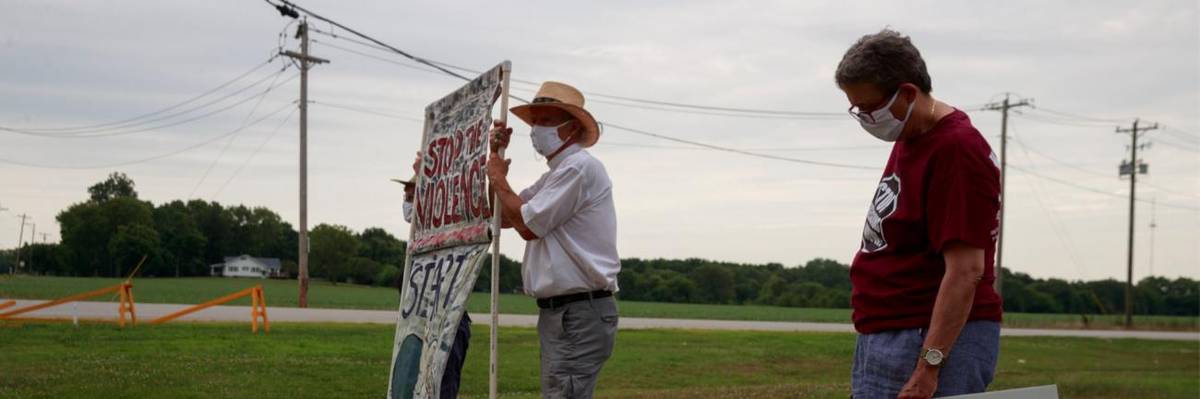
Glenda Breeden, Reverend Bill Breeden and Karen Burkhart stand outside the Terre Haute Federal Correctional Complex to protest before death row inmate Wesley Ira Purkey was scheduled to be executed by lethal injection. (Photo: Jeremy Hogan/SOPA Images/LightRocket via Getty Images)
Had I a hundred tongues. . . I could not name all the types of punishment. -- Virgil, Aeneid_
As the months since the events of January 6 at the United States Capitol have passed, one would be forgiven for assuming that the only issue confronting the country is the need for voting reform. At last count 38 state legislatures have devoted much of their time trying to enact voting reform in order to correct the non-existent deficiencies of the election just passed.
According to the Brennan Center for Justice, more than 400 voting restriction bills have been introduced in 48 states during the current legislative sessions of which 63 seem to have a chance of becoming law. As of this writing, 12 states have already enacted 26 laws to make voting more difficult.
As a result of the foregoing efforts, the news from South Carolina is like a breath of fresh air and completely unexpected. South Carolina is, after all, the state that has given us, and the United States Senate, Lindsey Graham, one of the brighter, if nonetheless lesser, lights in the United States Senate. He is constantly in the news. Few would have expected South Carolina to become a state that chose this year to reform its method of implementing the death penalty rather than join its Republican colleagues by taking steps to solve the non-existent problem of voter fraud. In March 2021, the forward-looking South Carolina legislators addressed the very real problem that exists in that state when it comes to implementing the death penalty.
One of the last rights given to a person condemned to death in South Carolina, is the right choose which of the two approved methods of execution the condemned person would like to undergo as the state fulfills its duty to execute that person. The two choices are: lethal injection, or, electrocution in the electric chair affectionately known as "Old Sparky." If the condemned decides neither prospect is appealing and refuses to make a choice, the default provision provided under South Carolina law is that the prisoner is put to death by lethal injection. Therein lies the problem. There are no drugs available to South Carolina to enable it to honor a prospective decedent's wish that he or she be executed by lethal injection. An example of the dilemma this poses for the state, but not the person to be executed, is offered by Richard Moore.
Richard Moore has been sentenced to death but has been uncooperative and has persistently refused to tell the authorities how he would like to be executed. State law decrees that if he refuses to express a preference, he is to be killed by lethal injection. Because of the unavailability of the drugs needed to execute him, Mr. Moore has, as it is, the last laugh. The state cannot execute him. It is to solve this dilemma that a new law has been passed by the South Carolina legislature and is now heading to the governor for signature. Although it has no effect on Mr. Moore since he was sentenced under the old law, under the new law there is both good news and bad news for the prisoner condemned to death.
The good news in the newly enacted law, at least from the point of view of the person to be executed, is that he or she is given an additional choice of how he or she would like to die. Under the old law the only choice was between lethal injection or the electric chair. Under the new law the person facing execution will not only be able to choose between those two traditional methods of being put to death, but now by the newly provided third method, execution by a firing squad. The bad news in the new legislation, from the prisoner's perspective, is that he or she will no longer be able to thwart the execution of the execution by refusing to make a choice, thus preventing the state from executing him because of the unavailability of the means to do it. Under the new law, if the prisoner follows Mr. Moore's example and refuses to express a preference for the means of execution, or selects lethal injection when no drugs are available to enable the state to honor the prospective decedent's request, the execution of the death penalty will not be put on hold. Under the new law, absent a positive choice by the condemned individual, he or she will be executed by being seated in Old Sparky. That method of execution is guaranteed to be successful. All that is needed for it to work is that it be properly plugged in. Good news for the state-less good for the person anticipating the event.
Dear Common Dreams reader, It’s been nearly 30 years since I co-founded Common Dreams with my late wife, Lina Newhouser. We had the radical notion that journalism should serve the public good, not corporate profits. It was clear to us from the outset what it would take to build such a project. No paid advertisements. No corporate sponsors. No millionaire publisher telling us what to think or do. Many people said we wouldn't last a year, but we proved those doubters wrong. Together with a tremendous team of journalists and dedicated staff, we built an independent media outlet free from the constraints of profits and corporate control. Our mission has always been simple: To inform. To inspire. To ignite change for the common good. Building Common Dreams was not easy. Our survival was never guaranteed. When you take on the most powerful forces—Wall Street greed, fossil fuel industry destruction, Big Tech lobbyists, and uber-rich oligarchs who have spent billions upon billions rigging the economy and democracy in their favor—the only bulwark you have is supporters who believe in your work. But here’s the urgent message from me today. It's never been this bad out there. And it's never been this hard to keep us going. At the very moment Common Dreams is most needed, the threats we face are intensifying. We need your support now more than ever. We don't accept corporate advertising and never will. We don't have a paywall because we don't think people should be blocked from critical news based on their ability to pay. Everything we do is funded by the donations of readers like you. When everyone does the little they can afford, we are strong. But if that support retreats or dries up, so do we. Will you donate now to make sure Common Dreams not only survives but thrives? —Craig Brown, Co-founder |
Had I a hundred tongues. . . I could not name all the types of punishment. -- Virgil, Aeneid_
As the months since the events of January 6 at the United States Capitol have passed, one would be forgiven for assuming that the only issue confronting the country is the need for voting reform. At last count 38 state legislatures have devoted much of their time trying to enact voting reform in order to correct the non-existent deficiencies of the election just passed.
According to the Brennan Center for Justice, more than 400 voting restriction bills have been introduced in 48 states during the current legislative sessions of which 63 seem to have a chance of becoming law. As of this writing, 12 states have already enacted 26 laws to make voting more difficult.
As a result of the foregoing efforts, the news from South Carolina is like a breath of fresh air and completely unexpected. South Carolina is, after all, the state that has given us, and the United States Senate, Lindsey Graham, one of the brighter, if nonetheless lesser, lights in the United States Senate. He is constantly in the news. Few would have expected South Carolina to become a state that chose this year to reform its method of implementing the death penalty rather than join its Republican colleagues by taking steps to solve the non-existent problem of voter fraud. In March 2021, the forward-looking South Carolina legislators addressed the very real problem that exists in that state when it comes to implementing the death penalty.
One of the last rights given to a person condemned to death in South Carolina, is the right choose which of the two approved methods of execution the condemned person would like to undergo as the state fulfills its duty to execute that person. The two choices are: lethal injection, or, electrocution in the electric chair affectionately known as "Old Sparky." If the condemned decides neither prospect is appealing and refuses to make a choice, the default provision provided under South Carolina law is that the prisoner is put to death by lethal injection. Therein lies the problem. There are no drugs available to South Carolina to enable it to honor a prospective decedent's wish that he or she be executed by lethal injection. An example of the dilemma this poses for the state, but not the person to be executed, is offered by Richard Moore.
Richard Moore has been sentenced to death but has been uncooperative and has persistently refused to tell the authorities how he would like to be executed. State law decrees that if he refuses to express a preference, he is to be killed by lethal injection. Because of the unavailability of the drugs needed to execute him, Mr. Moore has, as it is, the last laugh. The state cannot execute him. It is to solve this dilemma that a new law has been passed by the South Carolina legislature and is now heading to the governor for signature. Although it has no effect on Mr. Moore since he was sentenced under the old law, under the new law there is both good news and bad news for the prisoner condemned to death.
The good news in the newly enacted law, at least from the point of view of the person to be executed, is that he or she is given an additional choice of how he or she would like to die. Under the old law the only choice was between lethal injection or the electric chair. Under the new law the person facing execution will not only be able to choose between those two traditional methods of being put to death, but now by the newly provided third method, execution by a firing squad. The bad news in the new legislation, from the prisoner's perspective, is that he or she will no longer be able to thwart the execution of the execution by refusing to make a choice, thus preventing the state from executing him because of the unavailability of the means to do it. Under the new law, if the prisoner follows Mr. Moore's example and refuses to express a preference for the means of execution, or selects lethal injection when no drugs are available to enable the state to honor the prospective decedent's request, the execution of the death penalty will not be put on hold. Under the new law, absent a positive choice by the condemned individual, he or she will be executed by being seated in Old Sparky. That method of execution is guaranteed to be successful. All that is needed for it to work is that it be properly plugged in. Good news for the state-less good for the person anticipating the event.
Had I a hundred tongues. . . I could not name all the types of punishment. -- Virgil, Aeneid_
As the months since the events of January 6 at the United States Capitol have passed, one would be forgiven for assuming that the only issue confronting the country is the need for voting reform. At last count 38 state legislatures have devoted much of their time trying to enact voting reform in order to correct the non-existent deficiencies of the election just passed.
According to the Brennan Center for Justice, more than 400 voting restriction bills have been introduced in 48 states during the current legislative sessions of which 63 seem to have a chance of becoming law. As of this writing, 12 states have already enacted 26 laws to make voting more difficult.
As a result of the foregoing efforts, the news from South Carolina is like a breath of fresh air and completely unexpected. South Carolina is, after all, the state that has given us, and the United States Senate, Lindsey Graham, one of the brighter, if nonetheless lesser, lights in the United States Senate. He is constantly in the news. Few would have expected South Carolina to become a state that chose this year to reform its method of implementing the death penalty rather than join its Republican colleagues by taking steps to solve the non-existent problem of voter fraud. In March 2021, the forward-looking South Carolina legislators addressed the very real problem that exists in that state when it comes to implementing the death penalty.
One of the last rights given to a person condemned to death in South Carolina, is the right choose which of the two approved methods of execution the condemned person would like to undergo as the state fulfills its duty to execute that person. The two choices are: lethal injection, or, electrocution in the electric chair affectionately known as "Old Sparky." If the condemned decides neither prospect is appealing and refuses to make a choice, the default provision provided under South Carolina law is that the prisoner is put to death by lethal injection. Therein lies the problem. There are no drugs available to South Carolina to enable it to honor a prospective decedent's wish that he or she be executed by lethal injection. An example of the dilemma this poses for the state, but not the person to be executed, is offered by Richard Moore.
Richard Moore has been sentenced to death but has been uncooperative and has persistently refused to tell the authorities how he would like to be executed. State law decrees that if he refuses to express a preference, he is to be killed by lethal injection. Because of the unavailability of the drugs needed to execute him, Mr. Moore has, as it is, the last laugh. The state cannot execute him. It is to solve this dilemma that a new law has been passed by the South Carolina legislature and is now heading to the governor for signature. Although it has no effect on Mr. Moore since he was sentenced under the old law, under the new law there is both good news and bad news for the prisoner condemned to death.
The good news in the newly enacted law, at least from the point of view of the person to be executed, is that he or she is given an additional choice of how he or she would like to die. Under the old law the only choice was between lethal injection or the electric chair. Under the new law the person facing execution will not only be able to choose between those two traditional methods of being put to death, but now by the newly provided third method, execution by a firing squad. The bad news in the new legislation, from the prisoner's perspective, is that he or she will no longer be able to thwart the execution of the execution by refusing to make a choice, thus preventing the state from executing him because of the unavailability of the means to do it. Under the new law, if the prisoner follows Mr. Moore's example and refuses to express a preference for the means of execution, or selects lethal injection when no drugs are available to enable the state to honor the prospective decedent's request, the execution of the death penalty will not be put on hold. Under the new law, absent a positive choice by the condemned individual, he or she will be executed by being seated in Old Sparky. That method of execution is guaranteed to be successful. All that is needed for it to work is that it be properly plugged in. Good news for the state-less good for the person anticipating the event.